
Last Updated on September 10, 2026 by Daniel Globe
A poorly fitted travel pillow can leave your neck and shoulders feeling worse rather than better. If you step off a plane, train, or long car ride rubbing a sore shoulder, the pillow may be contributing to an awkward head or neck position. The key is knowing what a travel pillow can realistically do, how to test the fit, and when shoulder pain needs more than a comfort adjustment.
Quick Answer
A travel pillow may contribute to shoulder discomfort if it pushes your head forward, lets it fall heavily to one side, or makes you shrug your shoulders. It is unlikely to be the sole cause of a shoulder injury. Choose a pillow that supports your head comfortably without forcing your neck or shoulders into an awkward position.
Key Takeaways
- A poor-fitting travel pillow can encourage awkward neck posture and muscle tension, but it has not been proven to directly cause shoulder impingement or other shoulder injuries.
- Your head should feel supported without being pushed forward, tilted sharply to one side, or forcing your shoulders upward.
- No single material is proven best for everyone. Fit, height, adjustability, stability, and comfort matter more than whether the pillow is memory foam, inflatable, or another material.
- Changing position, supporting your arms, and using gentle pain-free movement can matter as much as the pillow itself.
- Worsening pain, major loss of motion, weakness, numbness, trauma, or shoulder pain with chest or breathing symptoms needs medical attention rather than another pillow.
Disclosure: As an Amazon Associate I earn from qualifying purchases. Some links on this page are affiliate links, at no extra cost to you.
How Travel Pillows Can Contribute to Shoulder Pain

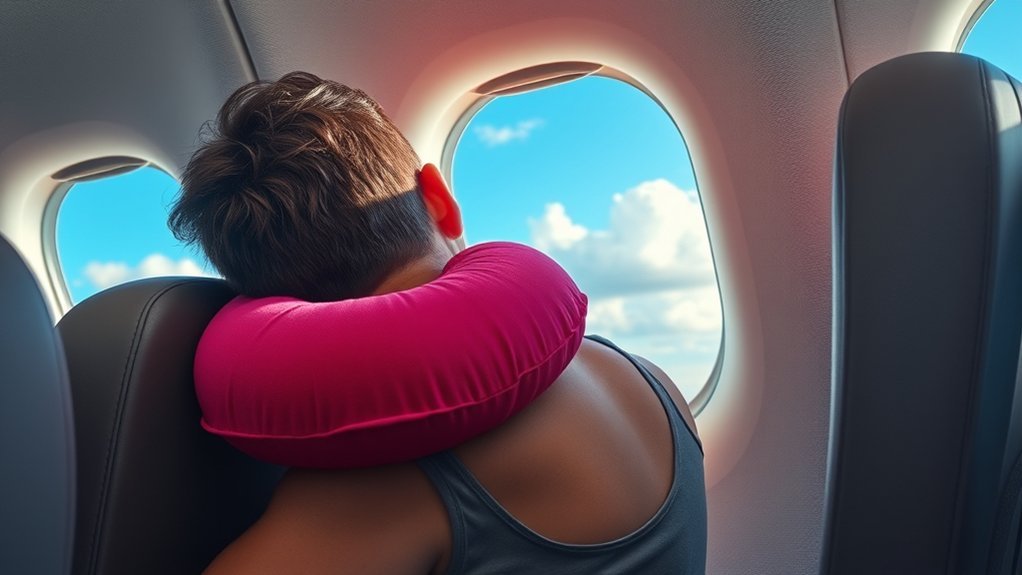
A travel pillow does not directly cause shoulder impingement simply because it is thick, firm, or poorly shaped. The more realistic concern is posture. If a pillow pushes your head forward, allows it to hang to one side, or makes you lift your shoulders to get comfortable, the muscles around your neck, upper back, and shoulder blades may have to work harder.
Mayo Clinic Health System explains that posture can influence shoulder-blade position, muscle efficiency, and available shoulder motion. Poor posture is one possible contributor to shoulder impingement symptoms, but it is only one of many factors. The American Academy of Orthopaedic Surgeons also lists repetitive overhead activity, injury, tendon irritation, and other causes of rotator-cuff-related shoulder pain.
Research on pillows is more limited than many buying guides suggest. A 2021 systematic review of pillow studies found that pillow shape and height can influence cervical alignment and waking neck symptoms. Those studies mainly involved ordinary sleeping pillows and neck pain, however, not airline travel pillows causing shoulder injuries.
Pillow height and shape can affect neck comfort and positioning, but there is no good evidence that one travel-pillow material or shape universally prevents shoulder pain.
How to Tell if Your Travel Pillow Is Causing the Problem
Shoulder pain after traveling does not automatically mean the pillow is at fault. Long periods of sitting, a pre-existing shoulder problem, neck irritation, carrying luggage, an awkward armrest, or sleeping against a window can all contribute.
Your pillow is more likely to be part of the problem if:
- Your chin is pushed noticeably toward your chest when the pillow is in place.
- Your head still drops sharply to one side despite wearing the pillow.
- You have to shrug one or both shoulders to make the pillow feel secure.
- The pillow presses directly into a painful part of your neck or shoulder.
- You repeatedly wake up in the same uncomfortable position while using it.
- Your discomfort improves soon after removing or readjusting the pillow.
Pain can also be referred from the neck rather than coming from the shoulder joint itself. If moving your neck changes the pain, or if you develop tingling, numbness, or weakness into the arm or hand, do not assume a different pillow will solve the problem.
Signs You’re Using the Wrong Travel Pillow
If you consistently feel worse while using your travel pillow, it may not fit your body or your seat well. Pay attention to what happens while you are wearing it rather than relying on the shape, price, or material printed on the package.
Poor Neck Support
Good neck support should reduce how far your head drifts without forcing it into a rigid position. If you wake up with stiffness, shoulder tightness, or difficulty turning your head after using the pillow, check its height and placement.
A pillow that is too low may do little to stop your head from falling sideways. One that is too tall or bulky can push the head forward. Adjustable pillows are useful because you can change their height, tightness, or inflation level rather than trying to make one fixed shape work in every seat.
Discomfort During Use
You should not need to fight the pillow to find a comfortable position. Constant readjustment, pressure under the jaw, a forced forward-head position, or one shoulder being pushed higher than the other are signs that the fit needs changing.
The goal is not to make your neck perfectly straight or immobile. It is to give your head enough support that your neck and shoulder muscles do not have to hold an awkward position for an extended period.
Note: Mild stiffness after sitting or sleeping awkwardly may improve with normal movement and a change of position. Pain that keeps worsening, limits your arm movement, or comes with numbness or weakness deserves more attention than simply switching pillows.
Essential Criteria for Selecting a Travel Pillow for Shoulder Pain Relief
When choosing a travel pillow, focus on how it positions your head in the seat you actually use. Shape, height, firmness, and adjustability all matter. Material affects feel and packability, but it should not be treated as a guarantee of pain relief.
Pillow Shape and Design
U-shaped, wraparound, J-shaped, and scarf-style travel pillows can all work when they fit correctly. A useful design should limit uncomfortable head drift without pressing your chin forward or crowding your shoulders. Side support can be especially helpful when sleeping upright, while an adjustable closure may help you position the support where you need it.
| Feature | What to Look For |
|---|---|
| Shape | Supports the direction your head normally falls without forcing your chin forward. |
| Side Support | Limits excessive sideways head tilt while you sleep upright. |
| Adjustability | Lets you change tightness, height, or inflation for different seats. |
| Firmness | Supportive enough to resist collapsing without creating uncomfortable pressure. |
| Cover | Breathable and preferably removable or washable for repeated travel. |
Material and Firmness
Memory foam is popular because it compresses around the head and neck while still providing resistance. That can feel comfortable for some travelers, but memory foam is not proven to be the best material for shoulder pain.
Inflatable, latex-like, fiber-filled, and other designs can also work. What matters is whether the pillow supports you at a comfortable height without creating pressure under your jaw, behind your neck, or against your shoulders.
Firmness should be judged the same way. Too little support may allow your head to collapse sideways; excessive firmness can create pressure and make it difficult to settle into the seat. A removable, washable cover is a practical advantage on equipment that repeatedly touches your face and neck.
Size and Adjustability
A travel pillow should fit your neck without forcing your shoulders upward. Taller travelers, shorter travelers, and people with different neck lengths may need very different pillow heights even when sitting in the same aircraft seat.
Adjustable straps, closures, removable inserts, or inflation valves can make fitting easier. Test the pillow with your back against a seat rather than standing in a store. A pillow that feels comfortable while standing may behave very differently once a seatback and headrest are behind you.
Foam vs. Inflatable Travel Pillows
Foam pillows usually provide a consistent shape without needing adjustment during the trip. Their main disadvantage is bulk. Inflatable pillows pack much smaller and let you change firmness by adding or releasing air, but overinflating one can make it unnecessarily rigid.
Neither type is automatically better for shoulder pain. A well-fitted inflatable pillow may be more comfortable than a poorly fitted foam model, and the reverse can also be true. Travelers dealing with recurring pain should prioritize the design they can adjust to a neutral, relaxed position rather than choosing by fill material alone.
How the Right Travel Pillow Support Can Help
A good travel pillow may reduce one source of discomfort by limiting extreme head positions while you doze. Look for four practical results:
- Your head stays reasonably centered: It does not repeatedly fall hard to one side or forward.
- Your shoulders remain relaxed: You do not have to shrug to keep the pillow in place.
- Your chin is not forced toward your chest: Excessive pillow thickness behind the neck is a common fit problem.
- You can change position: The pillow supports you without locking your neck into one rigid posture for hours.
How to Fit and Test a Travel Pillow Before Your Trip
You can catch most fit problems in a few minutes before leaving home:
- Sit against a firm chair or seatback. Testing while standing does not reproduce the way the pillow will interact with an airplane or train seat.
- Put the pillow on without tightening it fully. Settle your shoulders and let your back rest naturally against the chair.
- Close your eyes and relax your head. Notice whether your head falls forward, sharply sideways, or stays comfortably supported.
- Check your chin. If the pillow pushes your chin down or forward, reduce the height, move the thickest section, or choose a lower-profile design.
- Check your shoulders. They should remain down and relaxed rather than being pushed upward by the pillow.
- Try both sides. A pillow may feel comfortable leaning one direction but create pressure when you turn the other way.
Pro Tip: Before buying another pillow, test whether your seat’s adjustable headrest wings already provide enough side support. Combining a lower-profile pillow with the seat’s built-in support can be more comfortable than stacking a very thick pillow behind your neck.
Recommended Travel Pillow Types for Shoulder Pain Relief
No travel-pillow type is clinically proven to treat shoulder pain, but some designs make it easier to control head position and pressure. The best choice is the one that passes the fit test above.
Contoured Memory Foam Pillows
Contoured memory foam pillows are a practical option for travelers who prefer a structured pillow that holds its shape. Potential advantages include:
- Consistent support: Foam does not need reinflation during the trip.
- Contouring: It compresses around the head and neck rather than feeling completely rigid.
- Different profile heights: Some models are taller on one side or include removable inserts.
- Stable feel: A structured pillow may make it easier to prevent repeated head bobbing for some travelers.
The tradeoff is packing size. A bulky foam pillow may also be uncomfortable if the seat’s headrest already pushes your head forward. Test it against a seat before taking it on long trips.
Adjustable Neck Support Pillows
Adjustable travel pillows are useful when you regularly switch between aircraft, trains, buses, and cars. Depending on the design, you may be able to change inflation, remove filling, reposition the support, or tighten a front closure.
That flexibility is more important than whether the pillow contains memory foam or gel. The adjustment should let you support your head while keeping the jaw, neck, and shoulders relaxed. Removable washable covers and secure straps are useful practical features for frequent travelers.
Best Pillow Choices by Mode of Travel
The most useful pillow can change with the seat.
On flights, you are usually sleeping upright with limited room to reposition yourself. A wraparound or U-shaped design with useful side support may help keep the head from dropping, provided the back of the pillow is not so thick that it pushes your head forward.
In a car, passengers may prefer a smaller contoured pillow because a vehicle seat already has a substantial head restraint. Do not position a pillow in a way that prevents the vehicle’s head restraint from functioning as intended. Drivers should keep full freedom to turn and check traffic and should not use a pillow that restricts head movement or interferes with normal driving posture.
On trains, seating varies widely. An adjustable or inflatable pillow can be convenient because you can change its firmness depending on whether you are sitting upright, using a headrest, or leaning lightly against the side of the seat.
How to Adjust Your Seating Position for Comfort
Seating position matters just as much as the pillow. A few adjustments can reduce unnecessary muscle tension:
- Set the pillow after sitting down. The seatback determines how thick the pillow needs to be.
- Let your shoulders relax. Avoid deliberately pinning them back or shrugging them upward for long periods.
- Support your lower back if needed. A small cushion or rolled garment can help you avoid collapsing into a deep slouch.
- Support your forearms. Use the armrests or your lap when comfortable rather than letting one arm hang unsupported for hours.
- Change position periodically. There is no single perfect posture to hold for an entire long-haul trip.
Stretches and Exercises to Relieve Shoulder Pain While Traveling
Gentle movement can help after you have been sitting still, but stretching should not be painful. The American Academy of Orthopaedic Surgeons’ shoulder conditioning guidance specifically advises people not to ignore pain during exercise.
Caution: Keep movements gentle and within a comfortable range. Stop any stretch that produces sharp pain, worsening tingling, new weakness, or a clear increase in your shoulder symptoms. If raising your arm overhead hurts, skip overhead exercises such as wall angels.
- Gentle neck side bend — keep your shoulders relaxed and slowly tilt your head toward one side until you feel a mild stretch. Do not pull hard on your head.
- Shoulder rolls — slowly roll your shoulders backward several times, then relax them.
- Shoulder blade squeezes — gently draw your shoulder blades back and down, hold briefly, and release without forcing the movement.
- Small arm circles — when you have enough space, begin with small comfortable circles and stop if the movement causes pain.
- Crossover-arm stretch — gently bring one arm across your chest while holding the upper arm rather than pulling on the elbow. AAOS includes this movement in its general shoulder-conditioning program.
- Wall angels or wall slides — use these only if overhead movement is comfortable. Keep the range small if necessary.
- Doorway chest stretch — lean forward gently rather than forcing the shoulders backward. Skip it if it reproduces shoulder pain.
During layovers or rest stops, simply standing, walking, and changing position may feel better than performing a long stretching routine. You do not need to force a stretch to make movement useful.
When to Seek Professional Help for Shoulder Pain
A new pillow cannot diagnose or treat an underlying shoulder or neck condition. According to Mayo Clinic’s guidance on shoulder pain, worsening pain, swelling, increasing difficulty moving the shoulder, and certain injury-related symptoms warrant medical evaluation.
Arrange medical care if you notice:
- Worsening or persistent pain: Especially when normal self-care and avoiding aggravating positions are not helping.
- Loss of movement: Increasing difficulty lifting or using the arm normally.
- Swelling, redness, warmth, or marked tenderness: These deserve assessment rather than being blamed on travel posture.
- Numbness, tingling, or weakness: These symptoms can occur with nerve-related problems and should not be treated as a simple pillow-fit issue.
- Sleep or daily activities being repeatedly disrupted: A clinician or physical therapist can determine whether the neck, shoulder, or another structure is responsible.
Warning: Seek emergency medical help if shoulder pain occurs with chest tightness, difficulty breathing, or sweating. After a fall or other injury, urgent evaluation is also appropriate for a deformed-looking shoulder, inability to use the arm, intense pain, or sudden swelling. This article is for general information and is not a substitute for professional medical advice.
Practical Strategies for Traveling Comfortably With Shoulder Pain
Traveling with a sensitive shoulder is usually more comfortable when you address the whole seating setup rather than relying on one pillow.
- Fit the travel pillow while seated. Make sure it supports your head without pushing your chin forward.
- Use the seat’s built-in head support. Adjustable headrest wings may reduce how much extra pillow height you need.
- Keep your shoulders relaxed. A pillow that makes you shrug is probably too tall or positioned incorrectly.
- Support your arms. Resting your forearms comfortably can reduce the feeling that your shoulders have to hold the weight of your arms all trip.
- Change position regularly. Long periods in any one posture can become uncomfortable.
- Pack light when possible. Repeatedly lifting or carrying a heavy bag may be more relevant to your shoulder symptoms than the pillow itself.
Additional Ways to Manage Mild Shoulder Discomfort During Travel
A few simple measures may help when the discomfort appears mild and there has been no significant injury:
- Remove or readjust the pillow. Do not keep using it just because you brought it.
- Change your sitting position. Relax your shoulders and avoid leaning heavily onto one side for the entire trip.
- Use gentle movement. Shoulder rolls, comfortable arm movement, and brief walks during travel breaks may reduce stiffness.
- Use cold for minor soreness when appropriate. Mayo Clinic suggests an ice pack for about 15–20 minutes for minor shoulder pain. Keep a layer between cold packs and bare skin.
- Watch the pattern. Note whether pain changes with neck movement, shoulder movement, carrying luggage, or use of the pillow. That information can be useful if you later need a medical evaluation.
Frequently Asked Questions
Can travel pillows lead to long-term shoulder issues?
There is not good evidence that travel pillows by themselves cause long-term shoulder disease. A poor fit may aggravate muscle tension or an existing problem by keeping your head and upper body in an uncomfortable position. Persistent or worsening pain should be evaluated rather than blamed on the pillow alone.
How often should I replace my travel pillow?
There is no universal 1-year or 2-year replacement rule. Replace the pillow when it remains permanently flattened, no longer rebounds or holds its intended shape, has damaged closures or air valves, cannot be cleaned properly, or no longer supports your head comfortably.
Are there specific brands recommended for shoulder pain relief?
No single brand has been proven best for shoulder pain. A better approach is to compare fit, height, side support, adjustability, packability, and whether the pillow keeps your head comfortable without pushing your shoulders upward or your chin forward.
Can I use a travel pillow for other activities besides traveling?
Yes. Some people use travel pillows while reading, relaxing, or sitting for extended periods. The same fit rules apply: the pillow should feel comfortable, should not force your head forward, and should not encourage you to hold one rigid position for hours.
What materials are best for minimizing shoulder pain with travel pillows?
No material is proven best for everyone. Memory foam offers a structured, contouring feel, while inflatable pillows are lighter and easier to adjust. Pillow height, shape, stability, and personal comfort are more useful selection criteria than choosing a material based on pain-relief claims.
How do I know whether my shoulder pain is actually coming from my neck?
It can be difficult to tell without an examination. Pain that changes with neck movement or comes with numbness, tingling, or weakness may involve the neck or nerves rather than only the shoulder joint. Seek medical evaluation if those symptoms persist, worsen, or interfere with normal arm use.
Conclusion
A travel pillow can be part of the reason you feel sore after a long trip, but the issue is usually more complicated than one material or pillow shape. Focus on what the pillow does to your body: your head should feel supported, your chin should not be forced forward, and your shoulders should stay relaxed.
Combine a well-fitted pillow with comfortable arm support, regular position changes, and gentle pain-free movement. Most importantly, do not assume every shoulder symptom is an ergonomic problem. Worsening pain, weakness, numbness, major loss of motion, trauma, or symptoms involving the chest or breathing deserve proper medical evaluation.
Sources
- PubMed — Systematic review and meta-analysis of pillow designs — evidence on pillow height, shape, neck symptoms, sleep outcomes, and cervical alignment.
- Mayo Clinic Health System — Poor posture and shoulder pain — explains how posture can affect shoulder-blade position, muscle function, and shoulder movement.
- American Academy of Orthopaedic Surgeons — Shoulder Impingement / Rotator Cuff Tendinitis — causes, symptoms, evaluation, and treatment of rotator-cuff-related shoulder pain.
- American Academy of Orthopaedic Surgeons — Rotator Cuff and Shoulder Conditioning Program — guidance on gentle stretching, shoulder conditioning, and avoiding painful exercise.
- Mayo Clinic — Shoulder Pain: When to See a Doctor — emergency symptoms, injury red flags, routine evaluation, and basic self-care guidance.

