

Last Updated on September 10, 2026 by Daniel Globe
A bulky travel pillow can crowd your carry-on before you pack your clothes. The right choice is not one universal width or length. It is a pillow that fits your neck in a seated position, packs down to a manageable size, and stays within your airline’s baggage allowance.
Quick Answer
Travel pillows do not follow one standard size. Compare the pillow’s in-use dimensions, packed dimensions, thickness, weight, and fit around your neck. Inflatable and scarf-style designs usually pack smallest, while memory foam offers more structure but takes more room. Pack the pillow inside your allowed bag when airline rules are strict.
Key Takeaways
- There is no industry-wide “standard” travel pillow size, so check the exact product measurements.
- Fit matters more than overall width: the pillow should support your head without pressing on your throat or pushing your chin sharply downward.
- Compare packed size as well as full size. Inflatable, scarf-style, and compressible designs use space differently.
- TSA allows pillows through U.S. security, but each airline decides whether an unpacked pillow counts toward your baggage allowance.
- A clip makes a pillow easier to carry, but it does not guarantee that a gate agent will treat it as a free extra item.
What’s in This Article
- Understanding Travel Pillow Dimensions for Carry-On Packing
- Common Travel Pillow Types and Their Packing Benefits
- How to Choose the Right Travel Pillow Size
- How Pillow Shape Affects Packing and Comfort
- Do Pillows Count as Personal Items?
- Efficient Packing Techniques for Your Travel Pillow
- Comfort Items to Pack Alongside Your Travel Pillow
- Frequently Asked Questions
- Final Thoughts
Disclosure: As an Amazon Associate I earn from qualifying purchases. Some links on this page are affiliate links, at no extra cost to you.
Understanding Travel Pillow Dimensions for Carry-On Packing
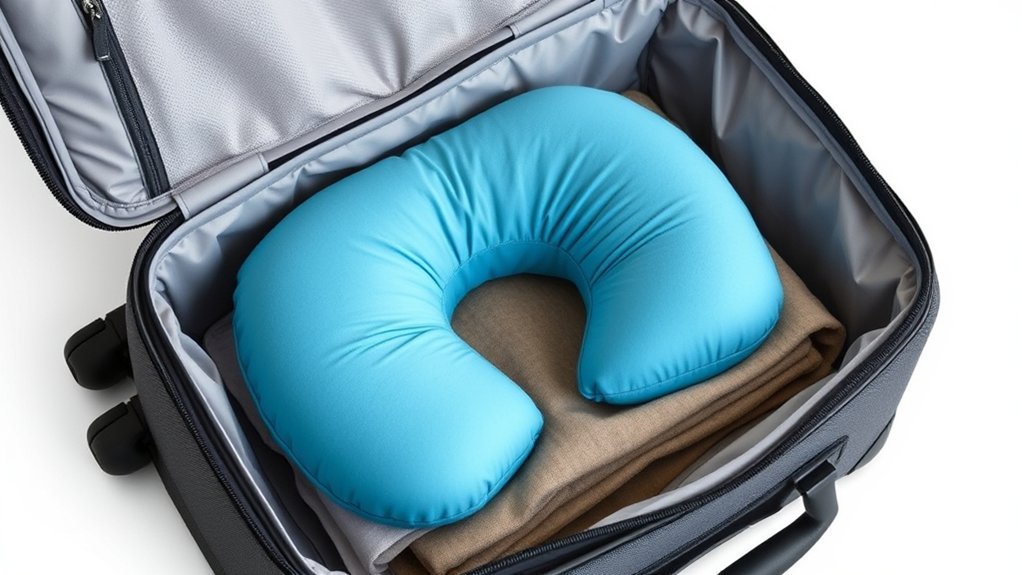
Travel pillow dimensions vary widely because the category includes U-shaped cushions, inflatable pillows, scarf-style supports, contoured foam pillows, small rectangular pillows, and empty covers that you fill with clothing. A single measurement such as “12 x 16 inches” does not tell you how high the sides are, how thick the back is, or how small the pillow becomes when packed.
Current manufacturer examples show that variation. The classic Trtl Travel Pillow is listed at 8.7 x 9.5 x 3.6 inches, the MUJI Inflatable Neck Cushion is 13.4 x 13 inches when open, and the travel-size TEMPUR-Neck Pillow is listed at 10 x 12 x 4 inches. These are product examples, not universal category standards.
Note: Check both the full dimensions and the packed dimensions. A large inflatable pillow may become smaller than a compact-looking foam pillow once both are stored.
| Measurement | Why It Matters |
|---|---|
| In-use width and depth | Shows how much space the pillow occupies around your neck and shoulders. |
| Side height or thickness | Affects how far your head can tilt before the pillow supports it. |
| Packed dimensions | Tells you how much carry-on space the pillow actually uses. |
| Weight | Matters most when your airline applies a cabin-bag weight limit. |
| Closure range | Helps you judge whether the pillow can sit snugly without squeezing your neck. |
Common Travel Pillow Types and Their Packing Benefits
Instead of shopping by one supposed standard size, compare the construction and packed shape. Each style uses space differently.
- Inflatable pillows: Usually the smallest after deflation. You can adjust firmness by releasing or adding air, but overinflation can make the pillow feel hard and push your head forward.
- Compressible memory foam pillows: Provide a structured shape and often come with a compression pouch. They remain bulkier than most inflatables and should not be stored tightly compressed longer than the manufacturer recommends.
- Scarf-style supports: Use an internal support and fabric wrap rather than a full U-shaped cushion. They are often light and book-sized when packed.
- Microbead or fiberfill pillows: Feel soft and flexible but usually do not compress as flat as an inflatable model.
- Small rectangular pillows: Work behind the head, lower back, or against a window, but they may slide unless the seat or wall holds them in place.
- Stuffable pillow covers: Carry clothing inside an empty neck-pillow shell. They save suitcase volume, but the final size and comfort depend on how evenly you fill them.
The most useful “size” is the smallest packed shape that still supports your head comfortably when you are seated.
How to Choose the Right Travel Pillow Size
Start with fit, then compare packed volume. Trip length can influence how much comfort gear you are willing to carry, but it does not create a reliable rule such as “15 x 18 inches for flights over six hours.” A larger pillow can be less comfortable if it pushes your head forward or crowds your jaw.
Body Size and Fit Considerations
Your height alone does not determine the right pillow. Neck length, shoulder shape, seat headrest, and the way you naturally lean all affect fit. Test the pillow while sitting upright, not while lying on a bed.
- The side support should meet your jaw or the side of your head before your neck bends sharply.
- The back should be thin enough that it does not force your chin toward your chest.
- The front closure should feel secure without pressing on your throat.
- You should be able to turn your head, breathe, and remove the pillow quickly.
- If the pillow creates pain, numbness, dizziness, or pressure, loosen it or stop using it.
Pro Tip: Wear the pillow in a dining chair for 10 to 15 minutes before your trip. Try looking straight ahead, leaning left and right, and resting against a headrest. This reveals pressure points better than measuring shoulder width alone.
Travel Duration and Seat Type
Longer journeys increase the value of stable support and a washable cover, but you still do not need a specific overall dimension. Think about the seat and your likely resting position.
| Travel Situation | What to Prioritize |
|---|---|
| Short flight or bus ride | Low weight, quick setup, and easy storage. |
| Long-haul economy flight | Stable side support, a thin back, breathable fabric, and a washable cover. |
| Window seat | A pillow that can support one side or sit safely between your head and the cabin wall. |
| Aisle or middle seat | Balanced support on both sides without extending into another passenger’s space. |
| Car travel | A shape that works with the vehicle headrest and does not interfere with the seat belt. |
Children and Smaller Travelers
Do not choose a children’s pillow by copying an adult dimension and scaling it down. Use an age-appropriate product that does not cover the face, tighten around the throat, or push the head into an unsafe position. An adult should supervise its use, especially when the child is sleeping.
Warning: A travel pillow must not interfere with a vehicle seat belt, child restraint, or aircraft safety instructions. Remove it if it changes the position of a harness or blocks a child’s face.
How Pillow Shape Affects Packing and Comfort
The outline of a pillow matters as much as its listed width and length. Different shapes control head movement in different ways.
- Traditional U-shaped: Supports both sides and the back of the neck, but a thick rear section can push the head forward against an airplane headrest.
- Open-front or clasped U-shaped: Lets you adjust how closely the sides meet under the chin.
- Scarf-style: Supports one side at a time and packs flatter than many foam U-shaped designs.
- Inflatable wraparound: Offers adjustable firmness and small packed volume, although the feel is less cushioned than memory foam.
- Rectangular or convertible: Can support the head, lumbar area, or window side, but usually needs a surface to hold it in place.
- Stuffable: Doubles as clothing storage, but uneven filling can create hard spots and an awkward shape.
If your current pillow causes discomfort, compare its rear thickness and side height before buying another. A smaller-looking design with better placement may support you more effectively than a larger cushion.
Do Pillows Count as Personal Items?
The Transportation Security Administration allows pillows in carry-on and checked baggage. That security rule does not decide whether an airline will count a loose pillow as your carry-on, personal item, or an extra article.
Airlines publish their own cabin-baggage limits. Their free-item lists commonly exempt items such as medical devices, mobility aids, and certain child-care items, but a standard neck pillow is not a universal exemption. The safest approach is to fit it inside your permitted carry-on or personal item before boarding.
Warning: Wearing a pillow around your neck or clipping it to a backpack does not guarantee that it will be ignored during bag sizing. Gate staff apply the operating airline’s policy.
Airline Rules Can Vary by Carrier
As of July 24, 2026, these official U.S. airline pages illustrate why you should check your carrier before flying:
| Airline | Published Rule Relevant to a Loose Pillow |
|---|---|
| American Airlines | One carry-on and one personal item; the personal item may not exceed 18 x 14 x 8 inches. The published exemption list does not name ordinary travel pillows. |
| Spirit Airlines | The included personal item must fit entirely in the sizer and may not exceed 18 x 14 x 8 inches. Another item or a larger item is treated as a carry-on. |
| Frontier Airlines | One personal item up to 18 x 14 x 8 inches is included. Frontier says personal-item size is checked during boarding and larger items can be charged. |
| Delta Air Lines | One carry-on and one personal item of similar size to a purse or laptop bag that fits beneath the seat. The page does not create a general pillow exemption. |
Major carriers such as Delta, United, and American can also limit cabin items when aircraft space is tight. Budget carriers such as Spirit and Frontier publish specific personal-item sizer rules. Review the policy for your exact airline and fare, including any operating partner on a codeshare trip. For more detail on one carrier, see this guide to Spirit Airlines personal item size.
Efficient Packing Techniques for Your Travel Pillow
Choose a packing method that matches the filling. An inflatable pillow, memory foam pillow, microbead cushion, and stuffable cover should not all be treated the same way.
Optimal Packing Methods
- Inflatable: Release all air, fold along the seams, and make sure it is dry before closing the storage pouch.
- Memory foam: Use the supplied compression case when available. Do not use a vacuum bag unless the manufacturer permits it.
- Fiberfill or soft rectangular pillow: Place it flat against the suitcase wall or use a vacuum bag only when the care instructions allow compression.
- Microbead: Avoid forcing it into an undersized pouch because the seams and beads can be damaged.
- Stuffable cover: Roll soft clothing and distribute it evenly so the pillow does not develop hard lumps.
Note: Cabeau says some of its memory foam pillows compress to one-third of their size, but it warns against storing one model in the compacted state for more than one month. Follow the instructions for your exact pillow rather than assuming long-term compression is harmless.
Pillow Attachment Strategies
A carabiner, snap strap, or built-in clip keeps a pillow within reach and prevents it from falling on the floor. Attach it through a purpose-made loop instead of piercing fabric or pulling on a zipper tab.
External attachment is a carrying method, not a baggage-rule loophole. Before you reach the gate, make sure you can place the pillow inside your approved bag if staff ask you to consolidate your items.
Product Example: The DreamShore Stuffable Travel Pillow
Pack a travel pillow in a way that saves room without creating a new oversized item.
The DreamShore model is a stuffable neck-pillow cover rather than a conventional pillow with fixed foam or fiber filling. You load it with soft clothing, which can free space inside your bag while giving those clothes a second use.
- Use soft items such as T-shirts, socks, or a light layer rather than chargers or other hard objects.
- Fill both sides evenly so the pillow does not press against one point on your neck.
- Do not overfill it. A very bulky stuffed pillow may be uncomfortable and may be treated as an extra item at the gate.
- Keep enough room in your carry-on to consolidate the pillow if your airline requires it.
The original 4.7-ounce claim should not be used for this product without a verified manufacturer specification. That published weight belongs to at least one different scarf-style travel pillow.
Comfort Items to Pack Alongside Your Travel Pillow
A pillow is only one part of a more comfortable trip. A light blanket or shawl helps with a cool cabin, an eye mask reduces light, and headphones or earplugs reduce noise. Keep each item compact so the full comfort kit still fits within your baggage allowance.
If you carry an essential-oil roller, remember that it is a liquid and avoid using strong scents around other passengers. Follow the TSA liquids rule when flying from a U.S. airport.
Compression socks may help some people during long-distance travel, but they are not a universal requirement. The CDC advises travelers with increased blood-clot risk to discuss preventive steps with a healthcare professional; some may benefit from graduated compression stockings.
Frequently Asked Questions
What is the standard travel pillow size?
There is no universal standard. Current products use very different shapes and measurements, so compare the exact in-use size, packed size, side height, rear thickness, weight, and closure range.
Can travel pillows be used on different modes of transportation?
Yes. You can use one on a plane, train, bus, or as a car passenger. In a vehicle, the pillow must not interfere with the seat belt, head restraint, driver visibility, or a child-safety harness.
Are inflatable travel pillows more space-efficient?
They are usually among the most space-efficient because the air can be removed. Packed size still varies by valve, fabric, and storage pouch, so check the manufacturer’s packed measurements.
How do I clean a travel pillow while traveling?
Follow the care label. Wash a removable cover when permitted, wipe an inflatable surface with mild soap and water, and let every part dry fully before packing. Do not soak a foam insert unless its manufacturer says it is washable.
Which travel pillow material is best?
No single material is best for everyone. Memory foam offers structure, inflatable cores save space, microbeads feel flexible, and polyester covers are often easy to wash. Choose based on support, heat, care instructions, packed size, and any material sensitivities.
Can I bring multiple travel pillows in my carry-on?
TSA permits pillows, but all items must still meet your airline’s baggage rules. Multiple pillows are safest when they fit inside your allowed carry-on or personal item without exceeding size or weight limits.
Does a pillow clipped to my bag count as another item?
It can. A clip does not change the airline’s allowance. Some gate agents may ask you to place the pillow inside your carry-on or personal item, especially when the airline uses a bag sizer or charges for carry-ons.
Final Thoughts
The right travel pillow size is the one that supports you in a seated position and still fits your packing plan. Ignore rigid rules that assign one dimension to adults, children, or a certain flight length. Compare fit, rear thickness, side height, packed volume, weight, and cleaning instructions, then confirm your airline’s current baggage policy before departure.
For the least packing bulk, start with an inflatable or scarf-style design. For more structured support, consider compressible foam and accept the extra volume. Whichever style you choose, test it before the trip and make sure you can place it inside your allowed bag at the gate.
Sources
- Transportation Security Administration: Pillows — confirms that pillows are permitted in carry-on and checked baggage.
- American Airlines: Carry-on Bags — provides the airline’s carry-on, personal-item, size, and exemption rules.
- Spirit Airlines: What Does a Personal Item Consist Of? — provides the personal-item size and sizer requirement.
- Frontier Airlines: Bag Options — provides current personal-item dimensions and boarding enforcement language.
- Trtl: Travel Pillow Dimensions and Weight — shows one current manufacturer example and confirms the 4.7-ounce specification for a different pillow style.
- CDC: Understanding Your Risk for Blood Clots With Travel — supports the qualified guidance on long-distance travel and compression stockings.


1 Comment
Pingback: Complete Travel Pillow Size Guide For Comfort [2026]