
Last Updated on September 10, 2026 by Daniel Globe
Traveling by air with hiking poles is easier when you know which rule actually matters. The Transportation Security Administration (TSA) allows some trekking poles in carry-on bags, while others must be checked. The key distinction is the pole’s tip, not simply whether the pole folds or collapses.
TSA rules are designed for the safety and security of passengers and crew, and sporting equipment can receive different treatment depending on its design. Hiking poles, also called trekking poles or walking poles, are a good example because a rounded pole and a sharp carbide-tipped pole do not have the same carry-on status.
This guide explains the current TSA rule, how to tell whether your poles are suitable for a carry-on, how airline and international rules fit into the picture, and how to pack your poles so you are less likely to run into problems at the airport.
Quick Answer
TSA allows blunt-tipped hiking poles in carry-on and checked bags, while sharp-tipped hiking poles must go in checked baggage. Folding or collapsing a pole does not change that security rule. The TSA officer makes the final checkpoint decision, and your airline can also impose its own carry-on size or equipment restrictions.
Disclosure: As an Amazon Associate I earn from qualifying purchases. Some links on this page are affiliate links, at no extra cost to you.
Hiking Poles and TSA: Key Takeaways
Key Takeaways
- TSA’s current rule is based mainly on the tip: blunt-tipped hiking poles may go in carry-on or checked bags, while sharp-tipped poles are not allowed in carry-on bags.
- Foldability makes a pole easier to pack, but it does not by itself make a sharp-tipped pole acceptable at a TSA checkpoint.
- A removable rubber cap is not a guaranteed workaround because TSA’s public rule does not define exactly how a capped sharp tip will be classified.
- The TSA officer makes the final decision at the checkpoint, even when an item is generally allowed.
- Airlines can apply their own cabin-baggage dimensions and sporting-equipment policies in addition to TSA security rules.
- For trips outside the United States, check the security rules at every airport where you will pass through screening because TSA rules apply to TSA checkpoints, not every airport worldwide.
What are hiking poles?
Hiking poles are lightweight sticks designed to provide extra points of contact with the ground while walking on trails. They are commonly made from aluminum or carbon fiber, and many models telescope or fold so their length can be adjusted for the user and reduced for storage.
Depending on the model, hiking poles may have ergonomic grips, wrist straps, shock-absorbing systems, baskets for snow or mud, rubber walking tips, or harder metal and carbide tips designed to grip dirt and rock.
Poles can help with balance on uneven ground, stream crossings, steep descents and climbs. Research has also found that pole use can reduce some lower-extremity joint forces and moments during downhill walking, although the effect varies with terrain, load and technique. A published downhill-hiking study indexed by the National Library of Medicine found lower loading around several lower-extremity joints when participants used trekking poles.
Hikers also use poles to test footing or water depth, move light brush away from a path, or support compatible shelters. That usefulness is why many travelers want their own poles at their destination — and why understanding the difference between trail equipment and airport-security rules matters before flying.
TSA guidelines for carrying hiking poles
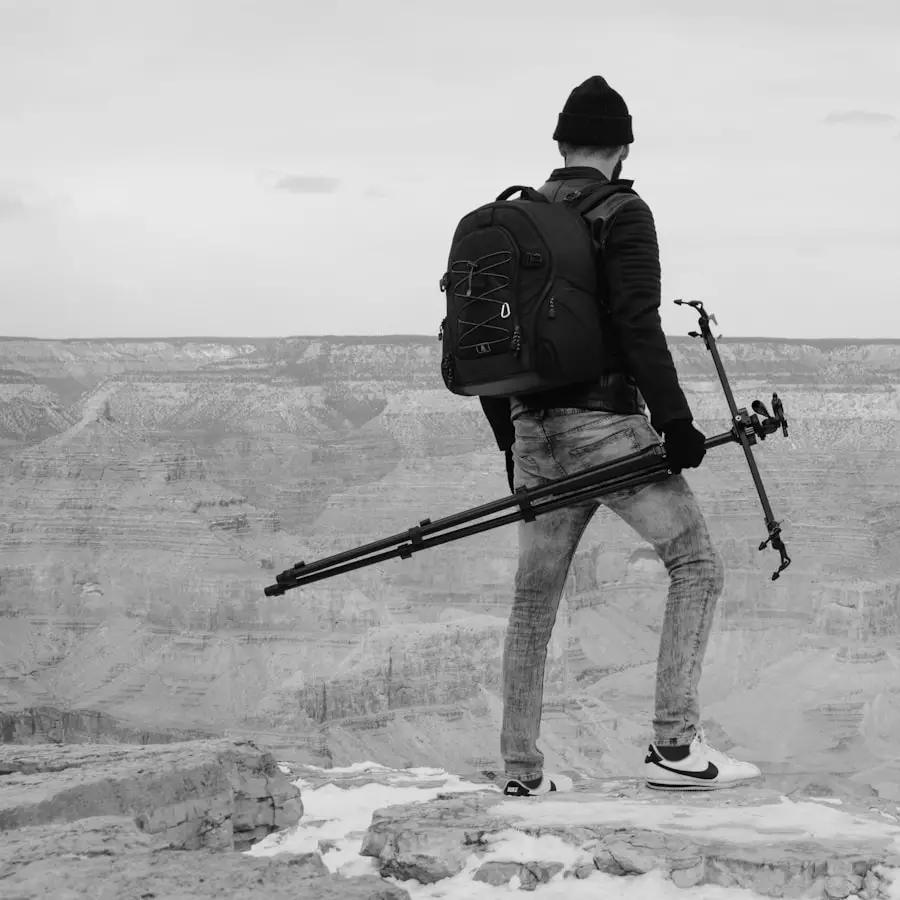
The current TSA rule is straightforward. According to TSA’s official hiking-pole guidance, blunt-tipped hiking poles are allowed in carry-on and checked baggage and must be screened like other property. Sharp-tipped hiking poles are not allowed as carry-on items.
This means a pole’s ability to telescope, fold or break into sections does not determine whether TSA permits it through the checkpoint. A compact folding pole can still be unsuitable for carry-on if it has a sharp tip. Conversely, a blunt-tipped pole may be permitted by TSA even if it does not fold, although it still has to meet the airline’s practical cabin-baggage requirements.
Warning: Do not pack a clearly sharp metal or carbide-tipped hiking pole in your carry-on and assume that folding it makes it acceptable. TSA specifically says sharp-tipped hiking poles are not allowed as carry-on items. If you are unsure whether your tip qualifies as blunt, the lowest-risk option is to place the poles in checked baggage.
TSA also states that the final decision rests with the officer at the security checkpoint. An item that is normally permitted can receive additional screening or be denied if the officer identifies a security concern. That means no article, screenshot or product description can guarantee that a particular pole will pass inspection.
Your airline is a separate part of the equation. TSA decides whether an item may pass through a U.S. security checkpoint, while the airline controls cabin-baggage dimensions, weight limits and equipment policies. For example, Delta currently lists hiking or trekking poles among items that may be carried when properly packed, in accordance with TSA requirements and the airline’s baggage allowances.
What counts as a blunt or sharp hiking-pole tip?
TSA’s public hiking-pole rule uses the terms blunt-tipped and sharp-tipped, but it does not publish a measurement, angle or universal product list defining exactly where one category ends and the other begins.
A visibly pointed metal or carbide trekking tip should therefore be treated as a sharp tip for travel planning. A permanently rounded, non-pointed end is much easier to identify as blunt.
Note: Many trekking poles use removable rubber covers over metal or carbide tips. TSA’s public hiking-pole page does not say that adding a removable rubber cap automatically changes a sharp-tipped pole into an approved blunt-tipped carry-on item. For an uncertain design, ask TSA before your trip or check the poles instead of relying on the cap.
TSA rules and airline rules are not the same thing
Passing security does not automatically mean a pole can be carried into the aircraft cabin. A blunt-tipped pole that TSA permits may still be too long for your airline’s carry-on allowance or may fall under a carrier-specific sporting-equipment policy.
TSA decides whether the pole can pass through a U.S. security checkpoint; your airline decides whether the packed pole meets its cabin-baggage rules.
Check both before leaving home, especially when using rigid poles that cannot collapse inside a standard carry-on bag.
What about international flights and connections?
TSA rules apply to TSA screening in the United States. They do not automatically control security screening at a foreign airport. If your return flight leaves another country, or your itinerary requires you to pass through security again during an international connection, the local aviation-security rules may be different.
Check the official security guidance for each airport or country where you will pass through screening, as well as the operating airline’s baggage rules. A pole accepted on your outbound flight from the United States is not a guarantee that it will be accepted in the cabin on the trip home.
What if you use a pole as a mobility aid?
TSA separately addresses canes, walkers and other mobility devices. Travelers with disabilities or medical conditions can also contact TSA Cares for information about screening procedures.
Do not assume that ordinary recreational trekking poles automatically receive the same treatment simply because they provide support while hiking. If you depend on a cane or other mobility aid for a disability or medical condition, follow TSA’s mobility-device procedures and contact TSA Cares before travel when additional screening assistance would help.
Tips for packing hiking poles for air travel
At a Glance
| Item | Tip |
| Hiking poles | Collapse or disassemble the poles where the design allows and place them in a protective sleeve or case. Protect the tips so they cannot damage the bag or injure someone handling it. |
| Carry-on or checked baggage | Check the tip against TSA’s rule first. Sharp-tipped poles belong in checked baggage; blunt-tipped poles may pass TSA screening but still need to comply with the airline’s cabin-baggage policy. |
| Length restrictions | Measure the pole at its smallest packed length and compare it with your airline’s current carry-on dimensions. TSA approval does not override the carrier’s size limits. |
| Security screening | Pack permitted carry-on poles where they can be reached easily if a TSA officer requests additional inspection. Follow the officer’s instructions at the checkpoint. |
Packing hiking poles carefully protects both the poles and everything around them. A dedicated trekking-pole sleeve or durable case can reduce scratches, prevent sections from catching on other gear and protect the pole’s locking mechanisms during baggage handling.
When checking collapsible poles, reduce them to their shortest safe packed length. If the manufacturer’s design allows sections to be separated without damaging the locking system, disassembly can also save space. Cover the tips and place the poles where heavy items are less likely to bend the shafts.
Pro Tip: Z-fold poles can pack much shorter than many telescoping models. That makes them easier to fit fully inside luggage, but their compact size does not override TSA’s sharp-tip rule.
Clothing can provide extra cushioning around the shaft sections. A small protective tip cover can also prevent a checked-bag pole from puncturing fabric or damaging nearby items. Secure paired poles together with their own straps or a reusable hook-and-loop strap so they do not shift independently inside the bag.
For a blunt-tipped pole you plan to carry on, keep it inside the bag rather than loosely attached to the outside whenever possible. It should remain accessible in case an officer wants a closer inspection.
Pre-flight hiking-pole checklist
- Inspect the tip: Determine whether it is clearly blunt or sharp.
- Do not rely on folding alone: A sharp-tipped folding pole is still a sharp-tipped pole under TSA’s published rule.
- Measure the collapsed length: Compare it with your airline’s current cabin-baggage limits.
- Check the operating airline: Review its sporting-equipment and carry-on rules, including any regional partner operating your flight.
- Check foreign security rules: Do this for your return airport and any connection where you must clear security again.
- Protect the poles: Cover tips and cushion shafts when checking them.
- Ask before guessing: TSA’s What Can I Bring? service includes AskTSA contact options when an item’s status is unclear.
Alternatives to bringing hiking poles through TSA
If you would rather avoid uncertainty at airport security, renting hiking poles at your destination can be a practical alternative. Outdoor shops, guide services and some trail-area rental businesses offer trekking poles, allowing you to travel without carrying them through the airport at all.
Another option is to buy an inexpensive pair after arrival. Instead of treating the poles as disposable equipment, keep them for future trips, give them to another traveler, or donate them where a local organization accepts used outdoor gear.
Some hikers also use a suitable natural walking stick on the trail. This is less consistent than purpose-built trekking poles and is not appropriate everywhere. Follow local park or land-management rules, and never cut live vegetation merely to make a walking stick.
Common misconceptions about bringing hiking poles through TSA

One common misconception is that every hiking pole is automatically banned from carry-on luggage. Under TSA’s current published guidance, that is not correct. Blunt-tipped hiking poles may be carried through the checkpoint, subject to screening and the TSA officer’s final decision.
The opposite assumption is also risky: a pole is not automatically suitable for carry-on simply because it folds into a small package. Foldability affects how conveniently it fits in luggage. TSA’s hiking-pole rule, however, distinguishes between blunt and sharp tips.
A third misconception is that a removable rubber cap guarantees that a carbide or metal trekking tip will be treated as blunt. TSA’s public guidance does not make that promise, so travelers should not build a nonrefundable travel plan around that assumption.
Finally, TSA approval is not the same as airline approval. A pole that passes the security rule can still be rejected as cabin baggage because of its packed size, shape or the carrier’s equipment policy.
What to do if TSA does not allow your hiking poles through the checkpoint
If a TSA officer says your hiking poles cannot pass through the checkpoint, stay calm and ask what security concern applies. TSA officers make the final decision on whether an item can enter the secure area, so explaining the product does not guarantee the decision will change.
Before giving up the poles, ask what options are available at that airport. Depending on the airport layout, airline policy and the time before departure, you may be able to leave the screening area and make another arrangement, such as checking the item, placing it somewhere permitted outside security, handing it to someone who is not traveling, or using an available shipping service. These options are not guaranteed, so allow extra time if you arrive with an item whose status is uncertain.
Warning: Do not assume you can surrender a prohibited pole and later file a routine claim to get it back or receive compensation. TSA’s policy for voluntarily abandoned prohibited property states that once the passenger abandons the item, it becomes federal property and is not returned to the passenger.
This situation is different from reporting property that was lost or damaged during screening. If keeping the poles matters to you, make alternative arrangements before voluntarily abandoning them whenever airport procedures and your departure time allow.
Conclusion and final thoughts
Flying with hiking poles is much simpler once you separate three questions: Is the tip allowed through TSA security? Will the packed pole meet the airline’s cabin-baggage rules? Will the same rules apply at every airport on the itinerary?
For U.S. TSA checkpoints, blunt-tipped hiking poles may go in carry-on or checked bags, while sharp-tipped poles are checked-baggage items. Folding a pole makes packing easier but does not erase a sharp tip. Because the officer has final checkpoint discretion and airlines can add their own baggage requirements, checking both TSA and your carrier shortly before departure remains the safest approach.
If avoiding uncertainty matters more than traveling carry-on only, checking securely packed poles or renting a pair at your destination is often the simplest solution. With the rule confirmed before you leave home, you can spend less time worrying about airport security and more time preparing for the trail.
If you’re looking for other practical travel gear, you may also be interested in a scarf with a hidden pocket for travel. It provides a discreet place to keep small valuables close while moving through airports and other busy travel areas.
Frequently Asked Questions
What are hiking poles?
Hiking poles, also called trekking poles, are walking poles used for extra stability and support on trails. Many are adjustable or foldable and use rubber, metal or carbide tips suited to different surfaces.
Can you carry hiking poles in your carry-on luggage with TSA?
Yes, if the hiking poles are blunt-tipped. TSA says blunt-tipped hiking poles may go in carry-on or checked baggage. Sharp-tipped hiking poles are not allowed as carry-on items. The TSA officer makes the final checkpoint decision, and your airline can impose additional cabin-baggage rules.
Can folding or collapsible hiking poles go in a carry-on?
They can if they meet TSA’s blunt-tip rule and your airline accepts their packed size. Folding or collapsing a pole makes it easier to store, but a sharp-tipped folding pole is still not permitted as a TSA carry-on item.
Does putting a rubber cap over a sharp trekking-pole tip make it TSA compliant?
Do not assume so. TSA’s public hiking-pole guidance distinguishes blunt tips from sharp tips but does not state that a removable rubber cover automatically changes the classification of a sharp metal or carbide tip. Ask TSA about your specific pole before travel or pack uncertain poles in checked baggage.
Are there restrictions or guidelines for carrying hiking poles with TSA?
Yes. The main published restriction is tip type: sharp-tipped hiking poles are not allowed as carry-on items. Blunt-tipped poles may be carried on, but they remain subject to screening and the officer’s final decision. Your airline’s size and equipment rules apply separately.
Can hiking poles be packed in checked luggage instead?
Yes. Checked baggage is the appropriate place for sharp-tipped hiking poles and is also a lower-risk choice when the tip classification is uncertain. Collapse or disassemble the poles where appropriate, cover the tips and cushion the shafts to prevent damage.
Does TSA have a specific rule for hiking poles?
Yes. TSA lists hiking poles as a specific item in its What Can I Bring? guidance and gives them a blunt-tip versus sharp-tip rule. TSA also tells travelers to check with their airline about whether hiking poles are accepted as carry-on items.
Do TSA hiking-pole rules apply on the return flight from another country?
Not necessarily. TSA rules govern TSA screening in the United States. A foreign airport uses its own aviation-security requirements, so check the official rules for your departure airport and any connection where you must clear security again.
What happens if TSA will not let my hiking poles through security?
Ask what options are available before voluntarily abandoning the poles. Depending on the airport, airline and time available, you may be able to leave the checkpoint and make another arrangement. TSA policy states that voluntarily abandoned prohibited property becomes federal property and is not returned to the passenger.
Sources
- Transportation Security Administration — Hiking Poles — official TSA rule for blunt-tipped and sharp-tipped hiking poles and checkpoint officer discretion.
- Transportation Security Administration — What Can I Bring? — general screening guidance, final-officer discretion and AskTSA information.
- Transportation Security Administration — TSA Travel Tips — TSA Cares, screening information and official travel-security resources.
- Transportation Security Administration — Management Directive 200.52 — official policy covering voluntarily abandoned prohibited property at TSA checkpoints.
- Delta Air Lines — Other Possibly Hazardous Items — current airline guidance listing hiking and trekking poles subject to TSA rules and baggage allowances.
- National Library of Medicine — Effects of Hiking Downhill Using Trekking Poles While Carrying External Loads — research supporting the qualified discussion of lower-extremity loading during downhill pole use.

