
Last Updated on September 10, 2026 by Daniel Globe
Finding the right travel pillow size matters when you’re petite, but there is no single “petite” measurement that works for everyone. A smaller adult may have a short or long neck, narrow or broad shoulders, and different sleeping habits. The best fit comes from matching the pillow’s support height, shape, and adjustability to how your head and neck sit in an upright seat.
Quick Answer
There is no universal travel pillow size for petite adults. Instead of relying on a 9-, 10-, or 11-inch width alone, look for low-profile or adjustable support that does not push your head forward or crowd your ears and jaw. Petite-specific models and height-adjustable designs are useful starting points.
Disclosure: As an Amazon Associate I earn from qualifying purchases. Some links on this page are affiliate links, at no extra cost to you.
Why Travel Pillow Size Matters for Petite Adults
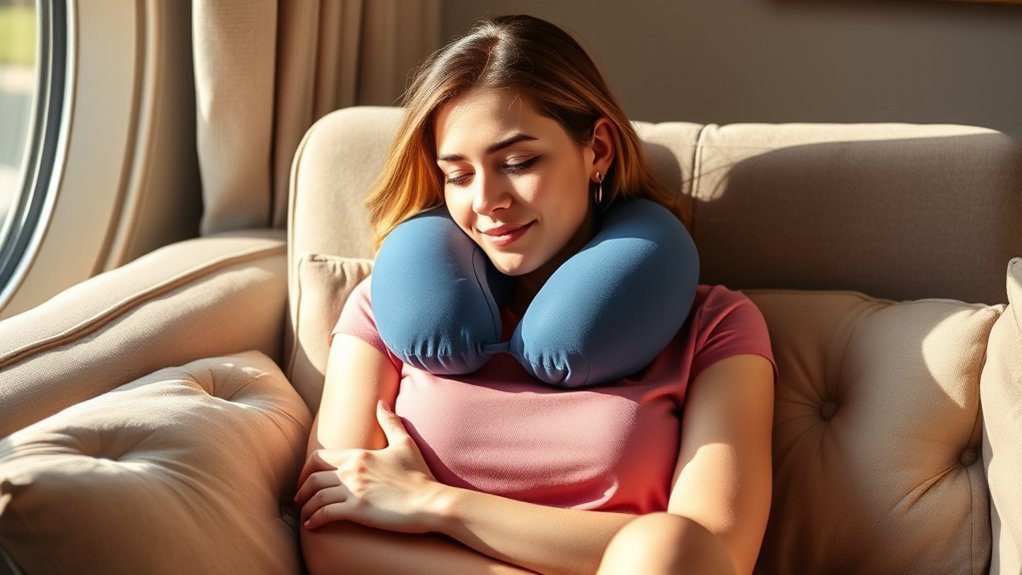
When you’re traveling, a pillow that sits too high or too far behind your head can feel worse than having no pillow at all. Petite travelers are especially likely to notice excess bulk when a full-size horseshoe pillow presses into the jaw, ears, or seat back.
Pillow height matters because it affects the position of the head and neck. A 2021 review of cervical pillow-height research found that pillow height influences cervical alignment and the mechanical load on the neck. That research was not designed to establish a particular travel-pillow size, but it supports a simple principle: the support should fit your body rather than forcing your neck into an awkward position.
For a petite traveler, the best pillow is not automatically the smallest one. It is the one that supports your head without pushing it forward, lifting your shoulders, crowding your ears, or forcing your chin into an uncomfortable angle.
Common Travel Pillow Sizes Tailored for Smaller Frames
Travel-pillow sizing is not standardized across brands. More importantly, the outside dimensions of two pillows do not tell you exactly how high they will sit against your neck. Foam thickness, internal braces, asymmetrical shapes, front closures, and seat-back straps all change the fit.
For that reason, treat published dimensions as comparison information rather than a universal small, medium, or large sizing system. Current manufacturer examples show how different the designs can be:
| Current Example | Published Size / Fit | Why It Matters for Petite Adults |
|---|---|---|
| Trtl Pillow Junior | 7.5 × 8.7 × 3.6 in; 3.9 oz | Trtl specifically says the smaller Junior model can be a good choice for petite adults. |
| Trtl Travel Pillow Original | 8.7 × 9.5 × 3.6 in; 4.7 oz | Compact wrap-style support with an adjustable fastening, but the internal support height itself is fixed. |
| Trtl Pillow Plus | 8.7 × 8.7 × 3.6 in; 9 oz | The support height can be raised or lowered, which can be useful when a fixed-height pillow feels too tall. |
| Cabeau Evolution S3 | Adult memory-foam design with adjustable front clasp | Uses a thin, flat back and raised side supports rather than relying on a single “petite” exterior dimension. |
Key Takeaways
- There is no universal 9-, 10-, or 11-inch travel-pillow size that automatically fits every petite adult.
- Support height and how the pillow sits against your jaw, ears, shoulders, and seat back matter more than exterior width alone.
- A smaller model such as Trtl Junior or a height-adjustable design such as Trtl Plus can be useful when standard pillows feel too tall.
- Memory foam conforms to your shape, while inflatable designs let you change firmness by adding or releasing air.
Petite Does Not Always Mean a Short Neck
Being short or petite does not automatically tell you your neck length or shoulder shape. Two people of the same height can need very different travel pillows. One may have a short neck and dislike tall side cushions, while another may need more height to stop the head from falling sideways.
That is why buying by your overall height alone is unreliable. Start with your own seated posture and pay attention to the vertical space between your shoulder, jaw, and ear. Then compare that space with the height and shape of the support you are considering.
How to Measure Your Ideal Travel Pillow Size
How can you tell whether a travel pillow will actually fit? Measurements help, but a short seated test is more useful than relying on one number.
- Measure your neck circumference with a soft tape measure if the pillow wraps around the neck or the manufacturer publishes a circumference-based fit range. Keep the tape snug, not tight.
- Notice your shoulder-to-jaw clearance while sitting upright. If a pillow’s side support fills more space than you have comfortably available, it may press into your jaw or ears.
- Check the product’s actual dimensions and fit instructions. Do not assume every brand’s “small” means the same thing.
- Look for useful adjustment. An adjustable closure changes tightness; an inflatable pillow changes firmness and volume; a height-adjustable support changes the vertical position of your head support.
- Test the pillow in a chair before your trip. Sit against a firm seat back for at least several minutes and try the positions you normally sleep in while traveling.
At a Glance
| Time Required | About 5–10 minutes for measuring and a seated fit check |
| Difficulty | Easy |
| Tools Needed | Soft measuring tape and an upright chair |
| Cost | $0 if you already have a measuring tape |
Note: Do not automatically size down when you fall between two options. Follow the manufacturer’s fit guidance. If the brand does not provide a clear sizing system, an adjustable model or a home trial is safer than relying on a universal rule.
How to Tell If a Travel Pillow Fits
A good petite travel-pillow fit should feel supportive without feeling like a neck brace. Use these checks while sitting in the same upright posture you expect to use on a plane, train, bus, or car.
Signs the Pillow Is Too Tall or Bulky
- Your ears are pushed upward or compressed by the side supports.
- Your chin is forced noticeably up or down.
- The rear cushion pushes your head forward away from the seat.
- Your shoulders have to shrug upward to make room for the pillow.
- You feel pressure along the jaw rather than gentle support beneath the side of the head.
Signs the Pillow Is Too Loose or Low
- Your head still drops far to one side before the pillow provides support.
- The pillow slides away whenever you relax.
- A large gap remains between your neck and the support.
- You must tighten the closure excessively just to keep the pillow in position.
Warning: A wrap-style pillow should feel snug, not restrictive. Stop using or loosen it if it causes numbness, tingling, painful pressure, or difficulty swallowing or breathing. A travel pillow is a comfort accessory, not treatment for persistent neck pain.
Key Features of Petite Travel Pillows for Comfort
Petite travelers usually benefit from features that let the pillow adapt to the body instead of forcing the body to adapt to a fixed, bulky shape.
| Feature | Benefit |
|---|---|
| Low-Profile or Compact Design | Reduces the chance that thick side cushions will crowd a shorter neck, jaw, or ears. |
| Contoured Memory Foam | Conforms to the shape of the head and neck while retaining the foam’s designed firmness. |
| Adjustable Strap or Wrap | Lets you change how closely the pillow sits around your neck. |
| Adjustable Support Height | Useful when fixed side supports sit too high or too low. |
| Inflatable Construction | Allows direct control over firmness and volume while packing very small when deflated. |
| Removable Washable Cover | Makes it easier to keep the pillow clean between flights and other trips. |
Selecting the right petite travel pillow comes down to matching these features to your own neck shape, preferred resting direction, seat design, and trip length.
Best Travel Pillow Shapes for Petite Adults: U-Shaped, Contoured, and More
The shape you choose matters as much as the dimensions because different shapes control head movement in different ways.
- U-shaped or horseshoe: Familiar and easy to find, but thick models can push into the ears or move the head forward. Petite travelers should pay close attention to side height and the thickness behind the neck.
- Contoured memory foam: Uses shaped sections to support the jaw, chin, sides of the neck, or back of the head. The contour can feel more secure than loose fill, but a contour that is too tall cannot always be adjusted.
- Wrap-style: Instead of surrounding the neck with a thick ring of foam, this style places structured support where you lean. The Trtl Original, for example, uses an internal support inside a fabric wrap and currently weighs 4.7 ounces.
- Height-adjustable wrap: The Trtl Pillow Plus lets the user raise or lower the internal support, which addresses one of the main problems petite travelers have with fixed-height designs.
- Inflatable: Lets you change air volume to reduce or increase firmness. This can be helpful when a fully inflated pillow feels too tall or stiff.
- Asymmetrical: Uses different heights on different sides so you can rotate the pillow to match how you lean. This can work well for travelers who do not stay in one sleeping position.
Choosing the Right Material and Firmness
Material affects support, heat, packing size, and adjustability. Memory foam conforms to the body and springs back toward its original shape, but its underlying firmness is normally fixed. If you specifically want to change firmness during a trip, an inflatable pillow gives you more direct control because you can add or release air.
Microbead and fiber-filled pillows can feel softer, but they may provide less structured resistance against sideways head movement. Whichever material you choose, make sure it does not create uncomfortable pressure along your jaw or behind your ears.
A removable, washable cover is especially useful on multi-leg trips. For example, Trtl says its fabric can be washed on a cold 30°C cycle after the internal support is removed, while Cabeau says the Evolution S3 cover is machine washable but the memory-foam insert should not be machine washed.
Pro Tip: If you tend to run warm, compare the fabric and ventilation as carefully as the pillow’s size. A compact pillow can still feel uncomfortable if thick fleece or dense foam traps heat around your neck.
Choose a Shape Based on How You Sleep
Your usual head movement can narrow the choices quickly:
- You lean mostly to one side: Look for firm lateral support, a wrap-style brace, or an asymmetrical pillow you can position on your preferred side.
- Your chin drops forward: Look for a design with usable front or chin support rather than relying only on cushioning behind the neck.
- You move between positions: A 360-degree pillow, adjustable closure, or inflatable design may be easier to reposition.
- The seat already pushes your head forward: Prioritize a thin or flat rear section so the pillow does not add even more bulk behind your head.
Travel Tips for Using Your Pillow
Owning the right pillow is only half the equation. Positioning and adjustment determine whether the support actually works for your body.
Adjust Pillow Positioning
Instead of assuming the pillow must sit symmetrically, follow the design’s instructions and experiment before your trip.
- Start with your head in a comfortable upright position rather than bending your neck to meet the pillow.
- Rotate or reposition an asymmetrical or wrap-style pillow to the side where you naturally lean.
- Use only enough closure tension to keep the support in place.
- Make sure the back of the pillow is not pushing your head noticeably forward.
- Try your normal reading, sleeping, and window-leaning positions before deciding the fit is right.
Trtl’s current fit guidance specifically recommends experimenting with the location of its internal support rather than assuming one fixed wearing position works for everyone.
Choose Lightweight Options
For petite travelers, packing bulk can matter as much as neck fit. Do not assume every travel pillow weighs less than a pound; check the current product specification instead.
| Pillow Example / Type | Verified or Typical Characteristic | Adjustability |
|---|---|---|
| Inflatable | Deflates to a very small packing size; exact weight varies by model | Firmness and volume change with inflation level |
| Trtl Pillow Junior | 3.9 oz | Adjustable wrap tightness; compact fixed support |
| Trtl Original | 4.7 oz | Adjustable wrap tightness; fixed support height |
| Trtl Pillow Plus | 9 oz | Adjustable wrap tightness and support height |
| Memory-Foam U-Shape | Weight varies substantially by size and foam density | Usually fixed foam firmness; some models add adjustable front closures |
Utilize Compact Storage
A compact travel pillow earns its space in your bag. A few practical habits help:
- Compare packed size as well as the pillow’s full dimensions.
- Choose inflatable or compressible designs when cabin-bag space is tight.
- Use a removable, washable cover when available to make cleaning easier.
- Use the manufacturer’s storage pouch or carry case when one is supplied.
- For memory foam, follow the manufacturer’s storage instructions instead of leaving it highly compressed for long periods.
Use Travel Pillows Safely in a Car
If you use your travel pillow on a road trip, it must not interfere with your normal restraint system. NHTSA recommends that the shoulder belt cross the middle of the chest and stay away from the neck, with the lap portion across the hips. Do not route the belt around, under, or behind a pillow to make the pillow feel more comfortable.
Warning: Never let a travel pillow change the intended position of a vehicle seat belt. If the pillow prevents the belt from lying correctly across your chest and hips, reposition or remove the pillow.
Real-World Options for Petite Travelers
It helps to see how petite-friendly features appear in current products rather than relying on generic size labels.
The Trtl Pillow Junior is the clearest petite-specific example in the current Trtl lineup. Although originally designed for children age 8 and older, Trtl also describes it as a good choice for petite adults. It measures 7.5 × 8.7 × 3.6 inches and weighs 3.9 ounces.
The standard Trtl Travel Pillow skips the traditional stuffed horseshoe shape. It uses a fabric wrap around an internal support, measures 8.7 × 9.5 × 3.6 inches, and weighs 4.7 ounces. Its wrap tightness can be adjusted, but the support structure has a fixed height.
The Trtl Pillow Plus adds height adjustment. The user can extend or shorten the support system, which is particularly relevant for someone who likes the wrap concept but finds a fixed support too high or too low. It measures 8.7 × 8.7 × 3.6 inches and weighs 9 ounces.
For travelers who prefer traditional memory foam, the Cabeau Evolution S3 uses raised side supports, a thin flat back, an adjustable front clasp, and a seat-strap system. Those features can help with fit, but Cabeau describes the S3 as an adult pillow rather than a petite-specific size, so smaller travelers should still test whether its side height works for them.
Personal Experiences: Best Travel Pillows for Petite Adults
Finding the right travel pillow can make a noticeable difference for petite adults, especially on a long journey, but real-world preferences are highly individual. A design that feels perfectly supportive to one short traveler can feel too tall or restrictive to another.
That is why first-hand fit matters more than brand reputation alone. Inflatable pillows appeal to travelers who want to reduce firmness or bulk after trying the pillow. Memory foam appeals to people who prefer a more structured contour. Wrap-style designs appeal to travelers who dislike a thick cushion behind the neck, while other people prefer the familiar feel of a conventional U-shape.
The most useful “personal experience” is therefore your own short trial before departure. Wear the pillow in an upright chair, relax your head in the direction you normally sleep, and keep it on long enough to notice pressure around the ears, jaw, chin, and shoulders. A pillow that becomes annoying after ten minutes at home is unlikely to improve during an overnight flight.
Frequently Asked Questions
Can I use a standard travel pillow if I’m petite?
Yes. A standard pillow can work if its support height and shape match your neck. The problem is not the “standard” label itself; it is excess height or bulk that pushes into your jaw or ears, lifts your shoulders, or moves your head forward. Adjustable closures and low-profile rear sections can improve the fit.
Is being petite the same as having a short neck?
No. Overall height does not determine neck length or shoulder shape. A petite adult can still need relatively tall side support, while a taller person can have a short neck. Test the pillow against your own seated posture rather than buying by body height alone.
How can I tell if a travel pillow is too tall?
Common signs include pressure under your ears or jaw, shoulders being pushed downward or forced to shrug, your chin being moved into an awkward angle, or the pillow pushing your head forward from the seat. The support should meet your head rather than forcing your body to make room for it.
How do I clean my travel pillow?
Follow the care label for the specific model. Many pillows use a machine-washable outer cover while the foam or internal support must be removed first. Trtl, for example, instructs users to remove the internal support and wash the fabric on a cold 30°C cycle. Cabeau says the Evolution S3 cover can be machine washed but its memory-foam insert should be cleaned separately rather than put in the washer.
Are inflatable pillows suitable for petite adults?
Yes. Their main advantage is adjustability: reducing the amount of air can reduce firmness and bulk when a fully inflated pillow feels too large. They also pack down very small. The tradeoff is that some travelers prefer the more structured feel of foam or an internal support brace.
What travel pillow is best for long flights, including trips on aircraft such as the Boeing 787?
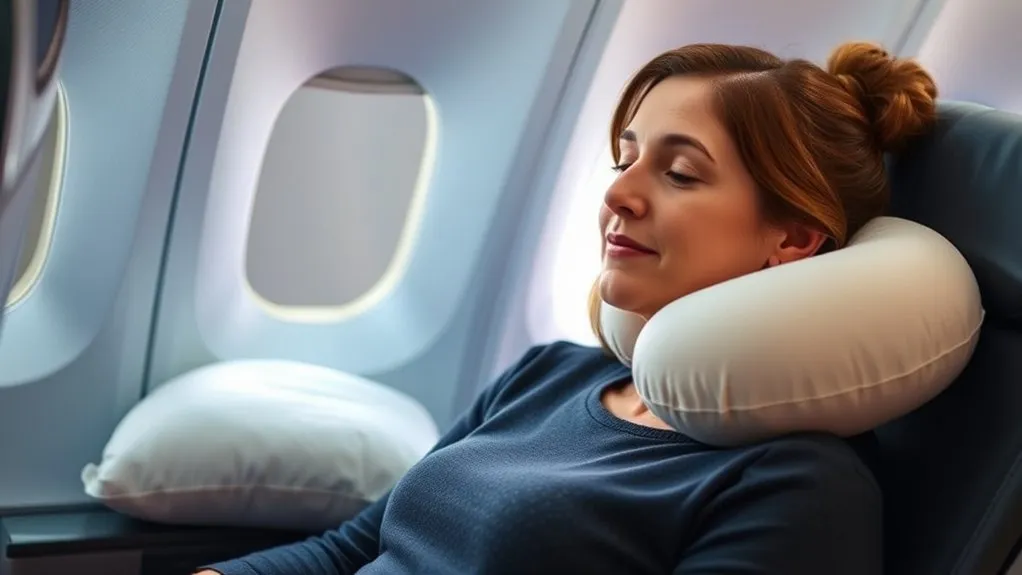
For a long flight, prioritize a pillow you can tolerate for hours: adequate side or chin support, no excessive pressure around the ears or jaw, a breathable cover, and a shape that does not push your head forward. Memory foam, adjustable wrap-style pillows, and inflatable designs can all work if the fit is right.
Can I adjust the firmness of my travel pillow?
It depends on the design. Inflatable pillows let you directly change firmness and volume by altering the air level. Memory foam conforms to your body but normally keeps its designed firmness. Wrap-style pillows may let you adjust tightness, and some models such as Trtl Plus also let you change support height.
Does pillow size actually affect neck health, or is it just comfort?
Pillow height can affect cervical positioning and comfort, and research on conventional pillows links inappropriate height with less favorable neck mechanics. However, that evidence does not establish one medically ideal travel-pillow size for petite adults. Choose a pillow that keeps you comfortable without forcing your head or neck into an awkward position, and seek medical advice for persistent or severe neck symptoms.
Conclusion
Finding the right travel pillow is not about chasing one fixed “petite” measurement. Exterior width alone cannot tell you whether a pillow will support a short or narrow neck comfortably. The better approach is to check support height, rear thickness, side pressure, adjustability, and how the pillow behaves when you relax in an upright seat.
For particularly small frames, a model that is explicitly sized smaller, such as the Trtl Pillow Junior, is worth comparing with standard designs. If your main problem is fixed support that sits too high, a height-adjustable model such as Trtl Plus or an inflatable design gives you more room to fine-tune the fit. Test whichever pillow you choose before the trip so you know it supports your head without creating a new pressure point.
Sources
- Lei et al., “Ergonomic Consideration in Pillow Height Determinants and Evaluation,” Healthcare, 2021 — supports the general relationship between pillow height, cervical alignment, and neck mechanics.
- Trtl Pillow Junior — Official Product Page — supports the current petite-adult recommendation, dimensions, weight, and compact design.
- Trtl Travel Pillow — Official Product Page — supports current Original model dimensions, 4.7 oz weight, wrap design, and fit guidance.
- Trtl Pillow Plus — Official Product Page — supports its adjustable support height, dimensions, weight, and washable construction.
- Cabeau Evolution S3 — Official Product Page — supports the thin flat back, raised side supports, adjustable front clasp, washable cover, and seat-strap system.
- National Highway Traffic Safety Administration — Seat Belt Safety — supports correct shoulder- and lap-belt positioning for road travel.
