
Last Updated on September 10, 2026 by Daniel Globe
Picking the wrong travel pillow can leave your head tilted, your shoulders raised, or your chin dropping every time you start to rest. The right fit may make upright travel more comfortable without crowding your seat or filling your bag. This guide shows you how to compare travel pillow size, shape, support height, and packed dimensions.
Quick Answer
There is no universal travel pillow size. Choose by fit: the sides should support your head without lifting your shoulders, the back should not push your head forward, and any front closure should feel snug but not tight. Then compare the pillow’s packed dimensions with your luggage.
Key Takeaways
- Travel pillows do not follow one standard adult, petite, or child size.
- Support height, neck opening, rear thickness, closure range, and shape matter more than outer width alone.
- A pillow is too tall if it lifts your shoulders or presses into your ears, and too short if your head still falls sideways.
- Inflatable models let you adjust firmness and loft, but the seams and basic shape still limit the fit.
- Check both worn size and packed size. Compression bags and a suitable carry-on can help, but airline baggage rules still apply.
Disclosure: As an Amazon Associate I earn from qualifying purchases. Some links on this page are affiliate links, at no extra cost to you.
Why Travel Pillow Size Matters

The size of your travel pillow affects where your head, jaw, neck, and shoulders rest while you sit. Research on seated posture shows that changes in the trunk and sitting position can also change head and neck posture, so the pillow must work with your seat rather than fight against it. You can read the study through PubMed.
A pillow that is too tall may lift your shoulders, press into your ears, or tilt your head. One that is too low may compress without stopping your head from falling sideways. A thick rear section can also push your head forward when the seatback is upright.
Trip length does not automatically determine the correct exterior size. A long flight calls for stable, comfortable support, but a larger pillow is not helpful if it creates pressure, traps heat, or crowds your seat.
The best travel pillow is not the widest one. It is the one that supports your resting position without lifting your shoulders, pushing your head forward, or feeling restrictive.
Key Factors for Choosing the Right Travel Pillow Size
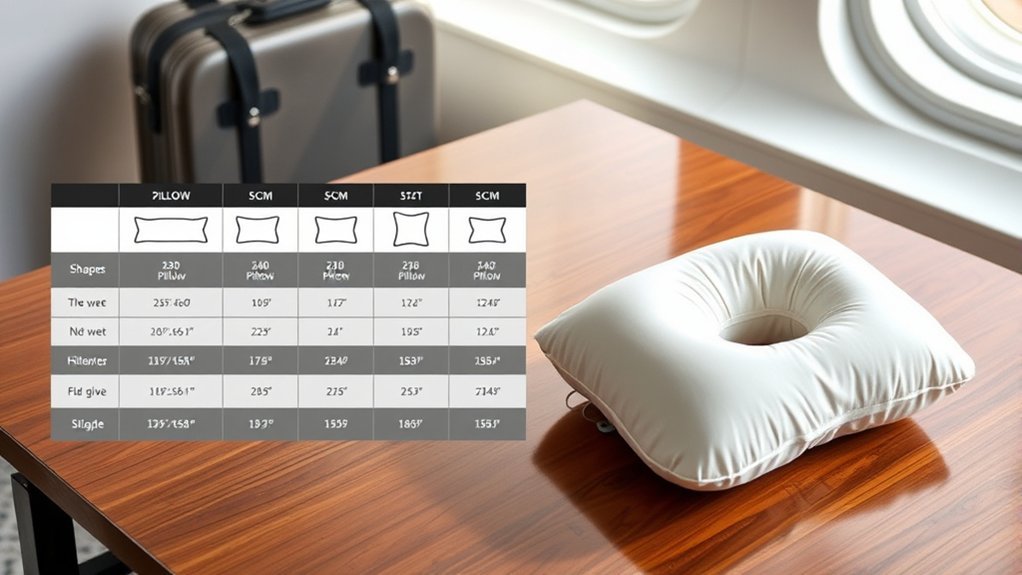
Manufacturers measure travel pillows in different ways. A wrap-style support may be smaller on paper than a U-shaped foam pillow while providing more support on one side. For example, the official Trtl Travel Pillow lists dimensions of 8.7 by 9.5 by 3.6 inches, but it fits and functions differently from the U-shaped Cabeau Evolution S3.
Check the following measurements and features instead of relying on one width number:
| Measurement | What It Tells You |
| Support height | Whether the side reaches your jaw or lower head without lifting your shoulder. |
| Neck opening | How loosely or closely a U-shaped pillow sits around your neck. |
| Closure range | Whether a clasp, strap, or wrap can hold the pillow in place without pressure around your throat. |
| Rear thickness | How far the pillow may push your head away from an upright seatback. |
| Outer dimensions | How much space the pillow may take beside you or inside your bag. |
| Packed dimensions | The actual space needed after deflation, folding, or compression. |
| Weight | How noticeable the pillow will be when attached to or carried inside your luggage. |
Neck Height Matters More Than Body Height
A tall traveler can have a short neck, while a petite traveler can need relatively tall side support. Sit upright and look at the space between the top of your shoulder and the underside of your jaw. The pillow should fill enough of that space to support your resting head without forcing the shoulder downward or upward.
Shoulder Shape Changes Where the Pillow Sits
Broad or level shoulders may hold a pillow higher. Sloping shoulders may let it sit lower. This is why selecting a 13 or 14-inch pillow based only on shoulder width is unreliable. Test where the support lands when you are seated.
Rear Thickness Can Make or Break the Fit
Many aircraft and bus seats already place the head slightly forward. If the pillow has a thick section directly behind your neck, it may increase that pressure. A flatter back, side-focused support, or wrap design may work better in an upright seat.
How to Choose the Best Travel Pillow for Your Needs
Use this process before buying or before the return period ends.
- Check your resting direction. Decide whether your head normally falls left, right, forward, or toward a window.
- Compare support height. Look for sides or a wrap that reach the area below your jaw without pressing into your ears.
- Check the back. Sit against a firm chair and make sure the pillow does not push your head noticeably forward.
- Adjust the closure or inflation. The pillow should stay in place without squeezing your neck or making swallowing uncomfortable.
- Test it for at least 10 to 15 minutes. Relax your jaw and shoulders, close your eyes, and let your head move naturally. A pillow that only feels good while you actively hold your posture may not work once you fall asleep.
Note: Wear the pillow in the direction shown by its manufacturer. Some products are designed with the opening in front, while others support the jaw from the front or one side.
Signs Your Travel Pillow Is Too Big or Too Tall
- Your shoulders rise when you put it on.
- The sides press into your ears or cheekbones.
- The pillow pushes your chin upward.
- A thick rear section forces your head forward.
- The front closure feels restrictive even at its loosest setting.
- The pillow crowds the seat beside you.
Signs Your Travel Pillow Is Too Small or Too Low
- Your head still falls far to one side.
- The pillow collapses before it reaches your jaw.
- The closure cannot keep the support in position.
- The pillow slides down onto your chest or shoulders.
- You must shrug or lean heavily toward the window to reach it.
Choosing for a Short or Long Neck
If you have a short neck, look for low-profile sides, a thin rear section, and an adjustable closure. If you have a longer neck, prioritize taller side support or a wrap that can be positioned higher. Do not assume the product labeled “large” is automatically taller. Check the size chart or ask the manufacturer which measurement changes between sizes.
How Pillow Shapes Affect Your Travel Comfort
Shape affects where the support is placed, how much space the pillow uses, and whether it can stop forward or sideways head movement.
- Traditional U-shaped pillows: Support the sides and back of the neck, but an open front may allow chin drop unless the pillow includes a clasp or raised front section.
- Wrap or scarf-style pillows: Concentrate support on one side and can be less bulky, but positioning and closure tension are important.
- Contoured foam pillows: Use shaped sides, a flatter back, or front support. Compare the contour with your neck height rather than relying on the overall dimensions.
- Inflatable pillows: Pack small and let you reduce or increase air pressure. Partial inflation can lower firmness and loft, but it cannot change the basic seam pattern or opening.
- Rectangular travel pillows: Can support the head against a window or serve as lower-back support, but they usually need a surface to lean against.
- Seat-attached designs: May reduce head movement without wrapping around the neck, but they only work with compatible headrests and must not interfere with safety instructions.
Memory foam, air chambers, fiber fill, and microbeads also feel different. Foam usually keeps a defined shape but takes more room. Air-filled models are highly packable but may feel less stable when underinflated. Loose fills can conform easily but may shift away from the area that needs support.
Will a Travel Pillow Fit Your Seat or Headrest?
A pillow can fit your body and still work poorly with your seat. Check these details before your trip:
- Seatback angle: A thick rear pillow may push your head forward in a very upright seat.
- Headrest wings: Adjustable wings may reduce how much side support you need from the pillow.
- Window access: A small rectangular pillow may work well at the window but offer little help in an aisle seat.
- Seat width: Large side bolsters can enter your neighbor’s space in a narrow row.
- Headrest straps: A seat-strap pillow needs an exposed, compatible headrest. Do not force straps around screens, tray mechanisms, safety equipment, or another passenger’s space.
- Headphones and glasses: Tall side panels may press over headphone cups or push glasses against your face.
Warning: A travel pillow is a comfort accessory, not a restraint. Remove or reposition it if it affects breathing, swallowing, circulation, your seat belt, your awareness of safety instructions, or your ability to exit the seat quickly.
Choosing a Travel Pillow for Children
Choose a child pillow only when the manufacturer gives an appropriate age or body-size range. An adult pillow may sit around a child’s ears, push the head forward, or leave too much space around the neck. Adult models are not automatically safe just because they feel soft. For example, Cabeau states that its adult Evolution S3 is too large to support children under 13 properly.
Infants should not sleep with travel pillows or other loose, pillow-like objects. The American Academy of Pediatrics safe-sleep guidance recommends a firm, flat sleep surface with no pillows or other soft objects in an infant’s sleep space.
For a child riding in a car safety seat, do not place a general travel pillow or extra padding behind the child, beneath the child, or under the harness. Use only items that came with the seat or that the seat manufacturer specifically approves for that model. This follows current AAP car-seat guidance.
How Firm Should a Travel Pillow Be?
The pillow should resist your head enough to provide support without creating a hard pressure point. Very soft fill may feel comfortable at first but compress too far when your head relaxes. A very firm pillow may hold its shape but feel uncomfortable around the jaw, ears, or collarbone.
Inflatable pillows are useful when you want to tune firmness. Start slightly under full inflation, test your position, and add small amounts of air. Overinflation can make the pillow rigid or raise the support higher than expected.
Adjustable-fill pillows offer another option. Removing fill can reduce height and pressure, while adding or redistributing fill can increase support. Make each change gradually and test it while sitting against a chair similar to your travel seat.
Packing Tips for Travel Pillows
Measure the pillow in the condition you will actually carry it. The full, worn dimensions tell you how much space it may use in your seat. The packed dimensions tell you whether it fits inside your luggage after deflation, folding, or compression.
Inflatable pillows usually pack flatter than solid foam. Compressible foam pillows may come with their own storage cases, while wrap-style designs can fold around another item. Use the case supplied by the manufacturer when possible because it is designed for that pillow’s shape and closure.
Do not assume that a pillow attached outside your bag is exempt from baggage rules. According to IATA baggage guidance, cabin baggage size and weight rules can vary by airline, cabin class, and aircraft. Check your operating airline before departure, especially when traveling on a basic fare or a small aircraft.
Weight matters too. A light pillow may be easy to clip outside your bag, while a heavier foam model can add noticeable weight to a tightly limited personal item.
Pro Tip: Measure your packed pillow against your carry-on’s interior dimensions, not only the bag’s advertised exterior size. Leave room for the storage case, zipper, and other packed items.
Note: Do not leave a foam pillow tightly compressed for long-term storage unless its manufacturer permits it. Extended compression may slow or reduce its return to the original shape.
How to Clean and Store a Travel Pillow
Always read the care label before washing. The correct method depends on whether the pillow contains memory foam, loose fill, an inflatable bladder, or a removable internal support.
- Removable cover: Zip it closed if instructed and wash it using the temperature and cycle on the label.
- Memory-foam insert: Do not soak or machine-wash it unless the manufacturer specifically allows that method. Many foam inserts should be wiped gently and air-dried.
- Inflatable bladder: Wipe it with a mild solution approved by the manufacturer. Keep liquid away from the valve and allow it to dry before folding.
- Wrap-style support: Remove any rigid internal part before machine washing when the instructions require it.
- Storage: Make sure every component is completely dry before closing the case to reduce odor and moisture buildup.
Official instructions differ even between popular products. Trtl permits cold machine washing after removing the internal support, while Cabeau tells owners to machine-wash the cover and wipe the memory-foam insert rather than washing the foam.
If you have dust-mite or other indoor allergies, focus on a removable, washable cover and complete drying rather than assuming a material name is automatically safe. The American College of Allergy, Asthma and Immunology recommends frequent washing and mite-resistant covers for controlling dust-mite exposure. Avoid any fabric, fragrance, latex, or cleaning product that you already know triggers symptoms.
Frequently Asked Questions
Can travel pillows be used for home relaxation as well?
Yes. A travel pillow can support your head while you read, watch television, or rest in a chair. Use it only where it feels comfortable, and do not treat it as a substitute for medical evaluation or a prescribed neck-support device.
How do I clean and maintain my travel pillow?
Follow the product’s care label. Removable covers may be machine washable, while memory foam, air bladders, and rigid supports often need separate care. Let every component dry fully before reassembly or storage.
Are there travel pillows specifically for children?
Yes, but choose one with manufacturer guidance that matches the child’s age or body size. Do not use a travel pillow for infant sleep, and do not add a pillow or insert to a car safety seat unless it came with the seat or the seat manufacturer specifically approves it.
What materials are best for allergy sufferers?
No single common fill is best for everyone. Look for a removable cover that you can wash and dry according to the label, and avoid materials or cleaning products that trigger your known allergies. A tightly woven or allergen-resistant cover may also help with dust-mite exposure.
Can I find adjustable travel pillows for custom support?
Yes. Inflatable pillows let you change air pressure and loft, while adjustable-fill, clasp, strap, and wrap designs let you change how closely the pillow sits. Adjustment helps, but you must still check support height, rear thickness, and the manufacturer’s size range.
How can I tell if a travel pillow is too tall?
It is probably too tall if it lifts your shoulders, presses into your ears, pushes your chin upward, or tilts your head away from its natural resting position. Try a lower-profile model or reduce the inflation or fill when the design allows it.
Does a travel pillow count as carry-on baggage?
It can. Policies vary by operating airline, fare, cabin class, aircraft, and how the pillow is carried. Check the airline’s current baggage page rather than assuming a pillow clipped outside your bag is always exempt.
Should I wear a U-shaped travel pillow backward?
Only when the manufacturer says the design supports that position. Some travelers place a traditional U-shape with the opening behind them for more chin support, but shaped backs, clasps, straps, and contours may be designed for one specific direction.
The right travel pillow size comes from matching the support to your neck, resting direction, seat, and luggage rather than choosing a universal width. Check the support height, rear thickness, closure, and packed dimensions, then test the pillow while sitting and relaxing your shoulders. A careful fit test will tell you more than a small, medium, or large label.
Sources
- International Air Transport Association: Travel and Baggage — explains that baggage allowances vary by airline, cabin class, and aircraft.
- American Academy of Pediatrics: Safe Sleep Guidance — supports the warning against pillows and soft objects in infant sleep spaces.
- American Academy of Pediatrics: Car Seats Information for Families — supports using only car-seat accessories supplied or approved by the seat manufacturer.
- PubMed: Influence of Sitting Postures on Head and Neck Posture — supports the connection between seated position and head or neck posture.
- American College of Allergy, Asthma and Immunology: Dust Allergy — supports washable covers and exposure-control guidance.
- Trtl Travel Pillow and Cabeau Evolution S3 — official dimensions, fitting information, age guidance, packing details, and cleaning instructions.

