

Last Updated on September 10, 2026 by Daniel Globe
A cooling travel pillow can make a warm flight, train ride, road trip, or hotel stay more comfortable, but no passive pillow stays cold forever. The best choice combines airflow, moisture control, suitable neck support, and a washable cover. Cooling claims also vary by product, so the fiber label, construction, care instructions, and return policy matter more than marketing terms alone.
Quick Answer
Choose a cooling travel pillow with a breathable or ventilated core, a removable moisture-managing cover, and enough support for your travel position. Phase change materials may buffer heat for several hours, while gel foam may feel cool at first. Always check the care label before washing.
Key Takeaways
- Airflow and moisture control usually matter more than a “cooling” label alone.
- Phase change material, gel foam, latex, and breathable covers manage heat in different ways, and none guarantees an all-night cold surface.
- Choose the pillow shape and loft for upright travel or flat sleeping, not just for the cover material.
- Wash only the parts the manufacturer says are washable; many foam cores should not go in a washing machine.
Disclosure: As an Amazon Associate I earn from qualifying purchases. Some links on this page are affiliate links, at no extra cost to you.
Why a Cooling Travel Pillow Can Improve Comfort
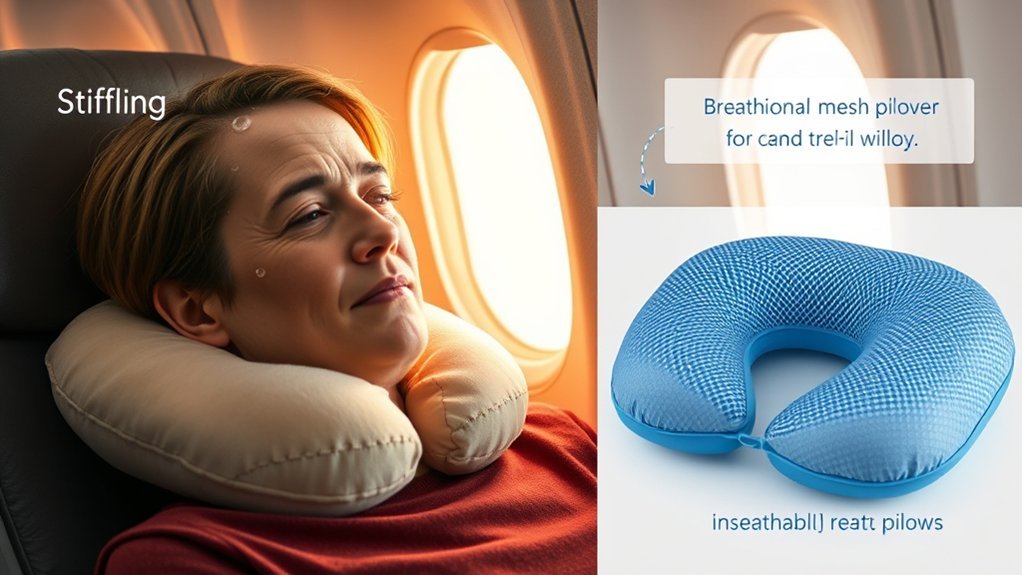
Heat and humidity can make sleep feel less comfortable. Research on the thermal environment and sleep shows that hot conditions can increase wakefulness, while humid heat adds to the body’s thermal load. A well-designed travel pillow may help by reducing heat buildup around your head and neck, moving moisture away from your skin, or providing a cooler initial surface.
The important qualifier is “may.” Most travel pillows use passive cooling rather than active refrigeration. Their real-world effect depends on cabin or room temperature, humidity, airflow, the pillowcase used, your own body heat, and how tightly the pillow fits. Support still matters: a pillow that feels cool but lets your head drop forward, or pushes it too far ahead, is not a good travel choice regardless of its cooling claims.
Note: “Cool-to-the-touch” usually describes the first sensation when your skin meets the fabric. It does not mean the pillow will remain cold for an entire trip.
A useful cooling pillow manages heat and moisture without sacrificing fit, support, or safe cleaning.
Key Features of Cooling Travel Pillows
Look beyond a single fabric name or gel layer. The strongest designs combine several practical features:
- Ventilation: Perforations, mesh panels, channels, or shredded fill create paths for air to move through or around the pillow.
- Moisture management: A cover that spreads moisture over a larger area can help it evaporate, although evaporation becomes less effective in high humidity.
- Phase change material: PCM can absorb and later release thermal energy as it changes phase. Research on thermal-management textiles supports the basic mechanism, and industry testing on PCM-treated sleep surfaces has reported measurable surface-temperature reductions lasting several hours before the material re-equalizes with body heat. Real-world performance still depends on the amount of PCM, its activation range, and the product’s construction.
- Removable cover: A washable cover is easier to keep fresh during repeated trips than a pillow with a fixed shell.
- Adjustable support: Removable fill, adjustable straps, or a flexible closure can improve fit without forcing the pillow tightly against your skin.
- Packability: A pillow should compress enough for your luggage without becoming misshapen or requiring prolonged tight storage that the maker discourages.
What Materials Can Help You Feel Cooler?
Cooling Materials at a Glance
| Ventilated or Shredded Foam | Creates more air space than a dense solid block, but the foam may still warm as it absorbs body heat. |
| Phase Change Material | Buffers temperature changes by storing and releasing heat, often for several hours per sleep cycle; the effect is limited by the amount and design of the material. |
| Gel-Infused Memory Foam | May feel cooler at first and can spread heat, but gel alone does not guarantee lasting cooling. |
| Perforated Latex | Offers springy support and air channels when perforated, but it can be heavier and bulkier than other travel fills. |
| Cotton, Linen, Lyocell, or Viscose Cover | Comfort depends on weave, weight, finish, and construction. The fiber name alone does not prove that a cover will sleep cool. |
Be careful with broad material claims. The Federal Trade Commission’s bamboo-textile guidance explains that most fabric marketed as bamboo is actually rayon or viscose made from bamboo. Likewise, a cover described as “eucalyptus” is commonly a regenerated cellulose fiber such as lyocell or viscose. Check the fiber-content label instead of assuming that the plant source guarantees cooling, sustainability, or allergy protection.
Organic certification addresses how a raw material is grown or processed under a specific standard; it does not automatically make a fabric more breathable. For any cover, the weave, knit, thickness, surface finish, and ability to dry between uses are more useful buying clues.
Pro Tip: Hold the cover up to a light and gently stretch it. A visible, open knit or mesh panel often signals better airflow than a thick, tightly laminated fabric, although the core still affects heat buildup.
Which Material Fits Your Trip?
| Upright airplane/train seat | Adjustable-loft or shredded-fill pillow with side and chin support |
| Flat hotel or hostel sleep | Compact rectangular ventilated foam or perforated latex |
| Hot, humid climates | Removable moisture-wicking cover plus mesh or perforated core; carry a spare dry cover |
| Lightest packing weight | Shredded or adjustable-fill pillow over latex, which tends to be heavier and bulkier |
How to Choose the Right Cooling Travel Pillow
Choose for Upright or Flat Sleep
For an airplane, train, or bus seat, look for side and chin support that limits head drop without placing a thick pad directly behind your neck. A large rear section can push your head forward against the seat. For hotel, hostel, or camping use, a compact rectangular pillow may work better because it supports the gap between your head and the sleeping surface.
Match the Loft and Firmness
Your head should feel supported without being forced sharply forward, backward, or to one side. Adjustable fill or an adjustable closure is useful when you cannot test the pillow in the exact seat beforehand. People with broader shoulders may prefer more side support, while smaller travelers may need a lower-profile design.
Check Packability and Care
Compare packed size, weight, compression instructions, removable-cover design, drying time, warranty, and return policy. A pillow that is technically cooler but difficult to clean or too bulky to carry may not be practical for repeated travel.
Read Cooling Claims Closely
Look for specific descriptions such as perforated foam, mesh zones, a named PCM layer, or a removable moisture-managing cover. Treat phrases such as “ice cold,” “self-cooling,” “temperature regulating,” and “hypoallergenic” as marketing claims unless the manufacturer explains the test method and conditions.
Create a Comfortable Sleep Environment When Traveling
A pillow works best as part of a cooler setup. In a hotel room, use safe ventilation, a fan, or air conditioning when available. On a plane, train, or bus, direct the personal air vent toward your upper body without making yourself uncomfortably cold. Wear light layers so you can adjust as the cabin temperature changes.
Use a clean, dry pillowcase that does not block the pillow’s ventilation panels. Avoid wrapping a cooling pillow in a thick fleece cover or waterproof protector unless the manufacturer designed it for that purpose. If your hair, clothing, or pillow cover becomes damp, let the pillow dry fully before packing it away.
Cooling is harder in humid conditions because sweat evaporates more slowly. A moisture-managing cover can still reduce clamminess, but it cannot overcome a hot, saturated environment by itself. Increasing safe airflow and changing a damp cover are often more effective than adding another dense layer.
Warning: A driver should never use a sleep pillow or any setup that encourages drowsiness or limits head movement. Cooling travel pillows are for passengers or for use after the vehicle is safely parked.
How to Maintain Your Cooling Pillow for Longevity
At a Glance
| Time Required | About 5 minutes of hands-on care, plus washing and full drying time |
| Difficulty | Easy, but the manufacturer’s care label takes priority |
| Tools Needed | Mild detergent, clean towel, and a ventilated drying area |
| Cost | Usually $0–$5 with household cleaning supplies |
- Read the sewn-in care label first. Separate the removable cover from the core only if the design allows it.
- Wash the cover as directed. Cold water, mild detergent, and air drying are common instructions, but product directions vary.
- Keep foam cores out of the washer unless the label clearly allows machine washing. For example, Tempur-Pedic states that its foam pillows are not washable, while removable covers can be washed according to their instructions.
- Dry every part completely. Trapped moisture can cause odor, damage, or microbial growth.
- Air the pillow after travel. Remove it from a compression sack and let it return to shape in a dry, ventilated place.
- Store it loosely when possible. Long-term tight compression can deform some foams or reduce loft.
- Inspect it before each trip. Replace it when the core no longer rebounds, the support has collapsed, seams or closures fail, an odor remains after approved cleaning, or moisture damage appears.
Warning: Do not assume the whole pillow is machine washable. Water, agitation, or high dryer heat can damage memory foam, cooling coatings, adhesives, or phase change layers.
Which Cooling Travel Pillow Type Is Best for Hot Sleepers?
The best category depends on whether you value a cool initial feel, steady airflow, strong support, low weight, or easy cleaning. The options below describe material types rather than endorsing untested products.
Gel-Infused Memory Foam
Gel-infused memory foam can offer close contouring and a cooler first touch than basic dense foam. Ventilation holes or shredded construction may improve airflow. However, the foam can still warm during prolonged contact, so check the cover, core density, ventilation, and fit rather than relying on the word “gel.” This type suits travelers who prefer a cradled, slower-response feel and do not mind moderate bulk.
Lyocell or Viscose Cover Options
Covers marketed with eucalyptus or bamboo language are often lyocell, rayon, or viscose made from plant-derived cellulose. They may feel smooth and may handle moisture well, but cooling depends on the finished fabric. Read the fiber label, check whether the cover is removable, and avoid treating “natural,” “antibacterial,” or “hypoallergenic” as automatic properties.
Adjustable-Loft and Ventilated Pillows
Adjustable designs let you remove fill or change the closure so the pillow fits your neck and seat. Shredded fill, mesh zones, and perforations can also create air space. These pillows are often the most flexible choice for people who switch between upright travel and flat sleeping, although loose fill can shift and may need reshaping.
Perforated Latex Pillows
Latex is responsive and does not have the slow sink of memory foam. Perforations can support airflow, and the material often rebounds well after use. Its drawbacks are weight, bulk, cost, and a springier feel that not every traveler likes. People with a known latex allergy should avoid direct exposure and follow medical advice.
What to Do If Your Travel Pillow Still Feels Hot
- Remove unnecessary layers. A thick pillowcase, hood, scarf, or waterproof cover can block airflow.
- Loosen the fit slightly. A very tight neck pillow can trap warm air and moisture against your skin.
- Expose the ventilation zones. Make sure mesh panels or perforations are not pressed flat against clothing or a seat cover.
- Change the damp surface. Carry a spare lightweight cover for long or humid trips.
- Let the pillow recover. Air it out between travel segments rather than keeping it compressed in a bag.
- Try a different construction. If a dense foam pillow repeatedly overheats, a ventilated, shredded-fill, or lower-contact design may suit you better.
Note: A pillow cannot treat unexplained night sweats. The Mayo Clinic advises contacting a health professional when night sweats occur regularly, interrupt sleep, or come with concerning symptoms such as fever, unexplained weight loss, pain, cough, or diarrhea.
Frequently Asked Questions
Can I use a regular pillowcase on a cooling travel pillow?
Yes, provided it fits safely and does not cover closures or ventilation features. A thick or tightly woven case may reduce airflow or hide a cool-touch surface. A lightweight, washable case is usually the better option.
How often should I replace my cooling travel pillow?
There is no universal one- or two-year rule. Replace it when it no longer supports your head, stays compressed, becomes lumpy, develops damaged seams or closures, retains an odor after approved cleaning, or shows moisture or mold damage.
Do cooling travel pillows work in humid environments?
They can still improve comfort, but moisture evaporation is slower in humid air. Prioritize airflow, a quick-drying removable cover, and a spare dry cover. Do not expect a passive pillow to overcome a very hot, humid room or cabin.
Can I wash my cooling travel pillow in a washing machine?
Only if the care label specifically says the entire pillow is machine washable. Many removable covers can be washed, while memory foam, latex cores, adhesives, or cooling layers may be damaged by water, agitation, or dryer heat.
Are there travel pillows that cool without gel?
Yes. Alternatives include phase change covers, mesh panels, perforated latex, ventilated foam, shredded fill, and lightweight moisture-managing covers. These designs manage heat passively, so they may feel more breathable without staying cold indefinitely.
Is a bamboo or eucalyptus cover automatically cooling?
No. Those terms often describe the plant source used to make rayon, viscose, or lyocell. Cooling depends on the final fabric’s knit or weave, thickness, finish, moisture handling, and the pillow core beneath it.
Can a cooling travel pillow stop night sweats?
It may reduce heat buildup around your head and neck, but it cannot diagnose or treat night sweats. Seek medical advice when sweating is regular, disrupts sleep, begins without a clear reason, or occurs with other concerning symptoms.
Conclusion
A good cooling travel pillow should feel comfortable, support your head and neck, dry between uses, and fit your luggage. Favor clear construction details over broad promises: ventilation, removable covers, adjustable support, and accurate fiber labels are more useful than a single “cooling” claim. Test the pillow in a seat similar to the one you will use, follow its care label, and change the surrounding airflow or layers when heat persists.
Sources
- Effects of Thermal Environment on Sleep and Circadian Rhythm — supports the discussion of heat, humidity, thermoregulation, and sleep.
- Thermal Management With Innovative Fibers and Textiles — explains heat-management textiles and phase change material systems.
- Federal Trade Commission: Bamboo Textiles — supports accurate labeling of rayon or viscose made from bamboo.
- FTC Textile and Wool Labeling Guidance — supports the use of recognized generic fiber names.
- Tempur-Pedic Pillow Care Guidance — provides a manufacturer example showing that a washable cover does not mean the foam core is washable.
- Mayo Clinic: Night Sweats—When to See a Doctor — supports the medical caution about persistent or concerning night sweats.

