
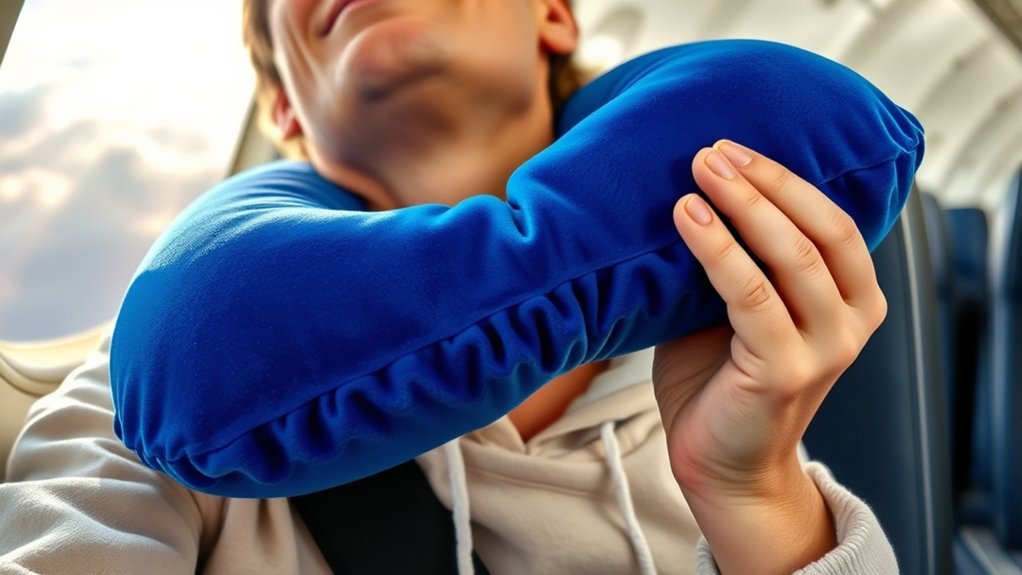
Last Updated on July 29, 2026 by Caleb Warren
If your travel pillow keeps slipping off your neck, the problem is usually the fit, position, inflation level, or pillow design—not a single type of fabric. A few small adjustments can keep the support closer to your jaw and shoulders without over-tightening it or attaching it unsafely to the seat.
Quick Answer
To stop a travel pillow from slipping, fit it snugly, place the support where your head naturally falls, and use only the pillow’s built-in clasp or manufacturer-designed seat straps. For an inflatable pillow, release a little air so it molds around your neck. Avoid improvised anchors that affect the seat, aisle, tray, or safety equipment.
Key Takeaways
- Start with fit: the pillow should support your jaw and sides of the neck without pressing on your throat.
- Positioning depends on the design. A U-shaped pillow, wrap-style support, and seat-strap pillow are not worn the same way.
- Slightly underinflating an inflatable pillow often improves its ability to mold around your neck and shoulders.
- Use only built-in closures or manufacturer-designed straps, and follow airline crew instructions.
At a Glance
| Time Required | 3–5 minutes |
| Difficulty | Easy |
| Tools Needed | Your travel pillow and its original clasp, toggle, insert, or seat straps |
| Cost | Usually $0 |
Disclosure: As an Amazon Associate I earn from qualifying purchases. Some links on this page are affiliate links, at no extra cost to you.
Understanding Why Your Travel Pillow Slips Off
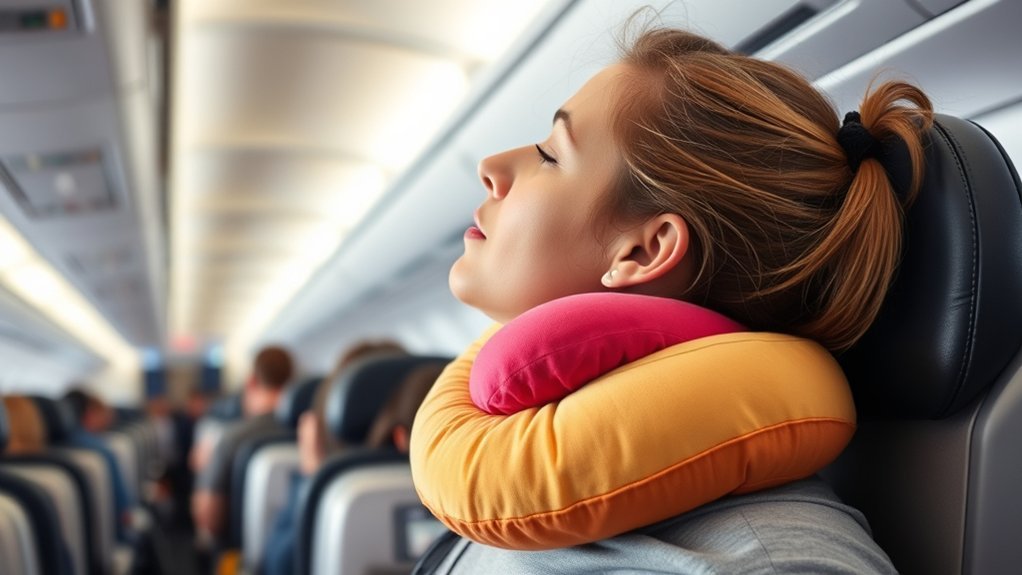
A travel pillow can move when it is too large, too loose, overinflated, or poorly matched to the way your head naturally leans. A thick rear cushion may also push your head away from the seat, while shallow side panels may fail to support your jaw.
Your clothing and seat surface can affect movement, but there is no universal fabric or friction number that predicts whether a pillow will stay in place. Fit, shape, closure, inflation, headrest position, and your sleeping posture usually matter more.
Research on ordinary sleep pillows shows that pillow height and support can change pressure around the head and neck and influence spinal alignment. Although those studies were not conducted in airplane seats, they support choosing an individualized fit instead of following one fixed orientation for every traveler or pillow. See the 2021 review of pillow-height research.
Main Reasons Your Travel Pillow Slips
Fit and Shape Mismatch
A pillow that is too wide may rotate around your neck. One that is too tall may press into your jaw or ears, while a low pillow may not reach the area where your head needs support. The rear section can also be too thick for an upright airplane seat, forcing your head forward.
A good fit should support the sides of your neck and the lower edge of your jaw without squeezing your throat. You should be able to breathe, swallow, and move your jaw normally.
Body Movement and Seat Position
Your head rarely stays centered while you sleep. It may tilt toward the window, fall toward the aisle, or drop forward. If the pillow’s strongest support is positioned somewhere else, your head can push the pillow out of place.
An adjustable headrest can help when its side wings are positioned near your head. A small amount of recline may also reduce forward head drop when reclining is permitted. Do not recline during takeoff, landing, or whenever the crew instructs passengers to keep their seats upright.
Pillow Material Characteristics
Material affects comfort, warmth, weight, and washability, but no fill stays steady in every situation. Consider the complete design:
- Memory foam: Molds around the neck but can feel bulky if the rear section is thick.
- Inflatable construction: Lets you change the firmness but may ride upward when overfilled.
- Fiber fill: Feels soft but may compress unevenly after repeated use.
- Wrap or brace designs: Support one side of the head and depend on correct placement and fastening.
- Textured or soft covers: May feel less slick against clothing, but fit and closure remain more important than the fabric name alone.
Techniques to Stop Your Travel Pillow From Slipping
- Identify the direction of movement. Notice whether the pillow rotates, rides upward, falls away from your jaw, or pushes your head forward.
- Reset the seat and headrest. Sit fully back in the seat. Adjust the headrest wings when available, and remove bulky clothing trapped behind your shoulders.
- Place support where your head leans. If your head falls left, place the strongest side support on the left. Do the opposite when you lean right.
- Adjust the built-in closure. Tighten a clasp, toggle, hook-and-loop panel, or wrap until the pillow stays close to your neck without throat pressure.
- Change the inflation level. For an inflatable pillow, release small amounts of air until it conforms to your neck instead of sitting rigidly around it.
- Check rear thickness. If the pillow pushes your head forward, turn it only when the design permits, lower it toward your shoulders, or use a model with a thinner back panel.
- Use seat straps only as designed. Follow the exact instructions supplied with a pillow that includes manufacturer-designed headrest straps. Do not create an improvised anchor with cords, luggage straps, or another passenger’s seat.
- Test for two minutes. Close your eyes, relax your neck, and let your head settle naturally. Make one adjustment at a time until the support remains comfortable.
Pro Tip: Test the pillow at home in a firm dining chair before traveling. Wear the same hoodie, jacket, or shirt you expect to wear on the trip so you can check the fit against your actual clothing.
Warning: Do not loop improvised straps around tray tables, emergency equipment, another passenger’s seat, or moving seat parts. Keep loose straps contained, keep the aisle clear, and follow all crew instructions.
How to Position Your Travel Pillow for Maximum Support
There is no single correct direction for every travel pillow. Start with the manufacturer’s instructions, then adjust the support to match the direction your head falls.
Standard U-Shaped Pillows
Most standard U-shaped pillows are worn with the opening toward the front so the side cushions can support the jaw. Fasten the front clasp when one is provided. If your chin keeps falling forward, you may be able to rotate the pillow so a thicker section sits under the chin, but only do this when it does not restrict breathing or push the neck into an uncomfortable angle.
Wrap or Brace-Style Pillows
Place the internal support against the side where your head needs help, then wrap and fasten the fabric as directed. Trtl, for example, instructs users to place its internal support beside the neck and adjust the wrap around it. Its position can be moved closer to the jaw or chin to suit the traveler. See the company’s official use and aftercare instructions.
Inflatable Travel Pillows
Inflate the pillow until it supports your neck, then release a little air. A slightly softer pillow usually conforms more easily to the space between your jaw, neck, and shoulders. If it rides upward, reduce the air further or secure its built-in front closure.
Pillows With Seat Straps
Use straps only when they are part of the original pillow design. Follow the routing shown in the product instructions and ask a crew member when you are unsure whether the straps are acceptable on that seat. Cabeau’s instructions for its S3 system, for example, describe wrapping the pillow’s own straps around a compatible headrest and fastening each strap to its matching section. See the manufacturer’s product instructions.
Note: The pillow should feel supportive rather than restrictive. Loosen or remove it if you notice throat pressure, trouble swallowing, jaw pain, numbness, tingling, dizziness, or worsening neck pain.
What Materials Keep Your Pillow Steady?
No single material guarantees that a travel pillow will stay in place. Look for a combination of features that improves fit and control:
- An adjustable front clasp or wrap: Helps keep the pillow close to the neck.
- A thin or flat rear section: Reduces the chance of the seat pushing your head forward.
- Raised side support: Helps catch the jaw when the head tilts.
- A removable, washable cover: Makes routine cleaning easier.
- A cover that feels comfortable against your clothing: Avoid a shell that feels unusually slick during your home test.
- Adjustable firmness: Useful when an inflatable or height-adjustable model feels too rigid.
Memory foam, air chambers, fiber fill, and internal braces can all work when the shape fits your neck. Choose by support height, rear thickness, closure range, washability, and comfort rather than relying on an unsupported friction rating.
User Experiences With Travel Pillows: Tips From Frequent Travelers
Travelers often need to experiment because seat shape, clothing, and sleeping posture change from trip to trip. These practical adjustments are worth testing:
- Place the strongest support on the side where your head naturally falls.
- Use the built-in front clasp instead of leaving a U-shaped pillow completely open.
- Lower the pillow toward your shoulders if it presses into your ears or jaw.
- Choose a thinner rear panel when the seat already has a thick headrest.
- Use the adjustable headrest wings when the seat includes them.
- Try a small change in recline when reclining is allowed.
- Practice putting the pillow on and taking it off before your trip.
A flight blanket can support your forearms or fill a gap beside your shoulder, but avoid wrapping it tightly around your neck. A folded sweater can serve the same purpose on a bus or train when it remains clear of the aisle.
Accessories to Enhance Your Travel Pillow Experience
An eye mask, earplugs, or noise-cancelling headphones may make it easier to relax, reducing the number of times you reposition your head. Make sure headphone bands, cords, hood strings, and pillow straps do not press painfully against one another.
A scarf or light blanket can fill a small gap near your shoulder, but it should not be tied tightly around your neck. An inflatable lap wedge may support your arms or upper body when the airline permits it and when it does not block the aisle, seat belt, tray, or nearby passengers.
Compression stockings address a separate travel-health concern and do not keep a neck pillow in place. The CDC says most travelers have a low blood-clot risk, while people with additional risk factors should discuss properly fitted compression stockings or other precautions with a healthcare professional. During long trips, move your legs regularly and walk when it is safe to do so. See the CDC’s travel and blood-clot guidance.
Troubleshooting by Pillow Type
U-Shaped Pillow Keeps Rotating
Fasten the front clasp, shorten the closure, or try a smaller size. If the pillow has no closure, a model with an adjustable clasp may provide a more stable fit.
Inflatable Pillow Rides Upward
Release a small amount of air and settle the lower edge onto your shoulders. Overinflation can make the pillow round, rigid, and more likely to move.
Pillow Pushes Your Head Forward
The rear panel may be too thick for the seat. Lower the pillow, use an approved alternate orientation, or choose a model with a slim rear section.
Wrap-Style Pillow Feels Too Tight
Loosen the fastening and move the internal support slightly lower or farther to the side. Your throat should remain clear, and your jaw should not be forced upward.
Seat-Strap Pillow Still Slips
Confirm that each strap follows the manufacturer’s routing and is attached only to a compatible headrest. Do not add separate luggage straps or cords. Remove the attachment when directed by the crew.
How to Choose the Right Size and Fit
Try the pillow while sitting upright rather than judging it only by its appearance. A suitable fit should meet these checks:
- The side support reaches the lower jaw without covering your ears.
- The rear panel does not force your head several inches forward.
- The closure can be tightened without pressing on your throat.
- You can fit one or two fingers between a front strap and your neck.
- Your shoulders, not your throat, carry the lower edge of the pillow.
- Your head remains reasonably upright when you relax your neck.
People with longer necks may need taller side support, while shorter travelers may be more comfortable with a lower pillow. Because body dimensions and support height vary, an adjustable design can be useful when fixed-size pillows repeatedly feel too high or too low.
Cleaning, Storage, and Replacement
Check the care label before washing any travel pillow. Do not assume the full pillow is machine-washable.
- Memory-foam pillow: Remove and wash the cover only when the label permits it. Spot-clean the foam and let it dry fully.
- Wrap pillow with an insert: Remove the internal support before washing when the manufacturer requires it.
- Inflatable pillow: Close the valve, wipe the surface with mild soap and water, and dry it before storage.
- Fiber-filled pillow: Follow the label because some are washable while others can clump or lose shape.
Cabeau advises washing removable covers on a gentle, cool cycle while keeping its memory-foam insert out of the washer. Trtl instructs users to remove the internal support from applicable models before a cool wash. Review the Cabeau cleaning guide and your own pillow’s label before cleaning.
There is no universal one-to-three-year lifespan. Replace the pillow when the foam no longer rebounds, an air chamber or valve leaks, a closure no longer holds, an internal support cracks, the cover cannot be cleaned, or the pillow no longer supports your head comfortably.
Frequently Asked Questions
Can travel pillows be washed without losing shape?
Some can, but you must follow the care label. A removable fabric cover may be machine-washable even when the memory-foam core is not. Wrap-style pillows may require you to remove an internal support before washing. Air-dry all parts completely before reassembly or storage.
Are inflatable travel pillows more likely to slip?
Not necessarily. Stability depends on shape, fit, closure, and inflation. An overfilled pillow may feel rigid and ride upward, while a slightly softer pillow can mold more closely around the neck and shoulders.
What size travel pillow is best for my neck?
Choose a size that reaches the lower edge of your jaw without covering your ears or squeezing your throat. The rear section should not push your head forward, and the closure should have enough adjustment to stay snug without feeling tight.
How long should a travel pillow last with regular use?
There is no standard lifespan. Replace it when the fill stays flattened, the valve leaks, the closure fails, an internal brace cracks, the cover is damaged, or the pillow no longer provides comfortable support.
Can I use a travel pillow on a bus or train?
Yes. The same fit and positioning principles apply. Keep straps, blankets, and other accessories away from the aisle, doors, nearby passengers, and moving seat parts.
Should the travel pillow opening face forward or backward?
It depends on the design. A standard U-shaped pillow is commonly worn with the opening in front, while some travelers rotate it to support a forward-dropping chin. Wrap, brace, and seat-strap pillows have their own instructions. Follow the manufacturer’s directions and use the position that supports you without restricting breathing.
Can I attach my travel pillow to an airplane seat?
Only use a seat attachment when it is built into the pillow, the headrest is compatible, and the airline or crew permits it. Do not use improvised cords or luggage straps, and never attach anything to a tray table, emergency equipment, another passenger’s seat, or a part that must move freely.
Conclusion
A travel pillow stays in place when its height, shape, firmness, and closure match your neck and sleeping position. Start by identifying how it moves, then adjust one feature at a time. Slightly deflate inflatable models, use built-in closures, and follow model-specific instructions for wraps or seat straps. Remove the pillow if it causes breathing restriction, numbness, jaw pain, or worsening neck discomfort.
Sources
- Ergonomic Consideration in Pillow Height Determinants and Evaluation — research on pillow height, pressure distribution, body dimensions, and neck alignment.
- Trtl How-To and Aftercare — model-specific positioning, adjustment, and cleaning instructions.
- Cabeau Neck’s Evolution S3 Instructions — manufacturer guidance for built-in headrest straps and adjustable support.
- Cabeau Travel Pillow Cleaning Guide — removable-cover and memory-foam care instructions.
- Federal Aviation Administration Carry-On Baggage Tips — cabin safety and loose-strap guidance.
- CDC: Understanding Your Risk for Blood Clots With Travel — movement, risk factors, and appropriate compression-stocking guidance.
