

Last Updated on July 24, 2026 by Caleb Warren
Choosing the right neck support for long flights or road trips can make the difference between arriving refreshed or spending your vacation recovering from severe neck strain. While traditional neck cushions have been a travel staple for decades, newer wrap-around designs have transformed how travelers sleep in upright seats. Understanding how a 360 travel pillow vs. U-shaped pillow impacts your head posture, cervical spine alignment, and overall comfort helps you select the ideal gear for your next journey.
Quick Answer
A 360 travel pillow provides full-perimeter neck and chin support, stopping forward head droop and lateral swaying across all sleeping positions. Traditional U-shaped pillows only cradle the back and sides of the neck, often causing head slumping during upright sleep. For long-haul flights and middle seats, a 360-degree pillow offers vastly superior ergonomic support.
Key Takeaways
- Full-Perimeter Support: 360 travel pillows feature adjustable wrap-around designs that support the chin and prevent forward head drop.
- Targeted Alignment: Standard U-shaped pillows keep the cervical spine neutral when leaning back, but lack anterior support.
- Packability & Density: Memory foam 360 pillows compress into compact travel sacks, while inflatable options offer the lightest profile.
- Best Travel Match: Choose a 360 pillow for long-haul flights and upright seating; choose a U-shaped pillow for short, semi-reclined journeys.
Disclosure: As an Amazon Associate I earn from qualifying purchases. Some links on this page are affiliate links, at no extra cost to you.
Understanding 360 Travel Pillows and U-Shaped Pillows
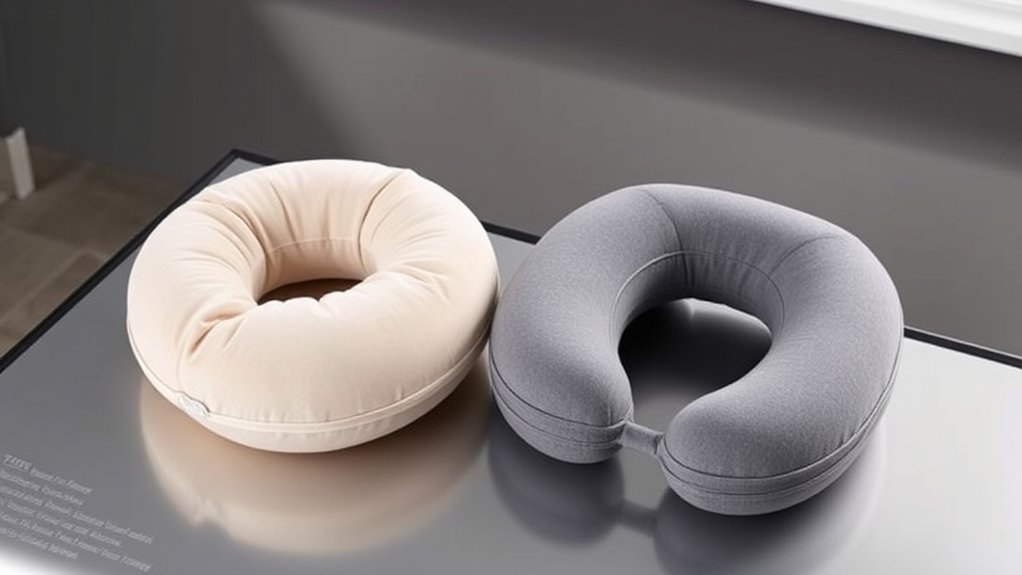
When selecting travel gear for an upcoming journey, understanding the fundamental differences between 360 travel pillows and standard U-shaped pillows is critical for long-term comfort. 360 travel pillows offer all-around support, anchoring your head, jaw, and neck in place across various sleeping positions. Many 360 models include adjustable velcro straps, chin-support toggles, and raised side walls that cater to side sleepers and upright seated travelers.
Conversely, traditional U-shaped pillows focus primarily on basic lateral neck support and partial cervical spine alignment. Because they feature an open front gap, U-shaped pillows frequently allow your head to drop forward as your muscles relax during sleep, creating acute strain on your neck flexors.
Warning: Sleeping with severe forward head flexion (head slumping forward) places up to 50–60 pounds of mechanical force on your cervical spine, leading to muscle spasms, headaches, and spinal nerve compression during long-haul flights.
Comprehensive Comparison: 360 Pillow vs. U-Shaped Pillow
To evaluate these two travel pillow categories effectively, consider how key structural and functional parameters compare across real-world travel scenarios:
| Feature / Metric | 360 Travel Pillow | Standard U-Shaped Pillow |
|---|---|---|
| Support Radius | Full 360° (Chin, jawline, sides, and neck base) | 180°–270° (Rear and sides of neck only) |
| Forward Head Protection | High (Interlocking or overlapping chin support) | Low (Open front gap allows head slumping) |
| Fit Adjustability | High (Customizable straps, toggles, or wraps) | Low (Fixed arc shape and uniform thickness) |
| Ideal Flight Seat | Middle or aisle seat in full upright position | Window seat or deep-recline seats |
| Storage & Packability | Compresses into carrying pouch (50% reduction) | Bulky unless inflatable; hangs off luggage |
Key Design Differences Between 360 and U-Shaped Pillows
When analyzing 360 travel pillows alongside classic U-shaped pillows, clear distinctions emerge in shape engineering, mechanical support, and overall packing efficiency.
Shape and Structure Differences
Modern travel pillows differ dramatically in geometry. 360 travel pillows utilize ergonomic contouring with high side walls and overlapping front supports. Key structural features include:
- Design Flexibility: Multi-directional support stabilizes the head regardless of movement or sudden vehicle shifts.
- Ergonomic Elevation: High side lobes bridge the gap between your shoulder and head, keeping your head upright when leaning sideways.
- Advanced Core Materials: Dense viscoelastic memory foam responds to body warmth to contour around your neck features.
- Versatile Reclining: Performs reliably in standard 90-degree upright seats where leaning back isn’t an option.
Support Mechanism Variations
Understanding support biomechanics highlights why travel pillow shapes matter. According to ergonomic studies from the National Institutes of Health (NCBI), maintaining neutral cervical lordosis reduces pressure on intervertebral discs during prolonged sitting. 360 travel pillows feature adjustable straps or wrap mechanisms that cradle the jawline, keeping the head upright and maintaining neutral spinal positioning. In contrast, rigid U-shaped pillows lack anterior support, forcing the chin toward the chest when muscles relax.
Pro Tip: When fitting a 360 travel pillow, adjust the chin enclosure snug enough to support your lower jaw without putting compression on your trachea. This prevents head-slump while ensuring easy breathing throughout your flight.
Portability and Storage Options
How a pillow fits into your carry-on allowance is essential when evaluating travel gear according to TSA baggage policies. Consider these packing mechanics:
- Compression Power: Most memory foam 360 pillows can be rolled down into a compact travel case, shrinking to half their size.
- Integrated Luggage Straps: Built-in snap straps allow seamless attachment to backpack handles or trolley bags.
- Inflatable Cores: Ultra-lightweight 360 inflatable designs flatten completely for minimal carry-on space.
- Cover Longevity: Removable outer covers protect the inner core from dirt and germs during transit.
Which Pillow Offers Better Comfort and Support?
In overall comfort ratings, 360 travel pillows consistently outperform traditional designs by adapting to real-world resting positions without letting your head drift out of alignment.
360-Degree Support Benefits
- All-Around Stabilization: Rest comfortably toward the front, side, or back without risking sudden awakenings from head-bobbing.
- Customizable Sizing: Adjustable tension closures accommodate various neck lengths and collar sizes.
- Pressure Distribution: Molded memory foam spreads support evenly to avoid painful pressure points behind the ears.
U-Shape Comfort Limitations
Despite their popularity, traditional U-shaped pillows possess structural limitations:
- Inadequate Forward Support: The open gap at the collarbone allows the head to slump forward freely during sleep.
- Fixed Sizing: Non-adjustable openings often feel too loose for small neck frames or too tight for wider shoulders.
- Luggage Bulk: Non-compressible fiber or microbead U-pillows consume substantial luggage space.
When to Use 360 Pillows vs. U-Shaped Pillows
Match your pillow selection to your specific travel conditions and sleeping style:
“Select a 360 pillow for long-haul flights and middle seats where upright posture is mandatory. Reserve traditional U-shaped pillows for short trips or window seats where you can lean against a wall.”
- Frequent Position Shifters: 360 pillows accommodate changing positions throughout long travel days.
- Upright Economy Travelers: 360 degree support keeps your head stable even when seats don’t recline.
- Short Getaways & Lounging: U-shaped pillows offer simple, lightweight support for quick train rides or domestic flights.
Choosing the Right Travel Pillow: A Quick Guide
To choose the best travel pillow for your needs, consider these decision factors:
- Sleeping Angle: If you fall asleep leaning forward or sideways, choose a 360 pillow with chin support.
- Flight Duration: For journeys over 4 hours, the anatomical support of a 360 pillow helps prevent neck fatigue.
- Storage Space: If carry-on space is limited, look for compressible 360 foam or inflatable options.
How to Maintain Your Travel Pillow for Longevity
Proper maintenance ensures your pillow provides hygienic, reliable support across years of travel:
Note: Never submerge a memory foam core in water or place it in a washing machine. Agitation breaks down the internal cell structure, destroying its supportive qualities.
- Clean the Outer Cover: Unzip and machine-wash the outer cover in cold water using a mild detergent, then air-dry to preserve fabric softness.
- Spot-Clean the Core: Wipe down memory foam cores with a damp cloth and mild soap, ensuring it fully dries away from direct sunlight.
- Store Uncompressed: When storing at home, unroll memory foam pillows out of their compression pouches so the foam retains its shape over time.
Frequently Asked Questions
Are 360 travel pillows machine washable?
Yes, most 360 travel pillows feature a removable, machine-washable outer fabric cover. However, you should never submerge or wash the internal memory foam core in a washing machine, as moisture breaks down foam cells; instead, spot-clean the foam core with a damp cloth.
Can U-shaped pillows be used for home use?
Yes, traditional U-shaped pillows work well at home for supportive reclining on a sofa, sitting upright in bed while reading, or watching television, where full 360-degree forward chin stabilization is not required.
What materials are commonly used in travel pillows?
Travel pillows primarily utilize high-density memory foam for contouring support, micro-beads for lightweight adaptability, or inflatable air cores for maximum packability. Viscoelastic memory foam is widely considered the gold standard for pressure relief and ergonomic support.
How long does a travel pillow typically last?
A high-quality memory foam travel pillow typically lasts 2 to 4 years with regular travel and proper care. Inflatable pillows may last 1 to 2 years before valve or seam wear occurs, while micro-bead pillows tend to lose resilience after 1 to 2 years of heavy compression.
Are there any travel pillows specifically for kids?
Yes, pediatric and child-sized travel pillows are specifically dimensioned to fit shorter neck lengths and narrower shoulders. They prevent over-extension of a child’s neck and often feature soft, hypoallergenic fabrics with child-friendly closures.
Conclusion
Choosing between a 360 travel pillow and a traditional U-shaped pillow comes down to your sleeping habits and typical travel conditions. If you struggle with forward head slumping, neck stiffness, or sleeping in upright economy flight seats, a 360 travel pillow provides the full-perimeter support needed for deep rest. Conversely, for quick domestic trips or semi-reclined lounging where basic lateral support is sufficient, a classic U-shaped pillow remains a light and accessible option. Investing in the right neck support ensures you arrive at your destination well-rested and ready to explore.
Sources
- National Institutes of Health (NCBI) — Research on cervical spine ergonomics and forward head posture mechanics.
- Transportation Security Administration (TSA) — Carry-on luggage rules and travel pillow screening guidelines.
- Spine-Health Ergonomics — Cervical spine alignment standards and preventing neck strain during extended sitting.
