
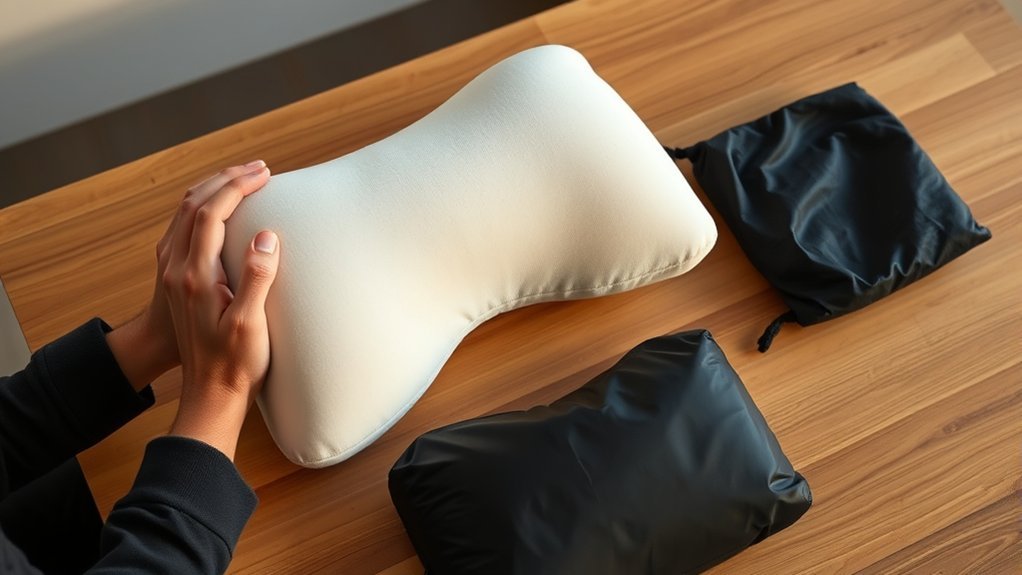
Last Updated on September 10, 2026 by Daniel Globe
You can compress many memory foam travel pillows for a trip, but the correct method depends on the pillow’s construction and care instructions. Gentle rolling in the supplied travel case is usually safer than forcing the pillow flat. Before packing, make sure the pillow is clean, completely dry, and approved for compression by its manufacturer.
Quick Answer
Most memory foam travel pillows can be compressed for a trip, but the safest method is to follow the care label and roll the pillow gently into its own case. Use a vacuum bag only when the manufacturer allows it. Unpack the pillow after arrival and store it fully expanded between trips.
Key Takeaways
- Check the care label before rolling, folding, or vacuum-sealing the pillow.
- Use the manufacturer’s compression pouch or travel case when one is provided.
- Compress the pillow only for travel, not for routine long-term storage.
- Never pack damp foam or force cold, stiff foam into a tight fold.
- Unpack the pillow after arrival and give it time to recover before use.
At a Glance
| Time Required | About 5 to 10 minutes to pack, plus several hours or overnight for recovery after unpacking |
| Difficulty | Easy |
| Tools Needed | Manufacturer-approved travel case, compression pouch, or soft straps; an approved vacuum bag is optional |
| Cost | Usually no added cost when the pillow includes a travel case |
Disclosure: As an Amazon Associate I earn from qualifying purchases. Some links on this page are affiliate links, at no extra cost to you.
How to Compress Your Memory Foam Travel Pillow for Travel
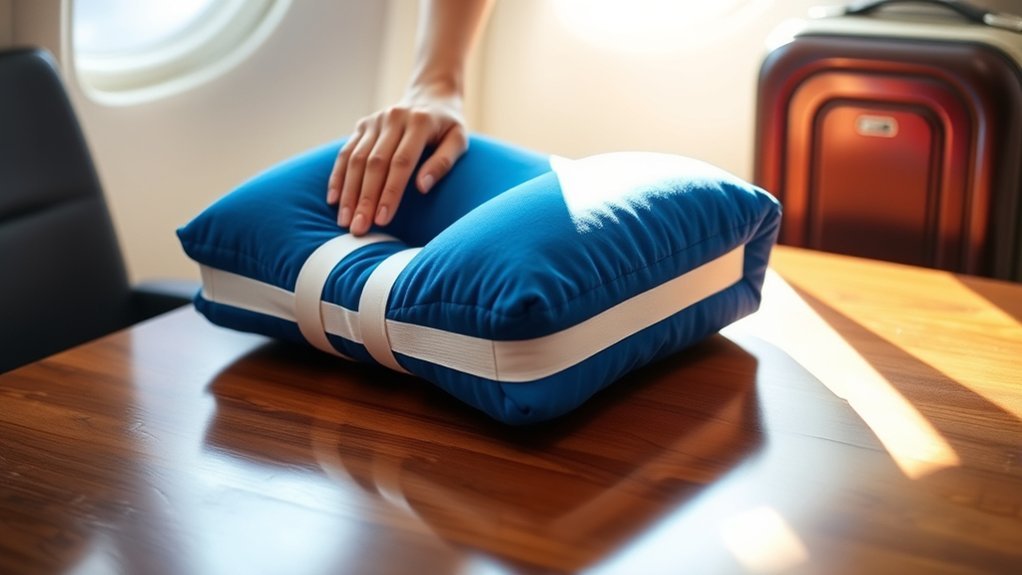
The safest packing method is usually to roll the pillow gradually and place it in the case supplied by the manufacturer. Do not assume that every foam pillow can be folded, rolled, or vacuum-sealed in the same way.
- Read the care label. Look for instructions about compression, folding, washing, heat, and storage. Check the manufacturer’s website if the label is unclear.
- Identify the pillow material. Solid memory foam, shredded foam, latex cores, gel grids, and foam-and-fiber hybrids may have different limits.
- Remove and clean the cover. Wash the removable cover only as directed, then let it dry completely.
- Inspect the foam. Do not compress foam that is damp, cracked, crumbling, unusually stiff, or permanently misshapen.
- Roll from one end. Press gently as you roll so air leaves the foam gradually. Avoid sharp folds, twisting, kneeling on the pillow, or pulling hard on the cover.
- Secure the roll. Place it in its travel case or use wide, soft straps. Do not use thin cords that can cut into the foam.
- Protect it in your luggage. Keep it away from sharp items, leaking toiletries, and heavy objects that could create deep creases.
Warning: Do not vacuum-seal a memory foam pillow unless its care instructions permit that method. Factory compression does not automatically mean a pillow is designed for repeated vacuum sealing at home.
Some travel pillows are specifically designed to be compacted. For example, Cabeau instructs owners of its TNE pillow to roll it into a compact case. The company also warns not to store that model compacted for more than one month. Other manufacturers use different limits, so the instructions for your exact model take priority.
Preparing Your Pillow for Compression
Preparation protects both the foam and the storage case. The pillow should be clean, dry, at room temperature, and free from damage before you compress it.
Remove and Clean the Pillow Cover
Remove the outer cover if it is designed to come off. Follow its washing label, then let it dry fully before putting it back on the foam. A damp cover can trap moisture against the pillow during travel.
Do not machine-wash the foam core unless the manufacturer specifically allows it. Many solid memory foam inserts should only be spot-cleaned or wiped lightly. For example, Tempur-Pedic says not to clean TEMPUR material with liquid, while Cabeau advises owners of certain models to wipe the insert with a damp cloth and let it air-dry.
Air Out the Pillow
After a trip or cleaning, place the pillow in a well-ventilated indoor area until it is completely dry and any trapped odor has faded. There is no universal requirement to air every pillow for exactly 24 hours. Drying time depends on the material, humidity, and whether the foam was spot-cleaned.
| Preparation Check | Why It Matters |
|---|---|
| Read the care label | Confirms whether rolling, folding, or vacuum compression is allowed |
| Dry the cover and foam fully | Reduces the risk of trapped moisture and odors |
| Bring cold foam to room temperature | Cold foam may be unusually stiff and easier to damage if forced |
| Check for cracks or crumbling | Damaged foam may worsen when tightly rolled |
| Empty nearby luggage pockets | Prevents keys, chargers, and other hard items from pressing into the pillow |
Best Practices for Compressing Your Pillow Safely
- Use gradual pressure. Roll slowly instead of crushing the pillow in one movement.
- Avoid sharp folds. A tight crease places more stress on one narrow section of foam.
- Use wide restraints. A broad strap, case, or pouch spreads pressure more evenly than string or thin elastic.
- Compress only when needed. Keep the pillow compact during transport, then remove it from the case after arrival.
- Keep it dry. Do not pack a damp pillow, even for a short flight or drive.
- Avoid temperature extremes. Do not leave the pillow in a hot vehicle or exposed to direct heat.
- Store it expanded at home. Between trips, place it in a clean, dry, ventilated location in its natural shape.
Pro Tip: Practice rolling the pillow at home before your trip. You can confirm that it fits the case and see how quickly it returns to shape without dealing with the problem at the airport or hotel.
The safest compression method is the one approved for your exact pillow, not necessarily the method that makes it smallest.
How to Use Vacuum Seal Bags
A vacuum bag can reduce bulk, but it should not be the default choice for every memory foam pillow. Use one only when the care label or manufacturer says the pillow can be vacuum-compressed.
- Confirm that vacuum compression is permitted for the exact model.
- Make sure the pillow and cover are completely dry.
- Place the pillow in a clean bag without forcing it through a narrow opening.
- Close the seal and remove air gradually.
- Stop if the foam develops a severe crease, the cover pulls at its seams, or the pillow becomes hard and uneven.
- Protect the valve and bag from punctures while packing.
- Open the bag after reaching your destination rather than leaving the pillow sealed for routine storage.
Note: A regular plastic bag can keep a dry pillow away from dirt or spills, but it may not compress the pillow effectively. Do not use an airtight plastic bag for long-term storage.
Alternative Methods for Compressing Pillows
Rolling is usually the simplest option, but the best method depends on the product. Compare each method before deciding how to pack your pillow.
| Method | Best Use | Main Caution |
|---|---|---|
| Gentle rolling | Compressible memory foam travel pillows | Do not create a sharp fold or twist the foam |
| Manufacturer travel case | Pillows sold with a fitted compression pouch | Use the case for transport, not indefinite storage |
| Vacuum bag | Models specifically approved for vacuum compression | Strong or extended compression may affect recovery |
| Towel wrapping | Protecting a dry pillow when no case is available | Provides little compression and must not be used on damp foam |
Rolling Method Advantages
Rolling spreads pressure across a larger area and avoids the hard center crease created by folding a pillow in half. Start at one end and roll inward while applying light, even pressure. Place the roll in the pillow’s own case or secure it with a wide strap.
Some models are designed for this method. The TEMPUR-Cloud pillow, for example, is advertised as rollable for travel. Tempur-Pedic still warns against keeping its foam tightly compressed for an extended period.
Compression Bag Effectiveness
A fitted compression case can make a travel pillow much easier to attach to luggage or place inside a carry-on. It also protects the cover from dirt and abrasion. A case supplied by the pillow manufacturer is preferable because its size and closure system were designed for that product.
Do not assume that the tightest possible compression is the best result. Stop when the pillow fits securely. Excess pressure provides little benefit if it leaves the foam sharply creased or strains the cover and zipper.
Towel Wrapping Technique
A clean towel can protect a dry pillow when you do not have a travel case, but it is not an effective vacuum-compression substitute. Roll the pillow gently, wrap the towel around it, and secure the bundle with broad elastic straps.
- Use only a clean, completely dry towel.
- Do not wrap a damp pillow in an attempt to dry it during travel.
- Avoid narrow rubber bands that can leave deep pressure lines.
- Remove the towel and unroll the pillow after reaching your destination.
Storing Your Compressed Pillow Effectively
Compression cases are mainly for transportation. Once the trip is over, remove the pillow, let it return to its natural shape, and store it uncompressed in a clean, dry, ventilated area.
Cabeau’s storage guidance recommends keeping memory foam neck pillows expanded for long-term storage. Purple also instructs owners of its Harmony Anywhere pillow to store the inner core uncompressed in a cool, dry location and warns against leaving the pillow compressed for extended periods.
- Use a clean pillowcase or breathable fabric bag for home storage.
- Keep the pillow away from damp basements, leaking pipes, and humid bathrooms.
- Do not place heavy boxes or luggage on top of it.
- Avoid direct sunlight, heaters, and hot vehicles.
- Check the pillow before the next trip for odors, cracks, crumbling foam, or loss of support.
Reviving Your Pillow After Compression
Unpack the pillow as soon as practical after reaching your destination. Place it on a clean, flat surface at normal room temperature and let the foam expand without weight on top of it.
- Remove the pillow from its case or compression bag.
- Unroll it slowly instead of pulling it flat.
- Gently press and release different areas to encourage airflow.
- Let it recover for several hours or overnight if needed.
- Wash the removable cover separately if it picked up dirt during travel.
- Do not use high heat, a hair dryer, or a clothes dryer on the foam unless the care label specifically permits it.
| What You Notice | What to Do |
|---|---|
| Pillow is slow to expand | Leave it flat at room temperature for several more hours |
| Foam feels cold and unusually hard | Let it warm naturally before pressing or unfolding it further |
| Minor temporary crease | Lay the pillow flat and gently massage the area |
| Stale travel odor | Air the pillow indoors and clean the cover according to its label |
| Cracks, crumbling, or permanent loss of support | Stop compressing it and contact the manufacturer about care or warranty options |
Warning: Do not force a cold, stiff foam pillow open. Tempur-Pedic notes that very cold TEMPUR material can become firm and may crack or split if it is forced while folded. Let cold foam warm naturally first.
Frequently Asked Questions
Can I compress my pillow if it is still damp?
No. Let the cover and foam dry completely before compression. Packing damp foam can trap moisture and cause odors, staining, or material damage.
How long can I keep a memory foam pillow compressed?
There is no universal limit. Follow the instructions for your exact model. Keep it compressed only as long as needed for travel, unpack it after arrival, and store it expanded between trips. Some manufacturers publish model-specific limits.
Will compression damage the pillow over time?
Occasional compression may be acceptable for pillows designed for travel. Repeated, excessive, or extended compression can reduce recovery, strain seams, or leave permanent deformation. Stop using the method if the pillow no longer returns to its original shape and support.
Can I use a regular plastic bag instead of a vacuum bag?
A clean plastic bag can protect a dry pillow from dirt or spills during a short trip, but it may not reduce the pillow’s size. Do not use an airtight plastic bag for long-term storage because the pillow should be kept expanded in a dry, ventilated location.
Are there pillows that should not be compressed?
Yes. Some molded foam, latex, gel-grid, cooling-layer, and hybrid pillows have special restrictions. Check the exact model rather than assuming that every product from one brand follows the same rule.
Is rolling better than folding a memory foam travel pillow?
Rolling is usually gentler because it spreads pressure over more of the pillow and avoids one sharp center crease. However, use the method shown by the manufacturer when the pillow includes a fitted case or special folding system.
What should I do if the pillow does not regain its shape?
Place it flat at room temperature and allow more recovery time. Gently press and release the compressed areas. If the pillow remains creased, cracked, lumpy, or unsupportive after an extended recovery period, contact the manufacturer and stop compressing it.
Conclusion
To compress a memory foam travel pillow safely, begin with the care label, make sure the pillow is completely dry, and use gentle, even pressure. A manufacturer-approved travel case is usually the safest option. Use a vacuum bag only when the manufacturer permits it, and avoid leaving the pillow compressed longer than necessary.
After your trip, unroll the pillow, let it recover at room temperature, and store it expanded in a clean, dry location. These steps save luggage space without placing unnecessary stress on the foam, cover, or seams.
Sources
- Cabeau TNE Neck Pillow Care and Packing Instructions — rolling method, travel-case use, cleaning, and compact-storage limit
- Cabeau Neck Pillow Storage Guide — short-term travel compression and expanded long-term storage
- Tempur-Pedic TEMPUR-Cloud Pillow — rollable travel design, foam care, and extended-compression warning
- Purple Harmony Anywhere Pillow Care — travel compression, uncompressed storage, heat, and prolonged-compression cautions
- CertiPUR-US Foam Care Guidance — moisture and memory foam cleaning precautions
- Tempur-Pedic Cold Material Guidance — handling temperature-sensitive foam after cold storage
