

Last Updated on July 25, 2026 by Caleb Warren
Unpacking a brand-new memory foam travel pillow often comes with an unexpected surprise: a distinct, sharp chemical odor. This smell is caused by off-gassing, a natural process where leftover volatile organic compounds (VOCs) from manufacturing escape into the air. While the scent usually fades within a few days, learning how to speed up gas dispersion safely ensures your trip starts with comfort rather than a headache.
Quick Answer
Memory foam travel pillow smell is caused by off-gassing VOCs from production. To eliminate the odor fast, remove the pillowcase and air the foam core in a well-ventilated room or shaded outdoors for 1 to 3 days. Dusting the foam with baking soda or placing it near an active fan speeds up dissipation significantly.
Key Takeaways
- Off-gassing is temporary: Most chemical odors dissipate within 24 to 72 hours under good ventilation, though lower-grade foams can take up to several weeks.
- Never submerge foam: Washing the solid memory foam core in water ruins its support structure and causes mold; only wash the removable cover.
- Use dry deodorizers: Baking soda and activated charcoal absorb VOC odors without damaging delicate polyurethane cells.
- Look for certifications: Choosing pillows certified by CertiPUR-US, OEKO-TEX Standard 100, or Greenguard Gold drastically reduces chemical exposure.
At a Glance: Deodorizing Your Travel Pillow
| Time Required | 24 to 72 hours (varies by foam quality) |
| Difficulty | Easy (Passive / Low Effort) |
| Tools Needed | Baking soda, vacuum cleaner, oscillating fan, activated charcoal bags |
| Cost | $0 to $10 |
Disclosure: As an Amazon Associate I earn from qualifying purchases. Some links on this page are affiliate links, at no extra cost to you.
What Is Off-Gassing and How Can You Mitigate It?
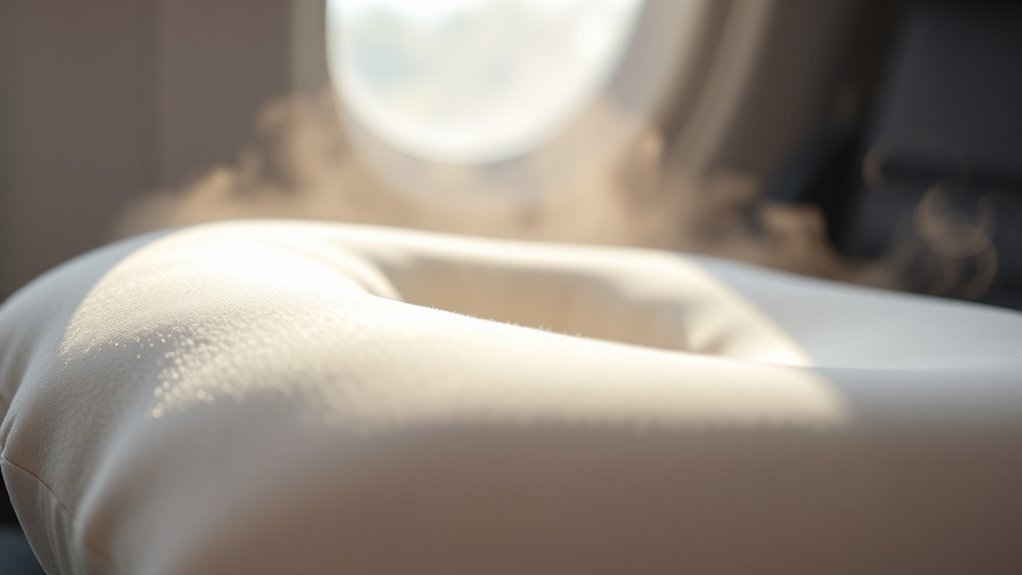
Off-gassing refers to the release of trapped gases and volatile organic compounds (VOCs) from newly manufactured foam products. Memory foam is made from viscoelastic polyurethane, created through chemical synthesis using polyols, isocyanates, and blowing agents. When the pillow is poured, molded, and immediately compressed into airtight plastic travel packaging, these leftover chemical vapors have nowhere to go.
The moment you unseal the plastic wrapper, the trapped VOCs escape into the surrounding air, creating a strong, factory-fresh odor. Practicing proactive off-gassing mitigation allows these gases to disperse safely before you place the pillow near your nose and throat during long flights.
To reduce off-gassing smells effectively:
- Strip off cover fabrics immediately: Unzip and remove the fabric casing to allow direct airflow across the open-cell structure of the foam core.
- Provide active ventilation: Place the foam core in a dry room with an open window or directly in front of a running electric fan.
- Utilize dry odor absorbers: Lightly sprinkle baking soda across the foam surfaces to trap lingering odor molecules.
How Long Will Your Travel Pillow Smell?
The duration of memory foam off-gassing depends primarily on foam density, manufacturing techniques, and storage conditions. Higher-quality, open-cell memory foam permits air to circulate freely through its matrix, allowing odor to dissipate within a few hours to 3 days. Conversely, budget travel pillows made with dense, low-grade polyurethane or heavy chemical flame retardants can retain scents for two to four weeks.
High-density viscoelastic foam packed in airtight plastic trap volatile compounds. Unsealing the pillow in a warm, ventilated room accelerates gas release up to 300% faster than in cold, enclosed spaces.
Environmental factors like room temperature, airflow velocity, and ambient humidity play massive roles in gas breakdown:
- Temperature: Warmer room temperatures encourage chemical molecules to volatilize and leave the foam quickly.
- Airflow: Moving air carries away released gas molecules, maintaining a concentration gradient that draws remaining VOCs out of the pillow core.
- Humidity: High humidity traps moisture inside foam pores, slowing down odor release and risking damp mildew retention.
Health Issues Linked to Off-Gassing From Memory Foam
For most healthy adults, off-gassing from a certified travel pillow represents a minor nuisance rather than a severe toxic danger. However, close physical proximity to un-aired memory foam can trigger short-term symptoms due to inhaled chemical vapors like formaldehyde, toluene, or benzene compounds commonly found in raw polyurethanes.
Warning: Individuals with asthma, chronic obstructive pulmonary disease (COPD), multiple chemical sensitivity (MCS), or severe allergies should never use a brand-new memory foam pillow without airing it out completely for at least 72 hours.
According to research published by the U.S. Environmental Protection Agency (EPA), exposure to elevated VOC levels can cause:
- Upper respiratory irritation, coughing, and shortness of breath
- Sinus congestion, watery eyes, and throat dryness
- Frequent headaches, dizziness, or nausea
- Contact dermatitis or skin redness upon direct contact
Vulnerable populations, including young infants, pregnant individuals, elderly travelers, and pets, possess higher respiratory rates and increased chemical sensitivity. Always air out new bedding products thoroughly away from living and sleeping quarters.
Ways to Reduce Off-Gassing Smells
Eliminating off-gassing odors quickly requires a combination of physical ventilation, absorbents, and atmospheric controls. The table below outlines proven methods to neutralize chemical smells before your trip:
| Technique | Description | Duration |
|---|---|---|
| Active Airing | Place bare foam core near an open window or behind an oscillating fan. | 1–3 days |
| Baking Soda Treatment | Lightly coat foam surfaces with baking soda, wait, then vacuum thoroughly. | 6–12 hours |
| Filtered Sunlight | Expose foam to indirect sunlight and fresh breeze outdoors. | 2–4 hours max |
| Activated Charcoal | Seal pillow in a breathable cotton bag alongside activated charcoal sachets. | 24 hours |
Pro Tip: Never leave memory foam in direct, harsh sunlight for extended periods. Ultraviolet (UV) rays degrade polyurethane polymers, causing the foam to discolor, harden, and break down prematurely.
When cleaning travel pillows, keep a strict separation between the foam core and outer fabric casing:
Caution: Do not submerge solid memory foam cores in water or place them in a washing machine. Solid foam acts like a dense sponge, trapping water inside internal cells that take weeks to dry, inviting internal mold growth and permanently destroying ergonomic elasticity.
Safe Alternatives to Reduce Off-Gassing in Travel Pillows
If you are sensitive to chemical smells or want to bypass off-gassing entirely, choose travel pillows constructed from low-emission, non-toxic materials backed by verified third-party safety credentials.
Look for recognized independent foam and textile certifications, such as:
- CertiPUR-US®: Guarantees foam is manufactured without heavy metals, ozone depleters, PBDE flame retardants, or formaldehyde, emitting low VOC levels (less than 0.5 parts per million).
- OEKO-TEX® Standard 100: Tests textile covers and foam components for hundreds of harmful substances to verify human-ecological safety according to OEKO-TEX international criteria.
- Greenguard Gold: Ensures products meet rigorous chemical emission limits designed specifically for sensitive environments like healthcare facilities and schools.
Naturally low-emission travel pillow alternatives include:
- Natural Dunlop or Talalay Latex: Derived from rubber tree sap, natural latex offers contoured neck support with minimal organic aroma that clears rapidly.
- Organic Buckwheat Hulls: Plant-based hull fillings provide firm, breathable, zero-VOC support with natural air ventilation.
- Inflatable Travel Pillows: Compact TPU or PVC air pillows eliminate foam off-gassing completely, though casing fabric should still be washed before use.
- Plant-Based Memory Foam: Replaces a percentage of petroleum polyols with natural soybean or castor oil ingredients, reducing overall chemical fumes.
Frequently Asked Questions
Can Off-Gassing Affect Pets or Children?
Yes, pets and children are more sensitive to off-gassing VOCs due to smaller lung capacities and faster respiratory rates. Always air out new memory foam items in a separate, closed room or outdoor porch away from children and pets until the chemical smell is completely gone.
Is Off-Gassing More Intense in Warmer Climates?
Yes, warmer ambient temperatures cause volatile organic compounds to evaporate and release faster from polyurethane foam matrices. While heat speeds up the overall off-gassing process, it also makes initial odor concentration more intense, making active room ventilation essential.
Do Different Brands Have Varying Levels of Off-Gassing?
Yes, off-gassing varies significantly by brand and foam quality. Premium brands utilizing open-cell technology, plant-based polyols, and pre-aired vacuum chambers emit far fewer odors than uncertified, low-cost memory foam compressed immediately after chemical molding.
Can I Wash My Travel Pillow to Eliminate Odors?
You can safely wash the removable fabric cover in a washing machine using mild detergent. However, you should never submerge or wash the solid memory foam core itself in water. To eliminate odors from the foam, use dry baking soda treatments, active air fan ventilation, or activated charcoal sachets.
What Materials Are Least Likely to Off-Gas?
Natural materials like 100% natural latex, organic buckwheat hulls, wool, and pure organic cotton are least likely to off-gas. Inflatable travel pillows made from medical-grade TPU also eliminate chemical foam emissions entirely.
Conclusion
Understanding memory foam off-gassing helps you take proactive, simple steps to safeguard your comfort and health. While the initial chemical smell of a new travel pillow can be unpleasant, it is almost always a temporary inconvenience that resolves with proper airing and ventilation. By removing the cover, placing the foam in front of a fan, or applying a dry baking soda treatment, you can dissipate lingering VOCs in a day or two. Investing in certified low-emission materials like CertiPUR-US or natural latex ensures your travel experience stays fresh, supportive, and completely odor-free.
Sources
- U.S. Environmental Protection Agency (EPA) — Technical overview of volatile organic compounds (VOCs) and indoor health impacts
- CertiPUR-US Standard Guidelines — Testing standards for low-VOC emissions in polyurethane foam
- OEKO-TEX® Standard 100 — International safety verification for human-ecological textile criteria
- Sleep Foundation — Comprehensive guide to memory foam off-gassing and bedding safety
