
Last Updated on July 28, 2026 by Daniel Globe
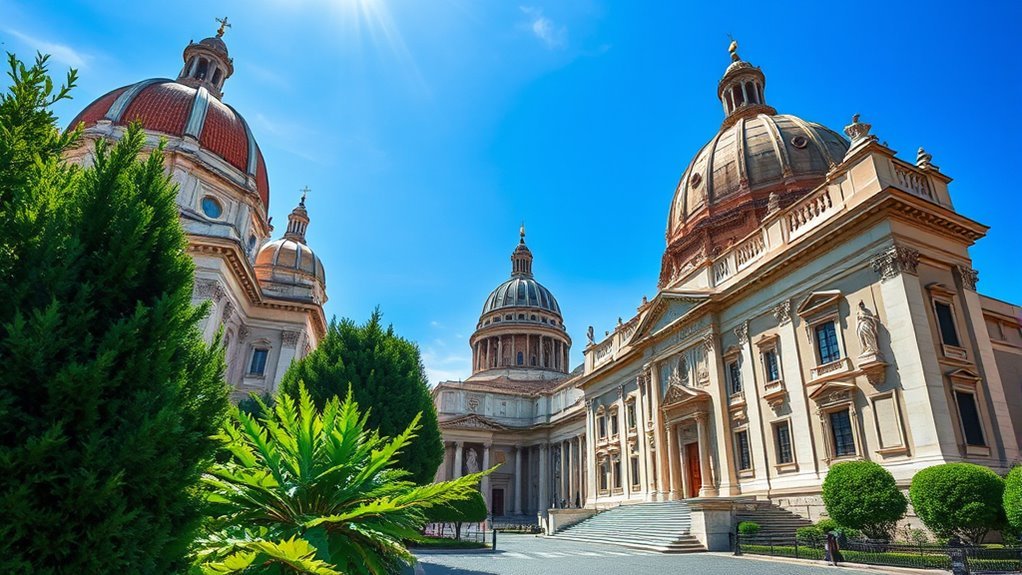
Rome’s churches are more than places of worship. They preserve ancient Roman structures, early Christian mosaics, Renaissance chapels, Baroque sculpture, underground temples, and centuries of local tradition. Some are famous landmarks, while others remain surprisingly peaceful. This guide covers the most beautiful churches in Rome and explains what makes each one worth visiting.
Quick Answer
Rome’s most beautiful churches include Santa Maria Maggiore for early mosaics, San Giovanni in Laterano for papal history, Santa Maria del Popolo for Caravaggio, Santa Maria della Vittoria for Bernini, San Clemente for underground archaeology, and the Pantheon for ancient Roman engineering. Most church sanctuaries are free, although several museums, crypts, and excavations require tickets.
Key Takeaways
- For early Christian art, prioritize Santa Maria Maggiore, Santa Maria in Trastevere, Santa Sabina, and Santa Prassede.
- For Baroque masterpieces, visit Santa Maria della Vittoria, San Carlo alle Quattro Fontane, and Sant’Ignazio.
- For Caravaggio, choose Santa Maria del Popolo and add San Luigi dei Francesi.
- The Pantheon now has paid admission, while crypts, cloisters, museums, and archaeological areas may charge separately.
- Opening hours can change for Masses, funerals, weddings, feast days, and restoration work, so verify them shortly before visiting.
Disclosure: As an Amazon Associate I earn from qualifying purchases. Some links on this page are affiliate links, at no extra cost to you.
Choose a Church by Interest
| Your Main Interest | Best Choices |
| Ancient architecture | Pantheon, San Clemente, and Santa Sabina |
| Mosaics | Santa Maria Maggiore, Santa Maria in Trastevere, Santa Prassede, and Santa Cecilia |
| Bernini | Santa Maria della Vittoria, Santa Maria del Popolo, and San Lorenzo in Lucina |
| Caravaggio | Santa Maria del Popolo and San Luigi dei Francesi |
| Underground history | San Clemente and Santa Cecilia in Trastevere |
| Quiet atmosphere | Santa Sabina, San Pietro in Montorio, and San Lorenzo in Lucina |
What to Know Before Visiting Churches in Rome
Most active churches allow visitors to enter the main sanctuary without paying. However, that does not mean every part of the complex is free. Cloisters, museums, crypts, archaeological excavations, audio guides, and special chapels may have separate tickets. The Pantheon is also a ticketed state monument as well as an active basilica.
Warning: Do not tour a church while a Mass, funeral, wedding, or private service is taking place. Remain quiet, avoid walking near the altar, and follow any instructions from church staff.
Wear clothing suited to an active place of worship. Shoulders should be covered, and shorts or skirts should not be excessively short. Individual churches may refuse entry to visitors wearing transparent, very low-cut, or otherwise unsuitable clothing.
Photography rules vary. Many churches permit quiet handheld photography without flash, while some chapels, crypts, excavations, and temporary displays prohibit it. Tripods and commercial photography usually require permission.
Accessibility also varies. Large basilicas may have ramps or step-free entrances, but historic chapels, cloisters, crypts, and underground levels can contain stairs, uneven floors, and narrow passages. Check the official visitor page when step-free access is essential.
Pro Tip: Allow about 30–45 minutes for a normal church visit and 60–90 minutes for the Pantheon, San Clemente’s excavations, or a church with a museum, crypt, or major art collection.
Suggested Church Routes
Ancient and Early Christian Route
Begin at San Giovanni in Laterano, continue to Santa Croce in Gerusalemme, then visit San Clemente and finish at Santa Sabina on the Aventine. This route combines papal history, relic traditions, underground Roman structures, and early Christian architecture.
Baroque and Historic Center Route
Start at San Carlo alle Quattro Fontane, walk to Santa Maria della Vittoria, continue to Sant’Ignazio, and finish at the Pantheon. Add Santa Maria del Popolo when you have enough time for a longer walk or short transit ride.
Trastevere and Janiculum Route
Visit Santa Cecilia in Trastevere, continue to Santa Maria in Trastevere, and climb toward San Pietro in Montorio. The route combines medieval art, neighborhood atmosphere, Renaissance architecture, and views from the Janiculum area.
Santa Maria Maggiore: Early Mosaics and Papal Grandeur
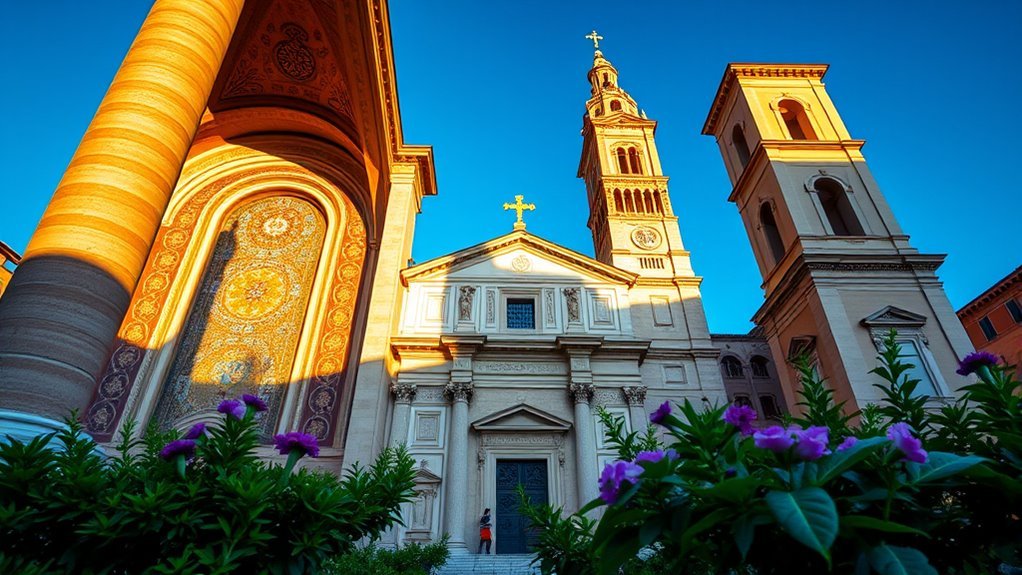
Santa Maria Maggiore is one of Rome’s four papal basilicas and one of the city’s most important early Christian monuments. The present basilica was created under Pope Sixtus III in the 5th century, shortly after the Council of Ephesus affirmed Mary’s title as Mother of God.
The oldest artistic treasures are the 5th-century mosaics along the nave and triumphal arch. Their biblical scenes are among the most important surviving mosaic cycles from late-antique Rome. The apse belongs to a different period: Jacopo Torriti created its magnificent Coronation of the Virgin mosaic at the end of the 13th century.
Look up to see the gilded coffered ceiling from the period of Pope Alexander VI. According to a long-standing tradition, some of its gold came from the first shipments brought to Spain from the Americas. This tradition concerns the ceiling, not the medieval apse mosaic.
The basilica also contains the revered Salus Populi Romani icon and the Holy Crib reliquary, which holds pieces of wood traditionally associated with the manger of the Nativity. These objects are important expressions of Catholic devotion, regardless of questions about their historical provenance.
San Giovanni in Laterano: The Cathedral of Rome
San Giovanni in Laterano is the cathedral of the Diocese of Rome and the church that contains the pope’s episcopal throne as Bishop of Rome. Its rank is higher than that of every other Catholic church, including St. Peter’s Basilica, although St. Peter’s is larger and more internationally famous.
The first basilica on this site was established under Emperor Constantine in the early 4th century. Fires, earthquakes, rebuilding campaigns, and Baroque renovations changed its appearance, but its religious importance remained constant.
- The monumental nave contains colossal statues of the Twelve Apostles.
- The floor preserves intricate Cosmatesque marble work.
- The apse displays mosaics shaped by medieval work and later restoration.
- The adjoining cloister is one of Rome’s finest examples of Cosmatesque craftsmanship.
- The nearby Holy Stairs and Lateran Baptistery can be visited as separate parts of the wider complex.
The Lateran Obelisk’s ancient granite shaft is 32.18 meters high, making it the tallest standing ancient Egyptian obelisk in the world.
The basilica’s main worship space is normally free to enter. The museum, cloister, excavations, or other parts of the Lateran complex may operate under separate hours and admission arrangements.
Santa Maria in Trastevere: Medieval Mosaics and Neighborhood Life
Santa Maria in Trastevere stands in one of Rome’s liveliest squares. Tradition connects its foundation to Pope Callistus I in the 3rd century, and it is often described as one of the earliest official Christian worship sites in Rome.
The building visitors see today is largely medieval. Its reused ancient columns divide the nave, while the apse glows with mosaics from different periods. The 12th-century apse composition is joined by late-13th-century scenes associated with Pietro Cavallini.
A local religious legend tells of a spring of oil that appeared on the site around the time of Christ’s birth. The story became part of the church’s identity and is represented in its symbolism, but it should be understood as tradition rather than documented history.
The piazza outside is almost as memorable as the interior. Visit in the morning for a quieter experience, then return in the evening to see the square become a social center for Trastevere.
The Pantheon: Rome’s Ancient Temple and Christian Basilica
The Pantheon is both one of ancient Rome’s best-preserved buildings and an active Catholic basilica dedicated to Saint Mary and the Martyrs. Marcus Agrippa founded the original temple between 27 and 25 BC. After fires damaged the earlier structure, Emperor Hadrian rebuilt the present building between approximately AD 118 and 125. It was consecrated as a Christian church in 609.
Architectural Design
The circular rotunda and rectangular portico form one of the most influential architectural compositions in the world. The interior height and the dome’s diameter are both just over 43 meters, allowing an imaginary sphere to fit within the space.
- The unreinforced concrete dome measures about 43.3 meters in diameter.
- The central oculus measures 8.92 meters across.
- The oculus is the interior’s main source of daylight.
- Coffers reduce weight while creating a strong geometric pattern.
- Raphael and members of Italy’s former royal family are buried inside.
Historical Significance
The Pantheon’s conversion into a church helped preserve the structure through the Middle Ages. Its continued use also gave the building layers of pagan Roman, Christian, artistic, and national significance.
The inscription across the portico still names Marcus Agrippa, linking Hadrian’s reconstruction to the earlier monument. Inside, Christian altars and tombs occupy a building whose geometry remains unmistakably Roman.
Ingenious Engineering
Roman builders varied the dome’s concrete aggregate, using heavier materials lower down and lighter volcanic materials toward the crown. The walls and supporting piers distribute the dome’s immense weight, while hidden relieving arches help move structural loads.
Rain enters through the open oculus, but the gently curved floor and drainage holes carry the water away. The changing beam of sunlight creates a different experience throughout the day and year.
Note: As of July 2026, standard Pantheon admission is €7. Normal opening hours are 9:00 AM–7:00 PM, with the last individual entry at 6:30 PM. Religious services, holidays, and special evening openings can change access.
Santa Croce in Gerusalemme: A Pilgrimage Church of Rome
Santa Croce in Gerusalemme stands on part of the ancient Sessorian imperial complex. The property became associated with Helena, the mother of Emperor Constantine, and developed into an important Christian sanctuary.
Historical and Devotional Significance of the Relics
The Chapel of the Relics contains objects venerated as fragments connected with Christ’s Passion, including pieces traditionally identified with the True Cross. These relics have deep devotional importance for pilgrims, although their authenticity belongs to religious tradition rather than demonstrable archaeological proof.
- Relics traditionally associated with the Crucifixion
- A long connection with Helena and Constantinian Rome
- Status as one of Rome’s traditional Seven Pilgrim Churches
- A quiet setting for prayer and reflection
- A museum and archaeological context extending beyond the main sanctuary
Architectural Highlights
The basilica developed through repeated medieval and Baroque rebuilding. Its current 18th-century façade uses curved forms typical of Roman Baroque design. Inside, ancient granite columns remain visible, while the apse contains painted decoration attributed to Antoniazzo Romano and his circle.
The Chapel of Saint Helena contains a mosaic decoration based on an earlier work. The combination of ancient structures, medieval history, Baroque architecture, and devotional objects gives Santa Croce a character unlike Rome’s more conventional art churches.
Santa Maria della Vittoria: Bernini’s Baroque Masterpiece
The small Church of Santa Maria della Vittoria contains one of Gian Lorenzo Bernini’s greatest works: The Ecstasy of Saint Teresa in the Cornaro Chapel.
Created between 1647 and 1652, the sculptural group represents Teresa of Ávila’s account of a mystical vision. Bernini combined white marble, gilded bronze rays, concealed daylight, colored stone, painted architecture, and sculpted spectators to turn the chapel into a theatrical religious scene.
- Natural light enters through a concealed window above the sculpture.
- Gilded rays intensify the appearance of divine illumination.
- Members of the Cornaro family appear in sculpted theater boxes.
- Colored marble frames the central white figures.
- The chapel demonstrates how Baroque artists combined architecture, sculpture, and light.
The church can become crowded because the chapel is small. Visit shortly after opening and avoid scheduled services when possible.
San Lorenzo in Lucina: Ancient Origins and Baroque Art
San Lorenzo in Lucina is one of Rome’s oldest titular churches. It stands in the Campo Marzio area on a site traditionally associated with a Roman woman named Lucina and an early Christian house church.
Architectural Evolution
The church has changed repeatedly since late antiquity. Its medieval portico and Romanesque bell tower contrast with an interior reshaped by later renovations. This mixture is more informative than a single, perfectly preserved style because it shows how Roman churches remained in active use for centuries.
- Early Christian origins
- A medieval portico and bell tower
- Baroque side chapels
- A later coffered nave ceiling
- Ancient materials reused in the structure
Artistic Highlights
Guido Reni’s restrained Crucifixion dominates the high altar. The Fonseca Chapel, designed by Bernini, contains a vivid portrait bust of the Portuguese physician Gabriele Fonseca, shown turning toward the altar in a moment of devotion.
Saint Lawrence and Church Tradition
The basilica is dedicated to Saint Lawrence, one of early Christianity’s most celebrated Roman martyrs. Objects connected with his martyrdom are venerated here according to church tradition. The church’s importance comes from the combination of that devotional history, its ancient foundation, and its major works of art.
Santa Maria del Popolo: Caravaggio, Raphael, and Bernini
Santa Maria del Popolo stands beside Piazza del Popolo, near Rome’s historic northern entrance. A chapel was established here in the Middle Ages, while the church received its Renaissance form during rebuilding in the 15th century.
The Cerasi Chapel contains two Caravaggio masterpieces painted around 1600–1601: The Crucifixion of Saint Peter and The Conversion of Saint Paul. Their dramatic lighting and compressed compositions reward close viewing.
The Chigi Chapel was designed by Raphael for the banker Agostino Chigi. Raphael prepared the chapel’s architecture and mosaic designs, while Bernini later completed and altered parts of the space.
- Two major Caravaggio paintings in the Cerasi Chapel
- Raphael’s design for the Chigi Chapel
- Later sculptural and architectural work by Bernini
- Renaissance frescoes associated with Pinturicchio and his workshop
- A convenient location at Piazza del Popolo
Some chapels can be dim. Coin-operated or timed lighting may be available, so carrying a few euro coins can be useful.
San Carlo alle Quattro Fontane: Borromini’s Compact Baroque Gem
San Carlo alle Quattro Fontane, often called San Carlino, is one of Francesco Borromini’s most inventive buildings. The Trinitarian order commissioned the church and convent in the 17th century, and Borromini worked on the complex during several stages of his career.
Architectural Innovation and Design
The church occupies a very small corner site, yet its interior feels open and rhythmic. Borromini used an oval-based plan, alternating curves, repeated geometric forms, and a patterned dome to create movement without relying on a large footprint.
- A curving façade that appears to move in and out
- An oval interior organized through complex geometry
- A coffered dome filled with crosses, octagons, and hexagons
- Hidden and carefully positioned sources of daylight
- A compact convent and cloister designed as part of the same complex
The Emotional Baroque Experience
Unlike heavily gilded Baroque churches, San Carlo relies largely on white stucco, proportion, shadow, and geometry. The restraint allows visitors to notice how walls, columns, niches, and the dome flow into one another.
Historical Context
Borromini began the project in the late 1630s and returned to it later in life. The undulating façade was among his final major works. The church stands within Rome’s UNESCO-listed historic center, but it should not be described as a separately inscribed World Heritage Site.
The four fountains at the surrounding intersection gave the church its name and make the exterior easy to identify.
Basilica di San Clemente: Layers of History Underground
The Basilica di San Clemente is one of the clearest places to experience Rome’s physical layers of history. The present 12th-century church stands above an earlier Christian basilica, which in turn lies above Roman buildings and a sanctuary connected with the cult of Mithras.
The upper church contains a brilliant apse mosaic centered on the Cross as a tree of life. Its Cosmatesque floor, medieval choir enclosure, and decorated ceiling show how the building continued to evolve after the 12th century.
Below, visitors descend into the earlier basilica, where medieval frescoes survive. A deeper level reveals Roman rooms, flowing water, and a Mithraic worship space. These lower areas require a ticket and include stairs, damp passages, uneven surfaces, and limited accessibility.
Pro Tip: Give San Clemente at least one hour. The underground route is the main reason to visit, and rushing through it removes much of the experience.
Santa Cecilia in Trastevere: Maderno, Cavallini, and Medieval Art
Santa Cecilia in Trastevere is dedicated to Cecilia, the patron saint of music. The basilica has ancient origins, although repeated medieval and Baroque changes shaped the building seen today.
- Stefano Maderno’s marble statue of Saint Cecilia lies beneath the high altar.
- Pietro Cavallini’s late-13th-century Last Judgment survives on the counter-façade.
- Arnolfo di Cambio’s Gothic ciborium rises above the altar.
- A 9th-century apse mosaic depicts Christ with saints and Pope Paschal I.
- Underground rooms preserve remains of Roman domestic and bathing structures.
Maderno created the reclining statue in 1600 after Cecilia’s tomb was opened. The sculpture represents the position in which her body was reportedly found and is one of the most moving works of early Baroque Rome. It is not a work by Bernini.
Access to Cavallini’s fresco and the underground area may follow narrower hours than the main basilica. Check the church’s current schedule before making a special trip for either attraction.
Sant’Ignazio di Loyola: Andrea Pozzo’s Illusionistic Ceiling
Sant’Ignazio di Loyola is one of Rome’s most spectacular examples of illusionistic Baroque painting. The church was built in the 17th century for the Jesuits and dedicated to Ignatius of Loyola.
Andrea Pozzo’s vast nave fresco dissolves the real architecture into an imagined vision of columns, clouds, figures, and open sky. The effect works most convincingly from a marked viewing point on the floor.
The apparent dome over the crossing is also an illusion. It is a large painted canvas rather than a true masonry dome. Pozzo used perspective to create the appearance of a deep architectural structure above the viewer.
- Stand on the marked floor points to see the intended perspective.
- Look at the ceiling from the side to understand how dramatically the illusion distorts.
- Visit earlier in the day for fewer visitors in the central viewing area.
- Remain clear of worshippers and liturgical spaces.
The Rooms of Saint Ignatius are a separate Jesuit site near the Church of the Gesù and should not be confused with an attraction inside Sant’Ignazio.
Santa Sabina: Early Christian Simplicity on the Aventine
Santa Sabina was founded in AD 425 and remains one of Rome’s clearest examples of early Christian basilica design. Its broad nave, rows of ancient columns, high windows, and restrained decoration create a calm interior very different from Rome’s Baroque churches.
The 5th-century wooden entrance doors contain carved biblical scenes. One small panel is widely regarded as one of the earliest surviving monumental representations of the Crucifixion, although the composition is much less graphic than later Christian images.
- A spacious early Christian basilica plan
- Ancient fluted Corinthian columns
- A surviving 5th-century mosaic inscription
- Historic carved wooden doors
- A long association with Saint Dominic and the Dominican Order
The neighboring Orange Garden provides the panoramic city views often associated with a visit to Santa Sabina. Combining the church, garden, and nearby Aventine sites makes an easy and peaceful outing.
Santa Maria della Concezione dei Cappuccini: Art and Mortality
Santa Maria della Concezione dei Cappuccini stands near the beginning of Via Veneto. The church contains important paintings, but most visitors come for the adjoining Capuchin museum and crypt.
The crypt’s chapels contain elaborate arrangements made from the bones of Capuchin friars. Skulls, vertebrae, pelvises, and other bones form arches, floral patterns, clocks, and chandeliers. The displays were created as a memento mori: a reminder that human life is temporary.
The tone is religious rather than theatrical. Visitors should behave respectfully and avoid treating the crypt as a novelty attraction. Museum admission is normally required, and photography rules may be stricter than in the main church.
Note: The crypt can be unsettling for children or visitors who are uncomfortable seeing human remains. Consider this before purchasing admission.
San Pietro in Montorio: Renaissance Art on the Janiculum
San Pietro in Montorio stands on the Janiculum Hill. The present church was rebuilt near the end of the 15th century with support from the Spanish monarchy.
- Bramante’s Tempietto: A small circular Renaissance monument in the adjoining cloister.
- Sebastiano del Piombo: The first chapel on the right contains his Flagellation of Christ.
- Renaissance chapels: Artists and architects connected with the church include Vasari, Ammannati, Daniele da Volterra, and Bernini.
- Religious tradition: The Tempietto marks a site traditionally associated with Saint Peter’s crucifixion.
- Janiculum setting: Nearby terraces offer broad views across Rome.
Bramante’s Tempietto was built in the early 16th century as a compact circular martyrium. Its ring of columns, dome, and carefully balanced proportions made it one of the defining monuments of High Renaissance architecture.
The Tempietto may follow different opening arrangements from the church because it forms part of the Royal Academy of Spain complex. Verify access before climbing the Janiculum specifically to see it.
More Beautiful Churches Worth Adding
St. Paul Outside the Walls
The Papal Basilica of St. Paul Outside the Walls is one of Rome’s four papal basilicas. Much of the building was reconstructed after a devastating fire in 1823, but the vast five-aisled interior, papal portrait medallions, medieval ciborium, and Cosmatesque cloister make it essential for visitors interested in monumental church architecture.
Santa Maria sopra Minerva
Santa Maria sopra Minerva, close to the Pantheon, has one of Rome’s rare Gothic church interiors. Highlights include Michelangelo’s Christ the Redeemer, frescoes by Filippino Lippi, and the tomb of Saint Catherine of Siena.
San Luigi dei Francesi
San Luigi dei Francesi is famous for Caravaggio’s three-painting cycle on the life of Saint Matthew. Its location between Piazza Navona and the Pantheon makes it one of the easiest major art churches to add to a central Rome walk.
Santa Prassede
The Basilica of Santa Prassede is only a short walk from Santa Maria Maggiore. Its 9th-century mosaics, especially those in the Chapel of Saint Zeno, are among Rome’s finest surviving examples of Byzantine-influenced medieval art.
Frequently Asked Questions
What are the opening hours for churches in Rome?
There is no universal schedule. Large basilicas may open from early morning until early evening, while smaller churches often close for several hours around lunchtime. Hours may also change for Masses, funerals, weddings, feast days, and restoration work. Check the official church or Turismo Roma page shortly before visiting.
Do Rome’s churches charge an entrance fee?
Most active church sanctuaries are free. However, museums, cloisters, crypts, archaeological excavations, audio guides, and special chapels may require payment. As of July 2026, standard admission to the Pantheon is €7, although exemptions and free-admission periods apply.
Are guided tours available?
Yes. Official audio guides, church tours, private licensed guides, and archaeological tours are available at many major sites. Book through an official church, museum, or recognized ticket platform when a tour includes restricted areas or paid excavations.
What should visitors wear?
Wear modest clothing suited to an active place of worship. Cover your shoulders and avoid very short shorts, short skirts, transparent clothing, and excessively low-cut tops. Carrying a lightweight scarf can help when visiting during hot weather.
Can you take photographs inside?
Photography is allowed in many churches, but rules vary. Turn off the flash, silence your phone, avoid tripods, and never photograph worshippers without permission. Crypts, excavations, individual chapels, and temporary exhibitions may prohibit all photography.
Are Rome’s historic churches wheelchair accessible?
Accessibility varies. Many major basilicas have step-free entrances or portable ramps, but medieval cloisters, crypts, bell towers, and underground archaeological levels may be inaccessible. Contact the site directly when a ramp, elevator, accessible restroom, or step-free route is required.
How many churches can you visit in one day?
Four to six churches is realistic when they are grouped by neighborhood. Allow 30–45 minutes for a normal visit and more time for the Pantheon, San Clemente, the Capuchin Crypt, or any complex with a museum or archaeological area.
Conclusion
The most beautiful churches in Rome reveal different periods of the city’s history. Santa Maria Maggiore preserves early mosaics, the Pantheon combines Roman engineering with Christian worship, Santa Maria del Popolo displays major works by Caravaggio and Raphael, and San Clemente lets you walk through structures built one above another.
Do not try to see every church in a single rushed day. Group them by neighborhood, check current schedules, and leave time to study the details. Rome’s churches are most rewarding when you look beyond the façade and understand how architecture, worship, art, archaeology, and local tradition meet inside.
Sources
- Turismo Roma — Churches and Basilicas — official directory and visitor information for churches in Rome.
- Turismo Roma — Basilica of Santa Maria Maggiore — mosaics, ceiling, architecture, and basilica history.
- Turismo Roma — Basilica of St. John Lateran — cathedral history, art, complex hours, and visitor details.
- Italian Ministry of Culture — Pantheon — official history, measurements, opening hours, admission prices, rules, and accessibility.
- Turismo Roma — Basilica of Santa Cecilia in Trastevere — Maderno statue, Cavallini fresco, mosaics, and visitor hours.
- Turismo Roma — Basilica of San Clemente — superimposed churches, Roman structures, and Mithraic remains.
