
Last Updated on September 10, 2026 by Daniel Globe
Choosing between an electric and gas scooter starts with one important question: are you comparing the same type of vehicle? A standing electric kick scooter, an electric moped, and a road-going gas scooter can have very different speeds, ranges, prices, and legal requirements. For a fair comparison, focus on equivalent road-going scooters and then weigh your commute, charging access, maintenance needs, budget, and local laws.
Quick Answer
For comparable road-going scooters, electric is usually better for short, predictable trips when you can charge reliably: it is quieter, has zero tailpipe emissions, and generally needs less routine powertrain maintenance. Gas remains convenient for longer trips because refueling is fast and does not depend on charging access.
Key Takeaways
- Compare the same vehicle class first. A $500 standing e-scooter is not a fair comparison with a highway-capable gas motor scooter.
- Electric scooters usually need less routine powertrain maintenance and produce no tailpipe exhaust.
- Gas scooters remain convenient for longer or unpredictable trips because filling a fuel tank takes only minutes.
- Top speed and range are model-specific. Electric scooters are not automatically slower than gas scooters.
- Licensing, registration, insurance, helmet, and road-use rules depend on the vehicle and your jurisdiction.
Disclosure: As an Amazon Associate I earn from qualifying purchases. Some links on this page are affiliate links, at no extra cost to you.
What’s the Difference Between Electric and Gas Scooters?
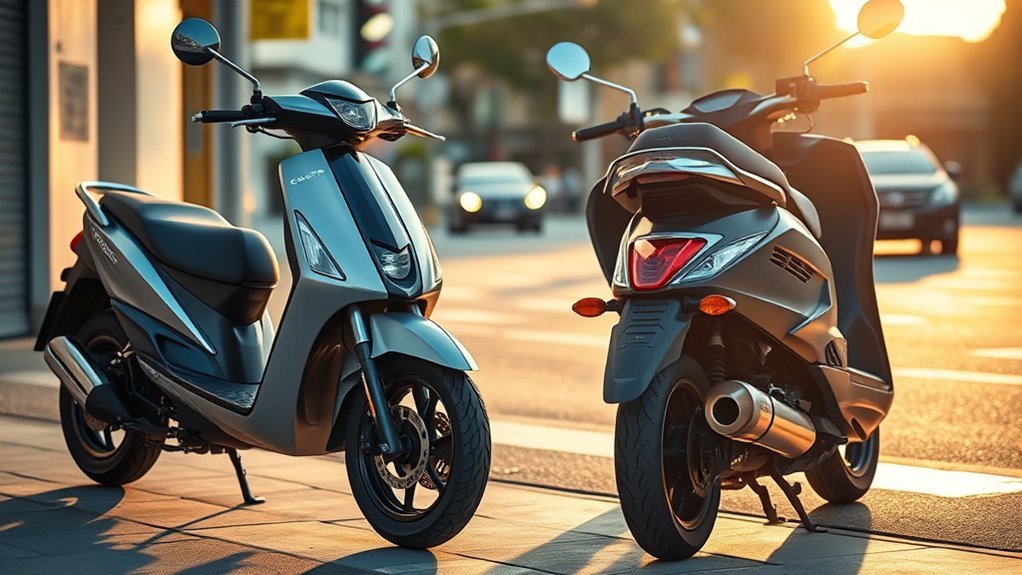
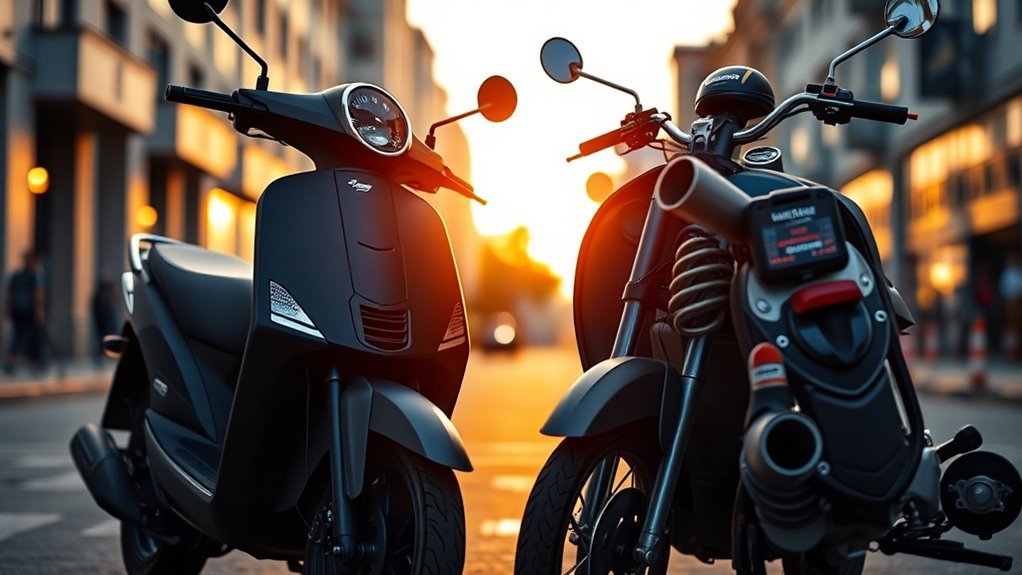
The main difference is the powertrain. An electric scooter uses a battery, controller, and electric motor. A gas scooter uses an internal-combustion engine, fuel system, exhaust, and related mechanical components. That difference affects how the scooter accelerates, how you refuel or recharge it, what maintenance it needs, and what comes out of the tailpipe.
The word scooter can also describe very different machines. A standing electric kick scooter used in a bike lane is not legally or mechanically equivalent to a seated electric moped or a 150cc gas scooter. For the rest of this comparison, “electric scooter” mainly means a seated, road-going electric scooter or moped unless a standing e-scooter is specifically mentioned.
| Vehicle type | Typical design | Important distinction |
|---|---|---|
| Standing electric scooter | Deck, handlebars, small wheels, electric motor | Often regulated as a micromobility device rather than a motorcycle or moped |
| Electric road scooter / moped | Seat, larger wheels, lights, road-oriented chassis | Can fall into moped, motorcycle, or another motor-vehicle class depending on local law |
| Gas road scooter | Seat, internal-combustion engine, fuel tank | Licensing and registration often depend on engine size, speed, and jurisdiction |
Electric Vs Gas Scooter Performance Compared
Neither power source automatically guarantees better performance. Acceleration, top speed, hill climbing, passenger ability, and payload depend on the motor or engine output, controller or transmission, gearing, weight, tires, chassis, and the limits built into the specific model.
Acceleration And Torque
Electric motors can deliver strong torque immediately, so many electric scooters feel responsive from a stop. That characteristic works especially well in stop-and-go city traffic. A gas scooter typically builds power as engine speed rises and transfers it through its transmission or continuously variable transmission.
That does not mean every electric scooter accelerates faster than every gas scooter. A low-powered urban electric model may be much slower than a larger gas scooter, while a high-powered electric road scooter can outperform smaller gas models. Compare actual acceleration, rated motor or engine output, curb weight, and rider reviews for the exact scooters on your shortlist rather than choosing by fuel type alone.
Top Speed And Range
The original assumption that electric scooters generally stop at 45–60 km/h is no longer reliable for road-going models. For example, NIU’s MQi GT series includes variants with manufacturer-listed top speeds reaching 62 mph (100 km/h). Other electric scooters are deliberately limited to much lower speeds to fit urban or moped regulations.
Gas scooters also span a wide performance range. A small-displacement city scooter and a larger maxi-scooter are not comparable simply because both burn gasoline. The safest rule is to compare vehicles with similar legal classifications and intended use.
Power source does not determine top speed by itself. Vehicle class, motor or engine output, gearing, weight, and legal restrictions matter more.
Range, Charging, and Refueling
Range is one of the most important practical differences, but there is no trustworthy universal figure such as “50–150 km for electric and 200–300 km for gas.” Manufacturer-rated range can vary widely, and your real-world result changes with speed, hills, temperature, wind, tire pressure, rider weight, passenger or cargo load, and riding style.
| Factor | Electric scooter | Gas scooter |
|---|---|---|
| Energy stop | Plug in or swap a removable battery if the model supports it | Fill the fuel tank |
| Typical downtime | Usually measured in hours for a full charge | Usually measured in minutes at a fuel station |
| Best use case | Predictable daily mileage with reliable charging | Longer or less predictable routes where fast refueling matters |
| Range planning | Leave a battery reserve instead of planning to arrive near 0% | Consider fuel-station availability on remote routes |
A current manufacturer example shows why model-specific data matter: the NIU MQi GT series publishes different range, speed, battery, and charging figures for different variants. Treat advertised range as a planning reference rather than a guaranteed distance.
Pro Tip: If your normal round trip is 25 miles, do not buy an electric scooter solely because its advertised range is exactly 25 miles. Leave a comfortable reserve for weather, detours, battery aging, hills, and higher-speed riding.
Purchase Price and Running Costs
Purchase price depends more on vehicle class, battery size, brand, features, and performance than on a simple electric-versus-gas rule. A low-cost standing e-scooter may cost hundreds of dollars, while a road-going electric scooter can cost several thousand. The same is true for gas scooters.
Upfront Purchase Cost
Current U.S. examples show why the original $300–$1,500 electric estimate was not a fair comparison. Vespa currently lists its road-going Elettrica 45 mph at a $7,999 MSRP, while Honda lists the 2026 PCX, a 157cc gas scooter, at a $4,349 base MSRP before its listed destination charge. These are only examples, not market-wide averages.
| Current example | Power source | Published price | Why it matters |
|---|---|---|---|
| Vespa Elettrica 45 mph | Electric | $7,999 MSRP | Shows that road-going electric scooters cannot be represented by kick-scooter price ranges |
| 2026 Honda PCX | Gas | $4,349 base MSRP, plus Honda’s listed destination charge | Shows that new gas road scooters commonly cost well above $1,000 |
When comparing purchase prices, include dealer fees, taxes, registration, required riding gear, home-charging equipment if needed, insurance, accessories, and any available incentives. Compare equivalent road-going vehicles rather than the cheapest product sold under the word “scooter.”
Ongoing Running Costs
Electric scooters often have an operating-cost advantage because electric motors are efficient and there is no gasoline to buy, but the exact savings depend on your electricity rate, gasoline price, efficiency, mileage, and model.
A simple way to compare energy costs is:
- Electric: battery energy used in kWh × your electricity rate ÷ miles actually traveled.
- Gas: local fuel price ÷ your scooter’s real-world miles per gallon.
Do the calculation with your own utility and fuel prices rather than relying on a generic “few cents per mile” claim. Also include servicing, tires, brakes, insurance, registration, and expected battery or engine-related repairs when estimating total ownership cost.
Which Scooter Is Cheaper to Maintain?
Electric scooters generally have an advantage in routine powertrain maintenance. The U.S. Department of Energy notes that all-electric vehicles typically require less maintenance because the battery, motor, and associated electronics need relatively little scheduled service and there are fewer moving parts and fluids than in an internal-combustion powertrain. See the DOE Alternative Fuels Data Center maintenance guidance.
That principle applies to the electric drivetrain, but an electric scooter is not maintenance-free. You still need to inspect and service items such as:
- Tires and tire pressure
- Brake pads, discs, drums, or brake fluid where applicable
- Suspension and steering components
- Wheel bearings
- Lights and electrical connections
- Drive belts, chains, or final-drive components if the model uses them
- The traction battery and charging equipment
Gas scooters add engine-related maintenance that may include engine oil, spark plugs, air filters, coolant, valve checks, fuel-system service, and transmission or drive-belt maintenance depending on the design.
The major long-term electric expense can be the traction battery. Battery life and replacement cost vary considerably, so check the battery warranty, replacement availability, labor cost, and manufacturer support before buying.
Battery Charging and Scooter Safety
Electric scooters remove fuel handling and exhaust from everyday use, but lithium-ion batteries introduce their own safety considerations. The U.S. Consumer Product Safety Commission advises consumers to follow the manufacturer’s charging instructions, use the supplied or approved charger, inspect the product for damage, and follow local riding laws.
Warning: CPSC advises being present while charging micromobility products, not charging them while sleeping, using only approved replacement batteries and chargers, and never using battery packs that have been modified or rebuilt by unqualified personnel. Damaged lithium-ion batteries can create serious fire hazards.
Before riding either type of scooter, check the tires, brakes, steering, lights, throttle, mirrors where fitted, and any visible damage. Wear appropriate protective gear and follow the manufacturer’s passenger, age, and load limits. Standing e-scooters deserve extra caution because small wheels can react sharply to potholes, curbs, debris, and uneven surfaces.
Weather, Hills, Load, and Real-World Range
Advertised electric range is normally measured under specified test conditions. Your actual mileage may be lower if you ride fast, climb steep hills, carry a passenger, ride into strong wind, use underinflated tires, or operate in temperatures that reduce battery performance.
Gas scooter fuel economy also changes with speed, load, hills, maintenance condition, tire pressure, and riding style. In either case, manufacturer ratings should be treated as comparison tools rather than promises.
Do not assume an electric scooter is waterproof. Check the manufacturer’s water-resistance or ingress-protection specifications and follow its restrictions for rain, puddles, washing, storage, and charging.
Noise, Emissions, and Environmental Impact
Electric scooters are generally much quieter at low speeds because they do not have an internal-combustion engine or exhaust system. Tire and wind noise still increase as speed rises, so “silent” is an exaggeration.
Electric scooters also have zero tailpipe emissions. That is different from having zero environmental impact. Electricity generation, battery manufacturing, raw-material extraction, tire wear, transport, and end-of-life disposal or recycling all contribute to the vehicle’s footprint.
The U.S. Environmental Protection Agency explains the same distinction for electric vehicles: there are no tailpipe emissions during electric operation, although electricity production can create upstream emissions. EPA also notes that lifecycle results depend on factors such as the electricity source and battery manufacturing.
Gas scooters produce exhaust while operating because fuel is burned onboard. If reducing local exhaust and engine noise is a priority, electric has a clear advantage at the point of use.
Which Scooter Fits Your Riding Style?
Your riding pattern matters more than slogans about one technology being universally better.
- Short, predictable city commute: electric is often convenient if home or workplace charging is reliable.
- Frequent long or unplanned trips: gas may be easier because refueling infrastructure is widespread and stops are short.
- Stop-and-go traffic: electric torque and quiet operation can make urban riding pleasant.
- Passengers or cargo: compare the manufacturer’s actual payload rating, seat, suspension, brakes, and power instead of assuming gas is stronger.
- Apartment living: check whether you can safely and legally charge or remove the battery before choosing electric.
- Minimal routine powertrain maintenance: electric usually has the advantage.
- Limited local service support: choose the type and brand that qualified shops in your area can actually repair.
If you regularly ride a known route and can recharge where you park, an electric scooter can be very practical. If your daily distance changes dramatically or you travel far beyond convenient charging, gas can still be the easier ownership experience.
Insurance, Theft, and Battery Replacement
Do not assume electric scooters always cost less to insure. Insurance pricing can depend on the scooter’s purchase price, repair cost, theft rate, speed, legal classification, rider age and record, location, deductibles, liability limits, and optional comprehensive or collision coverage.
Before buying, request insurance quotes for the exact model and VIN or vehicle class when possible. A more expensive electric scooter can cost more to replace after theft or a total loss even if it has fewer engine components.
For electric models, also investigate battery replacement. Ask how long the battery warranty lasts, what capacity-loss conditions are covered, whether replacement packs are still expected to be available in several years, and how much a replacement currently costs.
License, Registration, and Road Rules
Licensing cannot safely be determined from a simple rule such as “49cc does not need a motorcycle license.” Laws vary by country, state, province, and sometimes city, and authorities may define scooters according to speed, engine displacement, motor output, seating position, pedals, or whether the rider stands on a floorboard.
California illustrates how different the categories can be. According to the California DMV:
- A motor-driven cycle under 149cc must be registered and requires an M1 motorcycle license.
- A qualifying moped has separate licensing and plate requirements.
- A legally defined motorized scooter with a floorboard follows a different set of rules and does not require registration.
- Electric bicycles, mopeds, motorized scooters, motor-driven cycles, and motorcycles should not be treated as one legal category.
Another state may classify the same-looking vehicle differently. Before paying for a scooter, check your official state or national motor-vehicle authority and verify:
- License or endorsement requirements
- Minimum rider age
- Registration and plate requirements
- Insurance requirements
- Helmet laws
- Where the scooter may be ridden
- Passenger restrictions
- Maximum legal speed
- Parking and charging restrictions
Note: A manufacturer calling a product an “electric scooter” does not determine its legal classification. Your local vehicle code does.
Electric vs Gas Scooter Buying Checklist
Before deciding, compare the two options using the same route and the same expected workload.
- Define the vehicle class. Compare a road-going electric scooter with a similar road-going gas scooter.
- Measure your daily distance. Include detours and occasional extra trips.
- Check real charging access. Confirm where, when, and how safely you can charge.
- Compare manufacturer-rated speed and range. Do not rely on generic category averages.
- Leave a range reserve. Battery range can fall under harder riding conditions.
- Compare payload. Include your body weight, passenger, luggage, and accessories.
- Calculate energy or fuel cost using local prices.
- Compare service availability. Check nearby dealers and independent repair options.
- Price insurance for the exact model.
- Verify licensing and registration before purchase.
- For electric, check battery warranty and replacement cost.
- For gas, check the manufacturer’s scheduled engine and transmission maintenance.
Frequently Asked Questions
Do Cops Care About Electric Scooters?
Yes. Police and other enforcement authorities can enforce speed, helmet, roadway, sidewalk, parking, equipment, licensing, and impaired-riding rules. How an electric scooter is regulated depends on its legal classification and local law, so do not assume it is treated like a bicycle.
What Are the Negatives of Electric Scooters?
Common disadvantages include longer energy-stop times than gasoline refueling, dependence on charging access, range variation in demanding conditions, eventual battery aging, possible battery-replacement expense, and fewer repair options for some brands. Lithium-ion batteries also require proper charging, storage, and damage inspection.
Are Scooters Good for Autistic Kids?
A scooter may be enjoyable for some autistic children, but suitability is individual rather than universal. Consider the child’s balance, coordination, judgment, sensory preferences, ability to follow safety instructions, and the manufacturer’s age and weight limits. Use an appropriately sized scooter, a properly fitted helmet, a safe riding area, and suitable adult supervision.
Is Insurance More for Electric Vespas?
Not necessarily. Insurance is priced using factors such as the exact model, purchase and replacement value, theft exposure, rider history, location, speed, coverage level, and insurer. Get quotes for the specific electric Vespa and comparable gas scooter rather than assuming one power source is always cheaper.
Is an Electric or Gas Scooter Better for Daily Commuting?
Electric is often a strong choice for a predictable city commute when the scooter has enough real-world range and you have reliable charging. Gas can be more convenient when your mileage changes often, you regularly make longer trips, or you cannot charge where you park.
How Long Does an Electric Scooter Take to Charge?
Charging time is model-specific and depends on battery capacity and charger output. Road-going electric scooters commonly require several hours for a full charge. For example, current NIU MQi GT variants list charging times around four to five hours depending on configuration. Always use the charging time published for your exact battery and charger.
Do Electric Scooters Need Oil Changes?
An electric motor does not require engine-oil changes like a gasoline engine. However, the scooter may still have other lubricated or serviceable components depending on its design, so follow the manufacturer’s maintenance schedule for brakes, bearings, suspension, drive components, tires, and electrical systems.
Sources
- U.S. Consumer Product Safety Commission — Micromobility Information Center — riding, lithium-ion battery, and charging safety guidance.
- U.S. Department of Energy Alternative Fuels Data Center — electric-vehicle maintenance and battery considerations.
- U.S. Environmental Protection Agency — Electric Vehicles — tailpipe and upstream emissions information.
- California DMV — Motorcycles, Mopeds, and Scooters — examples of differing vehicle classifications, licensing, and registration rules.
- NIU — MQi GT specifications — current electric road-scooter speed, range, battery, and charging examples.
- Honda — 2026 PCX — current gas-scooter engine, fuel-capacity, and pricing example.
Conclusion
An electric scooter is usually the stronger choice when your trips are predictable, charging is convenient, lower routine powertrain maintenance matters, and you value quiet operation with zero tailpipe emissions. A gas scooter can still be the more practical choice when you regularly travel farther, cannot charge reliably, or want the convenience of refueling in minutes.
Do not choose based only on broad claims that electric is cheaper or gas is faster. Compare equivalent scooters by real-world range, top speed, payload, purchase price, energy cost, maintenance, battery or engine support, insurance, and local road rules. The better scooter is the one that fits your actual route and ownership conditions.
