
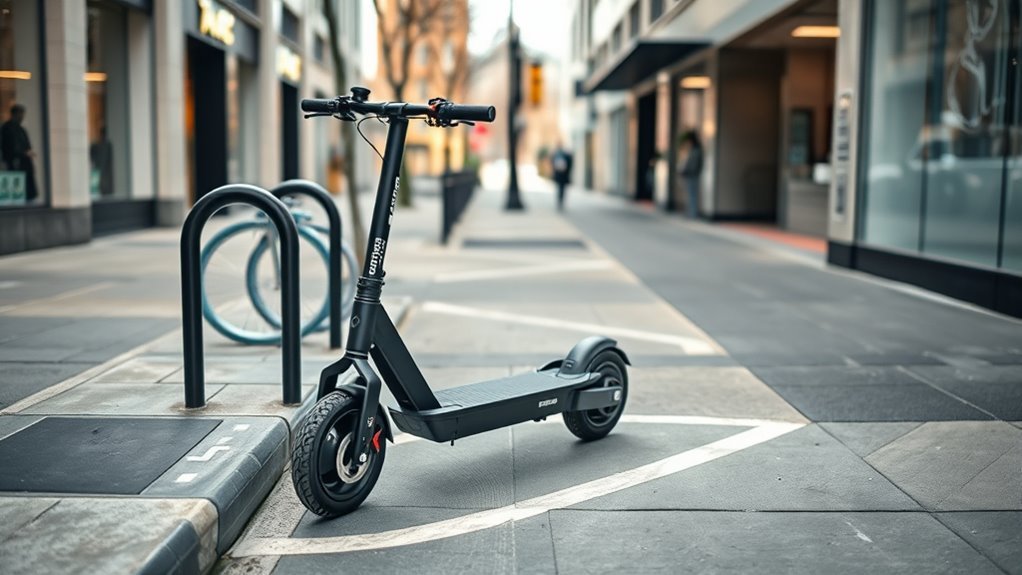
Last Updated on September 26, 2026 by Caleb Warren
Knowing where you can park an electric scooter can save you from parking fees and help keep sidewalks accessible. The rules depend on your city, the type of scooter, and whether you’re using a rental service. Some cities require marked parking areas, while others allow parking beside the curb or at approved bike racks.
Quick Answer
You can park an electric scooter in designated parking corrals, approved scooter racks, or other locations permitted by your city and rental provider. Some cities allow unobstructed sidewalk parking, while others require scooters to be locked to bike racks or designated fixtures. Never block pedestrian routes, entrances, curb ramps, or driveways.
Last checked: September 26, 2026. Dates and figures were verified against official sources.
Key Takeaways
- Rental scooter parking rules can differ from those for privately owned scooters.
- New York City uses both mandatory parking corrals and designated sidewalk parking areas.
- Portland and Washington, DC require shared scooters to be secured to approved fixtures.
- A rental ride may remain active until the app confirms that it has ended.
- Parking in a bike lane or blocking an accessible route can create hazards even when no warning sign is present.
Disclosure: As an Amazon Associate I earn from qualifying purchases. Some links on this page are affiliate links, at no extra cost to you.
Where Can You Park an Electric Scooter?
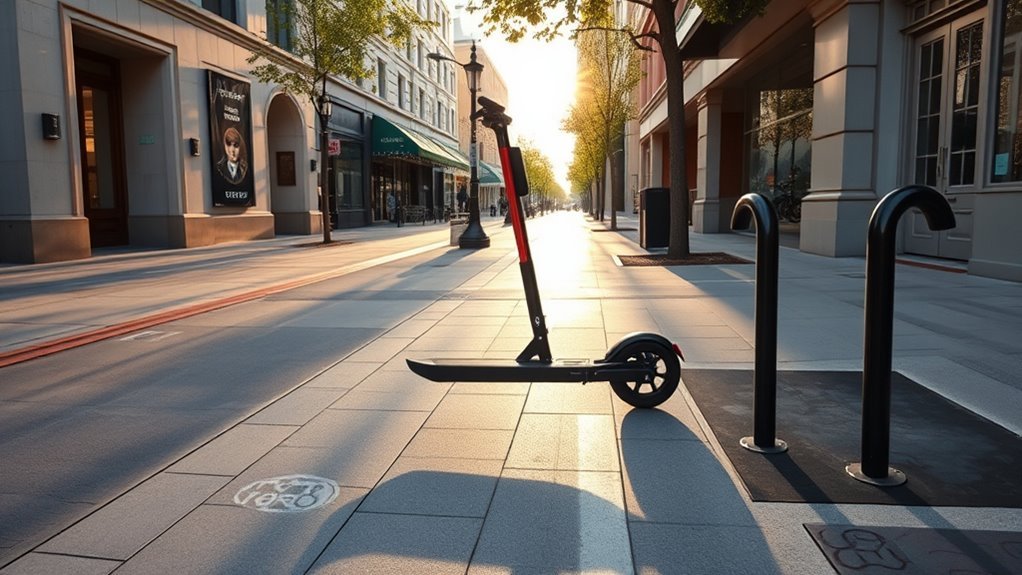
You can park an electric scooter wherever local rules permit it and the scooter does not obstruct public access. Common options include marked parking corrals, approved racks, and designated micromobility areas.
Some cities also permit sidewalk parking in the furniture zone. This is the part of the sidewalk closest to the street, where you usually find trees, signs, benches, and bike racks.
However, permission to park on a sidewalk is not universal. A city’s riding rules and parking rules are also different: riding on a sidewalk may be prohibited even when parking there is allowed.
Before ending a rental trip, use the provider’s app to identify permitted parking areas. A designated space may appear as a parking symbol, a marked zone, or a location where the app allows you to finish the ride.
Once you find an approved location, set the scooter upright with its kickstand. Leave entrances, ramps, curb cuts, and the pedestrian path clear.
If you’re parking on private property, get permission from the owner or property manager first. For shared scooters, that permission does not override the rental provider’s service-area restrictions.
If you notice an improperly parked rental scooter, report it through the provider’s app or customer service channel instead of leaving it obstructing the walkway.
Scooter Parking Rules by City
Electric scooter parking rules differ across US cities. A location that is legal in one city may be restricted in another, particularly for shared scooters.
Portland requires shared scooters to be locked to approved fixtures. Washington, DC has similar locking requirements, while New York City uses a combination of marked corrals and permitted sidewalk parking.
City Parking Zones
City parking zones help organize scooters without blocking pedestrians. They may be marked with painted lines, signs, parking racks, or digital boundaries in rental apps.
In New York City’s shared scooter program, parking depends on the specific location. The NYC DOT scooter parking rules identify two main types of parking areas:
- Free-floating zones: Park the scooter upright in the sidewalk furniture zone without blocking pedestrians or other infrastructure.
- Mandatory corral zones: Park inside the designated corral before ending your rental.
The city’s official scooter parking map identifies free-floating zones, mandatory corrals, and no-ride/no-park areas. Some parking corrals are digital-only and do not have physical painted markings.
Washington, DC also provides off-sidewalk parking corrals for personal and shared dockless scooters. However, shared devices must still meet the District’s locking requirements.
Local Scooter Laws
Local scooter laws determine where you can park, whether you must use a lock, and which areas are off-limits. Rental providers may impose additional restrictions through their apps.
The following comparison highlights important differences between cities mentioned in this guide.
| City | Parking rule |
|---|---|
| New York City | Use marked corrals in mandatory zones. In free-floating zones, park upright in the sidewalk furniture zone. |
| Washington, DC | Shared scooters must be locked to a bike rack or another permitted fixed object. Off-sidewalk corrals are also available. |
| Portland | Lock shared scooters to a public bike rack or, if none is available, a city signpost. |
| Eugene | Follow applicable local parking restrictions and keep pedestrian routes clear. Riding permissions do not establish parking permission. |
According to the Portland Bureau of Transportation, shared scooter riders must lock their vehicles to a public bike rack or a city signpost if no rack is available. Lyft scooters may also be secured to BIKETOWN stations.
Portland’s ban on sidewalk riding is separate from its scooter parking requirements.
In Eugene, the city’s official scooter guidance confirms that electric scooters may use bike lanes and certain shared-use paths but may not be ridden on sidewalks.
That does not mean a bike lane is a legal parking space. Keep the scooter out of moving bicycle traffic and follow any local parking signs or rental-app restrictions.
In Bend, do not assume that a rule allowing a scooter on a particular path also permits parking there. Use an authorized location and avoid obstructing pedestrian or bicycle traffic.
Fines and Penalties
Incorrect scooter parking can result in fines, service penalties, or removal, depending on local rules and the rental agreement.
In Portland, failing to follow the shared scooter locking requirement can create a parking violation. In Washington, DC, riders may face penalties from their rental provider for improperly parked dockless scooters.
New York City’s shared scooter operators also require riders to follow parking rules. A scooter left outside a permitted parking area or blocking public access may be reported to the operator.
For privately owned scooters, local parking and obstruction laws still apply. A personal scooter is not automatically exempt simply because no rental app is involved.
There is no single nationwide electric scooter parking fine. The consequences depend on the city, the violation, and the provider’s applicable terms.
Best Places to Park Your Scooter
The most practical parking location is an approved area that keeps the scooter stable and leaves enough room for everyone to pass. Marked corrals, scooter racks, and authorized bike racks are common options.
If you use a rental scooter, choose a location accepted by the provider’s app rather than assuming an ordinary bike rack is always permitted.
| Spot type | Benefit | Best use |
|---|---|---|
| Marked corrals | Organized parking within a designated area | Busy commercial streets and mandatory parking zones |
| E-scooter racks | Stable parking and suitable locking points | Transit hubs, workplaces, and public parking areas |
| App-approved zones | Location-specific guidance for rental scooters | Ending shared scooter trips |
For a privately owned scooter, an authorized rack can also provide a secure place to attach a suitable lock.
Some rental apps identify preferred parking locations or offer incentives for using them. Check the displayed terms before choosing your final parking spot.
A marked corral is especially useful in a busy area because it gives scooters a defined location outside the main pedestrian route.
Where Not to Park Your Scooter
Never leave your scooter where it blocks pedestrians, cyclists, vehicles, or emergency access. A convenient location is not necessarily a permitted parking space.
Avoid the following locations unless a specific, authorized parking arrangement clearly permits them:
- Pedestrian paths: Do not leave scooters across the clear walking area of a sidewalk.
- Curb ramps and curb cuts: Keep wheelchair access and street crossings open.
- Entrances and exits: Avoid blocking homes, businesses, transit stations, and building doors.
- Bike lanes: Never leave a scooter where cyclists must move into traffic to avoid it.
- Bus stops: Keep boarding areas and access routes clear.
- Driveways and crosswalks: Do not interfere with vehicles or people crossing the street.
- Restricted areas: Follow no-parking signs and app-based restrictions.
- Private property: Obtain permission and comply with any rental-service limitations.
Also avoid planting beds, grass, tree pits, and other landscaped areas where parking is prohibited.
A designated roadbed corral is different from leaving a scooter in an ordinary traffic lane. For example, New York City permits shared scooters inside approved roadbed corrals but does not allow general roadbed parking.
Warning: A scooter blocking a curb ramp or accessible walkway can prevent wheelchair users and other pedestrians from passing safely. Keep these routes clear even when an app appears to permit parking nearby.
How to Park Your Scooter Safely
To park safely, choose an authorized location, stabilize the scooter, secure it if required, and confirm that your rental has ended.
The following steps work for most electric scooters, although rental providers may require additional actions.
Choose Safe Parking Spots
Start by identifying a legal parking location before you stop your trip. Look for designated scooter zones, approved racks, or a permitted sidewalk furniture area.
For shared scooters, review the app’s parking map. A location may fall inside the service area but still be unsuitable for ending a ride.
Then check the surrounding space. Make sure the scooter will not block a doorway, curb ramp, bus stop, or pedestrian route.
If you’re parking a personal scooter, choose an authorized location with a suitable locking point. Avoid attaching it to a fixture where locking is prohibited.
Park Upright and Clear
Set the scooter upright using its kickstand. Make sure both the scooter and its handlebars remain within the permitted parking area.
A scooter can obstruct a walkway even when its wheels are beside the curb. Check the full width of the vehicle, including any handlebar or attached equipment.
Keep enough space between parked scooters to prevent them from leaning against one another or falling into the pedestrian path.
If your rental app requests a parking photo, position the scooter so the image clearly shows its location and the surrounding access area.
Lock and End Ride
For a shared scooter, complete the provider’s required locking and ride-ending process. Do not assume the trip has ended just because you’ve stopped riding.
Bird’s official cable-lock instructions explain how to secure equipped scooters and submit a parking photo.
- Move the scooter to an approved parking location.
- Set it upright with the kickstand.
- Attach the cable lock to an approved rack or fixture when required.
- Secure the lock according to the scooter’s instructions.
- Select the ride-ending option in the rental app.
- Take and submit the required parking photo.
- Confirm that the app shows your ride has ended.
If the app does not confirm the end of your trip, follow its instructions or contact the provider’s support team.
For a privately owned scooter, use a suitable U-lock or chain lock where permitted. Secure the scooter to an approved fixed object rather than relying on the kickstand alone.
What to Do When No Spot Is Available
If your preferred parking area is full, look for another approved location nearby. Do not leave the scooter outside a mandatory corral or in a prohibited area simply because the nearest space is occupied.
Use this order of options:
- Look for another available space within the designated parking zone.
- Check the rental app for a nearby alternative parking location.
- Use an approved bike rack or fixed object if local rules and the provider allow it.
- Move to another authorized parking area if the first location is full.
- Contact the provider if the app prevents you from ending the ride despite proper parking.
When using an alternative rack, keep the scooter upright and leave enough room for pedestrians, wheelchair users, and deliveries.
In cities with mandatory parking corrals, an ordinary sidewalk space may not be a legal alternative. New York City’s shared scooter program, for example, requires riders in mandatory corral zones to end their trips inside a designated corral.
If every nearby legal space is occupied, wait for one to become available or move to another approved location.
You can also report recurring parking shortages to the rental provider or local transportation department. Such reports can help identify locations that may need additional parking capacity.
Can You Park on Private Property?
Yes, you can park a privately owned electric scooter on private property with the owner’s permission. Rental scooters may have additional restrictions, even when the property owner allows parking.
For example, a business may provide scooter parking near its entrance. However, the rental provider may still prohibit ending a trip outside its approved service area.
Before leaving your scooter on private property:
- Ask the owner or property manager for permission.
- Look for posted parking restrictions.
- Use a designated scooter or bike parking area when available.
- Keep entrances, walkways, and accessibility routes clear.
- Follow apartment, residential, or workplace storage rules.
If you regularly park a personal scooter at home or work, a designated storage area may offer better protection against theft and accidental damage.
For rental scooters, permission from a business does not automatically make the location an authorized trip-ending point.
What Happens If You Park Wrong?
Parking an electric scooter incorrectly may lead to a warning, a fine, removal, or a rental-account penalty. The outcome depends on the local rules and the provider’s terms.
The consequences may be more serious when a scooter blocks accessibility routes or creates a hazard for pedestrians and cyclists.
| Violation | Result |
|---|---|
| Sidewalk blockage | Pedestrian hazards and possible enforcement |
| No-parking zone | Possible fines or provider penalties |
| Access point obstruction | Possible removal or relocation |
| Repeated violations | Possible account restrictions or suspension |
| Reported misuse | Provider investigation or city enforcement |
Washington, DC’s official bike and scooter parking guidance states that shared dockless scooters must be locked to a bike rack or another fixed object when not in use. Riders who park incorrectly may face provider penalties.
The District also accepts complaints about dockless scooters parked on private property or blocking sidewalks through its 311 service.
If you receive a parking penalty, review the reason given by the city or provider. Your parking photo and trip details may help establish where the scooter was left.
Do not assume that a successful ride-ending confirmation automatically proves that every local parking rule was followed.
If you see a poorly parked shared scooter, report its location and identifying details through the provider’s reporting channel. In New York City, residents can also report improperly parked shared scooters through 311.
How to Keep Scooter Parking Safe and Clean
Responsible scooter parking keeps public areas accessible and reduces the risk of scooters being damaged or removed. Small habits can make a noticeable difference in busy areas.
Use this simple checklist before leaving:
- Choose a location where scooter parking is permitted.
- Set the scooter upright on its kickstand.
- Keep handlebars and wheels out of the pedestrian route.
- Avoid blocking bicycle traffic or public infrastructure.
- Secure the scooter with an approved lock when required.
- Complete the rental app’s parking confirmation.
Do not leave scooters lying on their sides or stacked against other vehicles. A fallen scooter can become a trip hazard, especially in a crowded public area.
If you encounter an abandoned or damaged scooter, report it to the operator. Use the company’s reporting tool or the relevant city service instead of attempting repairs yourself.
These habits help keep scooter parking areas orderly and make shared streets easier for everyone to use.
Frequently Asked Questions
Are Electric Scooters Illegal in PA?
Stand-up electric scooters cannot legally be operated on public roadways in Pennsylvania under PennDOT’s published guidance. They may be used on private property. Do not confuse them with electric personal assistive mobility devices, which have a separate legal classification and different operating rules.
Can I Park My Scooter Anywhere?
No, you cannot park your scooter anywhere. Use locations permitted by local rules and, for rentals, your provider. Some cities require designated corrals or locking points, while others permit unobstructed sidewalk parking. Never block access routes or leave a scooter on private property without permission.
What Happens if You Get Caught on an Electric Scooter?
You may receive a warning or citation if you violate local scooter laws. Penalties can apply to prohibited riding, unsafe behavior, or improper parking. Depending on the circumstances, authorities may also remove a scooter, while rental providers may impose fees or account restrictions.
Can You Ride an Electric Scooter on the Sidewalk in Ohio?
Ohio generally permits qualifying low-speed micromobility devices on sidewalks under state law, but local authorities may regulate or prohibit their operation. Riders must yield to pedestrians. The rules depend on the device’s legal classification and the city where it is operated.
Can You Park an Electric Scooter on a Sidewalk?
Yes, in some jurisdictions, provided the scooter does not block pedestrian access. New York City’s shared scooter program permits parking in the sidewalk furniture zone outside mandatory corral areas. Ohio also permits unobstructed sidewalk parking for qualifying low-speed micromobility devices. Other cities and rental providers may impose stricter requirements.
Can You Park a Rental Scooter at a Bike Rack?
Yes, when the city and rental provider permit it. Portland requires shared scooters to be locked to public bike racks or approved alternatives. Washington, DC also requires shared dockless scooters to be secured to permitted fixed objects. Always follow the app’s instructions and keep the surrounding path clear.
Conclusion
Parking your electric scooter correctly starts with knowing the local rules and choosing an authorized location. Keep pedestrian routes clear, secure the scooter when required, and confirm that your rental trip has ended.
Before your next ride, identify a suitable parking area near your destination. That small step can help you avoid penalties while keeping sidewalks and shared spaces accessible.
Sources
- NYC DOT Shared E-Scooter Program FAQ: Official rules for free-floating parking, mandatory corrals, and prohibited locations.
- NYC DOT Parking Maps: Designated parking zones, corrals, and restricted areas.
- Portland Bureau of Transportation: Shared scooter locking requirements and local riding rules.
- City of Eugene: Official electric scooter operating guidance.
- District Department of Transportation: Bike racks, scooter corrals, locking requirements, and parking enforcement.
- Bird Help Center: Cable-lock instructions, ride-ending process, and parking-photo confirmation.
- PennDOT Micromobility Information Sheet: Pennsylvania electric scooter classifications and operating restrictions.
- Ohio Revised Code 4511.514: Operation of low-speed micromobility devices and local regulatory authority.
- Ohio Revised Code 4511.68: Parking restrictions and permitted unobstructed sidewalk parking.

