Last Updated on September 26, 2026 by Caleb Warren
The history of the electric scooter stretches back more than a century, but identifying the first model is not as simple as naming a year. Early motorized scooters ran on gasoline, while electric versions developed alongside changing battery technology. To understand when the first electric scooter was invented, you need to separate early prototypes, production models, and the modern stand-up scooters used today.
Quick Answer
The Autoped debuted in 1915, but it originally ran on gasoline. A later battery-powered Autoped followed. Although Elmer R. Johnson is sometimes credited with a 1915 electric prototype, that attribution lacks reliable primary documentation. Peugeot introduced its production electric Scoot’elec in 1996, while modern stand-up electric scooters became more common during the 2000s.
Disclosure: As an Amazon Associate I earn from qualifying purchases. Some links on this page are affiliate links, at no extra cost to you.
When Was the First Electric Scooter Invented?
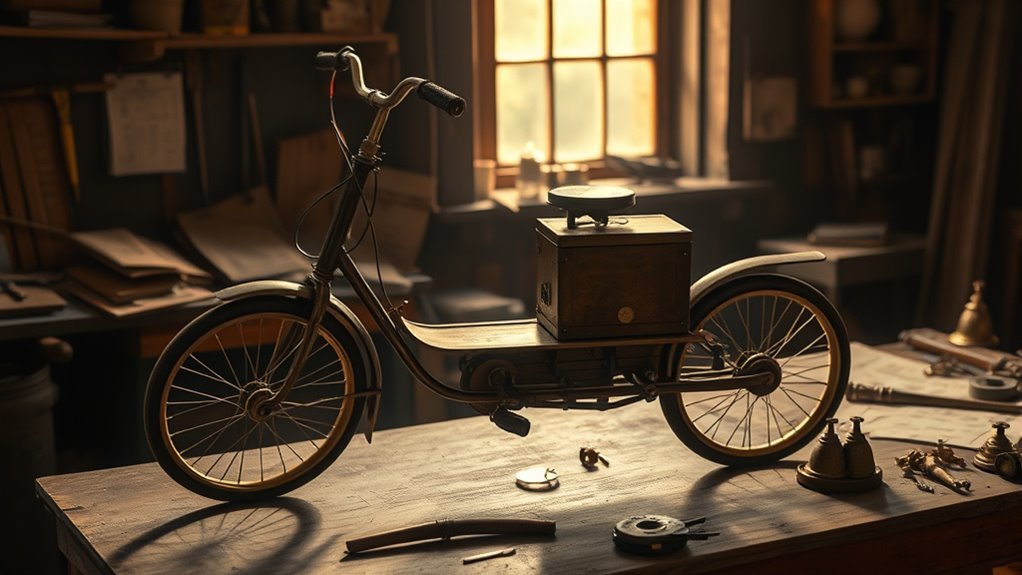
The first electric scooter is often dated to 1915, but the historical record requires a distinction between electric propulsion and gasoline-powered scooter design.
Elmer R. Johnson is sometimes credited with developing an electric scooter prototype in that year. However, the attribution is difficult to establish from contemporary patents or museum records. It should not be treated as a confirmed invention date.
What is well documented is the appearance of the Autoped in 1915. This compact, stand-up vehicle introduced several features that resemble modern scooters, including a riding platform and folding steering column.
The original Autoped used gasoline rather than an electric motor. The Smithsonian’s history of early motorized scooters explains how the machine became an important predecessor of modern personal transportation.
The distinction matters because an early motorized scooter is not automatically an electric scooter. A vehicle must use an electric motor for propulsion to qualify as an electric model.
The Autoped and Its 1915 Debut
The Autoped entered production in 1915 and became one of the earliest commercially produced motorized scooters. It offered a compact alternative to bicycles and larger motor vehicles.
Arthur Hugo Cecil Gibson developed the patented design, with Joseph F. Merkel also associated with its development. The Autoped Company of America manufactured the vehicle in Long Island City, New York.
Its air-cooled, four-stroke gasoline engine had a displacement of approximately 155cc. Historical accounts commonly describe a claimed maximum speed of around 30 mph.
That speed was ambitious for a small standing vehicle. The unusual steering and braking arrangement could also make the scooter difficult to control at higher speeds.
The Autoped attracted attention from commuters, delivery workers, and recreational riders. Postal workers were among those who experimented with the design.
It also became associated with personal independence. Photographs of women riding early motorized scooters illustrate how the machines offered another way to travel without depending on public transportation or a full-sized automobile.
Despite this interest, the Autoped never achieved widespread commercial success. Its higher cost than a bicycle and lack of a conventional seat limited its appeal.
What Made the Autoped Different?
The Autoped combined motorized propulsion, a standing platform, and folding construction in one compact machine. Its controls were especially unusual because the steering column handled more than steering.
Gibson’s self-propelled vehicle patent was originally filed on July 26, 1913, renewed in September 1915, and granted on July 25, 1916.
First Gas-Powered Scooter
The Autoped was among the earliest production gasoline-powered scooters. Its 155cc engine drove the front wheel, allowing the rider to travel without continuously pushing against the ground.
This made it different from an ordinary kick scooter, which depends entirely on human effort.
Period advertising emphasized economical operation, including claims of approximately 125 miles per gallon. That figure should be understood as a historical advertising claim rather than a verified modern fuel-economy measurement.
The engine provided greater speed and range than a conventional kick scooter, but it also introduced fuel costs, mechanical maintenance, noise, and exhaust emissions.
Portable Folding Design
The Autoped’s folding steering column was one of its most recognizable features. It reduced the space needed for storage and helped make the vehicle practical for urban use.
The design combined several important features:
- A collapsible steering column for easier storage.
- A standing platform supported by a compact frame.
- A front-mounted engine and drive mechanism.
- Integrated clutch, throttle, and braking controls.
The original article describes a 30-pound frame, although that exact weight is not established by the available museum specifications.
The steering column also served as a control mechanism. Moving it forward engaged the clutch, while pulling it backward operated the brake.
The Smithsonian’s 1918 Autoped collection record documents this unusual arrangement.
Early Public Appeal
The Autoped appealed to people looking for convenient personal transportation. Advertisements promoted it for commuting, shopping, deliveries, and short recreational journeys.
Its appeal came from three practical advantages: it required less storage space than a car, provided motorized movement, and offered greater independence from fixed transportation schedules.
However, the vehicle also had disadvantages. Its standing design was less comfortable than a seated motorcycle, while its price made it harder to justify against a bicycle.
Those limitations helped prevent widespread adoption, even though the Autoped established a recognizable design for later motorized scooters.
Early Electric Scooter Prototypes Before 1996
Electric scooter development took place over several decades rather than through one clearly documented invention. Early designers faced problems involving battery weight, available energy, motor performance, and manufacturing cost.
The transition from gasoline to electric propulsion became more practical as rechargeable batteries improved.
Early Stand-Up Prototypes
Early stand-up scooter development borrowed heavily from the compact format established by machines such as the Autoped.
A standing platform, handlebars, and a small motor offered a simple way to transport one person without the size of a conventional motorcycle.
However, early rechargeable batteries were heavy and stored relatively little energy. This limited the practicality of lightweight electric designs.
A major development came in 1991, when Sony commercialized the first rechargeable lithium-ion battery.
The U.S. Department of Energy’s battery history explains this milestone.
Lithium-ion technology eventually helped manufacturers create lighter electric vehicles with more useful range. However, early commercial electric scooters did not all use lithium-ion batteries.
Autoped and Successors
The Autoped influenced scooter development by demonstrating that a small standing vehicle could provide powered transportation.
Its design also illustrates why scooter history should distinguish the type of vehicle from its power source.
| Feature | Meaning |
|---|---|
| 1915 launch | Early production motorized scooter |
| 155cc engine | Gasoline propulsion, not electric power |
| Around 30 mph | Claimed maximum performance |
| Compact form | A recognizable predecessor of modern standing scooters |
Later electric scooters retained the basic idea of compact personal transportation while replacing the combustion engine with a rechargeable battery and electric motor.
Some subsequent electric scooters used a seated motorcycle-style design, while others followed the standing format associated with modern kick scooters.
Key Steps Before 1996
Several developments helped shape electric scooters before their wider commercial adoption.
- 1915: The gasoline-powered Autoped entered production, establishing an influential motorized scooter format.
- 1916: Gibson’s patent for the self-propelled vehicle was granted.
- Later Autoped development: A battery-powered version was introduced after the Everready Battery Company became involved.
- 1960s: Karl Kordesch experimented with hybrid electric motorcycle technology, demonstrating alternative approaches to powered two-wheel transportation.
- 1991: Commercial lithium-ion batteries created new opportunities for lightweight electric mobility.
- 1996: Peugeot introduced its Scoot’elec, an electric seated scooter intended for everyday transportation.
These milestones show that electric mobility developed through improvements in batteries, motors, controls, and vehicle design.
The gasoline-powered Autoped and later electric scooters belong to the same broad transportation history, but they should not be described as identical inventions.
From Gas-Powered Scooters to E-Scooters
The transition from gasoline scooters to electric models depended largely on rechargeable battery technology. Electric motors removed the need for onboard gasoline combustion, but early battery systems imposed major limits on weight and range.
Peugeot’s Scoot’elec became an important milestone in 1996.
According to Peugeot Motocycles’ company history, the manufacturer launched the Scoot’elec using nickel-cadmium battery technology.
This is an important correction to the common assumption that all successful electric scooters depended on lithium-ion batteries from the beginning.
The Scoot’elec was a seated electric motor scooter rather than the lightweight standing vehicle most people picture today.
The Lane Motor Museum’s Scoot’elec specifications document its key characteristics:
- 2.8 kW DC electric motor.
- Three nickel-cadmium battery units.
- Approximately 40 km, or 25 miles, of estimated range.
- Road-mode speed limited to approximately 45 km/h.
- Conventional seated scooter construction.
Peugeot’s model demonstrated that electric propulsion could support a practical urban scooter, although battery maintenance and purchase costs remained obstacles.
During the 2000s, electric stand-up scooters became more accessible.
Manufacturers such as Go-Ped and Razor helped develop the familiar format. Go-Ped’s documented ESR electric production generations began in 2004–2005, according to the company’s model-generation information.
These machines brought electric motors to compact scooter designs that could be used for recreation and short-distance travel.
Why Cities Embraced Electric Scooters
Electric scooters became popular in cities because they offered a convenient option for short journeys. They also helped address the last-mile problem: traveling between a transit stop and your final destination.
Modern shared scooter programs expanded rapidly after Bird began operating in Santa Monica in September 2017.
Bird’s founder described that initial deployment in a company statement filed with the SEC.
Companies such as Bird and Lime made scooters available through mobile apps, allowing riders to locate, unlock, and pay for short trips without owning a vehicle.
This model offered several advantages:
- Convenient travel between public transportation stops and nearby destinations.
- Less need to find automobile parking.
- Flexible access without purchasing a personal scooter.
- Useful transportation for short urban trips.
The scale of adoption became clear in 2018.
According to the National Association of City Transportation Officials, Americans took 38.5 million shared scooter trips that year.
Across shared bicycles and scooters combined, the total reached 84 million trips.
These figures measure completed journeys, not the number of scooters sold.
Electric scooters produce no exhaust while riding. However, their overall environmental benefit depends on manufacturing, battery life, charging, collection operations, and whether a scooter journey replaces a car trip or a journey that would otherwise have been made on foot.
Cities have also had to address parking, pedestrian access, rider safety, and appropriate places to operate scooters.
The Future of Electric Scooter Design
Electric scooter design continues to focus on safety, battery performance, portability, and connected technology. These improvements aim to make scooters more practical for daily transportation.
Manufacturers are developing stronger braking systems, improved lighting, more durable frames, and better battery management.
| Focus | Change |
|---|---|
| Safety | Improved brakes, lights, and visibility |
| Range | More efficient motors and battery systems |
| Smart tech | GPS, apps, diagnostics, and security features |
| Portability | Foldable frames and lighter construction |
| Materials | Durability, repairability, and improved recycling |
Some long-range scooters are designed for journeys exceeding 50 miles under specified test conditions. However, real-world range varies with speed, terrain, rider weight, temperature, and battery condition.
Connected features can help riders monitor battery status, locate their scooters, receive maintenance alerts, and improve theft protection.
Battery safety remains particularly important as electric scooter ownership grows.
The U.S. Consumer Product Safety Commission recommends wearing a helmet, checking brakes and tires before riding, following manufacturer instructions, and using an approved charger.
Better durability and repairability can also extend a scooter’s useful life and reduce unnecessary waste.
Frequently Asked Questions
When Did Electric Scooters First Come Out?
Early electric scooter development dates to the early twentieth century, although the exact first invention remains uncertain. The original gasoline-powered Autoped appeared in 1915, with a battery-powered version following later. Peugeot introduced its production electric Scoot’elec in 1996, and modern stand-up electric scooters became increasingly accessible during the 2000s.
Can a 70 Year Old Ride a Scooter?
Yes, a 70-year-old can ride an electric scooter if their balance, strength, vision, and mobility allow safe operation. Age alone does not determine suitability. Choose a stable model with manageable speed, wear a helmet, and follow the manufacturer’s weight limits. Anyone with concerns about balance, dizziness, or mobility should seek medical advice before riding.
Did Electric Scooters Exist in 2001?
Yes, electric scooters existed in 2001. Peugeot had already introduced the Scoot’elec in 1996. However, that vehicle was a seated electric scooter rather than a modern stand-up model. Electric stand-up scooters became more widely available during the following years, with manufacturers such as Go-Ped and Razor helping develop the market.
What Is the Oldest Scooter?
The history of scooter-style transportation can be traced to early human-powered vehicles, including Karl von Drais’s 1817 running machine. However, that invention was an ancestor of the bicycle, not a modern standing scooter. The Autoped, introduced in 1915, is an important early production motorized scooter and a more direct predecessor of modern motorized designs.
Was the Original Autoped Electric?
No, the original Autoped used a gasoline engine. Its compact standing platform and folding steering column made it an important predecessor of modern electric scooters, but its propulsion was not electric. A battery-powered version appeared later, creating a distinction between the original motorized design and subsequent electric development.
What Is the Difference Between an Electric Scooter and an Electric Kick Scooter?
An electric scooter can describe either a seated motor scooter or a standing electric kick scooter. Seated models resemble small motorcycles, while electric kick scooters use a standing platform and handlebars. Both rely on electric motors, but their frame designs, intended uses, operating speeds, and legal classifications can differ.
Conclusion
The history of the electric scooter is a gradual story of mechanical design, rechargeable batteries, and changing transportation needs. The 1915 Autoped established an influential motorized scooter format, while later electric models introduced battery-powered propulsion.
Peugeot’s 1996 Scoot’elec and the stand-up electric scooters developed during the 2000s helped bring electric personal transportation into wider use. Understanding the difference between these milestones gives you a clearer picture of how modern e-scooters developed.
Sources
- Smithsonian Magazine: Early motorized scooter history, the Autoped, and later battery-powered development.
- U.S. Patent 1,192,514: Arthur Hugo Cecil Gibson’s original invention and patent dates.
- Smithsonian National Museum of American History: Autoped mechanical construction and operating controls.
- U.S. Department of Energy: Commercial development of lithium-ion batteries.
- Peugeot Motocycles: Official Scoot’elec launch history.
- Lane Motor Museum: Scoot’elec specifications, batteries, motor, and range.
- Go-Ped: ESR electric scooter production generations.
- National Association of City Transportation Officials: Shared scooter ridership in 2018.
- Bird SEC filing: Initial shared electric scooter deployment in September 2017.
- U.S. Consumer Product Safety Commission: Electric scooter riding and battery safety.