
Last Updated on August 25, 2026 by Caleb Warren
On an electric scooter, ODO stands for odometer—a digital instrument that records the cumulative, lifetime distance the vehicle has traveled since it left the factory floor. Unlike a trip meter that you can reset after an afternoon ride or daily commute, the ODO serves as a permanent log of your scooter’s operational history. Monitoring your odometer allows you to stay ahead of mechanical wear, schedule critical safety inspections, assess battery health, and verify true usage when buying or selling a pre-owned machine.
Quick Answer
ODO stands for odometer on an electric scooter. It tracks the vehicle’s total lifetime mileage (in miles or kilometers) from the day of manufacture. The ODO cannot be reset during standard operation, making it the primary metric for tracking maintenance intervals, battery degradation, and resale value.
Key Takeaways
- Permanent Record: ODO measures lifetime distance and cannot be cleared with standard dashboard buttons.
- Mechanical Maintenance: Key scooter components—such as brake pads, tires, and folding latches—require physical inspections at specific ODO mileage milestones.
- How It Measures: Distance is calculated via brushless motor Hall sensors that monitor wheel revolutions against the programmed wheel diameter in the controller’s P-settings.
- ODO vs. Trip Meter: The trip meter logs individual journeys and can be zeroed out anytime; the ODO accumulates distance indefinitely.
Disclosure: As an Amazon Associate I earn from qualifying purchases. Some links on this page are affiliate links, at no extra cost to you.
What Does ODO Mean on an Electric Scooter?
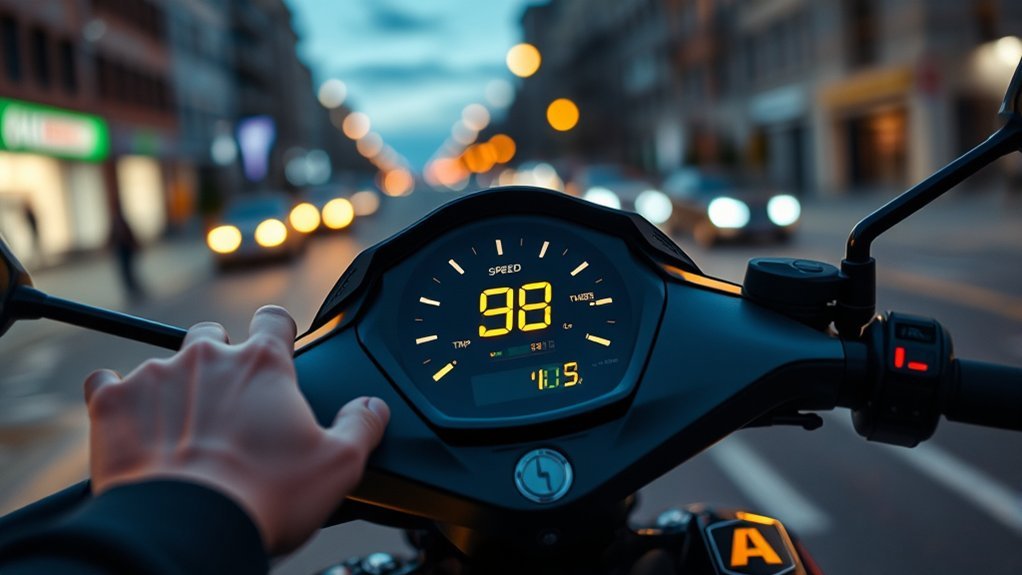
The term ODO is an abbreviation for odometer, derived from the ancient Greek words hodos (meaning “path” or “way”) and metron (“measure”). On modern electric scooters, the ODO readout on your liquid crystal display (LCD) or light-emitting diode (LED) dashboard reflects total accumulated distance in either miles (M / MPH mode) or kilometers (KM / KM/H mode).
Unlike automotive systems of the past that relied on mechanical gear cables driven by the front wheel hub, an electric scooter odometer is fully digital. It operates through the scooter’s central electronic speed controller (ESC), continuously recording distance as electrical pulses pass through the motor. Because it is designed as a lifetime ledger, the odometer remains intact even when you power down the scooter or disconnect the main lithium-ion battery pack.
How the Odometer Works: The Mechanics Behind the Mileage
Electric scooters calculate distance digitally rather than mechanically. Inside the hub motor, a series of Hall effect sensors detect the precise rotational position of the motor’s magnetic rotor. As the wheel spins, these sensors generate digital pulses that correspond to fractional rotations.
The calculation sequence follows a straightforward operational flow:
- Pulse Detection: The motor’s Hall sensors register every revolution of the wheel and transmit these frequency signals directly to the Electronic Speed Controller (ESC).
- Circumference Processing: The controller multiplies the total number of wheel rotations by the tire’s physical circumference ($\text{Circumference} = \pi \times \text{Diameter}$).
- Controller Memory Storage: The calculated distance increments are written to non-volatile electrically erasable programmable read-only memory (EEPROM) inside the controller and dashboard.
- Display Output: The processed value is broadcast to the dashboard screen whenever the display mode is toggled to “ODO”.
Note: Odometer precision depends heavily on tire circumference. If you switch from pneumatic air tires to solid rubber tires, or run significantly low tire pressure, your wheel’s effective rolling diameter shrinks. This causes the motor to spin more times per actual mile, leading to an odometer reading that can run 5% to 10% higher than your actual distance traveled.
Why the ODO Reading Matters for Riders
Tracking your scooter’s cumulative mileage is essential for preventative safety, warranty validation, and financial protection.
| Use Case | Rider Benefit | Practical Impact |
|---|---|---|
| Maintenance Timing | Component inspections based on real use | Prevents catastrophic brake failure, tire blowouts, and stem latch fatigue. |
| Warranty Verification | Proves coverage eligibility | Many brands (e.g., Segway, Apollo) cap warranty terms by both time (e.g., 12 months) and distance (e.g., 2,000 km). |
| Battery Health Tracking | Estimates charge cycle consumption | Helps gauge when lithium-ion cells approach their 300–500 full charge-cycle capacity drop. |
| Used Market Valuation | Provides transparent proof of wear | Prevents overpaying for heavily worn second-hand commuter scooters. |
ODO vs. Trip Meter: What’s the Difference?
Every standard electric scooter throttle display (such as the widespread QS-S4, EY3, or integrated LED cockpits) features both an ODO mode and a TRIP (or DST) mode. While they calculate distance using the same motor sensor inputs, their functions serve completely different purposes.
| Feature | Odometer (ODO) | Trip Meter (TRIP / DST) |
|---|---|---|
| Timeframe Tracked | Lifetime of the scooter | Single ride, commute, or day |
| Resettable? | No (Locked in firmware/EEPROM) | Yes (Manual button press or auto-cleared upon power off) |
| Primary Purpose | Scheduling service, tracking battery lifecycle, checking warranty | Measuring route distance, evaluating real-world single-charge range |
| Behavior on Power Off | Retains exact value permanently | Often resets to 0.0 automatically on budget throttles |
Can You Reset the ODO on an Electric Scooter?
Under normal operational conditions, you cannot reset the ODO on an electric scooter. Manufacturers intentionally lock the lifetime odometer counter inside the firmware to maintain an unalterable history of the vehicle’s usage.
Hardware vs. Controller Memory
While you cannot clear the ODO with a button combination, hardware replacements can create discrepancies:
- Display Replacements: On generic open-source throttle systems (e.g., QS-S4, TF-100, LH-100), the ODO counter is stored locally within the LCD display unit’s memory. If the display is replaced after physical damage, the new screen starts recording from 0 miles.
- Smart Central Controllers: On integrated smart scooters from major manufacturers like Segway-Ninebot, Xiaomi, or NIU, the master odometer is logged directly on the Electronic Control Unit (ESC) and Battery Management System (BMS). Even if you install a brand-new handlebar display, the system syncs with the ESC and restores the true lifetime mileage upon boot.
Warning: Attempting to flash modified firmware to reset or alter your scooter’s odometer voids manufacturer warranty coverage immediately. In many jurisdictions, intentionally modifying or misrepresenting vehicle mileage during a private sale constitutes consumer fraud under vehicle disclosure regulations.
Legal and Resale Transparency
Because electric scooters have become primary personal light electric vehicles (PLEVs) in urban transit, keeping accurate usage records has legal and consumer protection implications:
- Warranty Claims: If you file a warranty claim for a failed motor or cracked frame, technicians will cross-reference the ODO with the date of purchase to verify you have not exceeded commercial usage thresholds (frequently capped at 1,000–2,000 miles).
- Pre-Owned Market Trust: An unmolested ODO reading provides verifiable proof of how much life remains in the battery cells and drivetrain, ensuring fair valuation during resale.
How to Use ODO Data for Preventive Maintenance
Rather than waiting for a mechanical failure while riding, use your scooter’s ODO to perform systematic maintenance checks. Consult the schedule below to keep your scooter operating reliably.
| Milestone | Key Inspection Points | Required Action |
|---|---|---|
| Every 100 Miles (160 km) | Fasteners, tire pressure, folding mechanism | Check for loose stem bolts using blue Loctite (threadlocker); top up pneumatic tires to manufacturer PSI specifications (typically 45–50 PSI). |
| Every 300 Miles (480 km) | Brake pads, rotors, tire tread depth | Inspect disc brake pad thickness (replace if under 1mm); true warped brake rotors; check tire center tread for flat spots. |
| Every 600 Miles (1,000 km) | Wheel bearings, suspension pivots, brake cables | Check wheel bearings for crunching or side-to-side play; lubricate suspension pivot joints; bleed hydraulic brakes or replace stretched mechanical cables. |
| Every 1,200+ Miles (2,000 km) | Battery degradation, motor cable insulation | Perform a full battery capacity range test; inspect motor phase wire insulation where the cable enters the wheel axle for heat wear or fraying. |
Pro Tip: Keep a digital notes log on your phone or use your scooter’s companion app (such as the Segway-Ninebot App or Apollo App). Recording each mechanical service alongside the exact ODO value creates verifiable maintenance records that increase buyer confidence when you decide to sell or trade in your scooter.
Frequently Asked Questions
What is ODO in electric scooters?
ODO stands for odometer. It is a permanent digital counter on your scooter’s display that logs the total lifetime distance (in miles or kilometers) the scooter has traveled since manufacture.
How do you switch between ODO and Trip meter on the display?
On most electric scooter throttles (like the QS-S4, EY3, or standard single-button displays), a single short press of the Power button or Mode button toggles the lower screen readout sequentially through ODO, TRIP, VOL (voltage), and TIME.
Can you reset the ODO on an electric bike or scooter?
No. The odometer is hardcoded into the controller firmware and EEPROM memory to maintain a permanent record of vehicle usage. While replacing the physical LCD display on generic models might start the display at zero, the true controller mileage cannot be cleared via standard user menus.
Is ODO total mileage or current trip distance?
ODO is the total lifetime mileage. The TRIP (or DST) mode indicates current trip distance, which can be zeroed out manually at the start of every new ride.
Why does my scooter’s ODO show a different distance than GPS?
Scooter odometers calculate distance based on programmed wheel circumference in the P-settings (e.g., P06). If tire pressure is low, tire tread is worn, or the wheel size parameter is set incorrectly in the firmware, the wheel will spin more times per actual mile, creating a 3% to 10% discrepancy compared to satellite GPS tracking.
Conclusion
The ODO readout on your electric scooter is far more than a basic dashboard metric—it serves as the permanent health record and maintenance timeline for your ride. By understanding how the motor controller processes Hall sensor pulses to record mileage, distinguishing between your permanent ODO and temporary trip meters, and adhering to scheduled maintenance milestones, you can extend your scooter’s operational lifespan, maintain battery performance, and ensure safe riding for thousands of miles to come.
Sources
- Segway-Ninebot Official Support Documentation — Scooter controller architecture and firmware odometer logging specifications.
- ScienceDirect Engineering Reference — Hall Effect sensors in brushless DC (BLDC) hub motor speed and revolution sensing.
- SAE International (Society of Automotive Engineers) — Standards on light electric vehicle instrumentation, telemetry, and controller data logging.
- Apollo Scooters Technical Guides — Throttle display P-settings, wheel diameter configurations, and recommended preventative maintenance schedules.
