
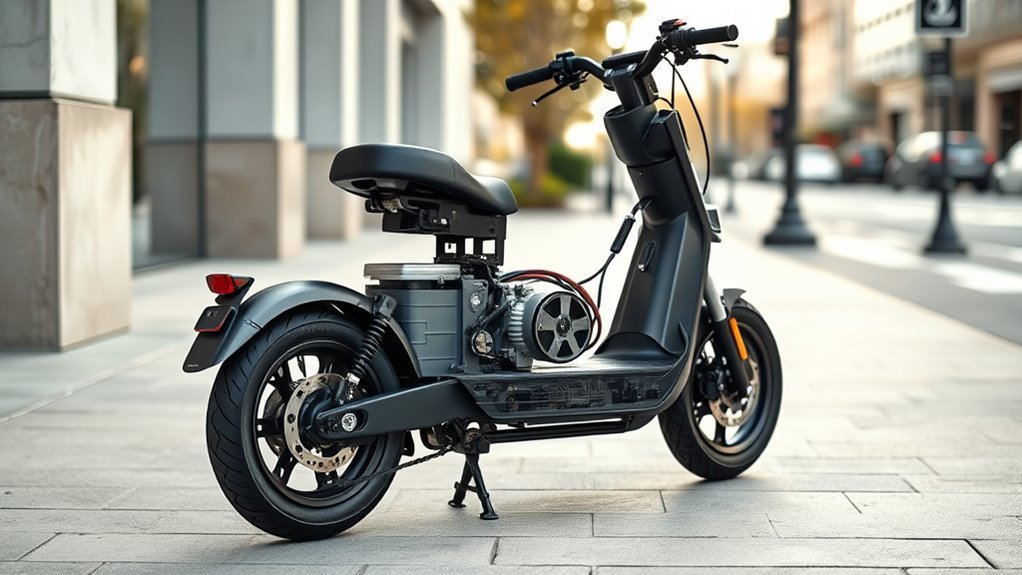
Last Updated on July 24, 2026 by Caleb Warren
An electric scooter moves by sending energy from a rechargeable battery through an electronic controller to an electric motor. The throttle tells the controller how much power you want, the motor turns one or both wheels, and the braking system slows the scooter. Range and performance depend on the whole system, not one headline specification.
Quick Answer
An electric scooter stores energy in a battery. Pressing the throttle sends a signal to the controller, which meters electrical power to a motor in the wheel. The motor creates torque that turns the wheel. Mechanical and electronic brakes then reduce speed, and some scooters recover a small amount of energy while slowing.
Key Takeaways
- The battery stores energy, while the battery management system helps control charging, discharge, temperature, and fault protection.
- The throttle sends a request. The controller, not the throttle itself, decides how much current reaches the motor.
- Many scooters use a brushless hub motor built into a wheel, although motor layouts and power levels vary.
- Real-world range changes with speed, hills, rider weight, temperature, tire pressure, wind, and battery condition.
- Electronic braking can support the main brakes, but it should not be treated as a substitute for properly maintained friction brakes.
Disclosure: As an Amazon Associate I earn from qualifying purchases. Some links on this page are affiliate links, at no extra cost to you.
How Does an Electric Scooter Work?
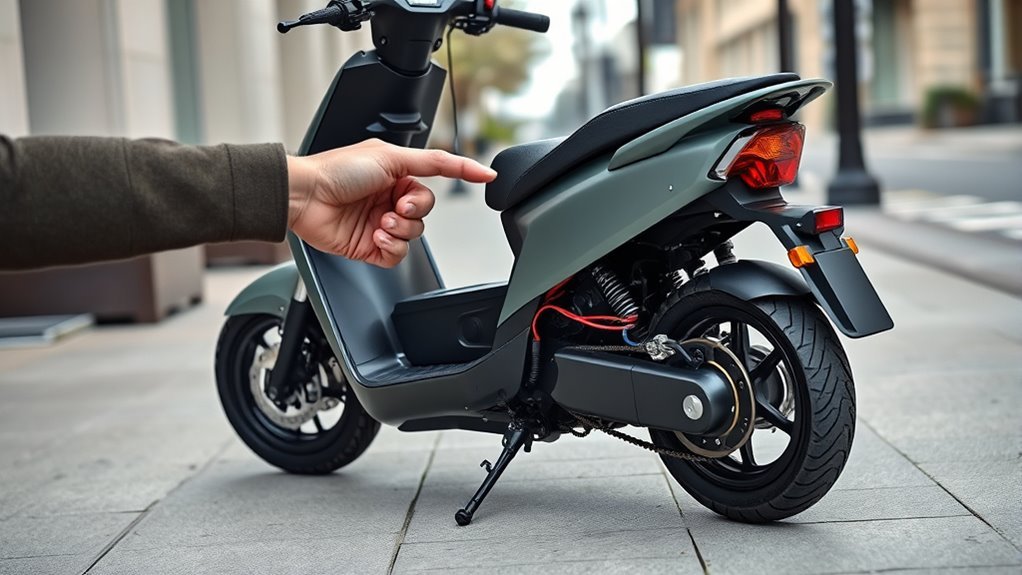
An electric scooter converts stored chemical energy into electrical energy and then into motion. A rechargeable battery pack supplies direct-current power. According to the U.S. Department of Energy’s battery overview, rechargeable batteries store energy chemically and release electricity through an external circuit when a device needs power.
When you press the throttle, a sensor sends a low-power command to the controller. The controller rapidly switches electrical current to the motor in the amount allowed by its programming, the battery, and the scooter’s selected riding mode. The motor creates torque, which turns the driven wheel and moves the scooter forward.
- The battery supplies energy: The pack provides the voltage and current available to the electrical system.
- The throttle requests power: A thumb, finger, or twist control tells the controller how much acceleration you want.
- The controller manages output: It regulates current, applies speed and temperature limits, and responds to brake cut-off signals.
- The motor creates torque: Electromagnetic force turns the rotor and the connected wheel.
- The brakes slow the scooter: Friction brakes provide stopping force, while an electronic brake may add resistance or recover some energy.
Battery to controller, controller to motor, motor to wheel: that is the basic energy path inside an electric scooter.
The Main Parts of an Electric Scooter
The battery, battery management system, controller, throttle, motor, and brakes form the core powertrain. The tires, frame, steering stem, folding mechanism, suspension, lights, and display do not create propulsion, but they strongly affect comfort, control, visibility, and safety.
| Part | What It Does | Why It Matters |
|---|---|---|
| Battery pack | Stores electrical energy | Affects available energy, weight, and charging time |
| Battery management system | Monitors cells and helps limit unsafe conditions | Supports battery protection and balanced operation |
| Throttle | Sends an acceleration request | Controls how precisely you can ask for power |
| Controller | Regulates current to the motor | Shapes acceleration, speed limits, and protection behavior |
| Motor | Converts electrical energy into wheel torque | Influences acceleration and hill performance |
| Brakes | Reduce speed and stop the scooter | Determine stopping control and backup capability |
| Tires and suspension | Keep the scooter in contact with the road | Affect grip, comfort, stability, and range |
| Frame and folding mechanism | Support the rider and connect the steering assembly | Affect structural strength and handling |
Battery and Motor
Many commuter scooters use a lithium-ion battery pack because it offers useful energy storage at a manageable size and weight. Battery capacity is commonly listed in watt-hours, or Wh. You can calculate the nominal figure by multiplying voltage by amp-hours: volts × amp-hours = watt-hours. A 36-volt, 10-amp-hour pack, for example, has a nominal capacity of 360 Wh.
More watt-hours usually provide more potential range when the scooters being compared are otherwise similar. However, watt-hours alone do not tell you the final distance. Motor tuning, controller limits, speed, tires, temperature, hills, wind, and rider weight can change energy use considerably.
The motor changes electrical power into rotational force. Many modern stand-up scooters use a brushless hub motor inside the front or rear wheel. A hub layout has few external drivetrain parts and responds quickly to controller input. Some performance scooters use two hub motors, while a smaller number use a chain or belt to transfer power from a separate motor to the wheel.
Throttle and Controller
The throttle is an input device, not a direct power switch. It sends a signal that represents your requested acceleration. The controller reads that signal together with brake inputs, riding mode, battery voltage, temperature data, and programmed limits. It then meters current to the motor.
A controller may also manage electronic braking, lights, the display, cruise functions, traction settings, and communication with an app. Features vary by model. The controller must be matched to the battery voltage, motor, sensors, and firmware; installing an incompatible controller can damage components or create unsafe operation.
Battery Management System
The battery management system, often shortened to BMS, monitors the battery pack. Depending on its design, it can track cell voltage, pack current, and temperature, and it can interrupt charging or discharge when it detects an unsafe condition. It also helps keep groups of cells operating within an acceptable range.
A BMS reduces risk, but it cannot make a damaged, modified, overheated, waterlogged, or incorrectly charged battery safe. Product-level testing matters too. UL Solutions explains that UL 2272 evaluates the electrical drive train, battery system, and charger combination used in personal e-mobility devices.
Tires, Suspension, Frame, and Controls
Pneumatic tires can absorb small bumps and offer useful grip, but they require correct pressure and can puncture. Solid tires reduce puncture concerns but often transmit more vibration and may offer less grip on some surfaces. Low tire pressure increases rolling resistance and can reduce range.
Suspension helps the wheels stay in contact with uneven ground, but it does not make potholes harmless. The frame, stem, handlebar, and folding latch carry repeated loads whenever you accelerate, brake, turn, or cross rough pavement. Loose fasteners or play in the folding mechanism should be checked before riding.
How the Battery Powers the Scooter
The battery pack contains connected cells that provide the voltage and energy the scooter needs. When the scooter is on and the BMS allows discharge, current flows from the pack to the controller. The controller then sends controlled pulses of power to the motor.
- Voltage is related to the electrical pressure available to the system.
- Current, measured in amps, changes with the power demanded by the motor.
- Watt-hours describe stored energy and are useful when comparing battery sizes.
- Usable capacity may be lower than the nominal label because the controller and BMS reserve a safety margin.
During charging, the charger converts household AC power into the DC voltage and current required by the battery. The BMS and charger work together to control the process. The U.S. Department of Transportation notes that micromobility charging times can range from about 2.5 to 9 hours, depending on battery capacity and charger specifications. Your model’s manual is the correct source for its charging time.
Warning: Use only the charger supplied or specifically approved by the scooter manufacturer. Charge while you are present, not while sleeping, and unplug the scooter when charging is complete. Stop using a battery that is swollen, leaking, unusually hot, damaged, hissing, smoking, or giving off a strong odor. Move away and call emergency services if it begins to smoke or burn.
The U.S. Consumer Product Safety Commission’s micromobility guidance also advises riders to follow the manufacturer’s charging instructions, stay present while charging, and use only an approved charger and replacement battery.
Note: There is no universal charging percentage that is best for every scooter. Follow the storage and charging limits in your owner’s manual. Avoid extreme heat, freezing storage, and leaving a deeply discharged battery unused for long periods.
What the Controller Does
The controller is the power electronics unit between the battery and motor. It interprets the throttle request and switches current through the motor windings in a timed sequence. This produces a rotating magnetic field that pulls or pushes the motor’s rotor around.
The controller can limit current during launch, reduce output when the battery voltage is low, cut drive power when a brake sensor activates, and restrict speed according to the scooter’s mode or local configuration. More advanced controllers can also monitor motor temperature, communicate with a display or app, and coordinate two motors.
The controller does not create energy. It manages how quickly the battery’s stored energy is used. Aggressive controller settings can improve acceleration, but they also increase current draw, heat, and stress on the battery and motor.
How the Throttle Controls Speed
When you press the throttle, a position sensor sends a changing electrical signal or a digital command to the controller. The controller compares that request with the scooter’s limits and operating conditions, then changes motor torque. More throttle usually requests more torque, which helps the scooter accelerate or maintain speed against resistance.
Throttle Signal Basics
- Thumb throttles use downward thumb movement and are common on commuter scooters.
- Finger throttles use a small trigger that you pull with a finger.
- Twist throttles rotate around the handlebar, similar to a motorcycle control.
- Kick-to-start systems may require the scooter to roll before the throttle becomes active.
Kick-to-start is a safety feature on many models because it reduces the chance of an unexpected launch while the scooter is standing still. Some scooters let you change this behavior in an app, but zero-start mode can make accidental throttle input more serious.
Speed Control With Grip
Throttle position affects requested motor torque, but it does not always map directly to a fixed speed. On level ground, the scooter may continue accelerating until it reaches its programmed limit. On a hill, the same throttle position may only maintain a lower speed because gravity and rolling resistance require more torque.
Motor wattage alone does not determine top speed. Battery voltage, controller current, wheel size, motor winding, software limits, rider weight, tire pressure, wind, and road slope all contribute. Advertised peak power may also be available only for short periods.
How the Motor Moves the Wheels
In a brushless motor, stationary coils create changing magnetic fields. Permanent magnets on the rotating part follow those fields, causing the rotor to turn. In a hub motor, the rotor is connected to the wheel, so motor rotation becomes wheel rotation without an external chain or belt.
- Front hub motor: Pulls the scooter from the front and can make the steering feel different under hard acceleration.
- Rear hub motor: Pushes from the rear and often offers predictable traction under acceleration.
- Dual motors: Increase available traction and power but also add weight and use energy faster when both are active.
- Chain or belt drive: Lets a separate motor drive the wheel through a reduction system, but it adds moving parts and maintenance.
The motor produces torque, while the wheel converts that torque into force at the road. A smaller wheel can increase the force available at the contact patch for the same axle torque, while a larger wheel rolls over obstacles more easily. Controller programming and traction conditions decide how much of the motor’s potential can be used safely.
How Electric Scooter Brakes Work
Electric scooters use different brake combinations. A scooter may have disc brakes, drum brakes, a rear-fender friction brake, an electronic brake, or a combination. There is no universal three-part layout.
| Brake Type | How It Slows the Scooter | Main Limitation |
|---|---|---|
| Disc brake | Caliper pads squeeze a rotor attached to the wheel | Needs adjustment and pad or rotor maintenance |
| Drum brake | Brake shoes press inside a covered drum | Less visible and harder to inspect |
| Rear-fender brake | Your foot pushes the fender against the tire | Can be less controlled, especially in wet conditions |
| Electronic brake | The controller makes the motor resist wheel rotation | Braking strength can fall at low speed or during an electrical fault |
| Regenerative brake | The motor acts partly as a generator and sends some energy toward the battery | Energy recovery varies and may be limited when the battery is full, cold, or unable to accept charge |
Some scooters blend electronic braking with a mechanical brake when you pull one lever. Others use separate controls. Electronic braking can reduce friction-brake wear and smooth deceleration, but it should not be your only dependable stopping method. A complete stop still requires adequate braking force and tire grip.
Pro Tip: Test the brakes at walking speed before every ride. Check lever feel, cable tension, pad wear, rotor condition, tire grip, and whether the electronic brake activates normally.
Regenerative braking does not refill the battery with all the energy used to accelerate. Losses occur in the tire, motor, controller, wiring, and battery. On a light scooter, recovered energy is usually a secondary benefit rather than a replacement for wall charging. Official Segway product information shows that regenerative braking exists on some models, such as the Ninebot KickScooter MAX, but the feature and its strength are model-specific.
Which Battery Types Are Used in Scooters?
Lithium-ion is the main battery family used in current portable electric scooters. Battery chemistry and pack design still vary. Older, low-cost, mobility, or specialized scooters may use other rechargeable chemistries.
| Battery Type | Typical Use | Trade-Offs |
|---|---|---|
| Lithium-ion | Most modern portable e-scooters | Good energy-to-weight ratio, but requires a compatible charger and careful protection from damage and heat |
| Nickel-metal hydride | Older or uncommon designs | Durable in some uses, but generally heavier for the same stored energy |
| Sealed lead-acid | Some older, seated, or budget scooters | Lower purchase cost, but much heavier and less energy-dense |
Do not replace a battery based only on matching voltage or connector shape. The pack must be approved for the scooter and compatible with the charger, controller, mounting system, current demand, and communication wiring.
What Changes Electric Scooter Range?
Range is the result of stored energy divided by energy use. A simple comparison is:
Estimated range = usable battery watt-hours ÷ average watt-hours used per mile or kilometer.
The challenge is that average energy use changes from ride to ride. Manufacturer range tests may use a light rider, moderate speed, warm temperature, correct tire pressure, and flat ground. Your result can be lower in normal traffic.
Battery Capacity
A larger Wh rating gives the scooter more stored energy, but only when the pack is healthy and the scooter can use that capacity. Battery age, cell balance, temperature, and voltage limits can reduce usable energy. A large battery also adds weight, which slightly increases the energy needed for acceleration and climbing.
Riding Conditions
- Speed: Higher speed increases aerodynamic drag and usually raises energy use sharply.
- Acceleration: Repeated full-power launches draw more current than gentle starts.
- Hills: Climbing converts battery energy into gravitational potential energy.
- Rider and cargo weight: More mass requires more energy to accelerate and climb.
- Temperature: Cold conditions can reduce available battery power and range.
- Wind: A headwind increases aerodynamic resistance.
- Tire pressure: Underinflated pneumatic tires increase rolling resistance.
- Stops: Stop-and-go riding uses more energy than steady riding, even when regenerative braking is available.
Motor and System Efficiency
Efficiency depends on the motor, controller, wiring, bearings, tires, and operating point. A motor can be efficient at one speed and load but less efficient when it is heavily loaded, moving slowly up a steep hill, or operating near its thermal limit.
Higher motor wattage can improve acceleration and climbing ability when the battery and controller support it. It does not guarantee better range. A powerful scooter ridden gently may be efficient, while the same scooter ridden at maximum speed can drain its battery quickly.
How to Get More Real-World Range
- Use a moderate riding mode and avoid unnecessary top-speed travel.
- Accelerate smoothly and look ahead so you can coast rather than brake late.
- Keep pneumatic tires at the pressure listed by the manufacturer.
- Remove unneeded cargo and avoid exceeding the rated load.
- Store and charge the battery within the temperature range in the manual.
- Address brake drag, rough bearings, damaged tires, and battery faults promptly.
Common Electric Scooter Problems and What They Mean
| Symptom | Possible Causes | Safe First Checks |
|---|---|---|
| Throttle does not respond | Low battery, active brake cut-off, kick-start setting, app lock, loose connector, controller fault | Check the display, charge level, brake lever return, riding mode, and manual |
| Jerky acceleration | Throttle sensor fault, loose motor connection, controller issue, damaged hall sensor, traction loss | Stop riding, inspect for visible damage, and arrange qualified service |
| Range suddenly drops | Cold weather, low tire pressure, brake drag, battery aging, high speed, steep route | Check tires, brakes, temperature, route, and battery error messages |
| Motor cuts out on a hill | Overtemperature protection, low voltage, excessive load, controller current limit | Stop safely, let the scooter cool, reduce load, and avoid repeated restart attempts |
| Charger or battery becomes unusually hot | Incompatible charger, damaged cells, poor ventilation, electrical fault | Disconnect only if safe, move away, and do not reuse until professionally inspected |
| Brake rubbing or weak braking | Misaligned caliper, worn pads, stretched cable, bent rotor, contaminated braking surface | Do not ride until the brake works correctly |
Do not open a sealed lithium-ion battery pack or attempt cell-level repairs unless you are trained and equipped for high-energy battery work. A damaged pack can short, release toxic smoke, or ignite.
Why Scooters Work So Well in Cities
Electric scooters are compact, easy to park, and useful for short trips or first-and-last-mile connections. Their electric motors produce no tailpipe exhaust while operating, and common residential outlets can charge many models. The U.S. Department of Transportation includes micromobility riders among active transportation users and notes the role of small devices in connecting people with other transport modes.
| City Advantage | Practical Effect | Important Limit |
|---|---|---|
| Compact size | Easy storage and parking | Small wheels are vulnerable to potholes and debris |
| Electric drive | Quiet operation and no tailpipe exhaust | Battery production and electricity generation still have environmental impacts |
| Quick access | Useful for short trips and transit connections | Rules for roads, bike lanes, sidewalks, helmets, and speed vary by location |
| Low routine energy use | Can cost less to operate than many motor vehicles | Tires, brakes, batteries, and structural parts still require maintenance |
City riding also brings risks. Small tires can stop suddenly on cracks or debris, wet surfaces reduce grip, and drivers may not expect a scooter in their path. Wear an appropriate helmet, keep both hands on the handlebar, use lights and reflective gear, obey local rules, and slow down where visibility is limited.
Sources
- U.S. Consumer Product Safety Commission: Micromobility Information Center — charging, riding, battery, and replacement-part safety guidance.
- CPSC: Warning About Universal Micromobility Chargers — charger compatibility and fire risk.
- UL Solutions: Personal E-Mobility Testing and Certification — UL 2272 scope and electrical-system testing.
- U.S. Department of Energy: DOE Explains Batteries — how rechargeable batteries store and release energy.
- U.S. Department of Transportation: Electric Micromobility Basics — device definitions and general charging-time range.
Frequently Asked Questions
What are the disadvantages of an electric scooter?
Common disadvantages include limited range, reduced performance in cold weather or on steep hills, exposure to rain and road hazards, small tires, limited cargo space, changing local rules, and the cost of tires, brakes, batteries, and structural repairs. Safe indoor charging and secure storage can also be difficult for some riders.
How far will an electric scooter go on a full charge?
There is no reliable universal distance. Compare battery watt-hours and independent real-world testing, then account for your weight, speed, hills, wind, temperature, tire pressure, and stops. Advertised range often comes from controlled conditions and may be higher than everyday results.
Can you ride an electric scooter on a highway?
Do not assume that you can. Access rules depend on the country, state, province, and city, and high-speed roads are unsafe for low-speed stand-up scooters. Check the current local traffic law and the rules for the exact road before riding.
What should I know before buying an electric scooter?
Check legal use, tested range, battery watt-hours, rider weight limit, braking setup, tire type, water-resistance rating, portability, parts support, warranty, approved charger availability, and independent safety certification. Choose a scooter that fits your route rather than buying only by top speed or peak motor power.
Can an electric scooter charge itself while you ride?
Some models recover a limited amount of energy during regenerative braking. They do not create free energy and cannot replace normal charging. Energy recovery depends on the scooter, speed, braking pattern, battery state, temperature, and controller programming.
Can you ride an electric scooter in the rain?
Only within the limits stated by the manufacturer. An IP rating does not make a scooter waterproof, and water damage may not be covered by warranty. Avoid deep water, flooding, high-pressure washing, wet charging ports, and riding when reduced grip or visibility makes the trip unsafe.
Do electric scooters have gears?
Most stand-up electric scooters do not have rider-operated gears. A hub motor usually drives the wheel directly, while the controller changes motor torque electronically. Some chain- or belt-driven designs use a fixed reduction ratio, but you still do not shift gears while riding.
Conclusion
An electric scooter works as a connected system. The battery stores energy, the BMS watches the pack, the throttle sends your request, the controller regulates current, and the motor turns the wheel. Brakes, tires, and the frame then determine how safely that motion is controlled.
Understanding that chain helps you compare scooters more realistically. Look beyond top speed and advertised range. Check battery energy, controller behavior, braking redundancy, tire condition, certification, charging instructions, and parts support. A well-matched and well-maintained system gives you smoother acceleration, more predictable range, and safer daily travel.
