

Last Updated on September 10, 2026 by Daniel Globe
An electric scooter can be cheap to charge, compact to store, and convenient for short trips, but whether it is worth buying depends heavily on where you live and where you plan to ride. For UK readers, the legal issue comes first: a privately owned e-scooter cannot currently be used legally on public roads, pavements, cycle lanes, or other public spaces. That makes buying one for an ordinary public-road commute much harder to justify, even if the running costs look attractive.
Quick Answer
An electric scooter can be worth it for short trips if you have somewhere legal to ride, safe storage, and a route within its real-world range. In the UK, however, buying a private e-scooter specifically for a public-road commute is usually hard to justify because private scooters remain illegal to ride in public.
Key Takeaways
- UK legality comes first: privately owned e-scooters may be used on private land with the landowner’s permission, but not on public roads, pavements, cycle lanes, or parks.
- Official rental trials are different: approved rental scooters can be ridden on roads and cycle lanes in participating English trial areas, subject to licensing and other rules.
- Electricity is inexpensive: a typical commuter-sized battery can cost only a few pence to the low teens in electricity for a charge, although actual cost depends on battery size, tariff, and charging losses.
- Advertised range is not guaranteed: speed, hills, rider weight, temperature, tyre pressure, and stop-start riding can all reduce it.
- Safety deserves serious weight: braking, road surface, visibility, protective gear, and battery-charging practices matter as much as price and range.
Disclosure: As an Amazon Associate I earn from qualifying purchases. Some links on this page are affiliate links, at no extra cost to you.
Is an Electric Scooter Worth It?
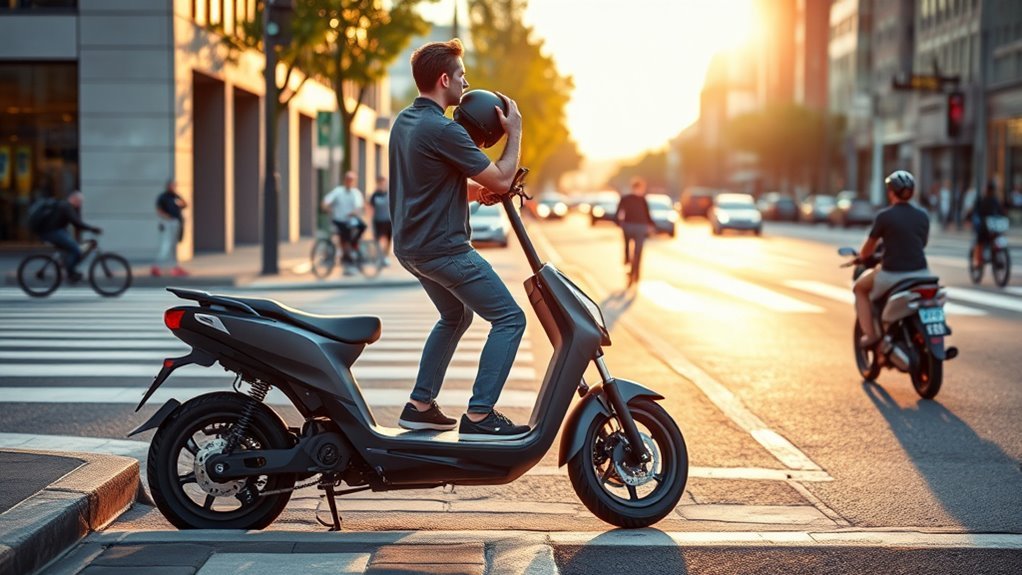
If you have a legal place to ride and mainly make short trips, an electric scooter can offer useful mobility with very low electricity consumption, little storage space, and less physical effort than a bicycle. The answer changes sharply, however, if you are buying one to commute on public streets in the UK.
Current GOV.UK guidance says privately owned e-scooters cannot legally be ridden in public. They can be used on private land with the landowner’s permission. Official rental e-scooters operating in authorised trial areas are a separate category and have different rules.
Warning: If your plan is to buy a private e-scooter and ride it to work on UK roads or cycle lanes, the legal restriction can outweigh nearly every cost or convenience advantage. Check the current government rules before spending money.
That means the practical answer is:
- Private-land use: potentially worth it if you have permission, enough space, and a suitable route.
- Authorised rental-trial area: renting can be useful for short urban journeys.
- Private scooter for an ordinary UK public commute: usually not worth buying under the current legal position.
- Outside the UK: check your national, regional, and city rules before judging value, because e-scooter laws vary widely.
Electric Scooter Costs: Purchase, Charging, and Upkeep
The purchase price is only one part of the cost. A useful comparison includes the scooter, electricity, tyres, brakes, repairs, possible battery replacement, accessories, secure storage, and the cost of the transport you would otherwise use.
Purchase Price Range
Electric scooter prices change frequently, so a fixed statement such as “a mid-range scooter costs £600” can become stale quickly. As a current example, the NIU UK manufacturer store listed commuter models from roughly £249 on sale to £699 at the time this article was updated, with other models between those figures. Premium scooters can cost considerably more.
Rather than buying by price alone, compare:
- battery capacity in watt-hours (Wh);
- realistic range for your route;
- braking system;
- tyre type and replacement cost;
- suspension and ride comfort;
- water-resistance rating and manufacturer restrictions;
- scooter weight if you need to carry it;
- maximum rider load;
- warranty length;
- replacement battery and spare-parts availability.
Charging Cost Savings
Electricity is one of the smallest ownership costs. The simplest way to estimate a full charge is:
Battery capacity in Wh ÷ 1,000 × electricity price per kWh = approximate battery-energy cost.
For example, Ofgem’s average electricity unit rate for a Direct Debit customer on a default tariff in Great Britain is 26.11p per kWh for July through September 2026. A scooter with a 460Wh battery therefore stores about 0.46kWh, equal to roughly 12p of electricity at that unit rate before allowing for charging losses.
A larger 551Wh pack works out at roughly 14p of stored energy at the same rate. Your actual bill can differ because of your tariff, charging losses, battery state, and how often you ride. The household standing charge is not caused by the scooter and normally should not be assigned to each charge.
Note: Claims such as “1p per mile” or “£13 per year” are only meaningful when battery efficiency and annual mileage are known. Calculate from your own route instead of relying on a universal yearly figure.
Maintenance and Repairs
E-scooters have fewer powertrain service items than petrol vehicles, but they are not maintenance-free. Costs depend heavily on the model and how it is ridden.
Common maintenance includes:
- checking tyre pressure and tread;
- repairing punctures or replacing tyres;
- adjusting or replacing brake components;
- checking folding joints and fasteners;
- cleaning the scooter after dirty or wet rides where permitted by the manufacturer;
- checking lights and controls;
- repairing crash damage;
- eventually replacing a worn or faulty battery.
A fixed annual maintenance estimate is not reliable across all scooters. Before buying, look up the actual cost and availability of tyres, brake parts, chargers, and replacement batteries for the exact model.
A Better Way to Calculate Your Savings
Instead of assuming that an e-scooter will save thousands of pounds each year, compare it with the transport it will actually replace.
First-year scooter cost = purchase price + electricity + maintenance + accessories + repairs.
First-year saving = cost of journeys replaced − first-year scooter cost.
For later years, remove the original purchase price but allow for larger repairs or battery replacement. If a scooter merely replaces walking or a bicycle you already own, the financial saving may be small or negative. If it legally replaces frequent taxi or car trips, the potential saving can be much larger.
Are Electric Scooters Legal Where You Live?
Legality can determine whether an electric scooter is useful at all. UK readers need to distinguish between a privately owned scooter and a scooter rented through an official government trial.
UK Public Road Rules
| Situation | Current position |
|---|---|
| Privately owned e-scooter on a public road | Not legal for normal public use. |
| Privately owned e-scooter on a pavement, cycle lane, public park, or other public space | Not legal. |
| Privately owned e-scooter on private land | Permitted with the landowner’s permission. |
| Approved rental-trial scooter on a road in a trial area | Permitted subject to trial rules. |
| Approved rental-trial scooter in a cycle lane | Generally permitted in an authorised trial area. |
| Rental-trial scooter on a pavement or motorway | Not permitted. |
Official rental-trial users need an appropriate full or provisional driving licence. The rental operator provides third-party motor insurance. Rental scooters are limited to a maximum of 15.5 mph, and local operators or authorities can impose lower limits.
The Department for Transport says the English rental-trial programme is currently due to continue until May 2028. Because trial areas and rules can change, use the current government trial guidance rather than relying on an old list.
Private Property Use
A privately owned electric scooter may be used on private land when the landowner gives permission. That does not remove the need for sensible safety precautions.
- Confirm that the landowner allows e-scooters.
- Inspect the surface for potholes, loose gravel, water, steep drops, and obstacles.
- Wear a correctly fitted helmet and suitable footwear.
- Keep speed appropriate for the space and conditions.
- Keep pedestrians and other users well clear.
- Follow the manufacturer’s rider-weight, age, weather, and operating instructions.
Local Law Variations
Outside the UK, rules can differ by country, state, province, and city. Some jurisdictions allow e-scooters in bicycle infrastructure, some impose speed or age limits, and others require registration, insurance, helmets, or specific equipment.
Check the transport or road authority for the exact place where you intend to ride. Do this before buying, not after the scooter arrives.
Electric Scooter Benefits for Daily Commuting
Where they can be used legally, e-scooters are well suited to short urban journeys and first- or last-mile connections.
- Low electricity use: small batteries consume far less energy than a car.
- Compact storage: many commuter scooters fold and fit into small storage spaces.
- Simple short trips: they can be convenient for errands or links between transport stops.
- Zero tailpipe emissions: there is no exhaust at the point of use.
- Less physical effort: useful when the rider does not want the exertion required by a conventional bicycle.
The environmental advantage needs context. In the Department for Transport’s first national trial evaluation, some rental-scooter journeys replaced car or taxi journeys, while many others replaced walking, public transport, or cycling. An e-scooter is therefore most likely to deliver a meaningful transport-emissions benefit when it replaces a motor-vehicle journey rather than an active journey you would otherwise have walked or cycled.
Electric Scooter Drawbacks: Range, Weather, and Safety
The main disadvantages are legal restrictions, exposure in a crash, variable real-world range, poor-weather limitations, small wheels, limited cargo capacity, theft risk, and the possibility of expensive battery or electronic repairs.
Advertised Range vs. Real-World Range
Do not treat the number printed on a product page as a guaranteed commuting range. For example, current Segway commuter models advertise different ranges depending on speed and test conditions. Manufacturer testing may use a moderate rider weight, smooth pavement, warm temperature, steady speed, and a fully charged battery.
Real-world range can fall when you have:
- a heavier rider or more luggage;
- steep hills;
- frequent acceleration and braking;
- high-speed riding;
- cold temperatures;
- strong headwinds;
- underinflated tyres;
- rough surfaces;
- an ageing battery.
Pro Tip: Choose enough battery capacity to finish your normal round trip with a comfortable reserve. If the journey only works when the advertised maximum range is achieved perfectly, the scooter is too marginal for that route.
Weather and Road Surface
Wet leaves, painted road markings, metal covers, loose gravel, potholes, ice, and standing water can be especially challenging on a scooter’s small wheels. Rain can also affect braking and visibility.
Water-resistance ratings vary by model. An IP rating does not automatically mean a scooter can be ridden through deep puddles, flooded roads, or heavy rain. Follow the exact manufacturer’s guidance and avoid charging a wet or damaged scooter.
Safety Risk
Department for Transport final figures show 1,377 reported Great Britain road collisions involving e-scooters in 2025, resulting in 1,477 casualties, including 10 fatalities.
Those figures cover reported road collisions involving e-scooters and should not be interpreted as a simple per-mile risk comparison with cars or bicycles. They do show why safety should be part of the buying decision rather than an afterthought.
For official rental-trial scooters, the government recommends wearing a cycle helmet, although it is not legally mandatory. Trial rules also prohibit intoxicated riding, mobile-phone use while riding, carrying a passenger, and towing.
Electric Scooter Battery and Charging Safety
Most e-scooters use lithium-ion batteries. These batteries are normally safe when properly designed and used, but damaged, poor-quality, modified, or incorrectly charged packs can cause serious fires.
Warning: GOV.UK advises against charging an e-scooter while you are asleep or away from home. Do not charge it where a fire could block your escape route, and do not use or charge a battery that is swollen, leaking, unusually hot, damaged, hissing, or giving off an unusual smell.
Follow these basic precautions:
- Buy the scooter, battery, and charger from a reputable seller.
- Register the product so you can receive safety-recall information.
- Use the charger supplied by the manufacturer or an authorised replacement.
- Follow the stated charging time and unplug the charger when charging is complete.
- Allow a hot battery to cool after use before charging it.
- Keep the scooter and charger away from combustible materials.
- Do not cover the charger or battery while charging.
- Do not modify or de-restrict the battery, charger, or electrical system.
- Check the battery after a crash or hard impact.
See the Department for Transport’s battery-safety guidance for detailed storage, charging, warning-sign, and disposal advice.
E-Scooters vs Cars, Bikes, and Public Transit
An e-scooter sits between walking, cycling, public transport, and driving. Which option is best depends on distance, legality, weather, physical ability, storage, cost, and the route itself.
| Option | Main strengths | Main drawbacks |
|---|---|---|
| E-scooter | Low electricity use, compact storage, little physical effort | UK private-use restrictions, weather exposure, crash risk, battery limits |
| Bicycle | Very low running cost, exercise, no charging on a conventional bike | More physical effort, storage and theft concerns |
| Public transport | No vehicle purchase, useful for longer trips, works in poor weather | Fares, timetables, transfers, and service disruption |
| Car | Weather protection, passenger/cargo space, long-distance flexibility | Purchase/depreciation, fuel or electricity, insurance, maintenance, parking |
For many short journeys, a bicycle may actually be the strongest UK alternative to a privately owned e-scooter because it avoids the current public-use restriction while remaining inexpensive to run. An authorised rental scooter can still fill a useful gap where a trial operates.
Who Should Buy an Electric Scooter?
An electric scooter may make sense when:
- you have private land where its use is permitted;
- your route is short enough for a comfortable battery reserve;
- you have secure, dry storage;
- you can charge it safely without blocking an escape route;
- you do not need to carry it up difficult stairs every day;
- the manufacturer supports your weight and intended terrain;
- spare tyres, brakes, batteries, and service are available;
- you understand the local law and how it applies to your exact route.
If you live in a UK rental-trial area and mainly want occasional public-road journeys, renting may make more sense than buying a private scooter that you cannot legally use for the same trip.
Electric Scooter “Worth It” Checklist
Before buying, answer these questions in order:
- Can I legally ride it on my intended route? If not, stop there.
- How far is my longest normal round trip? Leave a realistic battery reserve rather than relying on the claimed maximum.
- Can I lift and store it? Check the actual scooter weight, stair access, and available space.
- Can I charge it safely? You need an appropriate socket and a location that does not block an escape route.
- What happens when something breaks? Check tyre, brake, charger, controller, and battery availability.
- What transport will it replace? This determines whether there is a real financial or environmental saving.
- What is my bad-weather backup? A scooter may not be suitable every day of the year.
- Is the route itself safe? Rough surfaces, fast traffic, poor lighting, and lack of suitable infrastructure may outweigh convenience.
If you cannot give a confident answer to the legality, range, storage, and charging questions, buying the scooter is probably premature.
Frequently Asked Questions
What are the downsides of electric scooters?
The main drawbacks are legal restrictions, limited real-world range, poor-weather performance, exposure in a crash, small-wheel stability, theft risk, limited cargo capacity, and potential costs for tyres, brakes, electronics, and batteries.
Is it a good idea to get an electric scooter?
It can be if you have somewhere legal to ride, your journeys are short, you can store and charge it safely, and its real-world range fits your route. In the UK, buying a private scooter for an ordinary public-road commute is difficult to justify because private public use remains illegal.
Can you ride a privately owned electric scooter on UK roads?
No, not for normal public use under the current rules. Privately owned e-scooters may be used on private land with the landowner’s permission. Approved rental scooters in official trial areas have a limited legal exception for roads and cycle lanes.
How much does it cost to charge an electric scooter?
Multiply the battery’s watt-hour rating by your electricity rate. At 26.11p per kWh, a 460Wh battery contains roughly 12p of electricity from empty to full before charging losses. Your actual cost depends on battery size, tariff, charging efficiency, and how empty the battery is.
Are electric scooters suitable for autistic children?
Autism alone does not determine whether a motorised scooter is suitable. Consider the child’s age, balance, judgement, sensory needs, ability to follow safety instructions, the manufacturer’s minimum-age guidance, adult supervision, and local law. Do not assume an electric scooter provides specific developmental or therapeutic benefits without advice from an appropriate professional.
Can police stop you for riding a private e-scooter in public?
Yes. GOV.UK warns that illegal use of a privately owned e-scooter can lead to a fine, penalty points on a driving licence, and the scooter being seized or impounded. Enforcement can vary, but the underlying public-use restriction remains in force.
Sources
- GOV.UK — Riding an electric scooter: the rules — current private and rental e-scooter rules.
- Department for Transport — Using a rental e-scooter — trial locations, licence requirements, speed, helmet, and road-use rules.
- Department for Transport — E-scooter factsheet 2025 — final Great Britain collision and casualty statistics.
- Ofgem — Energy price cap unit rates — current electricity price used for the charging-cost examples.
- Department for Transport — Battery safety for e-scooter users — safe purchasing, charging, storage, warning signs, and battery disposal.
- Segway-Ninebot — F2 Pro E II specifications — representative battery capacity, rated range, and manufacturer range-test conditions.
Conclusion
So, is an electric scooter worth it? The low electricity use, compact size, and convenience can make one attractive for short journeys, but the answer is not simply about purchase price or range. You also need a legal route, realistic battery reserve, safe charging location, reliable parts support, secure storage, and a route you are comfortable riding.
For UK readers, the legal issue is decisive. A privately owned e-scooter is usually a poor choice for a normal public-road commute while public use remains illegal. If you have suitable private land, or you use an approved rental scooter in an official trial area, the economics and convenience can make much more sense.
