
Last Updated on September 10, 2026 by Daniel Globe
Most electric scooters take between 3 and 8 hours to fully charge, depending on battery capacity (measured in watt-hours), charger output amperage, ambient temperature, and battery health. Compact commuter scooters with 250Wh to 360Wh batteries typically recharge in 3 to 5 hours using a standard 2A charger, while high-performance scooters with 1,500Wh to 2,500Wh packs can require 10 to 20 hours unless equipped with dual charging ports or high-output fast chargers.
Quick Answer
An electric scooter takes an average of 4 to 6 hours to reach a 100% charge. Smaller commuter models (under 300Wh) take roughly 3 to 4.5 hours, mid-range commuter scooters (400Wh–600Wh) take 5 to 7 hours, and large dual-motor performance scooters (1,000Wh+) take 8 to 18+ hours with standard chargers.
Key Takeaways
- Battery capacity (Wh) and charger current (A) are the two primary variables governing charging speed.
- The final 15% to 20% charges significantly slower due to the Constant Voltage (CV) phase used by lithium-ion battery management systems (BMS) to safely balance cells.
- Charging at extreme temperatures (below 0°C or above 45°C) degrades battery capacity and triggers thermal BMS throttles.
- A standard full recharge costs an average of $0.05 to $0.25 in electricity, making e-scooters one of the most cost-effective urban transit methods.
At a Glance
| Average Time Required | 3 to 8 hours (standard commuter); 8 to 20 hours (performance packs) |
| Optimal Temperature | 10°C to 30°C (50°F to 86°F) |
| Standard Charger Output | 1.5A to 2.0A (42V to 54.6V nominal output) |
| Average Cost per Charge | $0.04 to $0.35 (based on US average utility rates) |
Disclosure: As an Amazon Associate I earn from qualifying purchases. Some links on this page are affiliate links, at no extra cost to you.
What’s the Average Scooter Charging Time?
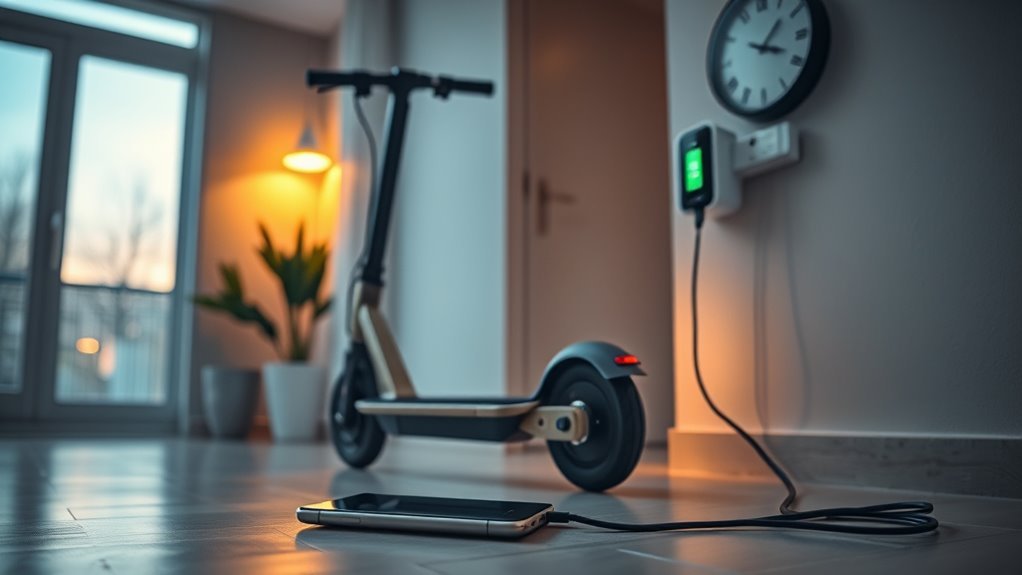
Across the entire personal light electric vehicle (PLEV) market, electric scooter charge times fall along a spectrum determined by vehicle classification. Budget and lightweight commuter models feature modest battery capacities to keep overall vehicle weight under 30 lbs, allowing them to charge fully during a short morning window. In contrast, dual-motor, long-range scooters carry heavy multi-cell battery packs engineered for sustained speeds and extended range, requiring substantially longer charge sessions.
The table below provides real-world charging benchmarks across different categories of electric scooters using their stock OEM chargers:
| Scooter Model | Battery Capacity | Stock Charger | Average Charge Time |
|---|---|---|---|
| Xiaomi Electric Scooter 4 Go | 165Wh (36V 4.6Ah) | 1.1A / 42V | 3.5 hours |
| Segway Ninebot KickScooter MAX G2 | 551Wh (36V 15.3Ah) | 2.0A Internal | 6.0 hours |
| Apollo City Pro | 960Wh (48V 20Ah) | 2.0A / 54.6V | 9.5 hours |
| Minimotors Dualtron Storm | 2,268Wh (72V 31.5Ah) | 1.75A / 84V | 18–20 hours (Single 1.75A) 5.5 hours (Fast Charger) |
Which Factors Change Scooter Charging Time?
While the rated capacity of your battery establishes the baseline, four key technical and environmental variables dictate how fast that energy is replenished during real-world use.
Modern scooters rely on intelligent Battery Management Systems (BMS). The BMS actively monitors incoming current, cell temperature, individual voltage deltas, and state of charge (SoC). When working in tandem with the charger, it dynamically throttles current to protect delicate lithium-ion chemistry.
1. Battery Capacity (Watt-Hours and Amp-Hours)
Battery capacity represents the total fuel tank of your scooter. It is measured either in Amp-Hours (Ah), which denotes current delivery over time, or Watt-Hours (Wh), which measures total stored electrical energy. Total energy is calculated as:
Watt-Hours (Wh) = Nominal Voltage (V) × Capacity (Ah)
A scooter with a 52V 18Ah battery pack stores 936Wh of energy. Because a 936Wh pack holds more than triple the energy of a standard 280Wh entry-level battery, pushing current into the pack naturally takes longer when utilizing identical charger amperages.
2. Charger Amperage and Output Wattage
Charger speed is dictated by continuous current delivery (amperes) and charging voltage. Standard manufacturer chargers supplied in the box deliver 1.5A to 2.0A of current. Upgrading to a manufacturer-approved 4A or 5A fast charger doubles or triples the rate of electron flow into the cathode during the initial charging phase, cutting overall plug-in time by up to 50% to 60%.
3. Ambient Temperature and Thermal Resistance
Lithium-ion chemistries rely on chemical intercalation, which slows drastically in cold conditions and faces hazardous resistance at elevated temperatures. According to battery engineering data from Battery University, charging lithium cells below 0°C (32°F) causes permanent lithium metal plating on the anode, creating internal short-circuits. Conversely, charging in environments above 45°C (113°F) triggers BMS thermal throttling or shutdown to prevent thermal runaway.
4. Battery Age and Internal Resistance
As a lithium-ion battery ages through hundreds of charge-discharge cycles, solid electrolyte interface (SEI) layer growth increases internal resistance ($R_i$). Higher resistance turns charging power into waste heat rather than stored chemical energy, forcing the charger to stay in the slower balancing phase longer.
Understanding the CC/CV Charging Curve (Why the Last 20% Takes Longer)
Electric scooter batteries do not charge at a static, linear speed from 0% to 100%. Scooter chargers utilize a strict two-stage charging profile known as Constant Current / Constant Voltage (CC/CV):
- Constant Current (CC) Stage (0% to ~80% SoC): The charger supplies a constant maximum current while pack voltage steadily climbs. This stage is fast, efficient, and accounts for the majority of the usable range restored in a short session.
- Constant Voltage (CV) Stage (~80% to 100% SoC): Once cell groups reach their peak voltage limit (typically 4.20V per cell), the charger locks the voltage and gradually tapers current down to a low trickle (often below 200mA). During this phase, the BMS balances cell strings to ensure equal voltage across all parallel groups.
“The final 15% to 20% of a scooter’s charging cycle often takes up to 40% of the total session time. This deliberate current tapering prevents dendritic growth and extends overall pack lifespan.”
How to Estimate Scooter Charging Time (With Formula)
You can calculate the approximate charge duration of any electric scooter using battery capacity, charger output, and a realistic efficiency coefficient that accounts for heat loss and the CC/CV taper.
Estimated Hours = (Battery Capacity in Wh ÷ Charger Power in Watts) × 1.15
Alternatively, using Amp-Hours and Charger Amperage:
Estimated Hours = (Battery Capacity in Ah ÷ Charger Amps) × 1.15
The 1.15 multiplier accounts for the typical 10% to 15% efficiency penalty incurred during energy conversion and final cell balancing.
Pro Tip: If you only need enough charge for a short commute, unplugging at 80% to 85% SoC allows you to skip the slow CV saturation phase entirely, saving substantial time while doubling your battery’s overall cycle lifespan.
How Much Does It Cost to Charge an Electric Scooter?
Charging an electric scooter costs fractions of a cent per mile. To calculate the exact cost for a full recharge, multiply your scooter’s battery capacity in kilowatt-hours (kWh) by your local electricity rate per kWh.
Cost = [Battery Wh ÷ 1000] × Electric Rate ($/kWh)
- Standard Commuter Scooter (360Wh / 0.36 kWh): At an average US residential rate of $0.16 per kWh, a 0% to 100% recharge costs approximately $0.057 (less than 6 cents).
- Long-Range Performance Scooter (1,500Wh / 1.5 kWh): At the same electricity rate, a full recharge costs approximately $0.24 (24 cents).
How to Charge an Electric Scooter Safely
Safe charging practices protect your home from fire hazards and ensure your battery achieves its full 3 to 5-year design lifespan. In accordance with micromobility guidelines outlined by the U.S. Consumer Product Safety Commission (CPSC), adherence to proper electrical protocols is vital.
Warning: Never charge an electric scooter immediately after a demanding ride. Riding heats the battery pack internally; allow the scooter to cool at room temperature for at least 30 minutes before connecting the charger. Always verify that your scooter and charger meet UL 2272 electrical safety certification.
- Connect to Wall First, Then Scooter: Plug the charger into the AC wall outlet before inserting the charging port pin into the scooter. This prevents electrical arcing across the sensitive charging port pins.
- Charge on Non-Flammable Surfaces: Keep the scooter away from carpets, beds, wooden furniture, and direct sunlight. Tile, concrete, or designated garage areas with active smoke detection are ideal.
- Avoid Unattended Overnight Charging: While modern BMS units feature overcharge cutoff circuits, passive hardware failures can still occur. Disconnect the charger once the indicator light switches from red to solid green.
- Never Use Generic Unmatched Chargers: A charger with an incorrect voltage output (such as plugging a 54.6V charger into a 42V battery) will bypass safety margins and cause catastrophic thermal runaway.
How to Charge Your Scooter Faster
If you need to reduce downtime between rides without compromising safety, apply these manufacturer-approved charging optimizations:
| Strategy | Implementation | Time-Saving Benefit |
|---|---|---|
| OEM Fast Charger | Upgrade from standard 2A to OEM-approved 4A or 5A unit. | Cuts charge time by 40% to 55%. |
| Dual Charging Ports | Connect two standard chargers simultaneously on supported dual-port models. | Doubles input current, halving charge time safely. |
| 20%–80% Partial Cycle | Charge during the high-speed Constant Current phase and disconnect before CV taper. | Restores 60% of total range in roughly 40% of standard full-session time. |
| Optimal Ambient Air | Maintain room temperature (20°C / 68°F) with adequate airflow around charger brick. | Prevents charger brick and BMS from thermal-throttling current. |
Note: Always verify that your scooter’s charge port wiring and BMS support higher amperage before utilizing a fast charger. Exceeding the maximum rated C-rate of the battery cells can cause premature degradation or blow internal charging port fuses.
Frequently Asked Questions
How long do 2 battery bars last on an electric scooter?
On a standard 5-bar display, 2 remaining bars indicate roughly 30% to 40% state of charge. On an entry-level commuter scooter (such as a 36V 7.8Ah model), this provides approximately 4 to 8 miles (6 to 13 km) of riding depending on rider weight, terrain, and speed mode. Keep in mind that lithium-ion voltage sags under heavy acceleration, meaning 2 bars can drop to 1 bar rapidly when climbing hills.
How far will an electric scooter go on a full charge?
Most commuter electric scooters achieve a real-world range of 12 to 25 miles (20 to 40 km) per charge. Mid-tier models travel between 25 and 45 miles, while high-capacity performance models equipped with 1,500Wh+ batteries can exceed 50 to 80 miles (80 to 130 km) on a single charge. Real-world range is typically 60% to 75% of manufacturer-claimed test figures.
How do I know when my scooter battery is fully charged?
The primary indicator is the LED status light on the charger brick: it illuminates red during active charging and turns solid green when complete. Additionally, your scooter’s cockpit display will show a full battery graphic or 100% in its companion app, and a digital voltmeter will read the maximum pack voltage (e.g., 42.0V for a 36V system; 54.6V for a 48V system).
How long will an electric scooter battery last before needing replacement?
A quality lithium-ion scooter battery lasts between 300 and 1,000 full charge cycles, which translates to 2 to 5 years of regular commuting. Once a battery passes its rated cycle life, it will continue to function but will retain only 70% to 80% of its original capacity. Storing the battery at room temperature and avoiding frequent 0% deep discharges significantly extends this lifespan.
Can I leave my electric scooter charging overnight?
While modern BMS protection systems prevent overcharging by shutting off current flow at 100%, leaving a scooter plugged in unattended overnight is not recommended. Continuous connection keeps the cells under high electrical tension and increases fire risk in the rare event of a component failure. Unplug the charger within an hour of the indicator light turning green.
Conclusion
Electric scooter charging time ranges from 3 to 8 hours for commuter models up to 10 to 20 hours for high-capacity performance scooters using stock chargers. By calculating your battery’s watt-hour capacity relative to your charger’s output, you can accurately plan recharge sessions and avoid guesswork.
To keep your battery performing optimally over thousands of miles, follow safe charging protocols: let the scooter cool for 30 minutes after riding, charge in a well-ventilated space between 10°C and 30°C, and disconnect the unit once the charger light turns green. Sticking to the 20% to 80% charge window for daily rides gives you faster top-ups while preserving long-term battery health.
Sources
- Battery University: BU-409 Charging Lithium-Ion — Technical reference on the Constant Current / Constant Voltage (CC/CV) charging stages and voltage cutoff curves.
- U.S. Consumer Product Safety Commission (CPSC) Micromobility Center — Safety standards, electrical hazards, and thermal management best practices for micro-mobility devices.
- UL Solutions: UL 2272 Standard for Electrical Systems for Personal E-Mobility — Industry standard benchmarks for personal light electric vehicle battery safety.
- Segway-Ninebot Official Documentation — Official technical specifications and internal charging parameters for standard commuter platforms.
