
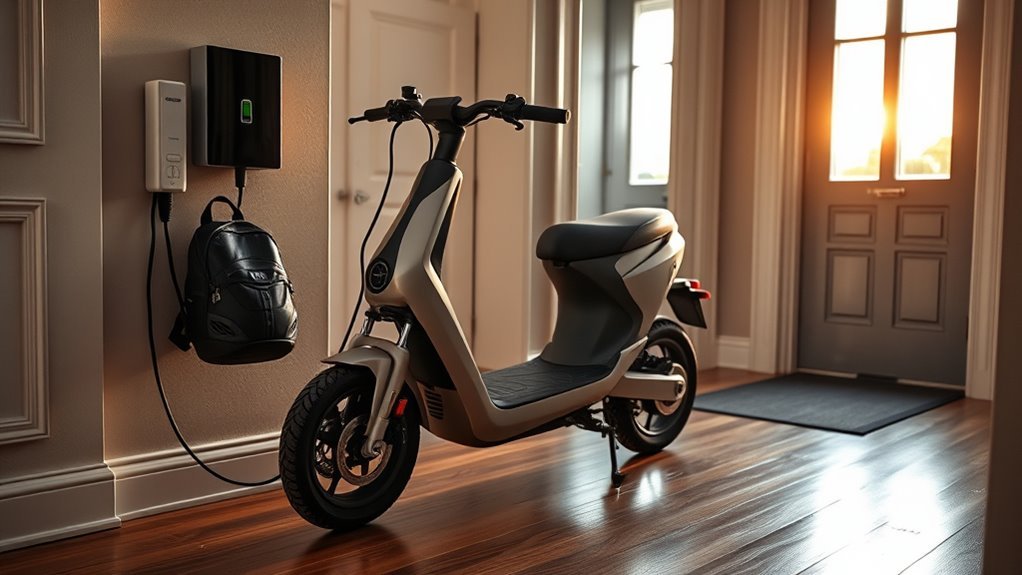
Last Updated on September 10, 2026 by Daniel Globe
How often you should charge your electric scooter depends on how much battery remains, how far you plan to ride next, and what your scooter manufacturer recommends. You do not have to charge after every short ride, but it is smart to avoid repeatedly running a lithium-ion battery to empty. For everyday use, regular partial charging can be easier on many batteries than repeated deep discharge.
Quick Answer
Charge your electric scooter when the remaining battery may not comfortably cover your next ride rather than following a rigid schedule. Avoid routinely draining lithium-ion batteries to empty, follow your model’s charging limits, and use only an approved charger. For safety, stay present while charging and never charge while sleeping.
Key Takeaways
- You do not need to charge after every short ride if plenty of battery remains for your next trip.
- Avoid routinely running a lithium-ion scooter battery all the way to shutdown.
- A 20%–80% range can be a useful battery-longevity strategy on some scooters, but your manufacturer’s instructions take priority.
- Charge only within your model’s specified temperature range and use the charger supplied or approved by the manufacturer.
- Stay present while charging. The U.S. Consumer Product Safety Commission says not to charge micromobility products while sleeping or when you are away from home.
Warning: Lithium-ion battery failures can cause serious fires. CPSC advises users to remain present while charging, never charge while sleeping or away from home, use only the charger provided or recommended by the manufacturer, and unplug the device when charging is complete.
Disclosure: As an Amazon Associate I earn from qualifying purchases. Some links on this page are affiliate links, at no extra cost to you.
How Often Should You Charge Your Electric Scooter?
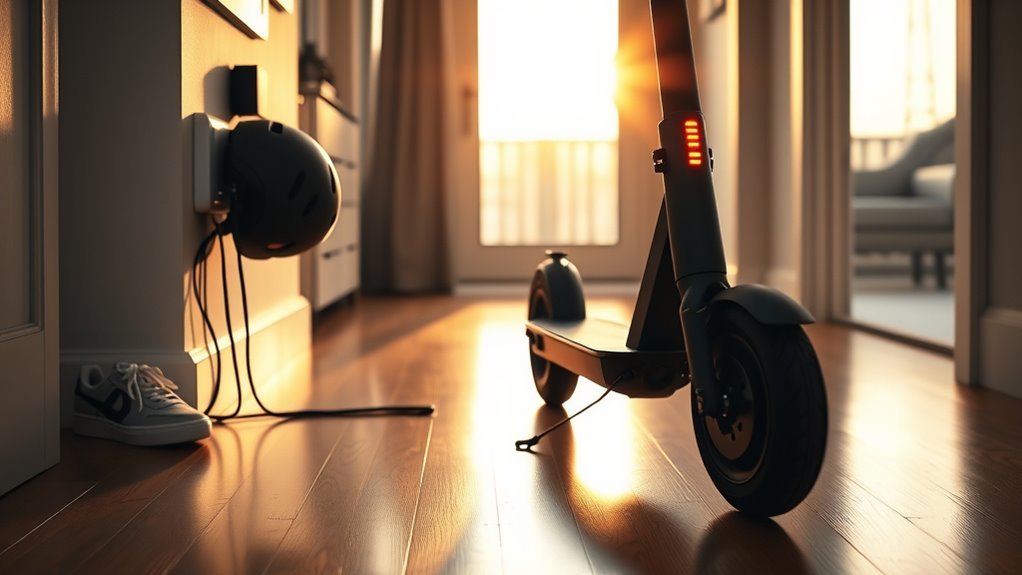
You should charge your electric scooter often enough that you have comfortable range for the next trip, but there is no universal rule requiring a charge after every ride. If you commute daily and return home with a low battery, topping up after the ride makes sense. If you take a short trip and still have plenty of charge, waiting is usually fine unless your manual says otherwise.
For lithium-ion batteries, the more useful rule is to avoid frequent deep discharge. Current NIU battery-health guidance, for example, recommends regular charging instead of repeatedly draining the battery very low. Some manufacturers also recommend partial charging for long-term battery health.
Before following any percentage target, check your scooter’s manual or official support page. Battery chemistry, battery-management systems, charging limits, and storage recommendations vary by model.
Check Your Electric Scooter Battery Level First
Check the battery level before every ride using the scooter’s display or official app. Your remaining charge should comfortably cover the planned trip with some reserve for hills, wind, stops, colder weather, or detours. If the battery is already low, recharge before leaving rather than trying to squeeze out the final few percent.
Battery Level Indicators
Electric scooters may show battery status as a percentage, battery icon, colored lights, or a series of bars. Do not assume that every scooter uses green, yellow, and red in the same way. Check your manual to learn what your specific display means.
Battery gauges can also move under load. A reading may fall temporarily during hard acceleration or climbing because the motor is drawing more power. If the indicator suddenly becomes much less accurate than before, drops rapidly, or conflicts with the scooter’s normal range, have the battery and electrical system inspected.
Charge Before Empty
For routine use, avoid intentionally running the scooter until it shuts down. Regular deep discharge can increase stress on many lithium-ion batteries. Instead, recharge while useful capacity remains.
There is no single percentage that applies to every scooter. Some riders use roughly 20% as a convenient point to start thinking about charging, while some manufacturers allow lower levels. Your scooter’s battery-management system and manual should determine the actual limits.
Pro Tip: Plan charging around your next ride rather than trying to hit an exact percentage every day. If tomorrow’s trip is long, charge enough to complete it with a comfortable reserve.
Top Up After Rides When You Commute Daily
If you commute every day, checking the battery after each ride is a good habit. Charge when the remaining level is too low for the next commute or when your manufacturer recommends it. This keeps the scooter ready without turning “charge after every ride” into an unnecessary rule.
Daily Readiness
For daily commuting, the goal is to begin each trip with enough energy for the route plus a reasonable reserve. A partial top-up after work can be useful if the battery has dropped significantly. If you still have plenty of capacity, you may not need to plug in immediately.
Regular partial charging also helps prevent the battery from spending repeated cycles near empty. That can support battery longevity while reducing the risk of an unexpected low-battery shutdown during the next commute.
Avoid Deep Discharge
Do not make a habit of riding until the battery reaches 0% or the scooter shuts itself down. Lithium-ion batteries generally tolerate partial cycles better than repeated deep cycles. Charge before the battery becomes critically low, but use your model’s manual rather than an arbitrary percentage as the final authority.
Should You Keep Your Charge Between 20% and 80%?
The 20%–80% rule is a useful battery-longevity strategy for some lithium-ion scooters, but it is not a universal charging requirement. NIU, for example, says that keeping certain batteries between approximately 20% and 80% when practical can reduce time spent at voltage extremes. That does not mean charging to 100% is automatically harmful or unsafe.
| Battery Level | Practical Guidance | What to Know |
|---|---|---|
| Around 20%–80% | Useful everyday range on some lithium-ion scooters | May reduce time spent at very high or very low state of charge |
| Low charge | Recharge before you risk running out | Avoid routine deep discharge |
| 80%–100% | Useful when you need maximum range | Do not leave the scooter charging after the charge cycle is complete |
| Near shutdown | Avoid as a routine habit | Repeated deep discharge may increase battery wear |
If you need the scooter’s full rated range for a long trip, charging to 100% can make sense when your manufacturer permits it. Battery care is about reducing unnecessary stress over time, not refusing to use the battery’s available capacity when you need it.
Charge at the Correct Temperature for Safety
Charge your electric scooter in a dry place and within the temperature limits stated by its manufacturer. Room temperature is generally a sensible environment, but there is no single temperature range for every scooter.
For example, Segway lists a charging ambient temperature of 0°C to 40°C (32°F to 104°F) for the Ninebot D38. Current NIU battery guidance for its cited scooters recommends charging and storage between 0°C and 35°C. Your model may specify something different.
- Keep the charging area dry and away from standing water.
- Keep the scooter away from heaters, direct sunlight, and other sources of excessive heat.
- If the battery is unusually hot after riding, wait until it returns to the manufacturer-approved charging temperature before plugging it in.
- Charge where you can see and monitor the scooter.
- Do not block an exit or place the scooter next to easily combustible materials.
Use the Correct Charger and Certified Equipment
Use only the charger supplied with your scooter or a replacement specifically approved by the manufacturer. A connector that physically fits does not prove that the voltage, current, communication, or safety controls are compatible.
In September 2024, CPSC warned consumers about unapproved “universal” micromobility chargers. The agency said it had received 156 reports of fire and thermal incidents involving universal chargers between January 1, 2023 and May 16, 2024.
When buying a scooter, also look for electrical-system certification from a recognized testing laboratory where applicable. UL 2272 covers electrical systems in personal e-mobility devices, including pathway e-scooters.
Spot the Signs Your Scooter Needs Charging
The dashboard or official app is usually more reliable than guessing from performance alone. Charge when the battery gauge shows that your remaining energy is too low for the planned trip.
You may also notice less range than usual as the battery gets low, but reduced speed or lighting behavior is not a standardized battery indicator across all scooters. Some controllers intentionally reduce power at low charge, while others maintain normal performance until the battery-management system intervenes.
More important are signs that suggest a battery fault rather than normal low charge. Stop using or charging the scooter if you notice unusual swelling, leaking, smoke, strong odor, abnormal noises, discoloration, or excessive heat. Move away from the device and follow local emergency guidance if there is smoke or fire.
Avoid Unattended Charging and Deep Discharges
Do not leave an electric scooter charging while you sleep or while nobody is home. The U.S. Consumer Product Safety Commission recommends that users remain present while charging micromobility products, follow the manufacturer’s instructions, and unplug the device when charging is complete.
- Do not intentionally drain the battery to zero as a regular habit.
- Do not leave the charger connected for long periods after charging is complete.
- Do not use an unapproved universal charger simply because its plug fits.
- Do not charge a battery that is swollen, leaking, unusually hot, damaged, smoking, or producing a strange odor.
CPSC advises micromobility owners to stay present while charging and never charge the device while sleeping.
Charging Habits That Extend Battery Life
You can reduce unnecessary battery wear by avoiding frequent deep discharge, minimizing excessive heat, using the correct charger, and following your model’s charging instructions. Regular partial charging works well for many lithium-ion scooters.
Optimal Charge Range
There is no universal percentage window for every electric scooter. For some lithium-ion batteries, staying roughly within 20%–80% during ordinary daily use can reduce exposure to the highest and lowest states of charge. NIU currently recommends this approach for its NQiX line when practical.
- Recharge before the battery routinely falls extremely low.
- Use an 80% target for routine use only if it suits your scooter and your range needs.
- Charge higher when you need extra range and your manufacturer allows it.
- Follow the manufacturer’s separate storage-charge recommendation when the scooter will sit unused.
Safe Charging Practices
Safe charging matters more than chasing a perfect percentage. Use the manufacturer-supplied or approved charger, plug it into a suitable outlet, keep the charging area dry, and remain nearby while it charges.
Inspect the charger, charging port, cable, and battery periodically. Stop charging if you see damaged insulation, bent or burned connectors, swelling, leaking, smoke, unusual odor, or abnormal heat. Do not modify the battery pack or use cells that have been rebuilt by an unqualified person.
Store Your Battery at a Partial Charge
For long-term storage, follow the battery level specified in your scooter’s manual rather than assuming exactly 40% is correct for every model. A partial or mid-level state of charge is common. For example, NIU currently recommends storing its NQiX batteries at around 50% if the scooter will be parked for more than a week.
- Check your manual for the recommended storage percentage.
- Check the battery periodically so it does not self-discharge to a damagingly low level.
- Recharge during storage at the interval specified by the manufacturer.
- Store the battery or scooter in a cool, dry location within its permitted storage-temperature range.
- Avoid long-term storage in a hot car, direct sunlight, or another high-temperature location.
A reminder every few weeks can help you remember to inspect the battery, but the charging interval in your scooter’s manual should take priority over a generic 4-to-8-week schedule.
Fix Common Electric Scooter Charging Problems
If your scooter will not charge, start with simple checks that do not require opening the battery or electrical system.
- Check the outlet. Test it with another known-working device.
- Check the charger indicator. If your charger has an LED, compare its behavior with the description in your scooter manual.
- Reseat the connections. Make sure the charger is fully connected to the outlet and charging port.
- Inspect the cable and plugs. Stop using the charger if you see cuts, exposed wires, burned areas, bent pins, melted plastic, or heat damage.
- Check battery temperature. If the battery is outside its permitted charging-temperature range, let it return to the approved range before trying again.
- Look for error codes. Check the scooter display or official app and compare any code with the manufacturer’s troubleshooting documentation.
If official service documentation instructs you to measure charger output and you are trained to use a properly rated multimeter safely, you can compare the charger’s output with its specified value. Do not open or probe inside the lithium-ion battery pack. High-current batteries can present serious shock, short-circuit, burn, and fire hazards.
Note: If the battery swells, leaks, smells strange, smokes, becomes abnormally hot, or shows physical damage, stop charging and using it. Do not treat those symptoms as an ordinary charger problem.
Frequently Asked Questions
Should I Charge My E-Scooter to 100%?
You can charge to 100% when you need maximum range and your manufacturer permits it. For some lithium-ion batteries, spending less time at a full state of charge may help long-term battery health, so an 80% target can be useful for routine short trips. Always follow your model’s instructions.
How Long Do 3 Bars Last on an Electric Scooter?
There is no universal mileage for three battery bars. Bar displays are calibrated differently by each manufacturer, and remaining range depends on battery size, speed, hills, rider weight, wind, temperature, tire pressure, and battery condition. Use your scooter’s percentage or range estimate when available.
How Long Can You Ride an Electric Scooter Before the Battery Dies?
It depends on the scooter. Electric scooters use batteries of very different sizes, so there is no reliable universal range such as 15–40 miles. Start with your model’s rated range and expect real-world distance to change with speed, terrain, rider weight, weather, tire pressure, and battery age.
What Happens if an Electric Scooter Is Not Used for a Long Time?
The battery slowly self-discharges while stored. If it remains unused long enough, it may fall to a damagingly low state of charge. Store it at the partial charge recommended by the manufacturer, keep it in the approved temperature range, and recharge it at the interval specified in the manual.
Is It Safe to Charge an Electric Scooter Overnight?
No. CPSC advises users to remain present while charging micromobility products and never charge them while sleeping or when nobody is home. Unplug the scooter when charging is complete.
Can I Use a Universal Electric Scooter Charger?
Do not use an unapproved universal charger simply because the connector fits. CPSC warns that different micromobility batteries have specific charging requirements. Use the original charger or a replacement specifically tested and approved for your scooter by the manufacturer.
Should I Charge My Scooter Immediately After Riding?
You can charge after riding if the battery is within the manufacturer’s permitted charging-temperature range. If the battery is unusually hot or cold, wait until it returns to the approved range before plugging it in. The exact waiting time varies with the scooter and conditions.
Does Cold Weather Affect Electric Scooter Charging?
Yes. Lithium-ion batteries have manufacturer-defined charging-temperature limits, and charging below the permitted temperature can be unsafe or blocked by the battery-management system. Bring the scooter or removable battery into an approved environment and follow the manual before charging.
Conclusion
The best electric scooter charging schedule is not a rigid “after every ride” rule. Check the battery before and after trips, recharge before you risk running out, and follow your scooter manufacturer’s instructions for charge limits, temperature, and storage. A 20%–80% routine can help battery longevity on some lithium-ion scooters, but a full charge is useful when you need maximum range. Most importantly, use an approved charger, stay present while charging, avoid repeated deep discharge, and stop using any battery that shows signs of damage or overheating.
Sources
- U.S. Consumer Product Safety Commission — Micromobility Safety Center — charging supervision, approved chargers, unplugging after charging, battery safety, and disposal guidance.
- U.S. Consumer Product Safety Commission — Universal Charger Warning — charger compatibility and reported fire/thermal incidents.
- NIU — How to Improve the Battery Health of Your Electric Scooter — regular charging, avoiding deep discharge, temperature guidance, and battery-health practices.
- NIU — Riding Smart: NQiX Battery Care — 20%–80% daily charging strategy and approximately 50% storage recommendation for the NQiX series.
- Segway — Ninebot KickScooter D38 Specifications — example manufacturer charging-temperature and battery-management specifications.
- UL Solutions — Personal E-Mobility Testing and Certification — UL 2272 electrical-system safety coverage for pathway e-scooters.
