
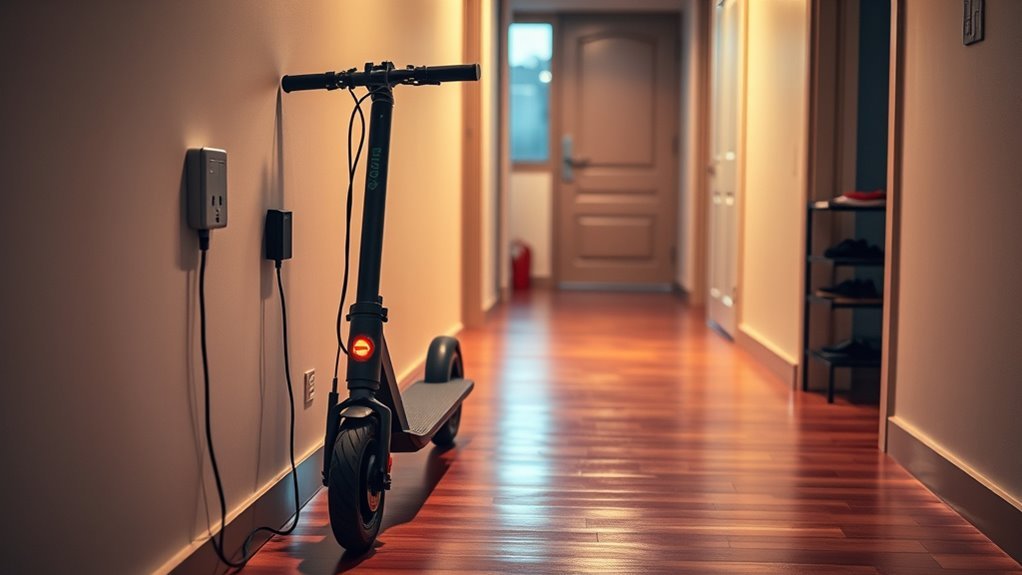
Last Updated on September 10, 2026 by Daniel Globe
Charging your electric scooter safely at home requires a designated, well-ventilated location on a non-flammable surface, a dedicated 120V grounded wall outlet, and your scooter’s original manufacturer-approved charger. Lithium-ion batteries store a substantial amount of energy in a compact space; charging them carelessly or using uncertified power adapters can lead to electrical shorts, battery degradation, or severe fire hazards. By establishing a safe charging routine, monitoring charge cycles, keeping cords properly organized, and following strict thermal management rules, you protect your living space, preserve your battery’s lifespan, and ensure reliable daily transportation.
Quick Answer
To charge an electric scooter safely at home, place it on a flat, fire-resistant surface (such as tile or concrete) in a cool, well-ventilated room. Plug the manufacturer-certified charger directly into a standard 120V wall outlet—never an extension cord or power strip. Let the battery cool for 30 minutes after riding before charging, monitor the process, and unplug as soon as it reaches full capacity.
Key Takeaways
- Plug Directly into the Wall: Always connect your charger directly to a grounded wall outlet; avoid extension cords and power strips.
- Avoid Overnight Charging: Charge only while awake and nearby so you can react immediately to unexpected heat, unusual odors, or charging faults.
- Enforce the 30-Minute Cooldown: Never plug in a scooter immediately after riding; let the battery cells normalize to ambient room temperature first.
- Optimize Battery Longevity: Maintain routine charge levels between 20% and 80% to maximize total lithium-ion cycle life.
- Ensure UL Certification: Verify that your electric scooter and charging unit carry official UL 2272 electrical system safety certification.
At a Glance
| Time Required | 3 to 8 hours (model dependent) |
| Difficulty | Beginner / Easy |
| Equipment Needed | OEM Manufacturer Charger, 120V Grounded Outlet, Hard Non-Flammable Floor |
| Estimated Cost | $0.05 to $0.20 per complete charge cycle |
Disclosure: As an Amazon Associate I earn from qualifying purchases. Some links on this page are affiliate links, at no extra cost to you.
Where Should You Charge Your Electric Scooter at Home?
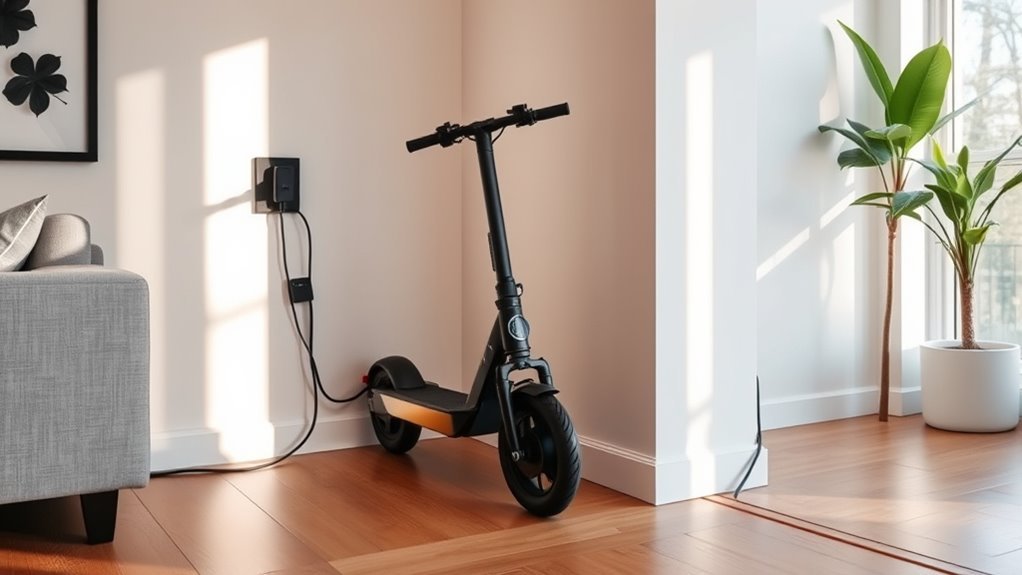
Your charging location plays a critical role in fire safety and battery health. Choose an open, well-ventilated area with a hard, non-combustible floor—such as tile, concrete, or stone. Avoid charging on carpets, wooden floors, or near soft furnishings like beds and curtains, which can trap heat and catch fire in an emergency.
Ventilation is vital because both the charger and the internal battery pack generate heat during normal charging. Maintain at least 2 to 3 feet of open space around the scooter to allow natural air circulation and heat dissipation. Never cover the charging brick or the scooter deck with jackets, towels, or boxes.
Warning: Never charge or store an electric scooter in primary hallways, entryways, or stairwells. If a battery malfunctions, it can release toxic smoke and intense flames, completely blocking your primary emergency escape route.
If your electric scooter features a removable battery pack, you have greater flexibility: you can lock the frame in a secure exterior storage area or garage and bring only the battery pack indoors to charge on a dedicated fire-resistant pad or inside a battery-safe charging box.
Can You Use a Standard Wall Outlet?
Yes, standard residential 120V AC wall outlets in North America (or 230V outlets in international regions) are fully compatible with electric scooter chargers. Standard chargers draw between 1.5A and 3.0A of current—well within the 15A or 20A capacity of a standard household circuit. However, the condition and configuration of that outlet matter significantly.
Outlet Compatibility and Electrical Checks
Before plugging in your charger, verify that the wall receptacle is structurally sound, clean, and properly grounded. Worn-out outlet contacts can create loose physical connections, leading to electrical arcing, localized heat buildup, and tripped breakers.
| Outlet Characteristic | Safety Requirement | Potential Risk If Ignored |
|---|---|---|
| Physical Condition | Tight plug fit, no charring or looseness | Electrical arcing, melting, high resistance |
| Circuit Load | Dedicated or light branch circuit | Nuisance circuit breaker trips |
| Grounding / GFCI | Three-prong grounded receptacle | Shock hazard during power surges |
| Charger Matching | OEM voltage/amperage profile matching | Overvoltage cell destruction |
Safe Charging Setup and Direct Connection Rules
For maximum safety, plug the power supply directly into the wall receptacle. Fire safety agencies such as the U.S. Consumer Product Safety Commission (CPSC) strongly advise against using extension cords, power strips, or plug splitters with micromobility devices. Thin-gauge extension cords introduce additional electrical resistance, causing the cord itself to heat up during extended charging sessions.
Always connect the charger plug to your scooter’s charging port first, and then insert the AC plug into the wall outlet. When charging is complete, reverse the process: unplug from the wall first, then disconnect the charging cable from your scooter.
How Do You Set Up an Apartment Charging Spot?
Creating a permanent, clean charging station in an apartment keeps your space organized, minimizes clutter, and reduces fire risks in compact living areas.
Choosing a Safe Spot
Select a dedicated corner away from main footpaths, heat sources (like radiators, space heaters, or ovens), and direct sunlight. If your apartment has a tiled kitchen or entryway corner away from doors, place a silicone or flame-retardant mat beneath the scooter to protect flooring from tire dirt and catch potential drips or debris.
Pro Tip: Implement the 30-Minute Rest Rule: After riding your scooter, allow the battery pack to cool down for at least 30 minutes before plugging it in. Charging a hot battery accelerates internal cell degradation and increases thermal stress.
Managing Cords and Electrical Hardware
Keep charging cables neatly routed along baseboards using adhesive cable clips. Never run cords beneath rugs, furniture, or door thresholds where foot traffic can pinch the copper wiring and degrade the protective insulation. Periodically inspect the charging brick, power cord, and port pins for discoloration, cracks, or loose fittings.
Why You Should Avoid Charging an Electric Scooter Overnight
Although modern electric scooters include a built-in Battery Management System (BMS) designed to stop charging when cells reach capacity, charging unattended overnight is a serious safety risk. If a BMS component or low-quality charger fails, the battery can silently overcharge, enter thermal runaway, and ignite while residents are asleep.
According to fire statistics from the National Fire Protection Association (NFPA), the majority of severe residential micromobility fires occur when devices are charged unattended or during sleeping hours. To stay safe:
- Charge your scooter only when you are awake, present, and in the same room or nearby area.
- If you must charge on a schedule, plug the charger into a heavy-duty, certified mechanical countdown timer that automatically cuts power after 4 to 5 hours.
- Unplug the charger as soon as the indicator light turns green (signaling a full charge).
What Charging Mistakes Should You Avoid?
Avoiding common charging errors protects your scooter’s electronics, preserves battery range, and safeguards your home against preventable hazards.
| Charging Mistake | Hazardous Outcome | Correct Practice |
|---|---|---|
| Using generic/knockoff chargers | Incorrect voltage/current leading to cell thermal runaway | Use only OEM or manufacturer-certified replacement units |
| Charging in freezing or hot conditions | Lithium plating (cold) or thermal stress (hot), destroying capacity | Charge between 50°F and 77°F (10°C to 25°C) indoors |
| Using extension cords or power strips | Overheating cord insulation and electrical fire risks | Connect charger plug directly into a dedicated wall outlet |
| Leaving plugged in long after 100% | High cell tension and accelerated battery wear | Disconnect power promptly once the indicator turns green |
| Charging wet or rain-soaked scooters | Direct short-circuits and permanent BMS failure | Towel dry completely and allow internal components to dry before plugging in |
How Do You Protect Your Electric Scooter Battery?
Lithium-ion batteries naturally degrade over time, but mindful charging habits can double their functional service life and maintain optimal commuting range.
“Operating and charging a lithium-ion battery within the 20% to 80% state-of-charge window minimizes mechanical stress on cathode materials, yielding up to two to three times more usable charge cycles than repeated 0% to 100% cycles.”
Follow these essential battery care protocols:
- Follow the 20%–80% Rule: Avoid running your battery down to 0%. Deep discharges put immense stress on cell chemistry. Recharge when the battery drops near 20%–30%.
- Store at 50% State of Charge: If you plan to store your scooter for several weeks or months without riding, charge it to approximately 50%–60% and keep it in a temperature-controlled environment. Check and top it off every 30 to 45 days.
- Respect Temperature Limits: Never charge your scooter in ambient temperatures below 32°F (0°C) or above 104°F (40°C). Charging at freezing temperatures causes permanent lithium metal plating on the anode, creating internal short-circuits.
How Do You Get Permission From Your Landlord or HOA?
Many apartment complexes and Homeowners Associations (HOAs) have enacted strict policies regarding micromobility devices due to fire safety concerns. Getting formal permission requires transparent communication and proof of safety compliance.
- Verify UL 2272 Certification: Check the serial sticker on the bottom of your deck or charger for the official UL or ETL certification mark. Presenting a certified scooter assures building managers that your model meets stringent electrical safety standards.
- Submit a Written Safety Plan: Outline where the scooter will be parked, your charging schedule, and your commitment to charging away from shared egress routes and fire exits.
- Confirm Renter’s Insurance Coverage: Review your policy or add personal liability coverage that includes personal electric vehicles, and share proof of coverage with management.
Where Can You Charge an Electric Scooter Outside Home?
If you have a longer commute, charging outside your home helps ensure you have sufficient battery power for the return trip.
| Location | Access Requirement | Safety Caution |
|---|---|---|
| Workplace Desk / Garage | Employer / Facilities approval | Do not block walkways, under-desk areas, or emergency doors |
| Transit Hubs & Bike Lockers | Municipal e-mobility access | Ensure outlets are weather-shielded and dry |
| Cafes & Coffee Shops | Customer courtesy (ask staff) | Keep cables completely tucked to prevent customer tripping hazards |
| Public EV Stations | Requires specialized J1772 to 120V adapter | Never attempt without a rated, commercial step-down converter |
What Should You Do If the Battery Looks Damaged?
A damaged lithium-ion battery can enter thermal runaway rapidly. If your battery casing is cracked, dented, swollen, discolored, or emitting an unusual chemical odor, take immediate safety precautions.
Note: In an active battery emergency (smoke, hissing sounds, sparks, or fire), do not attempt to move the scooter. Immediately evacuate everyone from the premises and dial 911 for the fire department. Lithium-ion fires produce hazardous hydrogen fluoride gas and require heavy water volume to cool.
- Disconnect Power Immediately: If safe to do so without touching a hot battery pack, pull the AC wall plug from the receptacle.
- Isolate the Unit: Move the scooter or battery outdoors onto a concrete or dirt surface away from buildings, cars, and flammables.
- Never Throw in Household Trash: Damaged batteries are classified as hazardous waste. Contact Call2Recycle or your local municipal hazardous material handling facility for proper disposal and recycling.
Frequently Asked Questions
Can you charge an electric scooter in an apartment?
Yes, you can charge an electric scooter in an apartment if your building allows it and you follow key fire safety rules. Always charge on a non-flammable surface (like tile) in a well-ventilated room, connect directly to a 120V wall outlet, avoid blocking exit paths, and monitor the charging process until complete.
How to charge a scooter in an apartment?
To charge a scooter in an apartment safely: allow the battery to cool for 30 minutes after riding, place the scooter on a dry, uncarpeted floor away from doors and curtains, plug the original manufacturer charger directly into the wall outlet, and disconnect the power as soon as the charger indicator light turns green.
What happens if you don’t move your electric scooter for 3 months?
If an electric scooter is left unused for 3 months without proper preparation, parasitic battery drain can drop the cells below their critical voltage threshold. This causes permanent capacity loss or triggers the Battery Management System (BMS) into sleep lock, rendering the battery unable to accept a charge. For seasonal storage, store the battery at around 50% charge in a cool, dry location and top it off every month.
Can you charge an electric scooter at an EV charging station?
You cannot plug a standard electric scooter charger directly into a Level 2 electric vehicle (EV) charging station because EV plugs use specialized J1772 connectors delivering 208V to 240V power. You can only charge at an EV station if you carry a certified J1772-to-NEMA-120V step-down adapter that matches your charger’s voltage rating.
Conclusion
Charging your electric scooter at home is simple and safe when you follow disciplined, standard operating practices. Always prioritize charging in a clear, well-ventilated space on a non-combustible surface, connect directly to a grounded 120V wall outlet, and use only your scooter manufacturer’s certified charger. By letting your battery cool down after rides, keeping your state of charge between 20% and 80%, and avoiding unmonitored overnight charging, you protect both your investment and your home while enjoying dependable, hassle-free daily mobility.
Sources
- National Fire Protection Association (NFPA) — Safety standards and residential fire prevention guidance for micromobility lithium-ion batteries.
- U.S. Consumer Product Safety Commission (CPSC) — Micromobility product safety bulletins and electrical hazards advisory.
- UL Solutions (UL 2272 Standard) — Electrical systems certification standards for personal e-mobility devices.
- Call2Recycle — Safe disposal and recycling protocols for end-of-life and damaged lithium-ion mobility batteries.
