
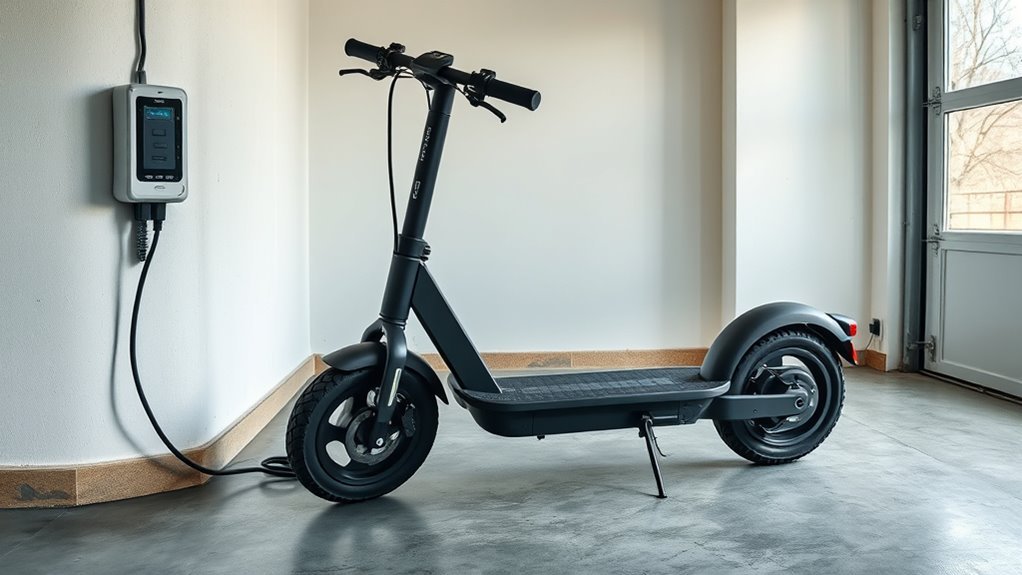
Last Updated on August 26, 2026 by Caleb Warren
Charging an electric scooter at home is usually straightforward, but lithium-ion batteries need careful handling. Use only the charger supplied or specifically approved for your scooter, keep the scooter and charging components dry, charge where you can monitor the device, and follow your model’s manual for temperature limits, connection order, charge time, and indicator lights.
Quick Answer
To safely charge an electric scooter at home, use the supplied or manufacturer-approved charger, charge only when the scooter and port are dry and at a safe temperature, plug into a suitable wall outlet, keep flammable items and exits clear, stay present while charging, and unplug the scooter when charging is complete.
Key Takeaways
- Use only the charger supplied with the scooter or a replacement specifically approved by its manufacturer.
- Never charge a wet, damaged, swollen, leaking, unusually hot, or modified battery.
- Charge in an open, dry area away from flammable materials and where the scooter cannot block an exit.
- Stay present while charging. Do not charge while sleeping or leave an e-scooter charging unattended overnight.
- Charging temperatures, connector order, LED meanings, charge times, and storage percentages vary by model, so follow the owner’s manual.
At a Glance
| Time Required | About 5–10 minutes to inspect and set up; actual charging time varies by scooter and battery |
| Difficulty | Easy |
| Tools Needed | Manufacturer-approved charger, owner’s manual, and a clean dry cloth for external surfaces if needed |
| Cost | Usually no extra cost when the original charger is available and undamaged |
Disclosure: As an Amazon Associate I earn from qualifying purchases. Some links on this page are affiliate links, at no extra cost to you.
Before You Charge Your Electric Scooter
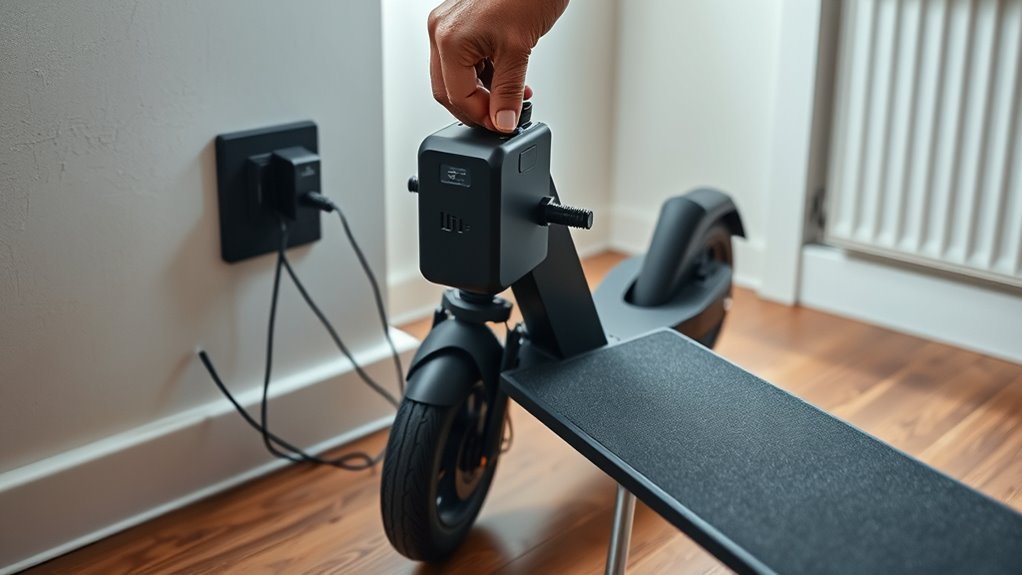
Before charging, turn off the scooter if your manual instructs you to do so and inspect the battery area, charging port, charger, plug, and cable. They should be dry and free of obvious damage. If the battery is unusually hot immediately after a ride, allow it to return to the charging temperature specified by the manufacturer before connecting the charger.
Check for cracks, frayed cable insulation, damaged pins, discoloration, swelling, leaking, unusual odors, or evidence of water intrusion. If you recently crashed the scooter or damaged the battery enclosure, do not assume it is safe to charge just because the scooter still runs.
Warning: Do not charge a battery that is swollen, leaking, deformed, unusually hot, making unusual noises, producing a strange odor, smoking, or visibly damaged. Stop using the scooter and follow the manufacturer’s service instructions. If there is smoke or fire, leave the area, close the door if you can do so safely, and call emergency services from a safe location.
Make Sure the Scooter and Charger Are Dry
Water and charging equipment are a dangerous combination. The scooter, charging port, charger body, cable, and connectors should all be completely dry before charging. Do not rely on a fixed waiting time after riding in rain because moisture can remain inside a recessed port or enclosure after exposed surfaces appear dry.
Dry Scooter Before Charging
If the scooter has been used in rain or splashed with water, move it to a dry location and allow external moisture to evaporate completely. Wipe only accessible exterior surfaces with a dry cloth. Do not insert metal objects, paper, cotton swabs, or other materials into the charging port.
If water may have entered the charging port, battery compartment, deck, or another electrical enclosure, consult your scooter’s manual or manufacturer before charging. A scooter’s water-resistance rating does not automatically mean it is safe to charge while wet.
Inspect Charger For Moisture
Look at the charger, power cord, connector, and scooter charging port under good light. Check for droplets, condensation, corrosion, bent contacts, damaged insulation, cracks, or scorch marks. If anything is wet or damaged, do not connect it to power.
Keep the charger away from sinks, bathrooms, wet floors, open windows during rain, and other places where water can reach it. Never handle the plug or charging connector with wet hands.
Wait After Wet Rides
There is no universal “30-minute” or “45-minute” rule that proves a scooter is dry enough to charge. Drying time depends on how wet the scooter became, airflow, temperature, scooter construction, and whether moisture entered an enclosed component. Charge only when the system is fully dry and the manufacturer’s instructions permit it.
| Checkpoint | What to Check | Safe Action |
|---|---|---|
| Charging port | Water, condensation, corrosion, bent contacts | Do not charge until fully dry and undamaged |
| Charger connector | Moisture, dirt, discoloration, damaged pins | Stop and replace/service if damaged |
| Cable and charger body | Wet spots, cuts, cracks, exposed wire | Do not use a damaged charger |
| Battery enclosure | Impact damage, swelling, leaking, water intrusion | Stop use and contact the manufacturer or authorized service provider |
Use the Manufacturer-Approved Charger
Use the charger supplied with your scooter or a replacement specifically approved for that exact scooter and battery. A connector that physically fits does not prove that a charger has the correct voltage, current, charging profile, polarity, communications, or protective features.
The U.S. Consumer Product Safety Commission advises consumers to use appropriate micromobility products, batteries, and chargers and to follow manufacturer charging instructions. Avoid unknown aftermarket chargers, modified battery packs, repurposed cells, and chargers with damaged cords or housings.
When buying an e-scooter in the United States, also look for credible third-party safety certification. UL Solutions identifies ANSI/CAN/UL 2272 as the standard covering electrical systems in personal e-mobility devices, including pathway e-scooters.
Pro Tip: Keep a photo of the charger label and the scooter’s model/serial information. If the original charger is lost or damaged, those details make it easier to obtain the exact approved replacement instead of guessing based on connector shape.
Charge Your Scooter in a Cool, Ventilated Spot
Choose an open, dry charging location with normal room-temperature conditions and enough airflow for heat to dissipate. Keep the scooter, battery, and charger away from heaters, radiators, direct sun, bedding, sofas, paper, clothing, fuel, solvents, and other flammable materials.
Do not position the scooter where it blocks a doorway, hallway, stairway, or the main route out of a room. FDNY lithium-ion battery safety guidance also advises charging directly from an appropriate wall electrical outlet rather than using power strips or overloading an outlet.
Cool, Dry Area
There is no single charging-temperature range that applies to every electric scooter. Some manufacturers specify charging close to room temperature, while exact lower and upper limits vary by model. Check the specifications in your manual and do not charge when the battery is colder or hotter than the permitted range.
If the battery feels significantly warmer than normal after riding, allow it to cool naturally. Do not place the battery in a refrigerator or freezer, apply ice, or use another rapid-cooling method.
Good Airflow Matters
Do not cover the charger or scooter with clothing, towels, bags, boxes, or blankets while charging. Avoid enclosed cabinets unless the charging system is specifically designed and approved for that use. Keeping the charger unobstructed helps prevent unnecessary heat buildup and makes it easier to notice abnormal heat, odor, noise, or smoke.
Follow the Correct Charging Steps
The exact sequence can differ among scooters, so your owner’s manual should take priority over generic instructions. A safe general process is:
- Read the charging instructions. Confirm the approved charger, charging-temperature range, expected indicator behavior, and any model-specific precautions.
- Inspect the scooter and charger. Make sure the port, connector, charger, and battery enclosure are dry and undamaged.
- Let an unusually hot battery cool. Charge only within the manufacturer’s permitted temperature range.
- Choose a safe location. Keep flammable materials and exit routes clear and use an appropriate wall outlet.
- Connect the charger in the order specified by the manufacturer. Do not assume every scooter uses the same wall-first or scooter-first procedure.
- Confirm charging has started normally. Use the LED, display, or app indication described in your manual.
- Stay present. Periodically check for unusual heat, smell, sound, swelling, or other abnormal behavior.
- Disconnect when charging is complete. Use the manufacturer-specified disconnection order and close the charging-port cover if your scooter has one.
Note: Charger-light meanings are model-specific. Red means charging and green means fully charged or maintenance charging on many scooters, but your manual is the authoritative reference for your model.
Avoid Overcharging and Battery Damage
Do not treat a Battery Management System, charger shutoff, or “smart” charger as permission to leave an e-scooter charging unattended. The CPSC’s micromobility charging guidance says consumers should be present when charging and should never charge while sleeping.
A safety system can reduce certain electrical risks, but it does not make unattended or overnight charging a good practice.
- Do not leave the scooter charging while you sleep.
- Do not routinely leave it connected long after the manufacturer says charging is complete.
- Do not use a damaged, modified, counterfeit, or incompatible battery or charger.
- Stop charging immediately if the battery or charger behaves abnormally.
Some owners use partial-charge habits such as keeping a lithium-ion battery between roughly 20% and 80% or 90% to reduce long-term cell stress. That is not a universal e-scooter safety requirement, and some battery systems may have different manufacturer recommendations. Follow your scooter maker’s battery-care guidance rather than applying one percentage rule to every model.
How Long Does an Electric Scooter Take to Charge?
Charging time varies with battery capacity, charger output, battery state of charge, battery temperature, battery age, and scooter design. Some scooters charge in a few hours, while larger batteries can take considerably longer. Use the charging time in your scooter’s specifications as the normal reference rather than comparing it with another model.
If charging suddenly takes much longer than usual, the charger never reaches the normal completion indication, or the battery gains very little range after a full charging cycle, stop relying on repeated charging attempts. Check the manual for error codes and contact the manufacturer or authorized service center if the problem continues.
Store Your Electric Scooter Battery Safely
For storage lasting weeks or months, follow the manufacturer’s instructions for battery percentage, temperature, and recharge interval. There is no universal rule that every scooter should be stored at exactly 50% or recharged every few weeks.
Store the scooter and battery in a dry location away from extreme heat, freezing conditions, direct sunlight, ignition sources, and combustible materials. Do not store a damaged or swollen lithium-ion battery for later use.
Troubleshoot Electric Scooter Charging Problems
If your electric scooter is not charging normally, start with external checks that do not require opening the battery or probing electrical terminals.
| Problem | Safe Checks | Next Step |
|---|---|---|
| No charging indication | Confirm the outlet is working, the approved charger is fully connected, and the scooter is within its permitted charging-temperature range | Check the manual for charger-light meanings or error codes |
| Charging stops early | Look for loose external connections and abnormal battery or charger temperature | Stop repeated attempts if the problem returns and contact authorized service |
| Charger indicates full but range is unusually low | Check the scooter display/app for battery errors and compare performance with normal conditions | Have the battery evaluated by the manufacturer or qualified service provider |
| Battery or charger becomes abnormal | Watch for swelling, leaking, strong odor, unusual sound, discoloration, smoke, or excessive heat | Stop charging and follow emergency/manufacturer guidance |
Do not open the battery pack, bypass its Battery Management System, repair damaged lithium-ion cells yourself, or probe unfamiliar battery terminals with a multimeter unless you are a qualified technician following the manufacturer’s service procedure. Consumer troubleshooting should stop before the battery enclosure or high-current electrical connections need to be opened.
What to Do if the Battery Overheats, Swells, or Smokes
Stop using or charging the scooter if you notice swelling, leaking, a change in shape or color, a strange smell, unusual noises, or abnormal heat. These can be warning signs of battery failure.
If there is smoke or fire, do not remain in the room trying to troubleshoot the scooter. Leave the area, close the door behind you if it is safe to do so, and call emergency services from a safe location. Lithium-ion battery fires can release hazardous gases and can reignite after appearing to be extinguished.
Replace and Recycle a Damaged or Worn Battery Safely
Replace a worn or failed battery only with the type approved for your scooter. Avoid rebuilt packs, repurposed cells, or unknown aftermarket batteries unless the scooter manufacturer specifically authorizes them.
Do not put a lithium-ion scooter battery in household garbage or a municipal recycling bin. The U.S. Environmental Protection Agency recommends using appropriate battery recycling, retailer take-back, or household hazardous-waste collection programs. If the battery is damaged, contact the manufacturer or local hazardous-waste program for handling instructions before transporting it.
Frequently Asked Questions
Can You Charge an Electric Scooter Inside Your House?
Yes, if the manufacturer permits indoor charging and you can do it safely. Use the approved charger, charge in a dry open area away from flammable materials, keep exits clear, use an appropriate wall outlet, and remain present. Local building or fire rules may impose additional requirements.
What Happens if You Don’t Move Your Electric Scooter for 3 Months?
The battery can slowly discharge and age while the scooter is stored. Follow the manufacturer’s recommended storage charge level, temperature, and recharge interval. Do not assume every lithium-ion scooter battery should be stored at exactly 50% or charged every few weeks.
Is It Possible to Charge an Electric Scooter at Home?
Yes. Most consumer e-scooters are designed to be recharged from normal household electrical power using their approved charging equipment. Follow the scooter manual, use the proper charger and outlet, and never charge a damaged or wet battery.
How to Safely Charge an E-Scooter?
Inspect the scooter and charger, make sure everything is dry and within the manufacturer’s permitted temperature range, use the approved charger, choose a clear area away from flammables, follow the manual’s connection sequence, stay present while charging, and disconnect when charging is complete.
Can You Leave an Electric Scooter Charging Overnight?
No. Current CPSC and fire-safety guidance recommends staying present while charging micromobility devices and never charging while sleeping. Do not rely on an automatic shutoff or Battery Management System as a reason to leave the scooter unattended overnight.
How Long Should You Wait to Charge an Electric Scooter After Riding?
There is no universal number of minutes. If the battery is unusually warm or outside the charging-temperature range in your manual, allow it to return to the permitted range before charging. If the scooter is wet, wait until the charging system is completely dry.
Can You Charge an Electric Scooter After Riding in Rain?
Only after the scooter, charging port, charger, and connectors are completely dry and there is no suspected water intrusion or damage. If water may have entered an electrical enclosure, follow the manufacturer’s inspection or service guidance before attempting to charge.
Conclusion
Safe electric scooter charging is less about memorizing one universal procedure and more about combining good fire-safety habits with your scooter manufacturer’s exact instructions. Keep the charging system dry, use only approved equipment, choose a clear area away from combustible materials, stay present, and stop immediately if you notice damage or abnormal battery behavior.
Do not charge while sleeping, do not improvise with an incompatible charger, and do not open or probe a lithium-ion battery pack for DIY troubleshooting. Taking those precautions helps reduce fire risk while protecting the battery and charging system.
Sources
- U.S. Consumer Product Safety Commission — Micromobility Information Center — safety guidance for e-scooters, e-bikes, batteries, and chargers.
- U.S. Consumer Product Safety Commission — Micromobility Battery Charging Safety — guidance to remain present while charging, avoid charging while sleeping, use the supplied charger, and unplug when done.
- FDNY — Lithium-Ion Battery Safety — charging-location, outlet, flammable-material, exit-path, and damaged-battery precautions.
- UL Solutions — Personal E-Mobility Evaluation, Testing and Certification — information about UL 2272 and electrical/fire safety certification for personal e-mobility devices.
- U.S. Environmental Protection Agency — Used Lithium-Ion Batteries — safe recycling and end-of-life handling guidance.
