
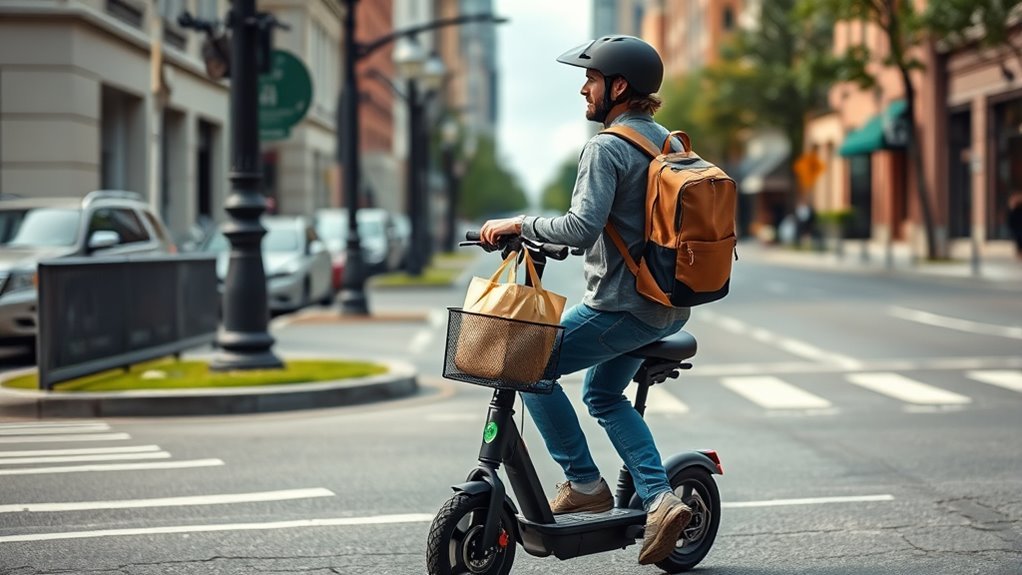
Last Updated on July 24, 2026 by Caleb Warren
Carrying a small load on an electric scooter can be practical, but the wrong setup can interfere with steering, braking, lights, cables, or balance. The safest approach is to use a snug backpack or a manufacturer-approved carrier, keep the load light and centered, and test the scooter at low speed before entering traffic.
Quick Answer
Carry small items in a snug backpack or a manufacturer-approved bag or rack that does not block the controls. Keep the load centered and within the scooter’s total payload rating. Never hang shopping bags from the handlebar grips. Secure everything, test the brakes at low speed, and avoid trailers unless the manufacturer specifically approves one.
Key Takeaways
- Your scooter’s payload rating includes you, your clothing, accessories, and everything you carry.
- A snug backpack is usually safer than loose bags attached to the steering area.
- Never hang grocery or shopping bags from the handlebar grips.
- Use baskets, racks, and trailers only when the scooter manufacturer approves the accessory and mounting method.
- Extra weight can increase stopping distance, reduce range, slow acceleration, and make hills harder to climb.
- Test the loaded scooter in a clear area before riding near traffic or pedestrians.
At a Glance
| Time Required | About 5 to 10 minutes to pack, secure, inspect, and test the load |
| Difficulty | Easy for a small, properly secured load |
| Tools Needed | Snug backpack or approved carrier, straps or cargo net, and an optional household scale |
| Cost | No added cost when using a suitable backpack; approved accessory costs vary by scooter |
Warning: Do not hang grocery bags, shopping bags, helmets, locks, or other objects from the handlebar grips. The U.S. Consumer Product Safety Commission advises riders to keep both hands on the handlebars and keep items off the handlebars. Hanging cargo can swing into the controls or pull the steering unexpectedly.
Disclosure: As an Amazon Associate I earn from qualifying purchases. Some links on this page are affiliate links, at no extra cost to you.
What You Can Carry on an Electric Scooter
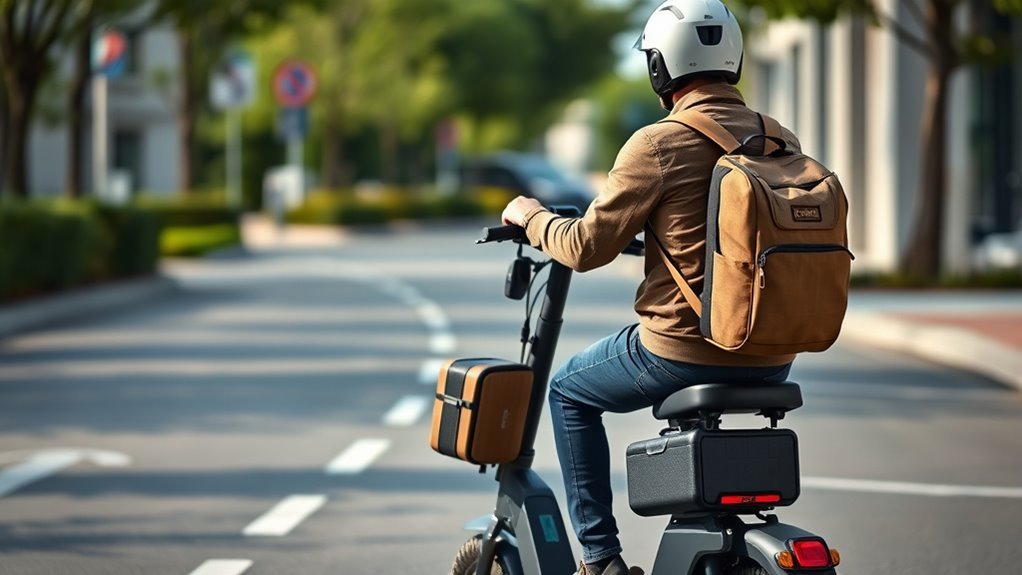
You can carry a small lunch bag, light work gear, a compact grocery load, a change of clothes, or similar personal items when they fit securely inside an appropriate carrier. The load must not block your view, lights, reflectors, brake levers, throttle, bell, cables, folding latch, wheels, or foot position.
Before loading anything, read the scooter’s manual and identify its maximum payload. That number normally applies to the complete load carried by the scooter, not just the rider. Add your body weight, clothing, backpack, locks, mounted accessories, and cargo together.
Choose items that are compact, closed, and unlikely to leak or break. A few small groceries are easier to control than a large box, long object, or loose collection of bags. Split a large purchase into more than one trip rather than pushing the scooter close to its limit.
The fact that an item physically fits on a scooter does not mean the scooter is designed to carry it safely.
Best Bags, Baskets, and Trailers
A snug backpack is usually the simplest cargo option because it keeps the steering area clear. A fixed bag, basket, or rack may also work, but only when it is compatible with the exact scooter and does not interfere with safe operation. Tow-behind trailers require much more caution and should not be treated as universal scooter accessories.
Bag Options for Scooters
A two-strap backpack that sits close to your body is usually the best choice for a light load. Tighten both shoulder straps so the bag cannot slide sideways when you brake or turn. Put dense items near the center of the bag and prevent hard or sharp objects from pressing against your back.
A messenger bag can swing across your body and pull your balance during a turn. Use one only for a very light load, shorten the strap, and secure the bag so it cannot move. Avoid carrying a loose tote or shopping bag in one hand because you need both hands for reliable steering and braking.
A waterproof bag can protect electronics and clothing from rain or road spray. However, a waterproof bag does not make wet riding safe. Reduced tire grip, poor visibility, and longer braking distances may still make it better to postpone the trip.
Pro Tip: After packing a backpack, put it on and lean gently left, right, forward, and backward. Repack it if the contents slide, strike your back, or make the bag pull strongly in one direction.
Basket and Rack Choices
Use a basket or cargo rack only when its maker identifies it as compatible with your scooter or the scooter manufacturer approves the mounting method. A clamp that happens to fit the stem is not proof that the scooter can safely carry the accessory.
A front-mounted carrier can add weight to the steering assembly and may block a light, brake cable, display, or folding mechanism. Avoid it unless the manufacturer specifically allows it. Never hang bags from the handlebar grips, even when the load feels light. Xiaomi’s official scooter safety notice also identifies hanging objects from the handlebar as improper use.
An approved rear rack keeps cargo away from the hand controls, but it can still change the scooter’s balance. Keep the load within the rack’s own limit and the scooter’s total payload limit. Confirm that the rack cannot touch the rear tire, suspension, brake, fender, light, or kickstand.
Trailer Capacity and Safety
Do not assume that a tow-behind trailer is safe merely because a hitch can be attached. Most scooter payload specifications describe the load carried by the scooter itself and do not provide a towing rating.
Use a trailer only when the scooter manufacturer expressly approves towing, identifies an approved hitch location, and gives a towing limit. The trailer maker must also state that the trailer is suitable for that scooter type. If either manual is silent, do not tow the trailer.
A trailer can increase stopping distance, require wider turns, strike curbs, swing during sudden steering, or push the scooter during downhill braking. Never use a homemade hitch or attach a trailer to the folding stem, handlebar, fender, suspension part, brake mount, or another point not designed for towing.
Warning: Do not place a child, adult passenger, or pet in a scooter trailer unless both the scooter and trailer manufacturers expressly approve that use. A stand-up electric scooter is normally designed for one rider.
How to Balance Scooter Cargo
Balanced cargo should remain centered and should not move when you accelerate, brake, turn, or cross a small bump. Avoid loading one side more heavily than the other. Stop immediately if the scooter pulls sideways, wobbles, bottoms out, or becomes difficult to steer.
Even Weight Distribution
Place heavier items near the center of a backpack or approved carrier. Keep them as low as the carrier safely allows, but do not place hard items where they can strike the rider or interfere with the scooter.
Do not counterbalance one unsafe load by adding weight to the opposite side. Reduce and repack the cargo instead. Your normal riding position should remain comfortable, and you should still have enough deck space to place both feet securely.
Secure Loose Items
Close every zipper, buckle, lid, and latch. Use straps or a properly sized cargo net on an approved rack or basket. Remove or tie back loose strap ends so they cannot enter a wheel, brake, or suspension component.
Keep phones, keys, and wallets inside a closed pocket or bag. Do not balance a phone on the display or place small objects where they can fall near the front wheel. Stop before opening a bag or using a phone.
Adjust Riding Technique
A loaded scooter may accelerate more slowly and take longer to stop. Practice in a clear, level area before riding on a road or shared path.
- Start at the scooter’s lowest practical speed mode.
- Accelerate gently so the cargo does not shift backward.
- Brake earlier and apply the controls smoothly.
- Take turns more slowly and keep your movements gradual.
- Leave more space behind vehicles, cyclists, and pedestrians.
- Slow down before bumps, cracks, wet leaves, or rough pavement.
- Stop and repack the load if anything moves or the scooter feels different.
Check the tire pressure against the scooter manual before carrying cargo. Low pressure can reduce stability, increase rolling resistance, and make the tires more vulnerable to damage. Inspect the suspension, brakes, and mounting hardware more often if you regularly carry loads.
How to Secure Loose Items
Complete a push-and-shake check before every loaded ride. Hold the scooter upright, press and pull the cargo from several directions, and confirm that nothing shifts, opens, hangs down, or touches a moving part.
| Check | What to Confirm |
|---|---|
| Straps | Tight, undamaged, and unable to enter a wheel or brake |
| Cargo net | Firm across the full load with every hook attached to an approved point |
| Closures | Zippers, lids, buckles, and latches fully closed |
| Controls | Full throttle and brake-lever movement with no obstruction |
| Steering | Handlebars turn freely in both directions without pulling cables |
| Wheels and suspension | No bag, strap, rack, or cargo can touch a tire or moving component |
| Lights and reflectors | Front light, rear light, indicators, and reflectors remain visible |
Inspect straps and mounting hardware again after the first few minutes of a ride. Vibration can loosen a new setup. Replace frayed straps, cracked clips, stretched nets, or loose brackets rather than relying on a temporary knot or improvised fastener.
How to Carry Cargo on an Electric Scooter Step by Step
- Read the manual. Find the scooter’s payload limit and any restrictions on bags, racks, baskets, modifications, or towing.
- Calculate the total load. Add your body weight, clothing, safety gear, locks, mounted accessories, carrier, and cargo.
- Choose the safest carrier. Start with a snug backpack. Use a fixed carrier only when its mounting method is approved for your scooter.
- Pack compactly. Center dense items, close every container, and remove glass, sharp objects, loose liquids, and anything oversized.
- Secure the load. Close every strap and latch, contain loose ends, and confirm that nothing can move or fall.
- Check the scooter. Test steering, throttle, brakes, lights, folding latch, deck space, wheels, tire pressure, and suspension clearance.
- Perform a low-speed test. Accelerate, brake, and turn in a clear area. Reduce or repack the load if control or stopping performance feels worse than expected.
Scooter Weight Limits and Cargo Rules
Do not rely on a general internet weight range. Use the rating for your exact model and version. For example, Segway currently lists a maximum payload of 220 pounds for the E3 and 286 pounds for the MAX G3. Those figures are examples, not limits that apply to every scooter.
Use this calculation:
Rider + clothing and protective gear + carrier + mounted accessories + locks + cargo = total scooter load
The total must remain below the scooter’s stated payload. Also follow the lower limit when an accessory has its own rating. For example, a scooter may have capacity remaining while a small rack has already reached its separate limit.
Do not plan to ride at the exact maximum if you can avoid it. Measurement error, road impacts, hills, tire condition, and cargo movement can all place extra stress on the scooter. Reduce the load if the suspension compresses heavily, a tire looks overloaded, the deck bottoms out, or the scooter struggles to start or climb a normal route.
Note: A maximum payload is not a promise that the scooter will maintain its advertised speed, hill performance, range, or stopping distance at that load.
How Extra Weight Affects Scooter Safety
Extra weight affects several parts of the ride at the same time. The change may be noticeable even when the total remains below the official payload limit.
| Effect | What You May Notice | How to Respond |
|---|---|---|
| Braking | The scooter takes longer to slow or stop | Brake earlier, ride slower, and leave more space |
| Acceleration | Slower starts and weaker response in traffic | Wait for a larger gap and accelerate smoothly |
| Range | The battery drains faster than on an unloaded ride | Plan a shorter route and recharge earlier |
| Hill climbing | Reduced speed or inability to maintain momentum | Choose a flatter route and avoid stopping on steep slopes |
| Steering | Heavy, uneven, delayed, or unstable handling | Stop and reduce or recenter the load |
| Tires and suspension | More compression, heat, wear, or bottoming out | Check pressure and condition and reduce the load |
Official Segway range information notes that real-world range can change with load, temperature, road conditions, speed, tire pressure, and riding habits. Do not use an unloaded advertised range to plan a heavily loaded trip.
What Not to Carry on an Electric Scooter
Some items create too much risk even when they fit within the payload rating. Avoid carrying:
- Shopping bags or other objects hanging from the handlebar grips
- Another rider or a child standing on the deck
- Long items that extend into traffic or affect steering
- Open drinks, leaking containers, or hot liquids
- Unprotected glass or fragile containers
- Sharp tools that could injure you during a fall
- Loose straps, cords, clothing, or nets near the wheels
- Items that block lights, reflectors, indicators, or your view
- Loads that leave too little room for both feet
- Anything that makes the scooter pull, wobble, rub, or bottom out
Do not attempt to hold a large box against the stem with one hand. Do not balance cargo on the deck between your feet unless the manufacturer provides a designed and approved cargo area.
Cargo Troubleshooting
| Problem | Likely Cause | Safe Response |
|---|---|---|
| Scooter pulls to one side | Uneven packing or a swinging bag | Stop, center the load, and tighten the carrier |
| Handlebars feel heavy | Too much weight on the steering assembly | Remove the front load and use a safer carrier |
| Rubbing or scraping sound | Cargo, strap, rack, or suspension touching a tire | Stop riding immediately and correct the clearance |
| Long stopping distance | Excess load, speed, wet surface, or brake problem | Reduce the load and speed; inspect the brakes before continuing |
| Load keeps loosening | Wrong carrier, worn fastener, or poor mounting point | Do not continue until the carrier is repaired or replaced |
| Battery drops quickly | Added load, hills, speed, low tire pressure, wind, or temperature | Shorten the route, reduce the load, and recharge early |
Legal and Safety Rules
Electric-scooter rules differ by country, state, province, and city. Laws may control where scooters can be used, minimum rider age, speed, helmets, lights, insurance, parking, and whether cargo accessories or trailers are permitted.
As one current example, the UK Department for Transport’s rental e-scooter guidance, updated July 7, 2026, tells riders not to hang bags from the handlebars. It also states that privately owned electric scooters remain illegal to use on public land in the UK. Other locations have different rules, so check the authority responsible for your route.
Wear a properly fitted bicycle helmet, use both hands, carry only one rider, and remain visible. The CPSC recommends checking the handlebars, brakes, throttle, bell, lights, tires, cables, and frame before riding.
Frequently Asked Questions
How do you carry stuff on an electric scooter?
Use a snug backpack or a manufacturer-approved carrier. Keep the cargo compact and centered, count it toward the scooter’s payload limit, close every strap and latch, and test steering and braking at low speed before entering traffic.
Are scooters good for autistic kids?
Autism alone does not determine whether an electric scooter is suitable. Consider the child’s age, balance, judgment, reaction to traffic, sensory tolerance, and ability to follow safety rules. The American Academy of Pediatrics recommends that children under 16 not operate or ride motorized or electric scooters. Ask the child’s healthcare professional or occupational therapist when individual guidance is needed.
What should you not do on an electric scooter?
Do not overload the scooter, carry a passenger, hang bags from the handlebar grips, use one hand to hold cargo, text while riding, wear distracting headphones, ride while impaired, or continue when cargo affects steering, braking, lights, or wheel clearance.
How long do two battery bars last on an electric scooter?
Two bars cannot be converted into a reliable number of miles. Displays, batteries, and bar sizes differ by model. Remaining range also changes with cargo weight, rider weight, speed, hills, temperature, wind, tire pressure, and repeated acceleration. Check the scooter’s estimated range and recharge before the battery becomes critically low.
Can you hang grocery bags from electric-scooter handlebars?
No. Grocery bags can swing, strike the brake or throttle, pull the steering, block cables, or enter the front wheel. Put a small load in a snug backpack or use a carrier approved for the exact scooter.
Can you attach a cargo trailer to an electric scooter?
Only when the scooter manufacturer expressly approves towing and provides a compatible hitch location and limit. A scooter’s normal payload rating is not automatically a trailer rating. Do not use a universal or homemade hitch when the manual does not authorize towing.
Conclusion
The safest way to carry things on an electric scooter is to keep the load small, centered, secured, and within the exact model’s payload rating. Use a snug backpack first, and use a rack, basket, or trailer only when the manufacturer approves it. Never hang bags from the handlebar grips. Check every attachment, test the brakes and steering at low speed, and reduce the load whenever the scooter feels less stable or harder to stop.
Sources
- U.S. Consumer Product Safety Commission Micromobility Information Center — supports helmet, inspection, one-rider, handlebar, visibility, and manufacturer-limit guidance.
- Xiaomi Scooter Safety Notice — identifies hanging objects from the handlebar as improper scooter use.
- Segway E3 Official Specifications — provides an official example of a 220-pound maximum payload and explains factors affecting range.
- Segway MAX G3 Official Specifications — provides an official 286-pound payload example and identifies load, speed, temperature, tire pressure, and riding conditions as range factors.
- UK Department for Transport Rental E-Scooter Guidance — supports current UK legal information and the warning against hanging bags from handlebars.
- American Academy of Pediatrics: Why Children Should Not Ride E-Scooters — supports child age, helmet, supervision, and injury-prevention guidance.
