
Last Updated on July 23, 2026 by Caleb Warren
To dispose of an electric scooter responsibly, start by checking its condition, battery type, model number, and recall status. A safe, working scooter may be repaired, sold, or donated. A broken scooter should go to a manufacturer take-back program, certified e-waste recycler, battery recycler, or approved household hazardous-waste program. Never place an electric scooter or its lithium-ion battery in household trash or curbside recycling.
Quick Answer
Reuse or repair a safe scooter when possible. Otherwise, contact the manufacturer, an electronics recycler, or your local hazardous-waste program. Leave an embedded battery installed unless the manufacturer and recycler say it is user-removable. Never trash the scooter, place it in curbside recycling, or move a swollen or overheating battery without professional instructions.
Key Takeaways
- Check the scooter’s model and serial number for recalls before selling, donating, repairing, or recycling it.
- Do not put an electric scooter or lithium-ion battery in household trash, a curbside recycling bin, or a standard scrap-metal load.
- Remove the battery only when it is undamaged, designed for user removal, and the recycler or manufacturer requests it.
- Call the receiving facility before visiting because battery-size, whole-scooter, damaged-pack, and fee policies vary.
- Stop using and charging a battery that is swollen, leaking, unusually hot, hissing, smoking, or recalled.
At a Glance
| Time Required | About 15–45 minutes to check the scooter, contact a facility, and prepare an intact unit |
| Difficulty | Easy for an intact scooter; professional guidance required for damaged, swollen, leaking, hot, or recalled batteries |
| Tools Needed | Model information, phone or computer, and non-conductive tape or a separate plastic bag only for an intact, safely removable battery |
| Cost | Often free through public or manufacturer programs, but fees and eligibility vary |
Disclosure: As an Amazon Associate I earn from qualifying purchases. Some links on this page are affiliate links, at no extra cost to you.
Which Scooters Need Special Disposal?
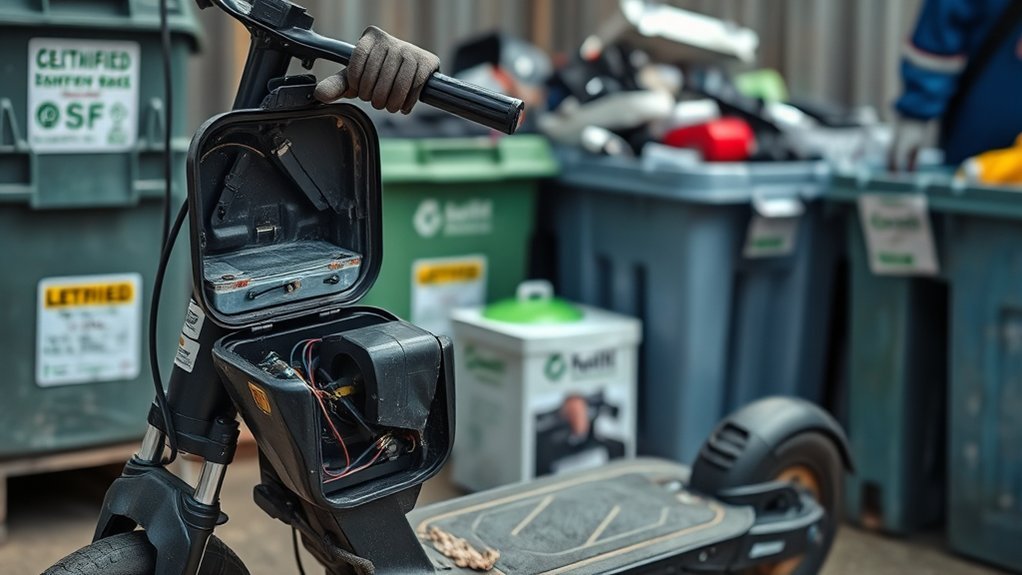
Almost every battery-powered scooter needs a separate disposal route. Electric scooters contain batteries, wiring, circuit boards, motors, metals, and plastics that should not enter ordinary household waste or curbside recycling.
The correct route depends more on the battery chemistry and condition than on the scooter’s speed or motor power. Most modern electric scooters use rechargeable lithium-ion batteries. Older or specialized models may use sealed lead-acid, nickel-metal-hydride, or another rechargeable chemistry. Each should go to a facility that accepts that battery type.
- Working scooter: Consider repair, resale, donation, or a trade-in program after checking for recalls.
- Broken scooter with an intact battery: Contact an electronics recycler, manufacturer, retailer program, or local waste authority.
- Scooter with an embedded battery: Leave the battery installed unless the manufacturer and receiving facility provide removal instructions.
- Swollen, leaking, hot, smoking, punctured, or fire-damaged battery: Stop using the scooter and obtain professional instructions before moving it.
- Recalled scooter: Follow the official recall remedy, which may require repair, return, disabling, refund processing, or special disposal.
- Non-electric kick scooter: Reuse it or ask a local scrap or recycling facility whether it accepts the frame and other materials.
Warning: Do not charge, open, crush, puncture, dismantle, or mail a battery that is swollen, leaking, smoking, unusually hot, hissing, recalled, or physically damaged. Move away from a smoking or burning battery and contact emergency services. For a damaged battery that is not actively burning, contact the manufacturer, local hazardous-waste program, or fire authority for handling instructions.
Why Does Electric Scooter Disposal Matter?
Electric scooter disposal matters because lithium-ion batteries can retain energy even when a scooter no longer runs. If a battery is crushed, punctured, short-circuited, or exposed to excessive heat, it can overheat and start a difficult-to-control fire.
The U.S. Environmental Protection Agency says lithium-ion batteries and devices containing them should not enter household trash or municipal recycling bins. Waste trucks and sorting equipment can damage the battery and create a fire hazard.
- You reduce the risk of fires in garbage trucks, recycling facilities, and landfills.
- You keep batteries away from waste systems that are not designed to handle them.
- You allow recyclers to recover materials such as cobalt, nickel, manganese, lithium, copper, aluminum, and steel when technically and economically practical.
- You conserve usable scooter parts through repair, refurbishment, or reuse.
- You comply with local rules that may prohibit rechargeable batteries or electronics in household waste.
EPA identified more than 240 lithium-ion-battery-related fires at 64 waste-management facilities between 2013 and 2020, showing why batteries must stay out of ordinary trash and mixed recycling.
How to Dispose of an Electric Scooter Step by Step
-
Stop using the scooter if it appears unsafe. Do not ride or charge it if the battery is swollen, leaking, unusually hot, smoking, hissing, punctured, water-damaged, or involved in a recall that tells owners to stop using it.
-
Record the identifying information. Find the brand, model, serial number, battery voltage, watt-hour rating if shown, and battery chemistry. The label may be beneath the deck, on the stem, beside the charging port, or in the manual.
-
Check for a recall. In the United States, search the CPSC recall database. Readers in other countries should check their national product-safety authority and the manufacturer’s website.
-
Decide whether safe reuse is possible. A non-recalled scooter with an intact battery may be repaired, sold, traded in, or donated. Do not pass a hazardous defect to another person.
-
Contact the manufacturer or retailer. Ask whether it offers repair, trade-in, mail-back, local drop-off, battery replacement, or product take-back. Confirm the accepted model and battery condition.
-
Find an approved local facility. Contact an electronics recycler, specialized battery recycler, municipal solid-waste department, or household hazardous-waste program.
-
Call before visiting. Tell the facility whether the battery is intact, removable, embedded, damaged, or recalled. Ask whether it accepts the whole scooter, whether an appointment or fee applies, and how the unit should be prepared.
-
Prepare the scooter only as instructed. Turn it off, remove personal accessories, and secure moving parts. Do not open the deck or battery enclosure unless the manufacturer identifies the battery as user-removable.
-
Transport it according to the facility’s instructions. Protect an intact scooter from movement and physical damage. Do not independently mail a lithium battery unless the receiving program provides a compliant shipping method and packaging instructions.
-
Keep proof of drop-off when available. A receipt or confirmation can be useful for a recall claim, business record, warranty issue, or local disposal requirement.
Pro Tip: Send the facility a photo of the scooter label and battery area before visiting. Staff can often identify the battery type, size, and correct collection stream from those details.
Can You Donate, Sell, or Repair It?
Before recycling a scooter, consider whether it can safely remain in use. Repair and reuse normally preserve more of the scooter’s value than dismantling it for raw materials.
First check the scooter’s recall status. Do not donate or sell a recalled scooter unless the official remedy has been completed and the scooter is safe to transfer. You should also disclose known faults, battery-age concerns, charging problems, crash damage, and missing parts.
| Option | Best For | Important Check |
|---|---|---|
| Donate | Safe, working, non-recalled scooters | Confirm the organization accepts battery-powered mobility products |
| Sell or give away | Usable scooters with an intact battery | Disclose faults and provide the correct charger and manual when possible |
| Repair | Scooters with replaceable tires, brakes, controls, wiring, or approved battery packs | Use compatible parts and a qualified repair provider |
| Parts recovery | Non-working units handled by a repair shop or recycler | Do not open or repurpose battery cells at home |
| Recycle | Unsafe, uneconomical, severely damaged, or end-of-life scooters | Confirm the facility accepts the whole scooter and its battery type |
Before transferring a connected scooter, sign out of its app, remove the scooter from your account, clear stored access codes, unpair Bluetooth connections, and delete saved location or payment information when the model stores such data.
How Do Manufacturer Take-Back Programs Work?
A manufacturer take-back program may provide a direct route for repair, refurbishment, trade-in, battery replacement, or recycling. Programs are voluntary in some regions and legally required under producer-responsibility rules in others, so eligibility varies by brand and location.
Program Eligibility Rules
Check the manufacturer’s official support or recycling page rather than assuming every store or service center accepts returns. Common requirements can include:
- A participating brand, model, or serial-number range
- Proof of purchase or account verification
- A complete scooter rather than loose parts
- An intact battery that is not swollen, leaking, punctured, or recalled
- Advance approval for a damaged or recalled unit
- A specific drop-off, pickup, or shipping process
Some programs offer a repair credit, trade-in value, replacement, refund, or discount, but these benefits are not guaranteed.
Return and Drop-Off Process
Contact customer service and provide the scooter’s model, serial number, purchase date, battery condition, and current location. Ask for written instructions that cover:
- The approved return location
- Whether the battery should remain installed
- Whether the scooter may be shipped
- Required packaging or labeling
- Any appointment, proof-of-purchase, or claim requirements
- Available refund, repair, or trade-in remedies
Do not create your own shipping package for a damaged or recalled lithium battery. Lithium batteries are regulated during transportation, and damaged batteries can require specialized packaging and handling. The Pipeline and Hazardous Materials Safety Administration provides current U.S. transportation guidance.
Refurbish, Recycle, or Dispose
After receiving a scooter, a manufacturer or its recycling partner may inspect it and choose the most suitable route:
- Repair and return it to the owner
- Refurbish it for safe reuse
- Recover working parts for approved repairs
- Separate the battery for specialized processing
- Recycle metals, circuit boards, plastics, and other components
- Send non-recoverable materials to an authorized disposal facility
The exact process depends on the product’s condition, local regulations, and the capabilities of the receiving facility.
Where Can You Recycle an Electric Scooter?
The best recycling route is a program that confirms it can accept both the scooter and its battery. Do not assume a curbside electronics collection, scrap yard, or retail battery box can take a large scooter battery.
Manufacturer Take-Back Programs
Start with the company that made or sold the scooter. Its program may be better equipped to identify the battery, provide recall instructions, replace reusable components, or direct the scooter to an approved recycling partner.
Ask whether the program accepts:
- Your exact scooter model
- Out-of-warranty products
- Loose batteries or only complete scooters
- Non-working products
- Damaged or recalled batteries
- Products purchased from another owner
Local E-Waste Centers
A local electronics recycler may accept the complete scooter, its removable battery, or both. In the United States, the EPA recommends checking for recyclers certified under the R2 or e-Stewards standards. You can learn more through the EPA’s certified electronics recyclers guidance.
Before visiting, ask these questions:
- Do you accept complete electric scooters from households?
- What battery chemistries and watt-hour sizes do you accept?
- Should an undamaged removable battery be separated?
- Do you accept embedded batteries?
- Do you accept swollen, damaged, recalled, or fire-exposed packs?
- Is there a fee, appointment, identification requirement, or quantity limit?
Note: Disposal laws and collection systems differ by country, state, province, and city. In the European Union, e-scooter traction batteries are generally treated as light-means-of-transport batteries under the EU Batteries Regulation. Always follow the rules and collection instructions where you live.
How Should You Recycle Lithium-Ion Batteries?
Send an intact lithium-ion scooter battery to a specialized battery recycler, approved electronics recycler, participating take-back program, or household hazardous-waste facility that confirms acceptance.
If the battery is designed for user removal, is undamaged, and the facility asks you to separate it, follow the manufacturer’s instructions. Do not force a connector, cut wires, open the battery casing, or remove a pack sealed beneath the scooter deck.
For an intact removable battery with safely accessible terminals:
- Turn the scooter off and disconnect the charger.
- Follow the manual’s removal procedure.
- Cover exposed terminals with non-conductive tape, such as electrical tape.
- Place the battery in a separate plastic bag if the recycler recommends it.
- Protect it from metal objects, impacts, moisture, direct sunlight, and excessive heat.
- Take it directly to the approved facility rather than storing it unnecessarily.
For an embedded battery, leave the scooter intact unless the manufacturer or recycler gives different instructions. EPA notes that not all lithium-ion batteries are removable or serviceable by the user.
For a swollen, leaking, hot, punctured, smoking, recalled, or fire-damaged battery, do not rely on ordinary drop-box instructions. Contact the manufacturer, waste authority, or receiving facility and describe the damage before attempting transport.
Can You Use a Hazardous Waste Event?
A household hazardous-waste event or permanent collection facility may accept an electric scooter, a removable scooter battery, or both. However, acceptance is not universal.
Check the city or county website and then call the program. Tell staff:
- The scooter brand and model
- The battery chemistry, voltage, or watt-hour rating if known
- Whether the battery is removable or embedded
- Whether it is intact, swollen, leaking, damaged, or recalled
- Whether you want to drop off the complete scooter or only the battery
Ask about residency requirements, event dates, appointments, fees, battery-size limits, and preparation instructions. Some events accept only household quantities, while others exclude large packs, whole vehicles, or damaged batteries.
Do not arrive unannounced with an unstable battery. Staff may need to direct you to a permanent hazardous-waste site, fire authority, manufacturer program, or specialist contractor.
How to Prepare an Intact Scooter for Drop-Off
Follow the receiving facility’s instructions first. Unless it requests something different, you can usually prepare an intact scooter by taking these basic steps:
- Turn the scooter off and unplug the charger.
- Do not deliberately drain, short-circuit, or open the battery.
- Fold and secure the stem if the normal folding mechanism works safely.
- Remove baskets, phone holders, bags, and other personal accessories.
- Keep the charger with the scooter if the program requests it.
- Protect the scooter from tipping, rolling, crushing, or contact with loose metal objects.
- Bring the model, serial number, recall information, and appointment confirmation.
If a removable battery has exposed terminals, use non-conductive tape or individual bagging as instructed by the recycler. Do not attempt to reach terminals inside a sealed deck or battery enclosure.
What Should You Never Do With an Old Scooter?
Avoid any disposal method that can damage the battery, expose waste workers to fire, or send electronic components into the wrong recycling stream.
- Do not place it in household trash. Compaction equipment can crush the battery.
- Do not use a curbside recycling bin. Municipal recycling systems are generally designed for paper, containers, glass, and other accepted household materials, not lithium-ion devices.
- Do not abandon it outdoors or beside a dumpster. Weather, impact, and unauthorized handling can damage the battery.
- Do not put the complete scooter in ordinary scrap metal. Confirm that the facility accepts battery-powered equipment.
- Do not open the battery pack. Individual cells can remain energized and may ignite if crushed, punctured, or short-circuited.
- Do not place a large or damaged scooter battery in a small retail collection box. These boxes may have chemistry, size, weight, or condition limits.
- Do not mail it without approved instructions. Lithium-battery shipping is regulated, and damaged or recalled batteries face additional restrictions.
- Do not donate or sell an unsafe or recalled scooter. Complete the official recall remedy or use the approved disposal process.
Frequently Asked Questions
Can you just throw away an electric scooter?
No. An electric scooter and its lithium-ion battery should not go in household trash or curbside recycling. Use a manufacturer take-back program, approved electronics recycler, battery recycler, or local household hazardous-waste program.
How do you get rid of an old e-scooter?
Check its condition and recall status, consider safe repair or reuse, contact the manufacturer, and then call a local electronics or hazardous-waste facility. Confirm whether it accepts the complete scooter, embedded batteries, and your battery’s condition before visiting.
Should you remove the scooter battery before recycling it?
Only remove it when the battery is undamaged, designed for user removal, and the manufacturer or recycler asks you to separate it. Leave embedded, sealed, damaged, swollen, leaking, hot, or recalled batteries in place and request professional instructions.
Are electric scooter batteries a fire hazard?
They can become a fire hazard if damaged, crushed, punctured, short-circuited, improperly charged, or exposed to excessive heat. Stop using a battery that swells, leaks, overheats, hisses, smokes, or shows physical damage.
Can an electric scooter go to a scrap-metal yard?
Only when the facility specifically accepts battery-powered scooters. Ordinary scrap loads may not accept lithium-ion batteries or electronics. Call first and follow the facility’s instructions about the battery, charger, and electronic parts.
Does electric scooter disposal cost money?
It may be free through a municipal collection event, recall remedy, retailer, or manufacturer program. Private recyclers and some public facilities may charge for large batteries, complete scooters, pickup, or damaged-pack handling. Confirm the fee before arrival.
Conclusion
When an electric scooter reaches the end of its useful life, first check whether it can be safely repaired, donated, sold, or returned. If reuse is not practical, contact the manufacturer, an approved electronics recycler, a specialized battery recycler, or your local household hazardous-waste program.
Keep the scooter and battery out of household trash and curbside recycling. Leave an embedded battery installed unless you receive clear removal instructions, and seek professional guidance before moving a damaged, swollen, hot, leaking, smoking, or recalled pack. A few careful checks protect you, waste workers, recycling facilities, and the materials that can be recovered from the scooter.
Sources
- U.S. EPA: Used Lithium-Ion Batteries — consumer disposal, terminal protection, embedded batteries, and recycling guidance
- U.S. EPA: Frequent Questions on Lithium-Ion Batteries — fire risks, battery materials, swollen batteries, and safe preparation
- U.S. EPA: Certified Electronics Recyclers — R2 and e-Stewards certification information
- PHMSA: Transporting Lithium Batteries — U.S. transport and shipping requirements
- U.S. Consumer Product Safety Commission: Recalls — current scooter and battery recall checks
- European Union Batteries Regulation 2023/1542 — EU rules for batteries, including light-means-of-transport batteries
