
Last Updated on September 26, 2026 by Caleb Warren
Knowing where to charge an electric scooter can make commuting and longer trips much easier. You don’t always need to return home when your battery runs low, but finding a suitable outlet takes some planning. The key is choosing a permitted charging location, using the correct charger, and allowing enough time for a useful recharge.
Quick Answer
You can charge an electric scooter at home, at work, at approved public outlets, and at businesses that permit charging. Some dedicated micromobility stations also provide charging access. A portable power station or suitable vehicle power supply offers another option. Always use the manufacturer-approved charger, confirm outlet compatibility, and stay present while the battery charges.
Key Takeaways
- An ordinary electric-car charging connector does not directly fit a typical electric scooter charger.
- Ask permission before using workplace, library, cafe, or privately owned outlets.
- Never charge while sleeping, and disconnect the charger when charging finishes.
- Choose a portable power station based on both battery capacity and charger power requirements.
- A secure, dry charging location is just as important as access to electricity.
Disclosure: As an Amazon Associate I earn from qualifying purchases. Some links on this page are affiliate links, at no extra cost to you.
Where Can You Charge an Electric Scooter?
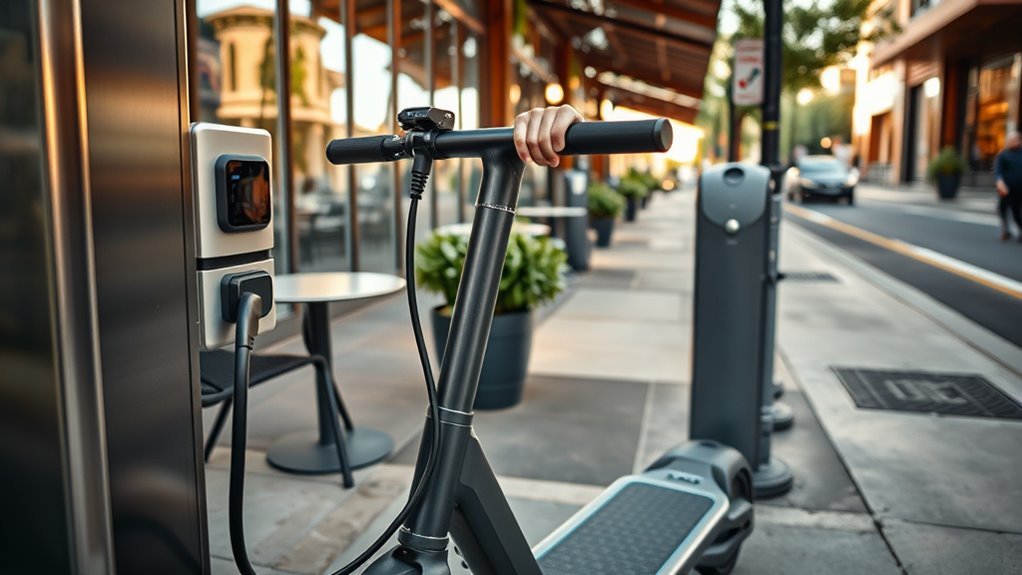
You can charge an electric scooter anywhere you have permission to use a compatible power supply and can follow the manufacturer’s charging instructions. For most personal scooters, this means using the supplied charger with a suitable household wall outlet.
However, an available outlet is not automatically an approved charging location. Building policies, outlet access, fire safety requirements, and scooter storage rules may limit where you can plug in.
These are the main charging options:
- Home: A suitable wall outlet in an approved charging area.
- Work: A designated location approved by your employer.
- Cafes and libraries: Outlets that staff explicitly permit you to use.
- Public charging locations: Dedicated scooter facilities or suitable accessible wall outlets.
- Community hosts: Private locations where the owner agrees to provide electricity.
- Portable power: A correctly sized power station or compatible vehicle power supply.
Your own charger is essential because scooter charging connectors and battery requirements vary between models. Do not assume that a charger from another scooter will work simply because its connector fits.
The U.S. Consumer Product Safety Commission warns against incompatible universal chargers because they can cause battery fires.
Charge Your Electric Scooter at Home
Home charging offers the most control over your scooter’s charging environment. You can use a suitable wall outlet, keep the scooter secure, and monitor the battery without searching for public power.
Choose a dry, ventilated location away from combustible materials and escape routes. Follow the scooter manufacturer’s instructions rather than assuming every model has identical charging requirements.
Home Charging Basics
Before charging, check the charger label, charging port, cable, and outlet. The charger’s input rating must match the available electrical supply.
Many U.S. scooters use chargers that connect to a standard 120V household outlet, although individual models may have different requirements.
| Check | Why it matters | Action |
|---|---|---|
| Charger | Prevents electrical mismatch | Use the manufacturer-approved unit |
| Outlet | Reduces electrical hazards | Inspect for damage |
| Space | Allows heat to dissipate | Choose a dry, ventilated area |
| Battery | Supports safe charging | Check for damage or swelling |
For a normal charging session:
- Allow the scooter to cool if the battery is unusually hot after riding.
- Move it to a suitable charging area.
- Inspect the charger, cable, and charging port.
- Connect the charger in the sequence specified by the manufacturer.
- Confirm that the charging indicator shows normal operation.
- Stay nearby and disconnect the charger when charging finishes.
Avoid improvised adapters, overloaded power strips, and extension cords. Plug the approved charger directly into a suitable wall outlet.
Why You Should Not Charge Overnight
Charging an electric scooter while you sleep is not recommended. A battery problem can develop without anyone noticing, particularly when the scooter is left in a bedroom, hallway, or enclosed storage area.
The CPSC’s micromobility charging guidance advises users to remain present during charging and never charge while sleeping or away from home.
Warning: Never charge a battery that is swollen, leaking, unusually hot, damaged, or making strange noises. Stop using the scooter and follow the manufacturer’s safety instructions. If the battery starts smoking or burning, move away and contact emergency services.
Plan charging sessions for times when you’re awake and can monitor the scooter. Keep charging equipment away from doors, stairs, windows, and other escape routes.
Disconnect the charger when the battery reaches its intended charge level. Even if your scooter has automatic charging protection, that feature does not make unattended charging risk-free.
Apartment Charging Options
Apartment charging depends on your building’s electrical access, storage facilities, and fire safety policies. Ask management where scooters or removable batteries may be charged before setting up a routine.
If your scooter has a manufacturer-approved removable battery, you may be able to charge the pack separately in an approved location. Follow the battery’s instructions and use only its compatible charger.
A removable battery also lets you secure the scooter separately, which can reduce theft risk.
Other options include an approved common-area outlet or a designated micromobility charging room. If several residents use electric scooters, a shared charging area may be more practical than individual hallway charging.
Charge Your Electric Scooter at Work
Workplace charging can help you complete a longer commute without returning home to recharge. However, you need permission before bringing a scooter indoors or connecting it to company electricity.
Ask whether your employer has a designated charging area and whether its fire safety policy allows lithium-ion scooter batteries.
Ask for Permission
Start by asking your manager, facilities team, or building administrator about charging rules. Explain that you want to use your approved scooter charger during the workday.
Confirm whether the scooter can enter the building, where it may be stored, and which outlets are authorized for charging.
A suitable charging location should not interfere with coworkers, emergency exits, or routine building operations.
If management permits charging, agree on a consistent location and follow any restrictions on charging hours or supervision.
Set Up a Charger
A dedicated workplace charging spot makes your routine more predictable. Place the scooter in the approved area, keep its charger accessible, and avoid leaving cables across walkways.
If your employer permits it, you can keep a second manufacturer-approved charger at work. This removes the need to carry one during every commute.
Label your charger so it is not confused with another employee’s equipment.
Keep the scooter secured while charging. A location covered by workplace security or within your normal view may help reduce theft risk.
Boost Your Daily Range
Charging at work can increase your usable daily range by replacing energy used during your morning commute. The amount you regain depends on your scooter’s battery capacity, charger output, and available charging time.
For example, if your morning trip uses a large portion of the battery, a daytime recharge may provide enough energy for the return journey.
Do not assume that charging at work automatically doubles your range. Your scooter may not reach a full charge before you leave.
Check the battery indicator before starting your trip home, especially if your route includes hills, long distances, or frequent stops.
Find Electric Scooter Charging Stations
Dedicated public charging stations for personal electric scooters are less common than charging stations for electric cars. Your most useful option may be a public facility with an accessible household outlet rather than a conventional EV charging connector.
PlugShare can help you investigate nearby charging locations. Its official map-filter guide explains how to narrow results by plug type and other location details.
When looking for a charging location:
- Search the area where you plan to stop.
- Filter for a suitable outlet type rather than assuming every EV connector will work.
- Review the location description, access restrictions, and recent user reports.
- Confirm that the outlet is available for scooter charging.
- Choose a backup location before depending on it for your return trip.
A listing on an EV charging map does not guarantee that the facility accepts scooters. Some locations are restricted to electric cars, registered users, or customers.
Also look for facilities that specifically advertise micromobility charging. Such locations may provide dedicated outlets, secure parking, or managed battery charging.
Ask to Charge at Cafes or Libraries
Cafes and libraries can provide useful charging stops when their policies permit scooters. However, a public-facing outlet is not necessarily available for charging personal vehicles.
Ask staff before bringing the scooter inside or plugging it in. Some businesses may allow a small charger but prohibit scooters because of space, battery safety, or insurance requirements.
At a cafe, buying a drink or snack is a considerate way to support the business providing electricity.
At a library, ask whether scooter batteries are allowed indoors and whether a designated charging area exists.
If charging is approved:
- Use your own manufacturer-approved charger.
- Keep the scooter and cable out of walkways.
- Stay present throughout the charging session.
- Keep the scooter within sight when possible.
- Disconnect the charger when finished.
A cafe visit may provide only a partial recharge. That can still be useful if you need enough energy to reach home or your next approved charging location.
These stops can also help you meet other local riders who may know suitable routes, repair services, and permitted charging facilities.
Plug Into EV Chargers and Wall Outlets
A standard wall outlet and an electric-car charging connector are different power connections. Most personal electric scooters use a separate charger designed to accept ordinary AC power and supply the correct charging voltage to the battery.
According to the U.S. Department of Energy’s EV charging guidance, Level 1 vehicle charging uses 120V AC, while Level 2 and DC fast charging use different equipment and connector arrangements.
That distinction matters because you cannot simply connect a typical scooter charger to an EV charging cable.
- Standard 120V wall outlet: Suitable when the scooter charger’s input rating matches and the outlet is approved for use.
- Dedicated scooter charging station: Suitable when it supports your scooter’s charging system.
- Level 2 EV connector: Not a direct replacement for a scooter’s ordinary wall plug.
- DC fast charger: Not intended for directly charging a conventional personal scooter battery.
Some EV charging locations also provide separate household outlets. However, their availability is site-specific, so confirm the actual outlet before traveling there.
A suitable wall outlet generally provides the same charging method you use at home. It does not automatically make your scooter charge faster.
For public charging, carry the correct charger, obey posted restrictions, and avoid occupying an EV charging space intended for a car.
Use Community Hosts Like Boondockers Welcome
Community hosts can provide another charging option, especially during longer trips. However, access depends on the host’s permission and the platform’s rules.
Boondockers Welcome is primarily an overnight RV hosting service, not a public electric scooter charging network. Some hosts offer electrical hookups, but those services are not guaranteed.
Its official stay rules explain that electrical hookups are optional and guests must follow host requirements.
If you are already traveling in an eligible RV, you can ask your host whether scooter charging is permitted. Confirm the available outlet type, charging location, and any applicable electricity charge before arriving.
Do not assume that a host accepts walk-in scooter riders or offers charging without an approved stay.
For ordinary scooter trips, a friend, family member, or another willing property owner may offer a simpler option. Always agree on charging access before relying on a private location.
Charge With a Power Station or Car
A portable power station or suitable vehicle power supply can provide backup charging when you cannot access a wall outlet. The equipment must supply enough power for your scooter’s approved charger.
Battery capacity, AC output, and electrical compatibility matter more than choosing a power station by its advertised size alone.
Power Station Basics
A portable power station stores electricity in its own battery and supplies it through built-in output ports. To charge a scooter, you normally connect the scooter’s approved charger to the station’s compatible AC outlet.
Check the scooter battery’s energy capacity in watt-hours (Wh), then compare it with the power station’s usable capacity.
| Feature | Benefit |
|---|---|
| Battery capacity (Wh) | Determines stored energy |
| AC output rating (W) | Determines supported charger power |
For a real example, the Segway Ninebot KickScooter E2 specifications list a 220Wh battery, a 36.3W charger output, and an approximate full charging time of 7.5 hours.
A power station with exactly 220Wh of advertised capacity would not necessarily provide a complete recharge from empty. Energy is lost during power conversion and charging.
Choose a station with capacity above the energy you want to replace, allowing additional room for those losses.
The station’s continuous AC output must also support the charger’s electrical input requirements. Check the charger’s input label rather than relying only on its DC output rating.
A fixed 300W minimum is not necessary for every scooter. The correct power requirement depends on the charger.
Charging From a Car
A car can sometimes supply electricity for scooter charging through a compatible built-in AC outlet, portable power station, or properly rated inverter.
Before using this method, confirm that the power supply supports the scooter charger and complies with the vehicle manufacturer’s instructions.
A small accessory outlet may not provide enough power for every charger. Exceeding its rated capacity can damage equipment or trigger electrical protection.
If you use an inverter connected to the vehicle’s electrical system, verify the required installation, operating conditions, and available output.
Some hybrid vehicles, including certain Prius configurations, can support external power equipment. However, the exact setup depends on the vehicle and its approved electrical connections.
Warning: Never connect scooter charging equipment directly to a vehicle’s high-voltage traction battery or improvise connections to its electrical system. Never run a gasoline-powered vehicle or generator in a garage or other enclosed space because of carbon monoxide danger.
Using vehicle power can also drain the vehicle’s battery if the electrical system is not operating as intended. Follow the vehicle manufacturer’s guidance and monitor the setup.
Off-Grid Charging Tips
Off-grid charging works when you have a suitable power source and enough stored energy to support the charging session.
A portable power station offers flexibility because it can be recharged before a trip and carried to a location without grid power.
Some models also accept solar input or vehicle charging, allowing you to replenish their stored energy during longer trips.
Solar charging depends on sunlight, panel output, and the station’s input limits. It is not a guaranteed way to refill a scooter battery during a short stop.
A portable generator is another possible backup source, provided its electrical output supports the approved scooter charger. Follow all generator safety instructions and operate it outdoors, away from buildings and occupied spaces.
For a reliable setup:
- Compare the scooter battery capacity with the station’s usable energy.
- Confirm the station’s continuous output supports the charger.
- Check that the available AC voltage matches the charger input.
- Allow for conversion losses when estimating charging capacity.
- Keep the station and charging connections dry.
- Monitor the equipment for unusual heat or charging behavior.
These checks help prevent the common mistake of buying a power station that can run the charger but cannot store enough energy for the desired recharge.
Keep Your Scooter Safe While Charging
Public charging creates two concerns: battery safety and theft. Choose a permitted location where you can monitor the scooter without blocking access for other people.
Use a strong U-lock or chain lock around an appropriate part of the frame and a fixed object, such as a suitable bike rack.
Do not secure the scooter only through a removable wheel or accessory.
If your model has GPS tracking or a built-in anti-theft feature, activate it as an additional security measure. Electronic tracking does not replace a physical lock.
Choose a shaded, dry charging spot. Never connect a charger when the plug, charging port, or electrical equipment is wet.
If the scooter has been exposed to rain, inspect it and follow the manufacturer’s drying and charging instructions before connecting power.
Keep the battery away from direct sunlight and excessive heat while charging.
Charge Your Scooter in an Apartment
If your apartment has no private garage or accessible outlet, start by asking building management about permitted scooter charging locations.
Building policies may restrict charging in apartments, hallways, storage rooms, or shared spaces. A removable battery does not automatically exempt you from these rules.
Where approved, you may be able to use a designated charging room, supervised common-area outlet, or suitable private charging space.
If your battery is removable, carry it only as directed by the manufacturer and charge it with the correct equipment.
New York City’s official lithium-ion battery safety guidance advises users to plug chargers directly into wall outlets, avoid extension cords, and never charge batteries overnight or unattended.
It also warns against charging near entrances, exits, and flammable materials.
If your building does not offer a suitable location, consider asking management about installing a designated charging area. Neighbors with similar needs may help demonstrate demand for shared facilities.
A trusted neighbor might also permit charging at their property, provided the arrangement follows applicable building and safety rules.
Frequently Asked Questions
Can We Charge an Electric Scooter Anywhere?
No, you cannot charge an electric scooter anywhere. You need permission to use the outlet, a compatible power supply, and a location that allows scooter charging. Always use the manufacturer-approved charger and avoid wet or damaged electrical equipment. Public access to a building does not automatically mean its outlets are available for personal vehicle charging.
Are Electric Scooters Illegal in PA?
Privately owned stand-up electric scooters are generally not permitted on Pennsylvania public roads, sidewalks, or bike lanes under the state’s existing vehicle rules. PennDOT distinguishes them from electric bicycles and self-balancing personal mobility devices. Private-property use is different, and permission from the property owner is necessary. Do not assume that a scooter’s speed or motor rating makes public-road use legal.
How Long Can You Ride an Electric Scooter Before It Dies?
Electric scooter range varies by model, battery size, terrain, rider weight, speed, and weather. For example, Segway lists approximately 12.4 miles of typical range for its Ninebot KickScooter E2. Other models have different ratings, so there is no universal riding distance. Check your scooter’s specifications and leave enough battery capacity to reach a reliable charging location.
What Happens if I Get Caught on My Electric Scooter?
The consequences depend on your location and the rule you violate. Riding where scooters are prohibited may lead to a citation or another enforcement action. Penalties are not the same in every jurisdiction. Check the applicable state and local regulations before riding, particularly when using sidewalks, roads, bike lanes, or restricted public property.
Can You Charge an Electric Scooter at a Tesla or Other EV Charging Station?
Not directly with a typical scooter charger. Electric-car charging connectors are different from ordinary household plugs. You may be able to charge at the same facility if it provides a separate compatible wall outlet or dedicated scooter charging equipment. Confirm access and permission before relying on that location.
How Long Does It Take to Charge an Electric Scooter?
Charging time depends on battery capacity, charger output, and the amount of charge remaining. Segway lists approximately 7.5 hours for a full charge of its Ninebot KickScooter E2. A partial recharge takes less time, but the exact duration varies. Use the charging time provided for your specific scooter rather than assuming every model charges at the same rate.
Can You Charge an Electric Scooter With a Portable Power Station?
Yes, if the power station provides compatible electrical output and enough usable energy. Compare its continuous AC output with your charger’s input requirements. Its watt-hour capacity must also cover the energy you want to replace, including conversion losses. Use the scooter’s approved charger between the power station and battery.
Conclusion
You can charge your electric scooter at home, work, approved public outlets, and other permitted locations. A portable power station can also provide backup energy when no suitable wall outlet is available.
Carry the correct charger, confirm access before traveling, and plan enough time for the battery to recharge. Most importantly, stay present while charging and never compromise electrical safety for convenience.
Sources
- U.S. Consumer Product Safety Commission: Electric scooter charging and lithium-ion battery safety.
- CPSC Universal Charger Warning: Risks associated with incompatible replacement chargers.
- PlugShare Support: Charging location searches and plug filters.
- U.S. Department of Energy: EV charging levels, connectors, and outlet compatibility.
- Boondockers Welcome: Host rules and electrical hookup access.
- Pennsylvania Department of Transportation: Electric scooter classifications and operating restrictions.
- Segway Support: Ninebot KickScooter E2 battery, charger, range, and charging specifications.
- NYC Lithium-Ion Battery Safety Guidance: Charging location, outlet, storage, and fire safety precautions.

