
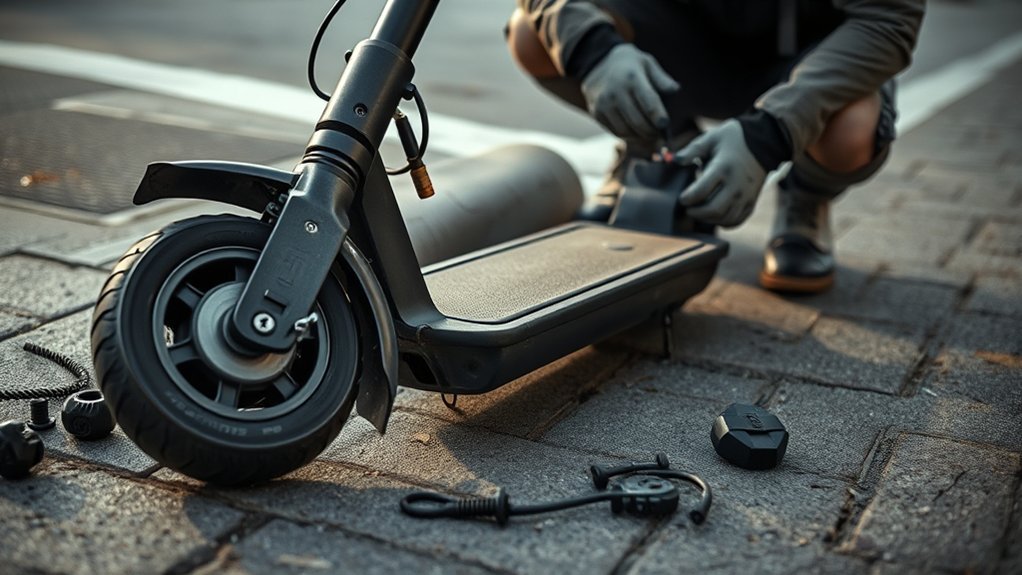
Last Updated on July 23, 2026 by Caleb Warren
A broken electric scooter may need only a tire, brake, connector, or charger repair, but a damaged battery or cracked frame can make continued use unsafe. Start with a visual safety check, look up the model’s manual and recall status, and compare the complete repair cost with the scooter’s condition and replacement value. When repair is not sensible, sell only safe usable parts, donate a fully working scooter, or use an approved electronics or household hazardous-waste program.
Quick Answer
Inspect the scooter for battery, frame, brake, tire, wiring, and charging faults before deciding what to do. Repair minor problems when the scooter remains structurally safe. Otherwise, sell safe parts, donate a fully working unit, or take the scooter and battery to an approved recycler. Never place a lithium-ion battery in household trash or curbside recycling.
Key Takeaways
- Stop using and charging the scooter if its battery is swollen, leaking, unusually hot, smoking, hissing, burned, or giving off a strong chemical odor.
- Check the manufacturer’s manual, warranty, service notices, and recall information before paying for repairs or selling the scooter.
- Do not open or probe a sealed battery pack unless the manufacturer provides a user-service procedure and you have the required training.
- Never put a lithium-ion scooter battery in household garbage or curbside recycling.
- Favor local pickup when selling a scooter with a battery, because lithium-battery shipping is regulated.
- Upcycle only safe, battery-free mechanical parts unless a qualified battery professional has evaluated the electrical components.
At a Glance
| Time Required | About 20–45 minutes for a basic visual inspection; professional diagnosis may take longer |
| Difficulty | Easy for visual checks; moderate to advanced for electrical diagnosis |
| Tools Needed | Manufacturer’s manual, flashlight, tire gauge or pump, basic hand tools, phone app if required, and a multimeter only for approved external test points |
| Cost | A visual inspection is usually free; parts, labor, transport, and recycling fees vary by model and location |
Disclosure: As an Amazon Associate I earn from qualifying purchases. Some links on this page are affiliate links, at no extra cost to you.
Check If Your Broken Electric Scooter Is Fixable
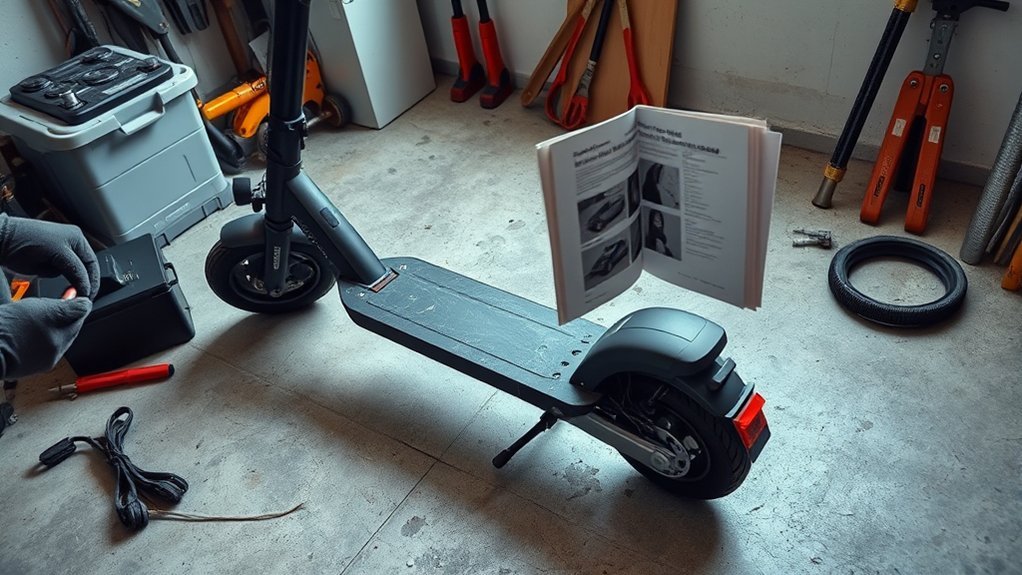
Begin with a safety assessment rather than immediately opening the deck or connecting a charger. Check the frame, stem, folding mechanism, deck, wheels, tires, brakes, wiring, charging port, display, and battery enclosure. Do not ride a scooter with a cracked frame, loose steering column, damaged folding latch, failed brake, badly worn tire, or exposed wiring.
Warning: Stop using and charging the scooter if the battery is swollen, leaking, unusually hot, smoking, hissing, burned, punctured, melted, or producing a strong chemical odor. Do not open the deck, press on the battery, or carry a smoking or rapidly heating scooter through an occupied building. Move away, warn others, and contact emergency services when there is an immediate fire risk.
Identify the Model and Check for Recalls
Find the scooter’s brand, model, serial number, battery identification label, and charger specifications. These details may appear under the deck, on the stem, inside the manufacturer’s app, or in the original paperwork.
Search the manufacturer’s support site for the correct manual, warranty terms, service bulletins, and repair instructions. In the United States, also search the Consumer Product Safety Commission recall database. If the scooter or battery is recalled, stop using it and follow the recall notice. Do not repair, donate, or sell it until the official remedy permits that action.
Check Warranty and Parts Support
Contact the manufacturer before disassembling a relatively new scooter. Opening the deck, cutting wires, installing an unapproved controller, or replacing the battery yourself may void warranty coverage. Ask whether the company offers remote diagnostics, authorized repair, replacement parts, battery take-back, or a discounted replacement program.
Parts availability matters as much as the immediate fault. A repair may not be worthwhile when a proprietary display, controller, battery, or folding component is no longer supported.
Inspect Structural and Mechanical Parts
- Frame and deck: Look for cracks, bends, separation, deep corrosion, or damage around welds and fasteners.
- Stem and folding latch: Hold the front wheel straight and gently check for looseness, movement, or a latch that will not lock completely.
- Wheels and tires: Check pressure, tread, punctures, sidewall damage, wheel alignment, and bearing play.
- Brakes: Test lever movement, cables or hydraulic lines, brake pads, discs, drums, and the electronic brake cut-off.
- Throttle: Confirm that it returns smoothly and does not stick.
- Lights and reflectors: Check that required lights work and that reflectors remain attached.
- Wiring: Look for pinched, melted, cut, wet, or exposed wires without pulling connectors apart unnecessarily.
A cracked frame, failed folding joint, major fire damage, or severe corrosion generally requires professional evaluation. Welding or reinforcing a load-bearing scooter frame without engineering guidance can create another failure point.
Inspect the Battery Without Opening It
Examine only the exterior surfaces that the manufacturer makes accessible. Look for a lifted or distorted deck cover, swelling, leakage, heat damage, corrosion, damaged connectors, or evidence that water entered the battery compartment.
Do not charge a scooter that was submerged, flooded, or heavily exposed to water until the manufacturer or a qualified technician evaluates it. Moisture can damage cells and electrical insulation even when the display initially works.
Note: Battery voltage alone does not prove that a pack is healthy. A battery can show normal open-circuit voltage while suffering from weak cells, excessive internal resistance, damaged insulation, or a faulty battery-management system.
Try the Fast Fixes First
After ruling out battery damage, structural failure, and recall issues, check the common problems that do not require opening the battery pack.
- Confirm the correct charger: Match the charger model and output information to the manufacturer’s specifications. Do not substitute a charger merely because its plug fits.
- Inspect the charger and port: Look for bent pins, looseness, corrosion, melting, frayed cables, or debris. Do not insert metal objects into the port.
- Check the outlet: Test the outlet with another suitable device and avoid damaged extension cords or overloaded power strips.
- Check external connectors: Reseat only the plugs identified as user-serviceable in the manual.
- Inflate or repair the tires: Low pressure, punctures, and damaged tubes can prevent safe operation even when the motor works.
- Check the brake cut-off: A stuck brake sensor may keep the controller from accepting throttle input. Follow the model-specific adjustment or reset procedure.
- Read the error code: Record the exact code before restarting the scooter. Compare it with the manufacturer’s manual or support documentation.
- Restart or reset the scooter: Use only the model-specific procedure. A generic button combination can change settings or fail to address the real fault.
- Update approved firmware: Use the official app and maintain sufficient charge during an update. Do not install unofficial firmware while diagnosing a safety problem.
When to Use a Multimeter
A multimeter can help test an external charger output, fuse, switch, or approved connector when the manual provides the expected value and test procedure. Set the meter correctly before touching the probes to the circuit.
Do not puncture insulation, bridge connector pins, short terminals, probe a damaged pack, or open a sealed battery enclosure to reach individual cells. Incorrect testing can damage the controller, create an arc, or bypass battery protection. Ask a qualified technician to perform internal pack diagnosis.
Pro Tip: Record the model number, error code, charging behavior, unusual sounds, recent water exposure, and the circumstances of the failure before contacting a repair shop. Clear symptoms can reduce diagnostic time and help the technician bring the correct parts.
Know When Repairs Aren’t Worth It
There is no universal percentage that determines whether every scooter should be repaired. Some owners use half of the scooter’s current value as a personal budget limit, but safety, reliability, and parts support matter more than a single number.
Request a written estimate that includes diagnosis, parts, labor, shipping, taxes, firmware work, and any follow-up adjustment. Then consider the following:
- Structural condition: A cracked stem, damaged folding joint, or compromised frame may make the scooter unsuitable for further use.
- Battery condition: A damaged, recalled, counterfeit, or unsupported pack can make repair unsafe or impractical.
- Number of faults: A motor, controller, display, charger, and battery problem together may exceed the value of a reliable replacement.
- Age and wear: Tires, bearings, brakes, cables, suspension parts, and wiring may soon need additional work.
- Parts availability: A low repair quote has little value when the replacement component cannot be obtained or supported.
- Warranty: Manufacturer coverage or a recall remedy can make repair or replacement much more economical.
- Replacement safety: Compare the repair with a scooter whose electrical system and charger comply with applicable safety standards, such as the certification framework described by UL Solutions for personal e-mobility devices.
- Future reliability: Consider whether the proposed repair addresses the root cause or only restores temporary operation.
Repair makes sense when the frame is sound, the battery is safe, the fault is clearly identified, suitable parts are available, and the completed scooter can pass a full brake, steering, tire, charging, and road test.
Protect Your Data Before Selling or Donating
Some electric scooters store account, Bluetooth, ride, location, lock, or ownership information in an app. Before transferring the scooter:
- Save any receipts, serial numbers, and maintenance records you need.
- Remove the scooter from your manufacturer account.
- Turn off app-based locks and recovery modes.
- Unpair Bluetooth access and delete shared users.
- Perform the manufacturer-approved ownership transfer or factory reset.
- Remove phone mounts, trackers, labels, keys, access cards, and personal accessories.
Do not perform a reset that hides an unresolved error or recall from the next owner. Disclose known faults and provide the correct manual, charger, and repair history.
Sell Your Broken Scooter for Parts
A non-running scooter may still contain useful wheels, brake components, lights, displays, chargers, controllers, motors, body panels, or frame hardware. Before listing anything, check the scooter and its components for recalls. Federal law prohibits selling products that remain subject to certain recalls, and the recall notice may require destruction or a specific disposal process.
Identify Valuable Components
Identify the exact brand, model, part number, electrical rating, connector type, condition, and known faults. Do not label a component as “tested” unless you used an appropriate procedure and can describe the result.
| Part | Possible Buyer | Listing Guidance |
|---|---|---|
| Battery | Authorized repairer or qualified rebuilder | Do not sell as usable if damaged, swollen, recalled, water-exposed, modified, or of unknown condition |
| Motor or powered wheel | Repair shop or experienced hobbyist | State connector type, wheel size, tested operation, noise, and bearing condition |
| Wheels and tires | DIY owner | Show tread, punctures, sidewall damage, rim damage, and bearing play |
| Controller or display | Repair shop or hobbyist | List firmware, part number, error history, connectors, and whether it was tested |
| Frame and body parts | Custom builder or repairer | Photograph cracks, bends, corrosion, stripped threads, welds, and folding hardware |
| Original charger | Owner of the exact supported model | Show the label, plug, cable condition, output rating, and model compatibility |
Prices vary widely by brand, specification, age, condition, recall status, and local demand. Compare completed sales for the exact part rather than copying the price of a different scooter or an untested listing.
List Condition Honestly
Describe every known fault, including water exposure, overheating, intermittent shutdowns, error codes, worn bearings, damaged threads, missing fasteners, bent parts, cracked covers, and prior modifications. Use clear photographs of the complete scooter, identification labels, connectors, damaged areas, and each included component.
State whether the item was tested, how it was tested, and whether the result was consistent. Do not describe an unknown battery as healthy simply because it accepts a charge or briefly powers the display.
Reach Local Buyers
Local repair shops, maker groups, scooter enthusiasts, and online local marketplaces may accept a complete project scooter or individual parts. Local pickup is usually simpler for a scooter that still contains a lithium-ion battery.
Warning: Do not place a damaged, defective, swollen, leaking, burned, or recalled lithium-ion battery in ordinary mail. Lithium batteries are regulated during transport, and damaged batteries may require specialized packaging and handling. Review current U.S. Department of Transportation lithium-battery guidance and the chosen carrier’s rules before shipping any battery-powered part.
For local pickup, keep the scooter powered off, prevent accidental throttle operation, secure it against movement, and tell the buyer about the battery’s known condition before the transfer.
Donate a Working Scooter
Donate an electric scooter only when it runs reliably, charges normally, has no open recall, and passes a complete safety inspection. A charity should not become responsible for an unsafe battery, cracked frame, missing charger, or unresolved braking problem.
Check Scooter Functionality
- Confirm that the battery charges without unusual heat, odor, noise, swelling, or shutdowns.
- Test throttle response and confirm that it returns to idle.
- Inspect brake pads, discs or drums, cables, hydraulic lines, electronic braking, and lever travel.
- Inflate the tires to the manufacturer’s specification and inspect them for cuts, exposed cords, punctures, or severe wear.
- Check wheel bearings, axle fasteners, steering alignment, stem movement, and the folding latch.
- Confirm that the lights, reflectors, horn or bell, display, speed modes, and charger work.
- Complete a brief low-speed test ride in a safe area while wearing suitable protective equipment.
If the scooter fails any safety check, repair it before donation or choose a recycler instead.
Find Donation Recipients
Contact organizations before arriving. A local transportation charity, repair cooperative, community workshop, youth program, school technical program, mutual-aid group, or neighborhood reuse organization may accept a working scooter when its policies and local laws allow it.
| Recipient Type | What to Confirm |
|---|---|
| Transportation or bicycle charity | It specifically accepts powered scooters and has a safe inspection process |
| Community repair cooperative | It accepts the model, battery type, charger, and available parts |
| Youth or community program | Age rules, supervision, protective equipment, storage, and local riding laws |
| School or technical workshop | Its insurance and safety policies allow lithium-powered equipment |
| Neighbor or individual recipient | The recipient understands the controls, condition, charging rules, and legal requirements |
Note: A standing electric kick scooter is not a medical mobility scooter. Do not present it as a substitute for medically appropriate mobility equipment for an older adult or disabled person. The recipient must be able to balance, steer, brake, mount, and dismount safely.
Prepare for Safe Handover
Clean the scooter without spraying water into the charging port, display, deck, motor, or battery compartment. Tighten only the fasteners covered by the maintenance instructions and use the stated torque values when the manual provides them.
Include:
- The original compatible charger.
- The user manual or a link to the official manual.
- Keys, access cards, or required security hardware.
- A written list of repairs, replaced parts, and remaining cosmetic damage.
- The model and serial number.
- Instructions for app ownership transfer.
- Recommended tire pressure and basic charging rules.
For a possible U.S. tax deduction, confirm that the recipient is a qualified organization and keep the required records. The deductible amount is generally based on fair-market value rather than the original purchase price. Review IRS Publication 561 or seek tax advice for your circumstances.
Recycle Your Scooter at an E-Waste Center
When the scooter cannot be repaired, sold safely, or donated, contact an electronics recycler, household hazardous-waste program, manufacturer take-back service, or local solid-waste authority. Do not assume that every electronics drop-off accepts large scooter batteries.
Ask the facility:
- Whether it accepts complete electric kick scooters.
- Whether the battery must remain installed or be removed.
- Whether it accepts damaged, defective, swollen, burned, or recalled batteries.
- Whether an appointment, fee, proof of residence, or special packaging is required.
- How the scooter should be transported.
The U.S. Environmental Protection Agency advises that lithium-ion batteries and devices containing them should go to a separate battery recycler or household hazardous-waste collection point, not household garbage or curbside recycling. Review the EPA’s used lithium-ion battery guidance before preparing the scooter.
Proper recycling helps recover materials from the battery, motor, wiring, controller, frame, and other components while reducing fire risks in garbage trucks, transfer stations, and municipal recycling facilities.
Remove the Scooter Battery Before Disposal
Do not automatically remove the battery. First read the manufacturer’s manual and ask the receiving facility whether it wants the pack installed or separated.
When Battery Removal May Be Appropriate
You may remove the pack when all of the following are true:
- The manufacturer identifies it as a user-removable component.
- The pack is cool, dry, intact, and free from swelling, leakage, burn marks, punctures, or deformation.
- You have the specified tools and instructions.
- The scooter is powered off and disconnected from its charger.
- The recycler has confirmed that it accepts the separated battery.
Follow the manual exactly, avoid pulling on wires, and do not touch exposed conductive parts. After removing an intact pack, protect exposed terminals with nonconductive tape or place the pack in an individual plastic bag if the collection program instructs you to do so.
When Not to Remove the Battery
Leave the battery in place and request professional guidance when:
- The pack is sealed inside the deck and not listed as user-serviceable.
- The enclosure is swollen, crushed, burned, wet, leaking, punctured, or unusually hot.
- Fasteners are stripped, corroded, or inaccessible.
- Wires or connectors have melted.
- The scooter is covered by a recall with specific disposal instructions.
- You cannot identify the battery chemistry or safe isolation procedure.
Do not pry, bend, drill, crush, cut, solder, or puncture a battery pack. Do not place a damaged pack into a standard retail battery collection box unless the program specifically confirms that the location accepts damaged batteries.
Transport the Scooter or Battery Safely
Call the receiving facility before moving a damaged scooter or battery. An intact removable battery should be protected from short circuits and movement according to the facility’s instructions. Keep it away from metal tools, keys, direct heat, and combustible materials.
A visibly damaged, leaking, smoking, burned, or rapidly heating battery may require specialized handling. Do not improvise shipping packaging or place it in ordinary mail.
Upcycle Scooter Parts Into Something Useful
Upcycling can be suitable for clean, battery-free mechanical parts that have no sharp edges, structural cracks, contamination, or electrical hazards. Remove all stored energy and hazardous components through an appropriate professional process before cutting, drilling, grinding, heating, or welding scooter parts.
- Wheels: Use sound wheels for a light rolling cart, display base, or workshop fixture.
- Handlebars: Convert clean handlebars into a wall-mounted rack after removing wiring, throttle parts, sharp edges, and damaged grips.
- Body panels: Use non-battery panels for signs, planters, or protective covers after smoothing and sealing cut edges.
- Frame tubing: A qualified fabricator may reuse undamaged battery-free tubing for art, storage, or garden structures.
- Lights and switches: Reuse only when their voltage, current, polarity, insulation, and condition are known and the new circuit includes suitable protection.
Warning: Do not turn a used scooter battery into a home solar pack, power bank, or electronics supply unless a qualified battery professional has tested the cells, battery-management system, enclosure, insulation, connectors, and protection devices for that exact second-life use.
When professional reuse is not practical, recycle the battery through an approved program and limit the upcycling project to safe non-electrical parts.
Avoid Battery Disposal Mistakes
Lithium-ion scooter batteries can retain enough energy to start a fire after the scooter stops working. Treat every pack as energized until a qualified recycler or technician takes responsibility for it.
- Do not put the battery or complete scooter in household garbage.
- Do not place it in curbside recycling.
- Do not crush, puncture, bend, drill, cut, or burn the battery.
- Do not charge a swollen, leaking, burned, water-damaged, or unusually hot pack.
- Do not use a charger simply because the connector fits.
- Do not leave a charging scooter unattended or charge it while sleeping.
- Do not sell a recalled product unless the official remedy and applicable law permit it.
- Do not mail a damaged, defective, or recalled battery through ordinary services.
- Do not store a loose battery where its terminals can contact metal objects.
- Do not place a damaged battery in a standard retail collection box without approval.
The safest disposal route is the one approved by the battery manufacturer and the local collection facility for the battery’s actual condition—not the nearest garbage or recycling bin.
For additional charging, product, and battery precautions, review the CPSC Micromobility Information Center.
Frequently Asked Questions
What can I do with a broken electric scooter?
Check its recall status and inspect the battery, frame, steering, brakes, tires, charger, wiring, display, controller, and motor. Repair it when the structure and battery are safe and the total cost is reasonable. Otherwise, sell safe usable parts, donate a completely working unit, upcycle battery-free parts, or take it to an approved recycler.
Are scooters good for autistic kids?
Some autistic children enjoy scooter riding and may use it as physical play, but suitability varies by child. Consider balance, coordination, judgment, sensory responses, communication, traffic awareness, and the ability to brake safely. Use a properly fitted helmet, follow age and weight limits, supervise the child, and ask an occupational therapist or pediatric clinician for individualized guidance when needed.
What should I do if an electric scooter stops working?
Power it off and check for battery heat, swelling, leakage, odor, smoke, water exposure, structural damage, brake problems, flat tires, loose external connectors, charger damage, and displayed error codes. Follow the model’s manual for restarting or resetting it. Do not open the battery pack. Use a qualified technician when the fault involves the battery, controller, motor, internal wiring, or frame.
Is it worth fixing an electric scooter?
It may be worth fixing when the frame and folding mechanism are sound, the battery is safe, parts remain available, and the estimate is substantially lower than a reliable replacement. Replacement is often more sensible when the scooter has structural damage, an unsafe or unsupported battery, several major electrical faults, or recurring failures.
Can I put an electric scooter battery in the trash?
No. Lithium-ion batteries and devices containing them should not go in household garbage or curbside recycling because they can start fires during collection and processing. Contact a battery recycler, electronics recycler, manufacturer take-back program, household hazardous-waste facility, or local waste authority.
Can I sell a broken electric scooter?
You may be able to sell a non-recalled scooter as a repair project or sell safe usable parts, subject to local law and marketplace rules. Disclose every known fault. Do not sell a recalled product contrary to the recall instructions, and do not represent a damaged, swollen, water-exposed, modified, or unknown-condition battery as safe.
What should I do with a swollen or leaking scooter battery?
Stop using and charging the scooter. Do not press, puncture, open, or place the battery in a normal collection box. Keep people away and contact the manufacturer, local hazardous-waste authority, or a facility that specifically accepts damaged lithium-ion batteries. Leave the area and call emergency services if the pack is smoking, burning, hissing, or rapidly heating.
Conclusion
Start with safety, not disassembly. Check for battery warning signs, structural damage, water exposure, recalls, warranty coverage, and model-specific instructions before attempting a repair. Minor tire, brake, charger, connector, or sensor faults may be economical to fix, while a damaged battery, cracked frame, failed folding joint, or combination of major electrical faults may make replacement the safer choice.
When repair is not practical, sell only legal and accurately described parts, donate only a fully working scooter, and upcycle only safe battery-free components. Take the battery and remaining scooter to a program that specifically accepts their type and condition. Never place a lithium-ion scooter battery in household trash or curbside recycling.
Sources
- U.S. Environmental Protection Agency: Used Lithium-Ion Batteries — supports separate collection, terminal protection, and the warning against household trash and curbside recycling.
- U.S. Consumer Product Safety Commission: Micromobility Information Center — supports scooter battery, charging, recall, and replacement-component safety guidance.
- U.S. Consumer Product Safety Commission: Recalls and Product Safety Warnings — provides current product recall information.
- Pipeline and Hazardous Materials Safety Administration: Transporting Lithium Batteries — supports lithium-battery packaging, short-circuit prevention, and transport restrictions.
- UL Solutions: Personal E-Mobility Testing and Certification — explains electrical-system safety evaluation for personal e-mobility devices.
- Internal Revenue Service Publication 561 — supports fair-market-value and recordkeeping guidance for donated property.
