
Last Updated on July 24, 2026 by Daniel Globe
Italy has several major international airports, and the best one depends on where your trip begins. Rome Fiumicino offers the broadest range of long-haul connections, Milan Malpensa serves northern Italy, and airports such as Venice, Naples, Bologna, Catania, Palermo, Bari, and Cagliari place you closer to specific regions. Comparing the flight route with the airport-to-city transfer often saves more time than choosing the cheapest fare alone.
Quick Answer
Rome Fiumicino is usually the best all-around airport for international flights to Italy. Choose Milan Malpensa for long-haul travel to northern Italy, Venice for the northeast, Naples for Campania and the Amalfi Coast, Pisa or Florence for Tuscany, and Catania or Palermo for Sicily.
Key Takeaways
- Rome Fiumicino (FCO) is Italy’s busiest airport and the strongest choice for intercontinental routes.
- Milan Malpensa (MXP) is the main long-haul gateway for northern Italy, while Linate is closer to central Milan.
- Secondary airports such as Bergamo and Ciampino can offer low fares, but city transfers may take longer.
- Regional airports can reduce ground travel when you are visiting Tuscany, Sicily, Sardinia, Puglia, or southern Italy.
- Routes and transport schedules change, so confirm your airline, terminal, and onward connection before travel.
Disclosure: As an Amazon Associate I earn from qualifying purchases. Some links on this page are affiliate links, at no extra cost to you.
Italy’s Main International Airports at a Glance
| Airport | Best for | Main public transport |
|---|---|---|
| Rome Fiumicino (FCO) | Rome, central Italy, long-haul connections | Leonardo Express and regional trains |
| Milan Malpensa (MXP) | Northern Italy and intercontinental flights | Malpensa Express from both passenger terminals |
| Milan Linate (LIN) | Central Milan and short-haul trips | M4 metro |
| Venice Marco Polo (VCE) | Venice and northeast Italy | Bus, Alilaguna water bus, and water taxi |
| Naples (NAP) | Naples, Pompeii, Capri, and the Amalfi Coast | Alibus, taxi, and private transfer |
| Bologna (BLQ) | Emilia-Romagna and rail trips across central and northern Italy | Marconi Express monorail |
| Milan Bergamo (BGY) | Low-cost flights and Bergamo | Direct coaches to Milan; bus to Bergamo station |
| Rome Ciampino (CIA) | Low-cost European flights | Termini coaches or Ciampino Airlink |
| Florence (FLR) | Florence and central Tuscany | T2 tram |
| Pisa (PSA) | Pisa, Lucca, the Tuscan coast, and wider Tuscany | PisaMover to Pisa Centrale |
| Catania (CTA) | Eastern Sicily, Mount Etna, Taormina, and Siracusa | Alibus, regional buses, taxi, and nearby rail connection |
| Palermo (PMO) | Palermo and western Sicily | Train, coach, and taxi |
| Bari (BRI) | Puglia, Matera, and the Adriatic coast | Train, bus, and taxi |
| Cagliari (CAG) | Southern Sardinia | Train, bus, and taxi |
Italy’s airports handled more than 229.7 million passengers in 2025, and Rome Fiumicino remained the country’s busiest airport, according to ENAC’s 2025 traffic report.
How to Choose the Best Airport in Italy
Start with your final destination, not only the airfare. A nonstop flight to an airport farther away may still beat a cheaper itinerary that requires a long train ride, an airport change, or an overnight stay. Compare the full trip from your departure city to your hotel.
- Choose Rome Fiumicino for the widest selection of intercontinental routes and easy rail access to central Rome.
- Choose Malpensa for many long-haul routes to northern Italy, the Alps, Lake Maggiore, and Milan.
- Choose Linate when central Milan is your priority and a suitable short-haul flight is available.
- Choose a regional airport when it places you close to the part of Italy you plan to explore.
- Check the arrival time because late-night public transport can be limited, especially at smaller airports.
Warning: An airport name may include a famous city even when the terminal is far from the center. Milan Bergamo is near Bergamo, not central Milan, and Rome Ciampino has fewer direct rail options than Fiumicino. Always price and time the ground transfer before booking.
Rome Fiumicino Airport: Italy’s Main Hub
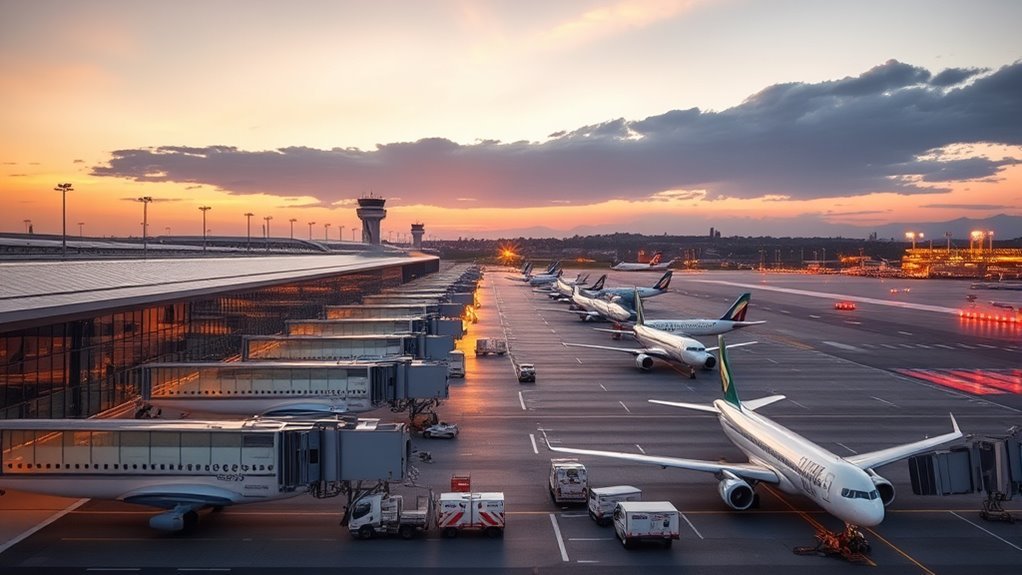
Rome Fiumicino Airport (FCO), also called Leonardo da Vinci Airport, is Italy’s busiest passenger airport and the country’s strongest all-around international gateway. It sits about 32 km southwest of Rome and handles domestic, European, and intercontinental flights through two passenger terminals.
The Leonardo Express runs nonstop between the airport and Roma Termini in about 32 minutes. Regional FL1 trains serve stations such as Trastevere, Ostiense, and Tiburtina, which can be more useful when your hotel is not near Termini. The airport also has buses, taxis, car rentals, lounges, restaurants, shops, and special-assistance services.
Fiumicino is the main hub for ITA Airways and a major connecting point for many international carriers. It is usually the best choice when you need the broadest route selection, a protected airline connection, or direct rail access to Rome.
Milan Malpensa Airport for Long-Haul Flights
Milan Malpensa Airport (MXP) is the main intercontinental airport for Milan and much of northern Italy. It has two passenger terminals: Terminal 1 handles a wide mix of domestic, international, and intercontinental services, while Terminal 2 is strongly associated with easyJet operations.
Both terminals have rail stations. The Malpensa Express connects the airport with central Milan stations, including Milano Centrale and Milano Cadorna. Check your ticket and terminal carefully because the journey pattern and travel time depend on the station and service you choose. Official airport information is available through SEA Milan Airports.
Malpensa is a practical base for Milan, Lake Maggiore, parts of Piedmont and Lombardy, and onward rail travel. It offers extensive shopping, dining, lounges, hotels, car rentals, and long-haul connections. For central Milan, however, Linate may provide a faster ground transfer when the flight options suit your route.
Milan Linate Airport for Central Milan
Milan Linate Airport (LIN) is much closer to central Milan than Malpensa or Bergamo. It mainly serves domestic and European routes, making it useful for business trips, short city breaks, and connections from other European hubs.
The M4 metro links the terminal directly with Milan’s urban transport network. This makes Linate one of Italy’s easiest airports for reaching a major city center without a coach or regional train. Check the official Linate airport information for current services and transport updates.
Venice Marco Polo Airport for Northern Italy Trips
Venice Marco Polo Airport (VCE) is the main airport for Venice and a useful gateway to the Veneto region and northeast Italy. Its route network includes domestic, European, and selected long-haul services. Airlines change by season, so use the airport’s live route and airline information rather than relying on a fixed carrier list.
You can travel between the airport and Venice by ACTV or ATVO bus to Piazzale Roma, Alilaguna water bus, private water taxi, road taxi, or chauffeur service. Mestre station is also connected by bus. The official Venice Airport transport guide lists the current options.
Choose Marco Polo when Venice is your first destination or when you are continuing to Padua, Vicenza, Verona, the Dolomites, or other parts of northeast Italy. Treviso Airport can offer low-cost alternatives, but it requires a longer ground transfer to Venice.
Naples Airport for Southern Italy Travel
Naples International Airport (NAP), also known as Capodichino, is the main airport for Naples and a practical entry point for Pompeii, Herculaneum, Capri, Sorrento, and the Amalfi Coast. Its compact passenger terminal includes shops, restaurants, lounges, car rentals, and passenger services.
Naples Airport Access
The official airport transport page lists Alibus services between the airport, central Naples, and the port. Taxis offer published flat-rate options for some common destinations, while private transfers can be useful for groups, late arrivals, or trips that continue beyond Naples.
| Access option | Best use |
|---|---|
| Alibus | Naples city center and port |
| Taxi | Direct city journeys and selected flat-rate routes |
| Private transfer | Sorrento, Amalfi Coast, groups, and late arrivals |
| Car rental | Regional road trips outside central Naples |
Allow extra time during busy periods because road traffic can affect buses, taxis, and private transfers. If you plan to stay in central Naples, public transport or a taxi is usually simpler than renting a car immediately.
Southern Italy Connections
Naples Airport serves domestic and international routes and gives you direct access to one of southern Italy’s main transport centers. Napoli Centrale connects with high-speed and regional rail services, while the port serves ferries and hydrofoils to islands and coastal destinations.
For the Amalfi Coast, compare a private transfer, bus connection, ferry, or a train-plus-bus route based on your arrival time and exact town. A destination such as Sorrento has different transport options from Amalfi, Positano, or Ravello.
Bologna Airport for Central Italy Access
Bologna Guglielmo Marconi Airport (BLQ) is a strong choice for Emilia-Romagna and for travelers who want fast access to Italy’s rail network. It serves domestic and international routes from a single passenger terminal with shops, dining, lounges, car rentals, and passenger services.
The Marconi Express is a monorail link, not a regional train. It connects the airport with Bologna Centrale in about seven minutes. From Bologna Centrale, high-speed and regional trains reach Florence, Milan, Venice, Verona, Rimini, and many other cities.
BLQ works especially well for Bologna, Modena, Parma, Ferrara, Ravenna, and wider Emilia-Romagna. It can also be a useful alternative when fares to Florence or Venice are high.
Milan Bergamo Airport for Budget Flights
Milan Bergamo Airport (BGY), also called Orio al Serio, is one of Italy’s major low-cost airports. It is close to Bergamo but much farther from central Milan, so the full transfer time matters when you compare fares.
| Feature | What to know |
|---|---|
| Passenger terminal | Compact layout with shops, food, and passenger services |
| Milan connection | Direct airport coaches serve Milano Centrale |
| Rail connection | No train station at the terminal; take the ATB bus to Bergamo station |
The airport’s official bus page lists direct coach services to Milan and other destinations. For rail travel, the airport explains that an ATB bus links the terminal with Bergamo station. BGY can be excellent for low fares, but it is less convenient for a tight connection at Malpensa or Linate.
Rome Ciampino Airport for Low-Cost Travel
Rome Ciampino Airport (CIA) is about 15 km from Rome and mainly serves low-cost, charter, and general aviation traffic. Its compact layout can be easy to navigate, but it has fewer direct public-transport options than Fiumicino.
Direct coaches connect the airport with Roma Termini. The Ciampino Airlink combines a bus to Ciampino railway station with a train to Rome. Local buses also connect with metro stations. Travel time varies with traffic and the chosen route, so avoid treating any single transfer time as guaranteed.
Ciampino can be a good value when the fare is much lower and your arrival time matches the transport schedule. Fiumicino is usually easier for long-haul travel, protected connections, and direct airport rail service.
Florence Airport for Tuscany Getaways
Florence Airport, also called Amerigo Vespucci or Peretola Airport (FLR), is about 4 km from central Florence. It is a convenient choice for Florence and nearby parts of Tuscany when a suitable flight is available.
- Reach central Florence on the T2 tram.
- Use Florence as a rail base for Siena, Bologna, Rome, and other cities.
- Choose a rental car only when your itinerary includes rural villages or countryside stays.
- Allow extra time for road travel during busy periods.
- Compare FLR with Pisa Airport because route availability and fares can differ.
The airport’s official transport page lists the tram, taxi, bus, and road options. Florence Airport is smaller than Rome Fiumicino or Milan Malpensa, so many long-haul travelers connect through another European hub.
Pisa Airport for Tuscany and the Coast
Pisa International Airport (PSA) is another major gateway to Tuscany. It is especially useful for Pisa, Lucca, Livorno, the Tuscan coast, and travelers who want a broader selection of low-cost European routes.
The PisaMover links the passenger terminal with Pisa Centrale railway station. From there, trains continue to Florence and other Tuscan destinations. Compare the total rail journey with the convenience of landing directly at Florence Airport.
Catania Airport for Sicily Travel
Catania Fontanarossa Airport (CTA) is the main gateway to eastern Sicily and one of Italy’s busiest regional airports. It serves domestic and international routes and is well placed for Catania, Mount Etna, Taormina, Siracusa, Noto, and the island’s southeast.
Catania Airport Location
The airport sits close to Catania and the main roads that run along Sicily’s eastern side. Its location makes it useful for travelers who want to begin exploring soon after arrival.
- Reach central Catania by Alibus or taxi.
- Use regional buses for several towns across eastern and southern Sicily.
- Connect with rail services through the nearby Catania Aeroporto Fontanarossa station.
- Rent a car for rural areas, beaches, and multi-stop island trips.
- Check Mount Etna activity and flight status before travel because volcanic ash can affect operations.
Sicily Flight Connections
Catania has frequent domestic links with cities such as Rome and Milan, plus a changing mix of European and seasonal routes. Check the airport and airline websites for the current schedule because destinations can change between summer and winter.
Choose Catania for eastern Sicily. Palermo is generally better for the island’s west, while Trapani can be useful for some low-cost routes and destinations in far western Sicily.
Airport Transport Options
The official Catania Airport bus guide lists city and regional services. Taxis, car rentals, and private transfers are also available.
- Take Alibus for central Catania.
- Use a regional coach when it serves your destination directly.
- Choose a taxi for a simple door-to-door city transfer.
- Book a private transfer when arriving late or carrying substantial luggage.
- Use a rental car for flexible travel around Etna, the coast, and smaller towns.
Palermo, Bari, and Cagliari for Regional Travel
Palermo, Bari, and Cagliari are important gateways for western Sicily, Puglia, and southern Sardinia. Each can save hours of ground travel compared with landing at a distant national hub.
| Airport | Regional reach | Useful connections |
|---|---|---|
| Palermo (PMO) | Palermo and western Sicily | Train, coach, taxi, and rental car |
| Bari (BRI) | Bari, Puglia, and Matera | Airport train, bus, taxi, and rental car |
| Cagliari (CAG) | Cagliari and southern Sardinia | Airport train, bus, taxi, and rental car |
Palermo Airport has rail and road connections to the city. Bari Airport has a rail link that makes central Bari easy to reach. Cagliari Airport is connected with central Cagliari and other Sardinian cities by train.
For island travel, choose the airport closest to the area you plan to explore. Driving from one end of Sicily or Sardinia to the other can take much longer than the map suggests, especially when your route includes mountain roads, city traffic, or ferry connections.
Other Useful International Airports in Italy
Italy has many additional airports that may fit a regional itinerary. Turin Airport is useful for Piedmont and parts of the western Alps. Verona Airport serves Lake Garda and the Veneto region. Treviso Airport offers low-cost access to northeast Italy, although it is farther from Venice than Marco Polo. Brindisi Airport is often a strong choice for southern Puglia, including Lecce and the Salento peninsula.
Smaller airports can have limited or seasonal route schedules. They work best when the flight is direct and the arrival airport clearly reduces your onward travel.
Planning Airport Transfers and Connections
Do not assume that flights using the same city name operate from the same airport. Rome, Milan, Venice, and parts of Tuscany have multiple airports, and changing between them can require a long road transfer.
- Leave a generous buffer for a self-transfer between separate tickets.
- Check whether you must collect and recheck baggage.
- Confirm the arrival and departure terminals before travel.
- Review the last train, metro, or coach time for a late arrival.
- Use the airport’s official website for current transport disruptions and terminal changes.
Pro Tip: Compare the total cost of airfare, baggage, airport transfer, and onward rail travel. A slightly higher fare to the closest airport can be cheaper and much easier than a low-cost flight to a distant secondary airport.
Accessibility and Passenger Assistance
Italian airports provide assistance for passengers with disabilities or reduced mobility under European passenger-rights rules. Request assistance through your airline or travel agent when booking, and reconfirm it before departure. Official airport pages explain meeting points, accessible transport, wheelchairs, security support, and boarding procedures.
Families should also check stroller rules, family lanes, nursery facilities, and car-seat arrangements before travel. These services vary by airport and airline.
Note: Airline routes, terminal assignments, security procedures, and public-transport schedules can change. Check the official airport and airline websites again shortly before departure.
Frequently Asked Questions
Which airport in Italy should I fly into?
Choose Rome Fiumicino for the widest international route selection, Malpensa for long-haul travel to northern Italy, Venice for the northeast, Naples for Campania, Pisa or Florence for Tuscany, and Catania or Palermo for Sicily.
What are the biggest international airports in Italy?
Rome Fiumicino is Italy’s busiest passenger airport. Milan Malpensa is the main intercontinental gateway for northern Italy. Bergamo, Naples, Catania, Venice, Bologna, and Milan Linate also handle substantial domestic and international traffic.
Which Italian airport has the worst traffic or delays?
No single airport is always the worst. Delays depend on weather, air-traffic restrictions, strikes, runway work, seasonal demand, and airline operations. Check live flight data and recent disruption notices for your travel date.
Should I use Rome Fiumicino or Ciampino?
Use Fiumicino for most long-haul flights, broad airline choice, direct rail service, and protected connections. Choose Ciampino when a low-cost European flight saves enough money and its coach or Airlink schedule fits your plans.
Which Milan airport is best?
Malpensa is best for many long-haul flights, Linate is usually easiest for central Milan, and Bergamo often has the lowest fares. Compare the flight schedule with the full airport transfer before choosing.
Is Florence or Pisa Airport better for Tuscany?
Florence Airport is closer to central Florence. Pisa Airport often offers more low-cost routes and is convenient for Pisa, Lucca, Livorno, and the coast. Both connect with rail travel, so the best choice depends on your first destination and fare.
Can I connect between different airports in Rome or Milan?
Yes, but an airport change is a self-transfer unless your airline states otherwise. Allow several hours, account for traffic, collect checked baggage when required, and confirm that you can reach the second airport before check-in closes.
What are some hidden gems in Italy with useful airport access?
Matera is reachable from Bari, Procida from Naples, the baroque towns of southeast Sicily from Catania, and the hill towns of Tuscany from Florence or Pisa. Tropea is usually reached through Lamezia Terme Airport.
Conclusion
Rome Fiumicino is the strongest general choice for international travel, but it is not automatically the best airport for every Italy trip. Malpensa suits many long-haul journeys to the north, Linate offers quick access to Milan, Venice serves the northeast, Naples opens southern Italy, and regional airports can place you much closer to Tuscany, Sicily, Sardinia, or Puglia. Choose the airport that gives you the best total journey, not only the lowest airfare.
Sources
- ENAC, Dati di traffico 2025 — current Italian airport traffic overview and Fiumicino’s national ranking.
- Aeroporti di Roma, Fiumicino train connections — Leonardo Express and regional rail information.
- SEA Milan Airports — official Malpensa and Linate airport information.
- Venice Marco Polo Airport transport guide — bus and water connections to Venice.
- Bologna Airport, Marconi Express — official airport-to-station travel information.
- Pisa Airport, PisaMover — official connection between the terminal and Pisa Centrale.

2 Comments
Pingback: NetJets Fractional Ownership: Complete Guide [2026]
Pingback: How To Disinfect A Travel Pillow 2026: Safe Steps