
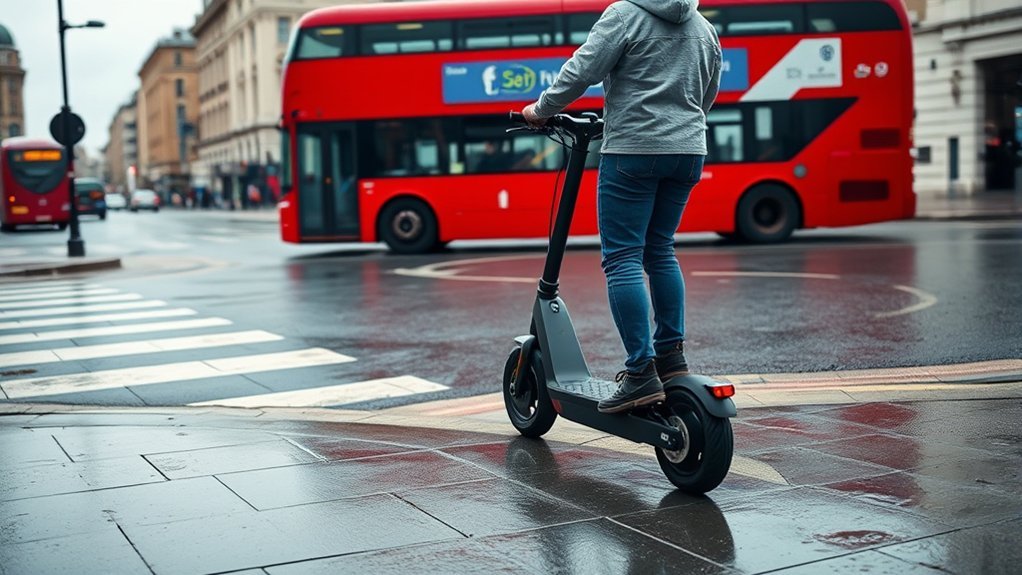
Last Updated on September 10, 2026 by Daniel Globe
In the UK, you can’t legally ride a privately owned electric scooter on public roads, pavements, or most other public land. Private e-scooters are treated as motor vehicles, so they’d need insurance, tax, licensing, and registration, which they don’t meet. You can only use one on private land with permission. Rental e-scooters are legal in approved trial areas, with a valid driving licence and scheme rules. There’s more to know about where and how you can ride.
Quick Answer
Privately owned electric scooters are illegal to ride on public roads, cycle lanes, or pavements in the UK and can only be used on private land with landowner permission. However, government-approved rental e-scooters can be ridden legally within designated trial areas provided you hold a valid driving licence and follow local scheme rules.
Key Takeaways
- Private e-scooters are classified as motor vehicles under UK law and cannot meet standard tax, insurance, and registration criteria for public roads.
- Rental e-scooters are legal only in approved trial zones (such as parts of London) and include third-party motor insurance through the operator.
- Riders of rental e-scooters must hold a valid full or provisional UK driving licence (or accepted foreign equivalent).
- Using an illegal private e-scooter on public land can result in a £300 fine, six penalty points, and seizure of the vehicle.
Disclosure: As an Amazon Associate I earn from qualifying purchases. Some links on this page are affiliate links, at no extra cost to you.
Are Electric Scooters Legal in the UK?
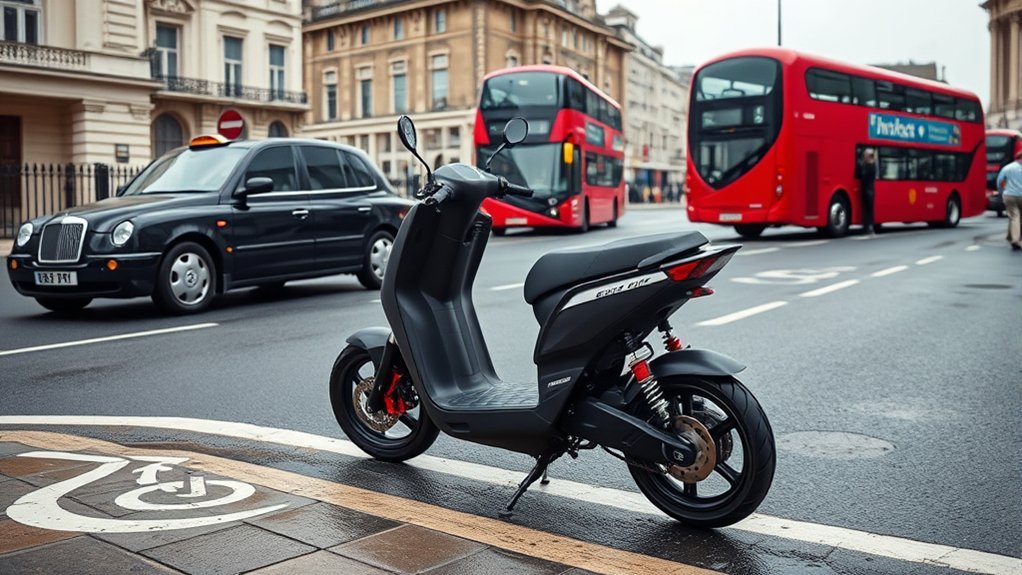
No, not if you mean privately owned electric scooters on public land in the UK. You can’t lawfully ride them on roads, pavements, or cycle lanes because electric regulations classify them as motor vehicles, and they don’t yet meet road vehicle standards. You may use one only on private land if the landowner gives permission. That distinction matters for scooter safety, because lawful use depends on where you ride and which machine you choose.
If you want public access, you can use a government-regulated rental e-scooter in a designated trial area. Those schemes began in 2020 and now operate in many places, including London. You’ll need a valid full or provisional UK driving licence, and the operator provides insurance. The law still leaves room for change, and debates about future legalisation continue. For now, however, your freedom is bounded by the current rules.
Why Private E-Scooters Are Illegal on Roads
You should know that private e-scooters count as motor vehicles under UK law, so they’re subject to the same legal rules as other vehicles. Because they don’t meet the required insurance, tax, and licensing conditions, you can’t legally use them on public roads. They’re only allowed on private land with the landowner’s permission.
Motor Vehicle Classification
Under UK road traffic law, an electric scooter is classed as a motor vehicle, which means it must meet the same core legal requirements as other vehicles before it can be used on public roads. This classification follows the legal definitions you’re expected to follow, and it places private e-scooters under motor vehicle regulations. In practice, you’d need insurance, tax, licensing, and registration for lawful road use. Because privately owned models usually lack the required lights, plates, and approved status, you can’t legally ride them on public roads. You may only use them on private land with the landowner’s permission. The state’s current trials for rental scooters show that freedom is possible, but only when rules are established first.
Road Use Restrictions
Because private electric scooters count as motor vehicles, the road-use rules are strict: you can’t legally ride one on public roads or highways in the UK. You may use one only on private land with the landowner’s permission. On public streets, your scooter usually lacks the insurance, tax, licensing, and registration needed for lawful use. If you ride anyway, you risk penalties, including a fine of up to £300 and six points on your driving licence. These restrictions reflect safety concerns, since uncontrolled use can endanger you and others. They also create enforcement challenges, especially with an estimated 1.2 million illegal private e-scooters in circulation. If you want mobility without legal risk, you must stay within the law.
Where You Can Ride Rental E-Scooters
You can ride rental e-scooters on public roads and in designated cycle lanes within UK trial areas. You must not use them on pavements or motorways, and you should follow any local scheme rules that apply in your area. These limits help protect pedestrians and keep your ride within the law.
Road And Cycle Lanes
Rental e-scooters can be ridden on public roads and designated cycle lanes in UK trial areas, provided you follow the rules of the local rental scheme. You need a valid full or provisional UK driving licence, and the operator’s insurance covers third-party claims while you ride. This lets you travel with confidence and lawful independence, without private ownership. For e scooter safety, you should wear a helmet, even though it isn’t mandatory. The rental regulations exist to protect you and others, so you must stay within the scheme’s terms. You can use these scooters on the routes allowed by the trial, but private e-scooters still can’t be used on public roads, pavements, or cycle lanes.
Restricted Areas To Avoid
Even in trial areas, there are places where you can’t ride a rental e-scooter, and knowing them helps you avoid penalties. You must stay off pavements, pedestrian-only areas, and motorways, because UK law forbids riding there. Check your local scheme before you set off, since rules can differ by city and by operator. In London and other trial areas, scooters operate only under strict conditions on public roads and designated cycle lanes. Respect pavement regulations and keep clear of unauthorized areas, even if they seem convenient. If you ignore the marked boundaries, you risk fines and penalty points on your driving licence. To ride freely and lawfully, use only the zones your rental app and local regulations approve.
Who Can Rent an E-Scooter in the UK?
Who can rent an e-scooter in the UK? You can do so if you hold a full or provisional UK driving licence, or a full licence from another country where local rules allow it. You should check the age requirements in your rental area before you begin the rental process.
| Requirement | What you need | Notes |
|---|---|---|
| UK licence | Full or provisional | Accepted for rentals |
| Foreign licence | Full overseas licence | Subject to local rules |
| Age | Area-specific minimum | Check before booking |
| L plates | Not needed | Even with provisional status |
| Scheme info | Operator or authority website | Confirm current access |
This access can support freer, practical mobility, but you must still follow the scheme’s conditions. Rental operators also include third-party motor insurance, so the legal framework is built into the service. For current availability, consult your local transport authority or the operator’s website before you ride.
Do You Need Insurance for Rental E-Scooters?
Yes, rental e-scooters in the UK already include third-party motor insurance through the scheme operator, so you do not need to arrange your own cover before riding. This means you can use a rental scooter without buying separate personal insurance, provided you ride within the scheme’s rules. The operator’s cover protects against third-party claims, which helps keep you compliant with UK road traffic law and supports freer, lawful travel.
Your rider responsibility is to understand what the policy covers and what it doesn’t. Before you ride, carry out insurance verification with the rental operator or app details, so you know the limits, exclusions, and reporting steps. You should also confirm that you hold a valid full or provisional UK driving licence, because rental schemes require it. By checking the insurance terms first, you protect yourself from avoidable disputes and ride with confidence, clarity, and genuine independence on the road.
When Will Private E-Scooters Be Legal?
When will private e-scooters become legal in the UK? At present, you can’t use them on public roads, pavements, or cycle lanes; you’re limited to private land with the landowner’s permission. The government has run rental trials since 2020, and it plans to extend them until May 2028 to assess safety and practicality. Those trials shape the future e scooter timeline, but they don’t set a firm date for your own machine.
You can expect private e scooter regulations to be debated further, because consultations show broad public support for legalisation. Even so, ministers still need to agree on details such as power ratings and speed limits before they can change the law. That means your freedom to ride a private e-scooter in public isn’t here yet. For now, watch policy developments closely, but don’t assume legalization is imminent.
Frequently Asked Questions
Can You Legally Ride an E-Scooter in the UK?
No, you generally can’t legally ride a private e-scooter on UK public roads or pavements. You can use government-approved rental scooters in trial areas under specific scheme rules and licence requirements, but private models remain restricted to private land with permission.
What Happens if You Get Caught With an E-Scooter in the UK?
If you are caught riding an illegal private e-scooter on public land, you face penalties including a fixed penalty fine of up to £300, six penalty points on your driving licence, and police seizure of the vehicle.
Why Are Electric Scooters Illegal in the UK but Not Electric Bikes?
Electric bicycles (EAPCs) are governed by specific bicycle regulations allowing pedal assistance up to 15 mph without requiring motor vehicle registration. Conversely, electric scooters are legally classified as motor vehicles under road traffic laws and lack type approval, insurance, and tax structures.
Who Banned E-Scooters in the UK?
E-scooters were not explicitly banned by a single entity; rather, they fall outside existing vehicle type-approval regulations enforced by the UK government and Department for Transport, restricting their public use unless part of an authorized rental trial.
Conclusion
So, if you’re asking whether an electric scooter is legal in the UK, the answer is mixed. Rental e-scooters can take you along approved roads, while private ones remain largely in legal twilight, like a bird kept on the ground. You’ll need to follow the rules, stay insured where required, and ride only where permitted. Until the law changes, you should treat e-scooters as a carefully fenced path, not an open road.
Sources
- GOV.UK Powered Transporters Information Sheet — details motor vehicle classification and legal definitions for e-scooters.
- GOV.UK E-Scooter Trials: Guidance for Users — outlines rules, licence requirements, and trial extension details.
