
Last Updated on September 10, 2026 by Daniel Globe
No, you can’t legally ride an electric scooter on public streets, bike lanes, sidewalks, trails, or in parks in Toronto under current rules. E-scooters are banned from all public property in the city, and Toronto has twice declined to join Ontario’s e-scooter pilot program. You may only use one on private property with the owner’s permission. Enforcement is limited but real, and fines can apply. Here’s the full picture, including why the ban exists and where the rules could head next.
Quick Answer
Electric scooters are illegal to ride on any public road, sidewalk, bike lane, trail, or park in Toronto. The city has not joined Ontario’s e-scooter pilot program, so riding is legal only on private property with the owner’s permission.
Disclosure: As an Amazon Associate I earn from qualifying purchases. Some links on this page are affiliate links, at no extra cost to you.
Is an Electric Scooter Legal in Toronto?
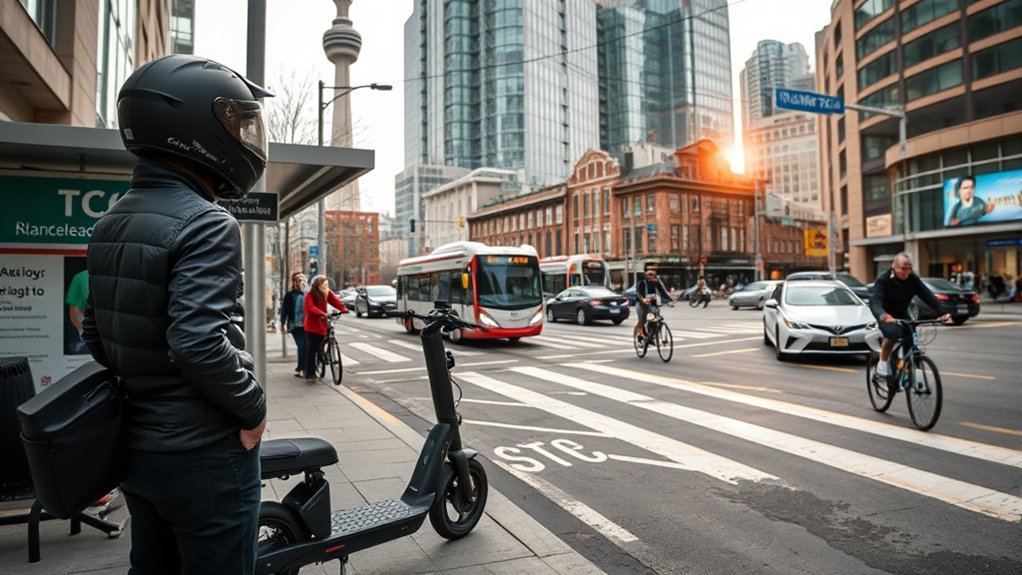
As of 2026, electric scooters are not legal for public use in Toronto. Toronto’s Municipal Code (Chapters 950, 886, and 608) prohibits operating, storing, or parking an e-scooter on any public street, sidewalk, bicycle lane, cycle track, trail, path, or park. Ontario’s e-scooter pilot program lets municipalities opt in to allow e-scooters on their roads — but Toronto City Council voted against joining in May 2021, and reaffirmed that decision in May 2024. As a result, e-scooters cannot be legally operated anywhere on public property in the city. You can lawfully ride one only on private property, and only with the owner’s permission.
Key Takeaways
- E-scooters are banned on all public property in Toronto — roads, sidewalks, bike lanes, trails, and parks.
- Toronto has twice declined Ontario’s e-scooter pilot program, most recently in May 2024.
- Riding is legal only on private property, with the owner’s consent.
- E-scooters can still be sold in stores, even though riding them in public isn’t allowed.
- SickKids reported e-scooter injuries more than doubled from 46 cases in 2024 to 107 in 2025.
Toronto’s E-Scooter Ban and Enforcement
Toronto’s ban remains in force, and the city has continued tightening enforcement rather than loosening it. In 2026, the city launched a “Rules for Rideables” public awareness campaign to help riders sort out which micromobility devices — bicycles, e-bikes, cargo bikes, mopeds, and e-scooters — are allowed where. Toronto Police also ran a dedicated micromobility education and enforcement campaign, and the Toronto Police Service may issue tickets under the Highway Traffic Act or municipal by-laws whenever a violation is observed. Enforcement has historically been inconsistent given competing policing priorities, but riders shouldn’t treat that as safety: officers can and do issue citations, most often for sidewalk and bike-lane riding.
Where You Can Ride an E-Scooter in Toronto
You can ride an e-scooter only on private property with the owner’s permission — public roads, bike lanes, sidewalks, trails, and parks are all off-limits under Toronto’s Municipal Code. This is a citywide rule; it doesn’t vary park-by-park or trail-by-trail the way some other bylaws do.
Private Property Use
Electric scooters may be used on private property in Toronto only with the owner’s permission, and riders should follow any site-specific rules. Private property rights govern that land, so wear a helmet, keep speed controlled, and yield to pedestrians or workers even where riding is allowed.
| Rule | Requirement | Result |
|---|---|---|
| Permission | Obtain owner consent | Legal use |
| Safety | Wear a helmet | Reduced risk |
| Conduct | Follow site rules | Continued access |
| Respect | Obey posted limits | No conflict |
| Care | Ride responsibly | Preserved freedom |
On private premises, riding is only allowed within the owner’s terms. Ignore them, and you may lose access to the property or still face enforcement if the riding spills onto public land.
Parks and Trails
Unlike some municipalities that carve out exceptions for parks or trails, Toronto’s ban applies uniformly — no city park or public trail permits e-scooter riding, including the Martin Goodman Trail and other waterfront paths. Treat every public green space the same as a public street.
- Assume all public parks and trails are off-limits unless you’re on private land within them.
- Wear a helmet and follow safety practices wherever riding is actually permitted (private property).
- Respect pedestrians and other path users.
- Don’t rely on informal or anecdotal “everyone rides here” claims — the bylaw doesn’t carve out exceptions.
Check Local Bylaws If You Travel Outside Toronto
Local bylaws determine where an e-scooter may be operated across the Greater Toronto Area, and rules differ sharply between neighbouring municipalities. Ontario law classifies e-scooters under a separate pilot framework from bicycles and e-bikes, and only municipalities that have formally opted in — Mississauga is one example — permit e-scooter riding under local rules. Before riding anywhere outside Toronto, confirm that specific city’s bylaw, since opting in, speed limits, and helmet requirements vary by municipality.
Note: Even where e-scooters are legal under Ontario’s pilot program, riders 15 and under are prohibited from operating one — this restriction applies province-wide, in every participating municipality.
E-Scooters vs. E-Bikes: Know the Difference
Toronto treats e-scooters and e-bikes very differently, and mixing them up is a common source of confusion. An e-bike has working pedals and is capped at 500 watts of motor output and 32 km/h of assisted speed under Ontario’s e-bike rules; a standing e-scooter has no pedals, a platform, and handlebars, and falls under the separate provincial pilot framework, which caps assisted speed at 24 km/h. Pedal-assist e-bikes are generally allowed in Toronto’s bike lanes and cycle tracks, provided they weigh 40 kilograms or less in physically separated lanes; e-scooters are not permitted in any bike lane, separated or not. Helmets are mandatory for e-bike riders in Ontario, while the pilot program’s helmet rule for e-scooters applies specifically to riders under 18.
How Ontario’s Pilot Program Affects Toronto Riders
Because Toronto has not opted into Ontario’s Electric Scooter Pilot Program, you cannot legally ride an e-scooter on public roads, sidewalks, or bike lanes in the city. The pilot, first launched in 2020, lets participating municipalities set their own local rules for e-scooters, so legality genuinely differs from one Ontario city to the next. A number of other Ontario municipalities have opted in and allow e-scooters under local bylaws; Toronto remains under a continuing ban, despite e-scooters being a visible presence on city streets.
- Lawful e-scooter riding routes inside Toronto are limited to private property.
- Riding on public roads, sidewalks, bike lanes, trails, or parks risks a ticket.
- Confirm whether a city has joined the pilot before riding there.
- Advocacy for a Toronto opt-in continues, but council has shown no sign of reversing course as of 2026.
This framework leaves riders with little legal mobility inside Toronto itself, though it shows regulated use is achievable where a municipality chooses it — as several other Ontario and Canadian cities have.
Why Toronto Restricts Electric Scooters
Toronto restricts electric scooters primarily on safety grounds. Injury data collected by Toronto Public Health and The Hospital for Sick Children (SickKids) shows a sharp rise in e-scooter-related harm, and the city has cited this as the basis for its precautionary approach. Liability and enforcement gaps compound the concern, since most riders operate without insurance and there’s no dedicated regulatory framework covering e-scooters the way there is for licensed motor vehicles.
Safety Concerns
Toronto restricts electric scooters in public spaces because of well-documented safety and liability concerns. Riders face faster travel, limited stopping distance, and heightened collision risk with pedestrians, cyclists, and vehicles. According to City of Toronto data drawn from the SickKids Trauma Registry:
- Ontario’s e-scooter pilot regulation caps assisted speed at 24 km/h.
- SickKids-reported e-scooter injuries more than doubled year over year, from 46 cases in 2024 to 107 in 2025.
- Nearly half of e-scooter injuries treated involved children aged 10 to 13, and most injured youth were not wearing a helmet.
- Separately, Toronto Public Health found emergency department visits for e-scooter falls nearly doubled citywide, from 423 in 2022 to 804 in 2024.
SickKids reported that e-scooter injuries more than doubled in a single year — from 46 cases in 2024 to 107 in 2025 — with nearly half involving children aged 10 to 13.
Because most e-scooters exceed the standards required for street legality and riders typically carry no insurance, Toronto’s restrictions are framed as a precautionary, safety-first measure rather than a permanent policy stance.
Liability and Enforcement
E-scooters operate in a legal grey zone in Toronto: they aren’t licensed or insured the way motor vehicles are, so responsibility after a collision can be unclear, and a rider’s personal liability insurance may or may not respond depending on the policy’s own wording. Toronto Police may enforce Highway Traffic Act and municipal by-law violations when an infraction is observed, but with finite policing resources, tickets remain relatively uncommon compared with the number of e-scooters visibly in use. That gap between the law and everyday riding is exactly why the city has ramped up public-awareness campaigns rather than relying on enforcement alone.
Warning: Riding an e-scooter on any Toronto public road, sidewalk, or bike lane can result in a ticket under the Highway Traffic Act or municipal by-laws, and the city has signalled it’s considering stronger enforcement tools, including possible seizure of devices.
Can You Buy an E-Scooter in Toronto?
Yes. The City of Toronto doesn’t have authority to regulate retail sales — only where and how e-scooters are used in public. That means e-scooters are widely available in stores, and are sometimes marketed to teenagers and children, even though riding one in public remains illegal citywide and Ontario law separately bars anyone 15 or under from operating an e-scooter even in municipalities where they’re allowed. If you buy one in Toronto, plan to use it strictly on private property.
Pro Tip: If you want to legally ride a purchased e-scooter on public roads, you’ll need to do it outside Toronto, in a municipality that has opted into Ontario’s pilot program — and confirm that city’s local speed, age, and helmet rules first.
Battery Safety
E-scooters run on lithium-ion batteries, which are generally safe when certified, properly charged, and undamaged — but overcharged, modified, or damaged batteries can catch fire or explode. Toronto Fire Services recommends charging on a hard, non-flammable surface, avoiding overnight unattended charging, and never using aftermarket chargers not approved for the device.
How Toronto’s E-Scooter Laws Could Change
Toronto hasn’t legalized electric scooters, but the picture isn’t static. In 2026, Toronto’s Infrastructure and Environment Committee has continued reviewing enforcement options — including scaled fine increases and potential seizure powers — while the province has separately opened a consultation on updating the pilot program ahead of its scheduled 2029 sunset. Any future change would likely weigh injury data, public demand, and lessons from municipalities that have already opted into the pilot, such as Mississauga, Ottawa, and several others across Ontario. For now, thousands of riders continue using e-scooters informally despite the ban, which is part of why officials are actively debating whether stricter enforcement or a regulated framework is the better path forward.
Toronto may eventually regulate e-scooters, balancing safety data, public demand, and lessons from other municipalities’ pilot experience before any citywide change.
- A formal permit or registration system.
- Helmet or minimum-age requirements for adult riders.
- Stricter enforcement, potentially including seizure of devices.
- Dedicated infrastructure if the city eventually opts into the pilot.
Frequently Asked Questions
What happens if I get caught riding my electric scooter in Toronto?
You can be fined and stopped by police, especially for sidewalk or bike-lane riding. The City of Toronto doesn’t publish a single fixed penalty amount online — tickets are issued under the Highway Traffic Act and municipal by-laws when officers observe a violation, and the city has said it’s considering stronger enforcement measures, including possible seizure of devices.
Do I need a license to ride an electric scooter in Canada?
No, Ontario’s e-scooter pilot program doesn’t require a driver’s license. But in Toronto specifically, the license question is moot — riding on any public street or sidewalk is illegal regardless of licensing, since the city hasn’t opted into the pilot at all.
What is the fine for riding a scooter in Toronto?
Toronto hasn’t published a fixed penalty schedule specifically for e-scooters; fines are issued under the Highway Traffic Act and municipal by-laws at an officer’s discretion. Enforcement has historically been inconsistent, but the city has run dedicated micromobility enforcement campaigns and is reviewing whether to increase penalties.
Can I buy an e-scooter in Toronto even though I can’t ride it in public?
Yes. The city can’t regulate retail sales, only public use, so e-scooters remain available in stores and online. You can legally own one — you just can’t ride it anywhere on public property in Toronto.
Conclusion
In Toronto, you can’t legally ride a privately owned electric scooter on public roads, sidewalks, bike lanes, trails, or in parks under the city’s ongoing ban. Ontario’s pilot program lets some municipalities allow e-scooters, but Toronto has opted out twice, most recently reaffirming that decision in May 2024. Rising injury data — including SickKids’ finding that reported e-scooter injuries more than doubled from 46 cases in 2024 to 107 in 2025 — is part of why the city continues taking a precautionary approach rather than moving toward legalization. Until that changes, private property is the only place to legally ride one in Toronto.
This article summarizes public information for general awareness and is not legal advice. Confirm current requirements with the City of Toronto or a qualified professional before making decisions that depend on them.
Sources
- City of Toronto — Electric Scooters — official ban, enforcement, and injury statistics
- Ontario.ca — Electric Kick-Style Scooters (E-Scooters) — provincial pilot program rules and speed cap
- SickKids — Growing Number of Injuries From E-Scooters and E-Bicycles — trauma registry injury data
- Toronto Municipal Code, Chapter 950 — traffic and parking by-law provisions
- City of Toronto — Lithium-ion Battery Safety — battery fire risk guidance
