
Last Updated on September 10, 2026 by Daniel Globe
New York City limits a legal electric scooter to 15 mph. Riders must be at least 16, may generally use bike lanes and streets with posted speed limits of 30 mph or less, and must stay off sidewalks. The details matter, though: helmet rules, equipment requirements, park and greenway rules, shared-scooter service areas, and penalties can all affect whether a ride is legal.
Quick Answer
The NYC electric scooter speed limit is 15 mph. You must be at least 16 to ride, stay off sidewalks, and use bike lanes or eligible streets posted at 30 mph or less. Riders ages 16 and 17 must wear a helmet. Common New York e-scooter violations can carry a civil fine of up to $50.
Key Takeaways
- 15 mph is the maximum legal operating speed for an e-scooter in NYC.
- A legal New York e-scooter must have a motor-only maximum capability of no more than 20 mph.
- You must be 16 or older; riders ages 16 and 17 must wear a helmet.
- Bike lanes and streets posted at 30 mph or less are generally permitted; sidewalks are not.
- NYC’s current shared e-scooter program operates in the East Bronx and Eastern Queens, and rental-program riders must be 18 or older.
- Since October 24, 2025, NYC also limits e-bikes to 15 mph while they are being operated, even though their statutory class definitions may allow higher assisted capabilities.
Note: This article provides general information about New York and New York City rules, not legal advice. Micromobility rules can change, and posted signs or location-specific restrictions may be more restrictive. Check current NYC DOT, NYC Parks, and New York State guidance when necessary.
Disclosure: As an Amazon Associate I earn from qualifying purchases. Some links on this page are affiliate links, at no extra cost to you.
What Is the Legal Speed Limit for an Electric Scooter?
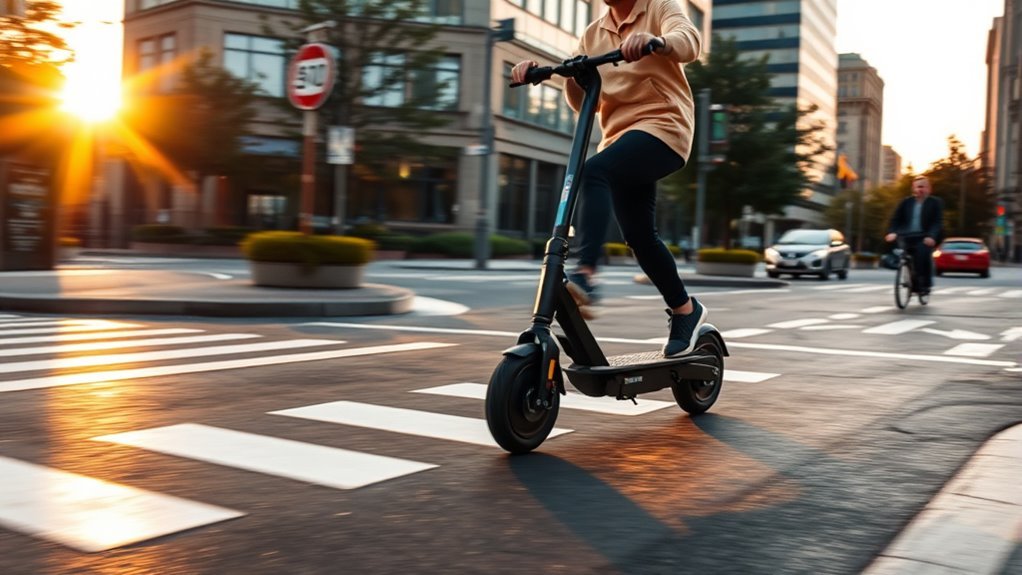
In New York City, you may not operate a legal electric scooter faster than 15 miles per hour. The rule comes from New York Vehicle and Traffic Law §1282 and is reflected in current NYC Department of Transportation guidance.
The 15 mph number is an operating limit. It should not be confused with the legal definition of an electric scooter. Under New York Vehicle and Traffic Law §114-e, a qualifying e-scooter can have a maximum motor-only capability of up to 20 mph on a paved, level surface, but you still may not operate it above 15 mph on New York roads where e-scooters are authorized.
You may generally ride in bicycle lanes and on streets with posted speed limits of 30 mph or less. Sidewalk riding is prohibited in NYC. Riders must be at least 16, and riders ages 16 and 17 must wear an approved helmet.
What Counts as a Legal Electric Scooter in New York?
New York law defines an electric scooter as a device weighing less than 100 pounds that has handlebars, a floorboard or seat that the operator can stand or sit on, and an electric motor. It may use electric power, human power, or both, and its motor-only maximum speed on a paved, level surface may not exceed 20 mph.
This distinction matters when shopping for high-speed machines advertised online as “e-scooters.” A device capable of much higher motor-powered speeds may fall outside New York’s legal e-scooter definition and may instead be subject to other motor-vehicle requirements or prohibitions. The New York Attorney General reiterated this distinction in July 2026.
New York also requires an e-scooter operated on a public highway or street to carry a permanent manufacturer label showing its maximum motor-assisted speed, the number of people for whom it is designed, and its motor wattage.
Warning: A product being marketed as an “electric scooter” does not automatically make it street-legal in New York. Check its weight, labeled motor-assisted speed, and other specifications before riding it on public streets.
New York City’s 15 MPH E-Scooter Limit
In New York City, an e-scooter must remain at or below 15 mph wherever it is legally operated. That includes eligible vehicle lanes, bike lanes, and other locations where e-scooters are authorized. The 15 mph limit applies whether the scooter is privately owned or part of an authorized shared program.
NYC’s 15 MPH Rule
New York Vehicle and Traffic Law §1282 states that no person may operate an electric scooter above 15 mph. NYC’s traffic rules also use a 15 mph maximum for e-scooters and, since October 24, 2025, for bicycles with electric assist and pedal-assist commercial bicycles.
Use the scooter’s speed display when available and slow down further when pedestrian traffic, visibility, pavement conditions, weather, intersections, or posted restrictions make 15 mph unsafe. A legal maximum is not a requirement to ride at that speed.
Where Scooters May Ride
E-scooters may generally be ridden in bike lanes and on streets with posted speed limits of 30 mph or less. They may not be ridden on sidewalks in NYC. According to current NYC DOT guidance, e-scooters may also use bridge bike lanes and certain park drives and greenways.
When riding in the roadway, New York law generally directs an e-scooter rider to use a usable bicycle lane when one is available. If there is no usable bike lane, the rider should stay near the right-hand curb or roadway edge, or on a usable right-hand shoulder, except when preparing for a left turn or when avoiding unsafe conditions.
Fines And Enforcement
New York Vehicle and Traffic Law §1282 provides a civil fine of up to $50 for several common e-scooter violations, including operating above 15 mph, violating the minimum-age rule, carrying an unlawful passenger, and operating on a sidewalk.
Under New York VTL §1282, exceeding the 15 mph e-scooter limit is among the violations that can result in a civil fine of up to $50.
Other conduct can carry separate or more serious penalties. For example, New York has specific offenses covering impaired e-scooter operation and leaving certain injury crashes without stopping and reporting. A high-speed device that does not meet the state’s legal e-scooter definition may also be governed by different rules.
Where You Can Ride an Electric Scooter
You may generally ride a legal electric scooter in NYC bike lanes and on streets where the posted speed limit is 30 mph or less. You must keep the scooter at or below 15 mph and must not ride on sidewalks.
Private legal e-scooters may be used in Manhattan under the ordinary riding rules. NYC’s shared rental e-scooter program, however, currently operates in the East Bronx and Eastern Queens rather than Manhattan.
Permitted Riding Areas
Current NYC DOT guidance permits legal e-scooters in the following locations, subject to posted restrictions and traffic rules:
- Designated bicycle lanes
- Eligible vehicle lanes on streets posted at 30 mph or less
- Bridge bicycle lanes where e-scooters are permitted
- Park drives and greenways covered by current NYC Parks/NYC DOT authorization
Do not confuse an e-scooter with a Class 1, Class 2, or Class 3 e-bike. Those classes apply to bicycles with electric assist. An electric scooter is a separate vehicle type under New York law.
Roadway and Lane Rules
Location rules can be summarized this way:
| Location | Rule | What to Know |
|---|---|---|
| Bike lane | 15 mph maximum | Use a usable bike lane when available. |
| Street posted at 30 mph or less | 15 mph scooter maximum | Ride near the right side when no usable bike lane exists, subject to safety exceptions. |
| Sidewalk | Riding prohibited | Pedestrian space is not a riding lane. |
| Bridge | Bike lane only where authorized | Follow bridge-specific signs and NYC DOT guidance. |
Always obey traffic signals, signs and right-of-way rules. New York law specifically requires e-scooter operators to yield the right of way to pedestrians.
Who Can Legally Ride an Electric Scooter?
You must be at least 16 years old to operate an electric scooter in New York. New York also prohibits a person under 16 from riding as a passenger on one.
A driver’s license, license plate and DMV registration are not required for a legal e-scooter that fits New York’s statutory definition. Riders ages 16 and 17 must wear a qualifying helmet. NYC DOT recommends helmet use for all e-scooter riders.
- You must be 16 or older to operate an e-scooter.
- A person under 16 may not ride as a passenger.
- Riders 16 and 17 must wear a helmet.
- No driver’s license is required for a legal e-scooter.
- No DMV registration or license plate is required for a legal e-scooter.
- You must yield to pedestrians and obey applicable traffic laws.
Pro Tip: Even when you are 18 or older and helmet use is not generally mandatory for a private e-scooter, wearing a properly fitted helmet is one of the simplest ways to reduce the risk of serious head injury.
How E-Scooter Laws Differ From E-Bikes
E-scooters and e-bikes are separate legal categories even though they share many NYC operating rules. The distinction is especially important when discussing speed.
A legal New York e-scooter may have a motor-only maximum capability of no more than 20 mph, but the rider may not operate it above 15 mph.
E-bike classes describe how a bicycle’s motor works and the speed at which motor assistance is designed to stop. Class 1 e-bikes provide pedal assistance up to 20 mph; Class 2 e-bikes may use a throttle up to 20 mph; and Class 3 e-bikes may provide assistance up to 25 mph and are a New York City-specific class. Those figures describe the legal vehicle classifications—not the current NYC riding limit.
Effective October 24, 2025, NYC’s traffic rule for electric micromobility prohibits operating an e-bike, e-scooter, or pedal-assist commercial bicycle above 15 mph, subject to applicable official signs.
| Device | Class/Design Capability | NYC Operating Limit |
|---|---|---|
| Legal e-scooter | Motor-only maximum no more than 20 mph | 15 mph |
| Class 1 e-bike | Pedal assist to 20 mph | 15 mph |
| Class 2 e-bike | Throttle capability to 20 mph | 15 mph |
| Class 3 e-bike | Assist/throttle capability to 25 mph under the class definition | 15 mph |
Sidewalk, Bike Lane, and Street Rules
When riding an electric scooter in New York City, stay off sidewalks, use bicycle lanes when they are available and usable, and operate only on eligible streets posted at 30 mph or less. Your e-scooter itself remains subject to the 15 mph maximum.
- Sidewalk: Do not ride there.
- Bike lane: Generally permitted; stay at or below 15 mph.
- Eligible street: Posted speed limit must generally be 30 mph or less.
- Pedestrians: Yield the right of way.
- Traffic controls: Obey signals, signs and applicable traffic rules.
- Passengers: An e-scooter may not carry more than one person at a time.
When no usable bike lane is available, VTL §1284 generally directs e-scooter riders toward the right-hand curb, roadway edge, or usable right shoulder. You may move away from that position when preparing for a left turn or when conditions such as parked vehicles, surface hazards, pedestrians, animals or a narrow lane make the position unsafe.
Required E-Scooter Equipment in New York
Speed is only one part of legal operation. New York Vehicle and Traffic Law §1285 establishes several equipment requirements.
- Brake: The scooter must have a brake capable of bringing it to a controlled stop.
- Audible warning device: It must have a bell or other device audible from at least 100 feet. A siren or whistle is not permitted as the required warning device.
- Front light at night: From one-half hour after sunset until one-half hour before sunrise, the scooter must have a white front light visible from at least 500 feet.
- Rear light at night: A red light must be visible from at least 300 feet to the rear.
- Side visibility: At least one required light must be visible from 200 feet from each side.
- Manufacturer label: A scooter used on a public street or highway must carry the required permanent label identifying speed, rider capacity and motor wattage.
You also may not carry a package or other item that prevents you from keeping at least one hand on the handlebars or that blocks your view.
How to Keep Your E-Scooter Under 15 MPH
Many electric scooters can reach 15 mph quickly, so speed control should be deliberate rather than reactive. Use an available low-speed or eco mode, watch the speed display, and accelerate smoothly.
Use Speed Modes
If your scooter offers a configurable limiter, eco mode or low-speed riding mode, use it to make compliance easier. Check the manufacturer’s manual to confirm exactly how the mode works. Some displays show an estimated speed rather than a laboratory-grade measurement, so leave yourself a margin below the legal limit.
- Choose a mode that keeps normal riding at or below 15 mph.
- Check the dashboard speed regularly.
- Do not modify firmware or hardware to defeat legal speed restrictions.
- Slow below 15 mph in crowded, wet or low-visibility conditions.
- Obey any posted restriction that requires an even lower speed.
Watch Your Throttle
Apply the throttle smoothly instead of using abrupt full-power inputs. Rapid acceleration makes it easier to overshoot the legal maximum and gives you less time to respond to pedestrians, turning vehicles, potholes and opening car doors.
On downhill sections, remember that gravity can increase speed even if you are not applying much motor power. Use the brakes progressively and check the display rather than assuming that releasing the throttle will automatically keep you below 15 mph.
What Happens If You Speed on an E-Scooter?
If you operate a legal electric scooter above 15 mph, you violate New York Vehicle and Traffic Law §1282. The statute provides for a civil fine of up to $50 for a violation of its speed provision.
- You may receive a summons or citation.
- A §1282 violation may result in a civil fine of up to $50.
- Speeding can make it harder to stop safely for pedestrians and traffic hazards.
- Your conduct may become relevant when fault is investigated after a collision.
- Separate violations can carry separate penalties.
Do not assume every device marketed as an e-scooter receives the same treatment. A machine that exceeds New York’s legal e-scooter definition can fall under different motorized-vehicle rules.
Shared E-Scooter Rules in NYC
Private e-scooters and NYC’s shared rental program should not be confused. As of August 26, 2026, the NYC DOT Shared E-Scooter Program operates in the East Bronx and Eastern Queens.
Bird, Lime and Veo currently participate in the program. Although the general legal minimum age to operate a private e-scooter is 16, a person must be at least 18 to participate in NYC’s shared e-scooter program.
The shared scooters remain subject to riding-area and speed restrictions. Availability in one service area does not authorize riding on sidewalks or other prohibited pedestrian spaces.
E-Scooter Rules in NYC Parks and Greenways
Current NYC DOT guidance states that e-bikes and stand-up e-scooters are allowed on park drives and greenways as part of an NYC Parks-led pilot program. This does not mean you may ride an e-scooter on every path inside every park.
Stay on authorized park drives and greenways, obey posted signs and speed restrictions, yield to pedestrians, and do not treat park sidewalks, pedestrian walkways or boardwalks as ordinary scooter lanes.
Note: Park micromobility rules have been under active review. Before relying on an older article or saved map, check current NYC Parks guidance and any signs at the specific park or greenway.
Other Important E-Scooter Rules
Several New York rules are easy to miss when a rider focuses only on the speed limit.
- An electric scooter may not carry more than one person at a time.
- A person under 16 may not operate or ride as a passenger on an e-scooter.
- You must yield the right of way to pedestrians.
- You may not carry an item that blocks your view or prevents you from keeping at least one hand on the handlebars.
- When entering a roadway from a driveway, alley, private road or over a curb, an e-scooter operator must come to a full stop first.
- New York law prohibits operating an e-scooter while impaired or intoxicated by alcohol or drugs.
Warning: Impaired e-scooter operation is not merely a general safety concern. New York VTL §1289 creates specific alcohol- and drug-related offenses that can carry substantially more serious penalties than an ordinary speed violation.
What to Do After an E-Scooter Crash
After an e-scooter crash, first move out of immediate traffic danger if you can do so safely and assess whether anyone needs emergency medical help. Call 911 for serious injuries or an unsafe crash scene.
Take reasonable steps to preserve information about what happened:
- Photograph the scene, roadway conditions, signals, vehicles and visible damage.
- Exchange names and contact information with involved parties.
- Collect witness contact information.
- Preserve the scooter and damaged safety gear if a serious injury or dispute is likely.
- Save app records, ride information, messages and relevant photographs.
- Seek medical evaluation when symptoms suggest a head, neck, back or other significant injury.
New York also imposes specific reporting duties after certain e-scooter crashes. For an operator age 18 or older who knows or has reason to know that their operation of the scooter caused physical injury to another person, VTL §1287 requires the operator to stop and provide identifying information and report the incident to police as specified by the law. Leaving after causing serious physical injury can constitute a Class B misdemeanor under VTL §1288.
Insurance and no-fault coverage can depend on how the crash happened, whether a motor vehicle was involved, available insurance policies and other facts. Do not assume that coverage automatically applies—or automatically does not apply. For a serious injury or disputed liability, consider obtaining advice based on the specific circumstances.
Frequently Asked Questions
Can Electric Scooters Go 70 MPH?
Some high-performance products marketed as scooters may be physically capable of extreme speeds, but they are not legal New York “electric scooters” under VTL §114-e if their motor-only maximum capability exceeds 20 mph. A 70 mph device should not be treated as an ordinary street-legal NYC e-scooter.
What Happens if I Get Caught on My Electric Scooter?
The consequence depends on the violation. For a legal e-scooter, violations of VTL §1282 such as riding above 15 mph, riding on a sidewalk, or violating certain passenger or age rules can result in a civil fine of up to $50. Different or more serious conduct can carry different penalties.
Can an E-Bike Go 40 MPH?
A device powered to 40 mph does not fit New York’s ordinary Class 1, Class 2 or Class 3 e-bike definitions. Class 1 and 2 e-bikes are defined around 20 mph assistance limits and Class 3 around 25 mph. In NYC, the current operating speed limit for legal e-bikes is 15 mph.
Can an Electric Scooter Go 30 MPH?
A device with a motor-only maximum capability of 30 mph does not meet New York’s statutory definition of an electric scooter, which caps that capability at 20 mph. Even a compliant legal e-scooter may not be operated above 15 mph.
Do You Need a License to Ride an Electric Scooter in NYC?
No driver’s license is required to operate a legal electric scooter in NYC. A qualifying e-scooter also does not require a license plate or DMV registration. The rider must be at least 16.
Do You Have to Wear a Helmet on an E-Scooter in NYC?
Riders ages 16 and 17 are legally required to wear a qualifying helmet. Helmets are recommended for adult riders as well.
Can You Ride an Electric Scooter in NYC Parks and Greenways?
Current NYC guidance allows stand-up e-scooters on park drives and greenways under an NYC Parks-led pilot program. That permission does not extend automatically to sidewalks, pedestrian walkways or every park path, so follow current Parks guidance and posted signs.
Are Shared E-Scooters Available in Manhattan?
No. As of August 26, 2026, NYC DOT’s shared e-scooter program operates in the East Bronx and Eastern Queens. Private legal e-scooters may still be used in Manhattan where ordinary NYC riding rules allow them.
Conclusion
For a legal electric scooter in New York City, remember the core number: 15 mph. You must be at least 16, stay off sidewalks, use eligible bike lanes and streets, yield to pedestrians, and follow the applicable helmet and equipment rules.
Also check the scooter itself. Under New York law, a legal e-scooter is not simply any fast two-wheeled device sold under that name. Its legal definition, labeling and equipment matter. Because NYC micromobility policy continues to evolve, especially around parks and shared programs, use current official guidance when planning a ride.
Sources
- NYC Department of Transportation — Electric Bicycles & More — current NYC speed, riding-area, bridge, helmet, and park/greenway guidance.
- New York Vehicle and Traffic Law §1282 — age, passenger, pedestrian, roadway, sidewalk, speed, labeling and civil-fine rules.
- New York Vehicle and Traffic Law §1285 and §1286 — required lights, bell, brake and helmet rules.
- NYC Rules — Speed Limits for E-Bikes, E-Scooters, and Pedal-Assist Commercial Bicycles — adopted NYC 15 mph operating rule effective October 24, 2025.
- NYC311 — Shared E-Scooter Program — current East Bronx and Eastern Queens service areas and 18+ participation requirement.
- NYC Parks — E-Bikes and E-Scooters — current park-drive and greenway guidance.
