
Last Updated on September 10, 2026 by Daniel Globe
You cannot easily overcharge a modern electric scooter under normal conditions because built-in Battery Management Systems (BMS) automatically cut off the electrical current once the cells reach 100% capacity. However, if the BMS malfunctions, you use an incompatible aftermarket charger, or the internal cell sensors fail, an electric scooter can overcharge. This overcharging leads to excessive heat generation, lithium plating, permanent capacity loss, battery swelling, and in worst-case scenarios, catastrophic thermal runaway fires.
Quick Answer
While modern e-scooters feature automatic Battery Management Systems (BMS) to stop charging when full, hardware malfunctions, damaged chargers, or cheap uncertified packs can cause overcharging. Leaving a scooter plugged in indefinitely stresses the cells, degrades lifespan, and increases fire risks if protection circuits fail.
Key Takeaways
- BMS Acts as the Primary Shield: Modern lithium-ion scooter packs rely on a BMS to shut off incoming voltage at full capacity (~4.2V per cell).
- Failure Modes Exist: Mismatched charger voltages, failed MOSFET switches, or counterfeit batteries can bypass overcharge protection.
- Optimal 20%–80% Rule: Operating your scooter between 20% and 80% State of Charge (SoC) can double or triple total battery cycle life.
- Avoid Overnight Charging: Unplugging after full charge prevents extended thermal stress and mitigates catastrophic failure risks.
- Look for UL 2272 Certification: Certified scooters meet strict electrical and fire safety testing standards.
At a Glance: Electric Scooter Charging Best Practices
| Charging Time Window | Typically 3 to 8 hours (dependent on battery Ah and charger amperage) |
| Ideal Temperature Range | 32°F to 113°F (0°C to 45°C) — never charge below freezing |
| Recommended Equipment | OEM manufacturer-supplied charger or UL-listed equivalent, outlet timer |
| Target State of Charge (Daily) | 20% minimum to 80%–90% maximum (charge to 100% only before long rides) |
Disclosure: As an Amazon Associate I earn from qualifying purchases. Some links on this page are affiliate links, at no extra cost to you.
Can You Overcharge an Electric Scooter?
The short answer is: technically yes, but rarely under standard operating conditions. Modern electric scooters use lithium-ion battery packs (typically comprised of 18650 or 21700 cylindrical cells) wired in series and parallel. These packs are paired with an electronic circuit board called a Battery Management System (BMS) designed to prevent overcharging, over-discharging, and short-circuiting.
When everything functions as designed, the charger and the BMS work through a two-stage Constant Current / Constant Voltage (CC/CV) charging profile. According to research from Battery University, once each cell reaches its upper voltage limit (usually 4.20V), the current drops significantly until it terminates completely. However, overcharging occurs when this regulation chain breaks down due to component failure, incorrect voltage inputs, or physical cell degradation.
What Happens When You Overcharge One?
When a lithium-ion pack receives excess voltage or continuous current past saturation, severe chemical and structural degradation occurs inside the cells:
- Lithium Plating & Dendrite Growth: Forcing current into a saturated cathode causes metallic lithium ions to plate onto the anode surface rather than intercalating into the graphite layers. Over time, these microscopic metallic spikes (dendrites) can pierce the polymer separator between electrodes, creating an internal short circuit.
- Electrolyte Decomposition & Gas Buildup: Excess voltage forces the liquid electrolyte solvent to break down chemically, producing gases such as carbon dioxide, methane, and hydrogen. This causes the battery casing or pouch to swell and creates high internal mechanical pressure.
- Accelerated Capacity Loss: High state-of-charge exposure generates heat and thickens the Solid Electrolyte Interphase (SEI) layer, permanently reducing the battery’s capacity and increasing internal resistance.
- Thermal Runaway: If an internal short occurs or internal temperatures exceed roughly 140°F to 160°F (60°C to 70°C), an uncontrollable self-heating exothermic reaction begins. This can escalate in seconds, venting toxic gas, flames, and causing explosions.
“Thermal runaway occurs when an internal chemical reaction generates heat faster than it can be dissipated, creating an accelerating loop of rising temperature and catastrophic cell failure.”
Do Electric Scooters Have Overcharge Protection?
Yes, virtually all production electric scooters manufactured today feature multi-layer safety protections. The primary line of defense is the BMS, supplemented by specialized regulation circuits inside the original equipment manufacturer (OEM) charger.
Built-In BMS Protection
The Battery Management System monitors individual cell group voltages, total pack voltage, temperature, and current flow. When charging, it executes three vital tasks:
| Safety Function | Mechanism | Failure Consequence |
|---|---|---|
| Overvoltage Protection (OVP) | Cuts charging circuit via MOSFET switches when cells reach 4.20V–4.25V | Overvoltage stresses cell chemistry, causing gas generation and swelling |
| Cell Balancing | Bleeds off excess energy from higher-voltage cell groups to match weaker groups | Unbalanced cells lead to premature pack failure or single-cell overcharging |
| Over-Temperature Cutoff (NTC) | Thermistor sensors halt charge input if pack temperature exceeds safe thresholds | Pack charges while overheated, dramatically accelerating cell degradation |
Limits of Auto Shutoff
While auto shutoff is standard, it is not a 100% guarantee against overcharging. Auto shutoff can fail under several real-world conditions:
- Welded/Shorted MOSFETs: High voltage spikes or prolonged heat can fuse switching transistors in an open state, allowing current to flow continuously into a full battery.
- Counterfeit or Mismatched Chargers: Using a 54.6V charger (for a 48V nominal system) on a 36V nominal scooter (42V max) will overwhelm the BMS cutoff threshold and force dangerous overvoltage.
- Cell Imbalance in Cheap Packs: In low-cost scooters without active cell balancing, the BMS may read total pack voltage rather than individual series groups, inadvertently allowing one cell group to overcharge past 4.35V while another rests at 4.05V.
- Standards Compliance: Scooters certified under UL 2272 (Standard for Electrical Systems for Personal E-Mobility Devices) undergo stringent testing for overcharge resistance, whereas unbranded, non-certified devices frequently skimp on secondary safety circuits.
Signs Your Scooter Battery Is Damaged
Early diagnosis of battery damage prevents safety hazards and saves you from sudden roadside breakdowns. Check for these mechanical, electrical, and physical warning signs:
- Significant Range Loss: If your scooter suddenly covers 30% to 50% less distance on a full charge despite consistent riding style and tire pressure, irreversible cell degradation has taken place.
- Abnormal Heat During Charging: A charger brick will become moderately warm, but the scooter deck/battery enclosure should never feel hot to the touch.
- Physical Swelling or Casing Deformity: Gas buildup causes battery packs to expand. If the scooter deck lid is bulging, warped, or popping screws, stop using it immediately.
- Rapid Voltage Drops Under Load: If your battery indicator drops from four bars to one bar during light acceleration, internal resistance has spiked.
- Unusual Odors: A sweet, fruity, or acetone-like chemical smell indicates that electrolyte vapor is venting through safety seals.
What to Do If Your Scooter Overheats
If your electric scooter deck or battery becomes unusually hot during or after charging, treat the situation as an immediate safety priority by following established emergency recommendations from the National Fire Protection Association (NFPA).
Warning: If the battery pack is hissing, crackling, smoking, bulging, or emitting strong chemical vapors, do not attempt to move it indoors. Evacuate the area immediately, move the scooter away from structures and combustible materials if safely possible, and call your local emergency services (911/emergency fire department). Never inhale lithium battery smoke, as it contains toxic hydrogen fluoride.
For moderate overheating without smoke or swelling:
- Unplug Immediately: Disconnect the charger from the wall outlet first, then from the scooter port.
- Relocate to a Fire-Safe Area: Move the scooter outdoors onto concrete, asphalt, or tile, well away from wooden decks, drywall, vehicles, or flammable materials.
- Allow Natural Dissipation: Let the battery cool down for at least 2 to 3 hours. Do not pour water on a sealed casing or attempt to cool it in a refrigerator, as rapid temperature drops cause internal condensation.
- Inspect and Test: Do not plug the scooter back in until a certified technician has tested the pack with a multimeter for shorted cells and checked the charger’s output voltage.
How to Charge Your Scooter Safely
Establishing a disciplined charging routine drastically reduces safety hazards and prolongs the operational lifespan of your scooter’s battery pack.
Pro Tip: Plug your scooter charger into a simple mechanical outlet timer or smart plug set to turn off after 4–5 hours. This eliminates the risk of trickle charging or passive overvoltage exposure if you forget to disconnect it manually.
- Let the Battery Cool Down Before Charging: Never plug in your scooter immediately after a ride. Lithium cells heat up during discharge; allow 20 to 30 minutes for the pack to return to ambient room temperature before connecting power.
- Charge on Hard, Non-Flammable Surfaces: Always charge on concrete, stone, or ceramic tile floors. Avoid charging on carpets, beds, couches, or near paper and chemicals.
- Maintain a Ventilated, Temperate Environment: Keep charging areas between 50°F and 80°F (10°C to 27°C). Never charge in direct sunlight, hot garages in midsummer, or freezing outdoor sheds.
- Use Dedicated Wall Sockets: Plug the charger directly into a grounded wall receptacle. Avoid daisy-chaining light-duty extension cords or overloaded surge protectors.
Best Charging Habits to Extend Battery Life
Lithium-ion cells experience mechanical and chemical strain when stored at extreme states of charge. Implementing proven charging protocols can extend battery longevity from 300 cycles up to 1,000+ full equivalent cycles.
Charge Between 20% and 80%
Operating your scooter within the 20% to 80% State of Charge (SoC) bracket minimizes chemical degradation. The highest stress on lithium cathode materials occurs above 4.10V per cell (roughly 85%–90% full) and below 3.0V per cell (deep discharge).
- Daily Commutes: Charge up to 80%–90% for typical daily use.
- Long Distance Rides: Charge to 100% right before embarking on a long trip, avoiding letting the pack sit at 100% for days.
- Prevent Deep Discharges: Plug in your scooter when the battery meter drops to 20%–25% rather than riding until the motor cuts out.
Avoid Overnight Charging
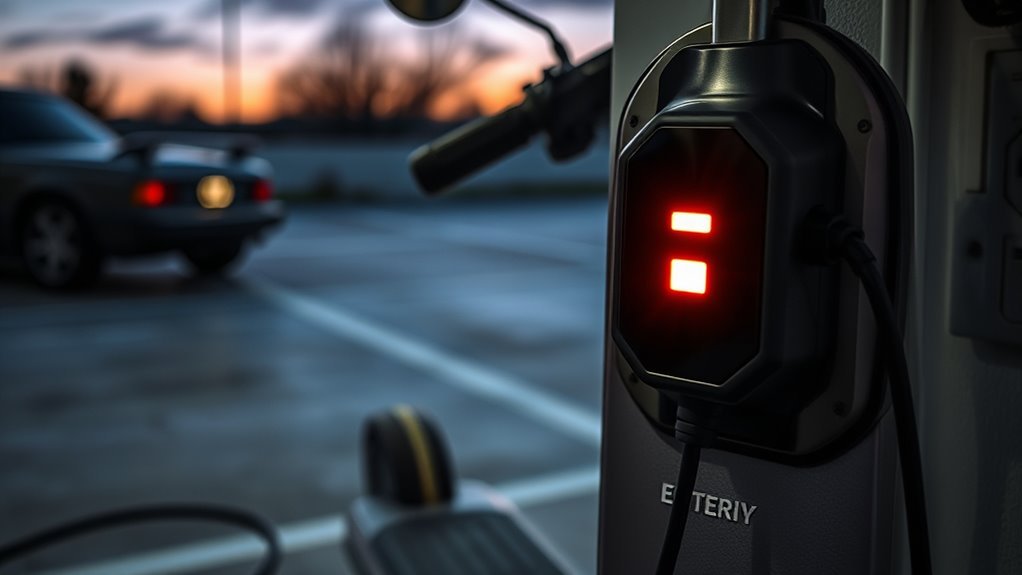
Leaving your e-scooter plugged in overnight keeps the battery at peak voltage (100% SoC) and elevated ambient temperatures for hours after the charge cycle terminates. If a passive electrical surge occurs or the BMS fails while you sleep, response time is dangerously delayed. Unplug the unit once the charger’s LED indicator turns green.
Use Proper Chargers
Never substitute an original manufacturer charger with a generic multi-voltage power supply simply because the plug barrel fits the charge port. Chargers must match the exact voltage curve, polarity, and maximum current (amperage) required by your specific BMS model.
Note: Fast chargers (e.g., 4A–5A instead of standard 2A) generate significantly more internal heat. Unless your manufacturer explicitly rates your battery for high-current fast charging, stick with the standard OEM charger to preserve cell longevity.
How to Store Your Scooter Battery
Proper storage is vital when taking a hiatus during winter months or extended travel:
- Store at 40% to 60% Charge: Storing a lithium pack at 100% accelerates capacity fade, while storing it near 0% risks parasitic BMS drain pushing cells into irreversible deep sleep (under-voltage lockout).
- Optimal Climate: Store the scooter in a dry environment maintained between 50°F and 68°F (10°C and 20°C).
- Perform Periodic Top-Offs: Because all lithium packs slowly self-discharge, check the charge level every 60 to 90 days and top it back up to 50%–60%.
Frequently Asked Questions
Do electric scooters stop charging when full?
Yes. Modern electric scooters contain a Battery Management System (BMS) with overvoltage protection circuitry that automatically cuts off current intake once the battery cells reach full capacity (typically 4.2V per cell). However, you should still disconnect the charger once full to prevent secondary thermal exposure or potential BMS failure risks.
Is it bad to leave your e-scooter on charge overnight?
Yes, it is considered poor practice. While the BMS usually halts active charging, keeping the battery resting at 100% saturation for long periods accelerates cell degradation. Furthermore, unattended overnight charging increases fire risks in the event of an electrical fault or charger malfunction.
What happens if an electric scooter is not used for a long time?
An idle electric scooter slowly loses charge through natural self-discharge and parasitic BMS drain. If left uncharged for months, the cell voltage can drop below critical safety thresholds (under 2.5V per cell), causing irreversible chemical breakdown and preventing the battery from accepting a charge ever again.
How long do 2 bars last on an electric scooter?
Two bars on a standard 5-bar display generally indicate roughly 30% to 40% remaining battery capacity. Depending on your scooter’s maximum range, rider weight, terrain gradient, and speed mode, this typically equates to 6 to 12 miles of real-world riding range.
Sources
- Battery University (Cadex Electronics) — Technical breakdown of CC/CV charging stages and lithium-ion saturation limits.
- U.S. Consumer Product Safety Commission (CPSC) — Micromobility safety guidelines, fire hazard alerts, and certification criteria.
- National Fire Protection Association (NFPA) — Emergency protocols for managing lithium-ion thermal runaway and safe storage practices.
- UL Standards (Underwriters Laboratories) — UL 2272 electrical and fire safety certification standards for personal e-mobility devices.
Conclusion
While built-in Battery Management Systems effectively protect modern electric scooters from overcharging under normal conditions, they are electronic components that can wear out or fail. Leaving your scooter continuously plugged in, using cheap third-party chargers, or ignoring physical battery damage exposes you to accelerated capacity loss and severe safety hazards. By adhering to the 20%–80% charge rule, avoiding overnight charging, using an outlet timer, and storing your scooter in a cool, climate-controlled space, you will safeguard your battery pack, maximize its operating life, and ensure every ride is reliable and safe.
