
Last Updated on August 25, 2026 by Caleb Warren
Most commuter electric scooters weigh between 26 and 45 pounds (12 to 20.5 kg), while high-performance and off-road models can weigh anywhere from 60 to over 140 pounds (27 to 63+ kg). An electric scooter’s weight is primarily dictated by its battery capacity, motor configuration (single vs. dual), suspension system, and frame materials. Choosing the right weight requires balancing everyday portability—such as carrying the scooter up stairs or onto public transit—with your requirements for range, top speed, and hill-climbing power.
Quick Answer
The average commuter electric scooter weighs 30 to 42 pounds, offering a 15 to 25-mile range and a top speed of 15 to 20 mph. Ultra-lightweight models weigh under 30 pounds for easy stair climbing, while high-performance dual-motor scooters exceed 70 to 140 pounds to support large batteries, robust suspension, and speeds over 40 mph.
Key Takeaways
- Under 30 lbs (Ultra-Light): Best for multi-modal public transit and walk-up apartments, but features shorter range (10–15 miles) and minimal suspension.
- 30 to 50 lbs (Standard Commuter): The industry sweet spot, balancing reliable 20–35 mile range, pneumatic tires, and manageable one-handed carrying.
- Over 50 lbs (Heavy-Duty & Performance): Delivers 40+ mile ranges, dual motors, and hydraulic suspension, but requires ground-floor storage or vehicle trunk transport.
- Battery & Motors = 60%+ of Mass: High-capacity lithium-ion packs and dual hub motors account for the vast majority of added weight on performance scooters.
Disclosure: As an Amazon Associate I earn from qualifying purchases. Some links on this page are affiliate links, at no extra cost to you.
How Much Does an Electric Scooter Weigh?
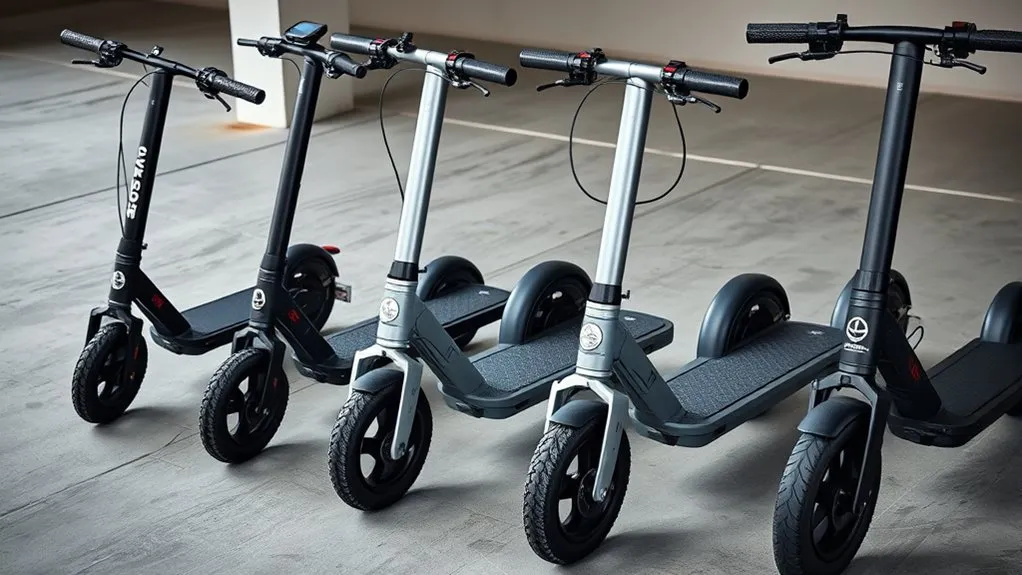
Electric scooter weight varies across four primary categories based on vehicle purpose. A model engineered for carrying onto subways utilizes aerospace-grade aluminum or carbon fiber with a compact battery pack, keeping total weight under 30 pounds. Conversely, a machine built for highway speeds and steep off-road trails requires high-voltage dual motors, dual swingarm suspension, and heavy steel-reinforced folding mechanisms, pushing the weight past 100 pounds.
| Weight Class | Weight Range | Representative Models | Typical Range & Speed | Best For |
|---|---|---|---|---|
| Ultra-Lightweight | Under 30 lbs (<13.6 kg) | Unagi Model One (26.5 lbs), Segway Air T15 (23.2 lbs) | 10–15 miles | 15–20 mph | Subway transfers, walk-up apartments, short city hops |
| Standard Commuter | 30–48 lbs (13.6–21.8 kg) | Segway Ninebot Max G30LP (38.6 lbs), NIU KQi2 Pro (40.5 lbs) | 20–35 miles | 18–22 mph | Daily urban commuting, moderate hills, paved roads |
| Mid-Weight / Long-Range | 49–70 lbs (22.2–31.8 kg) | Segway Ninebot Max G2 (53.5 lbs), Apollo City Pro (65 lbs) | 35–50 miles | 25–32 mph | Suburban commuters, rough pavement, riders over 220 lbs |
| Heavy-Duty & Performance | 71–145+ lbs (32.2–66+ kg) | NAMI Burn-E 2 (100 lbs), Kaabo Wolf King GT Pro (115 lbs), Dualtron X Limited (182 lbs) | 50–90+ miles | 40–65+ mph | Off-roading, highway speeds, long-distance touring |
What Makes an Electric Scooter Heavier?
An electric scooter’s overall heft is not arbitrary; it represents a direct mechanical trade-off between performance capacity and physical mass. Four major components dictate more than 85% of total scooter weight.
1. Battery Pack Capacity (Watt-Hours)
The battery pack is the single heaviest component on any long-range electric scooter. Modern scooters use lithium-ion cells (typically 18650 or 21700 form factors). Because lithium-ion energy density averages roughly 35 to 50 Watt-hours (Wh) per pound (including cell casing, nickel strips, thermal management, and the Battery Management System), higher range demands physical mass:
- A standard 280 Wh commuter battery (15 miles of real-world range) weighs approximately 6 to 8 pounds.
- A mid-tier 550 Wh battery (25–30 miles of range) adds roughly 12 to 15 pounds.
- A massive 2,000+ Wh performance battery pack found on models like the NAMI Burn-E 2 adds 35 to 45 pounds to the deck alone.
2. Motor Configuration and Stator Size
Electric hub motors rely on heavy copper windings, neodymium magnets, and steel stator rings to generate torque. A basic 250W to 350W front or rear hub motor weighs between 7 and 10 pounds. Upgrading to dual-motor all-wheel drive immediately doubles that mass, adding 18 to 25 pounds of motor hardware before factoring in the reinforced axle mounts and heavier dual-channel motor controllers.
3. Frame Geometry, Suspension, and Brakes
While lightweight scooters use 6061-T6 aluminum or magnesium alloys with rigid forks, heavier scooters incorporate:
- Dual Coil or Hydraulic Suspension: Front and rear shock assemblies add 6 to 12 pounds of steel and fluid mechanics.
- Braking Hardware: Full hydraulic dual-disc brake systems with 140mm or 160mm rotors add 3 to 5 pounds compared to basic electronic or drum brakes.
- Reinforced Stems and Folding Clamps: High-speed stability requires thicker neck brackets and heavy-duty locking collars to prevent stem wobble under hard braking.
Pro Tip: If your commute includes climbing more than two flights of stairs daily, establish a strict 35-pound ceiling. Scooters exceeding 40 pounds quickly cause shoulder strain and forearm fatigue when carried in one hand in folded mode.
How Electric Scooter Weight Affects Speed and Range
Vehicle mass directly shapes real-world riding dynamics, efficiency, and road safety:
- Inertia and Road Stability: Heavier scooters (50+ lbs) possess greater inertia. This makes them significantly more stable at speeds above 20 mph, as road imperfections, potholes, and crosswinds are less likely to deflect the handlebars.
- Rolling Resistance and Energy Consumption: A heavier total payload (scooter weight + rider weight) demands higher current draw ($Wh/\text{mile}$) from the motor during acceleration and hill climbs. While a 28-pound scooter might consume 18 Wh/mile at 15 mph, an 80-pound dual-motor scooter cruising at 25 mph consumes 35 to 45 Wh/mile.
- Braking Distances: Stopping distance increases with vehicle mass. A 100-pound scooter traveling at 30 mph carries exponentially more kinetic energy ($E_k = \frac{1}{2}mv^2$) than a 30-pound commuter at 15 mph, necessitating hydraulic disc brakes and wider pneumatic tires for sufficient pavement traction.
Warning: Never attempt to bring standard adult electric scooters on commercial passenger flights. The Federal Aviation Administration (FAA) and international airline regulations strictly restrict passenger lithium-ion batteries to 100Wh (or up to 160Wh with airline approval). Almost all commuter e-scooters feature battery packs rated between 250Wh and 2,000Wh.
Why Electric Scooter Weight Matters for Commuters
For daily urban riders, carrying ergonomics matter just as much as riding comfort. How you store and transport the scooter off-road determines whether it enhances or hinders your routine.
Portability for Multi-Modal Transit
If you combine your scooter ride with subways, commuter rail, or bus connections, pay close attention to folded stem balance and deck width. A 28-pound scooter can easily be tucked between your legs on a crowded train car or stowed overhead. A 55-pound machine with wide handlebars often exceeds transit dimension guidelines and cannot be hoisted into train luggage racks.
Balancing Weight, Range, and Rider Payload
Rider weight directly dictates the minimum structural requirements of the scooter. Riders weighing over 200 pounds (90 kg) generally need a scooter with at least a 500W motor and a reinforced deck (typically weighing 38 to 52 lbs). Selecting an ultra-lightweight scooter under 30 lbs will result in sluggish hill-climbing, reduced acceleration, and significantly truncated battery life for heavier riders.
How to Pick the Right Electric Scooter Weight
To choose the ideal weight for your lifestyle, evaluate your typical commute against these four physical checkpoints:
- Step Count Test: Do you have an elevator at home and work? If you must carry the unit up more than 15 steps daily, stay under 35 lbs.
- Vehicle Trunk Lifting: If you regularly load your scooter into a compact car trunk, verify you can safely deadlift 45 to 60 lbs to chest height without scratching the bumper.
- Pavement Quality: Smooth asphalt permits rigid, ultra-light scooters with solid rubber tires (under 30 lbs). Cracked pavement, cobblestones, and train tracks require 10-inch pneumatic tires and suspension (adding 8–15 lbs of structural weight).
- Required Round-Trip Range: If your daily round trip exceeds 20 miles without midday charging opportunities, plan for a mid-weight scooter in the 42 to 55-pound bracket to accommodate a 500Wh+ battery pack.
Note: Check your local municipal vehicle codes before buying performance-class scooters over 70 lbs. Many jurisdictions classify motorized scooters weighing over 100 lbs or capable of speeds exceeding 20–28 mph as mopeds, requiring licensing, registration, and DOT-approved helmets.
Electric Scooter Weight Trends to Watch
The personal electric vehicle (PEV) industry is steadily advancing in power-to-weight efficiency through three key manufacturing improvements:
- High-Density 21700 Battery Cells: Transitioning from older 18650 cells to high-capacity 21700 and pouch cells allows manufacturers to deliver 15–20% more watt-hours per unit volume without increasing overall battery pack weight.
- Carbon Fiber & Magnesium Deck Casting: High-end urban models increasingly use forged carbon fiber stems and one-piece cast magnesium alloy decks to reduce frame weight by up to 30% compared to traditional extruded steel.
- Integrated Motor-Inverter Architecture: Silicon Carbide (SiC) and GaN MOSFET controllers are reducing the footprint of electronic speed controllers, shrinking both the cooling heat sink requirements and structural enclosure bulk.
Frequently Asked Questions
What is the average weight of a commuter electric scooter?
The average commuter electric scooter weighs between 30 and 42 pounds (13.6 to 19 kg). This weight class typically includes a single 350W to 500W hub motor, a 300Wh to 450Wh lithium battery pack, 8.5 to 10-inch tires, and an aluminum frame designed for a balance of one-handed portability and everyday range.
Is a 9-pound scooter heavy?
No. In fact, an adult motorized electric scooter weighing only 9 pounds does not exist on the commercial market. Non-motorized kick scooters or children’s micro-scooters can weigh 6 to 10 pounds, but functional adult electric scooters with a motor and lithium battery start at a minimum of 20 to 24 pounds.
Which is heavier: an electric scooter or a standard bicycle?
Most electric scooters are heavier than traditional, non-electric bicycles. A standard adult road or hybrid bicycle typically weighs 22 to 30 pounds, whereas standard commuter electric scooters weigh 32 to 45 pounds due to the integrated battery and electric hub motor. However, electric scooters remain significantly lighter and more compact than full-sized electric bikes (e-bikes), which commonly weigh 45 to 75 pounds.
Which electric scooter is the lightest on the market?
Among adult commuter models, the Segway Ninebot Air T15 (23.2 lbs), the Unagi Model One E500 (26.5 lbs), and select ultra-compact carbon models like the Fluid Mosquito / E-Twow Booster series (29 lbs) rank among the lightest viable options available. These achieve minimal weight by utilizing smaller 150Wh–250Wh battery packs and slim magnesium-alloy or carbon components.
Can I take my electric scooter on an airplane?
Almost certainly no. The FAA and international aviation safety regulations prohibit lithium-ion battery packs exceeding 100Wh to 160Wh on commercial flights in either carry-on or checked luggage due to thermal runaway fire hazards. Because standard commuter scooters have batteries starting at 250Wh, they cannot fly on commercial aircraft.
Conclusion
Electric scooter weight is the ultimate balancing point between everyday portability and on-road performance. If your daily route requires navigating subway turnstiles, bus racks, or multiple flights of stairs, target an ultra-light or standard commuter model between 26 and 38 pounds. If you prioritize hill-climbing power, stability at speeds over 25 mph, plush suspension, and 30+ miles of real-world range, expect to manage a mid-to-heavy machine between 45 and 70+ pounds. Evaluate your lifting requirements, daily route pavement quality, and storage constraints first to select a scooter that fits your daily life without unnecessary physical strain.
Sources
- Segway-Ninebot Global — Technical specification sheets for Max G30LP, Max G2, and Air T15 models.
- Unagi Scooters — Engineering materials and dual-motor specifications for the Model One E500.
- Minimotors USA / Dualtron — High-performance chassis, dual-motor stator, and battery weight specifications.
- Federal Aviation Administration (FAA) — Hazardous materials guidelines on passenger lithium-ion battery capacity limits (100Wh/160Wh).
- U.S. Consumer Product Safety Commission (CPSC) — Micromobility device safety standards and structural guidelines.

