
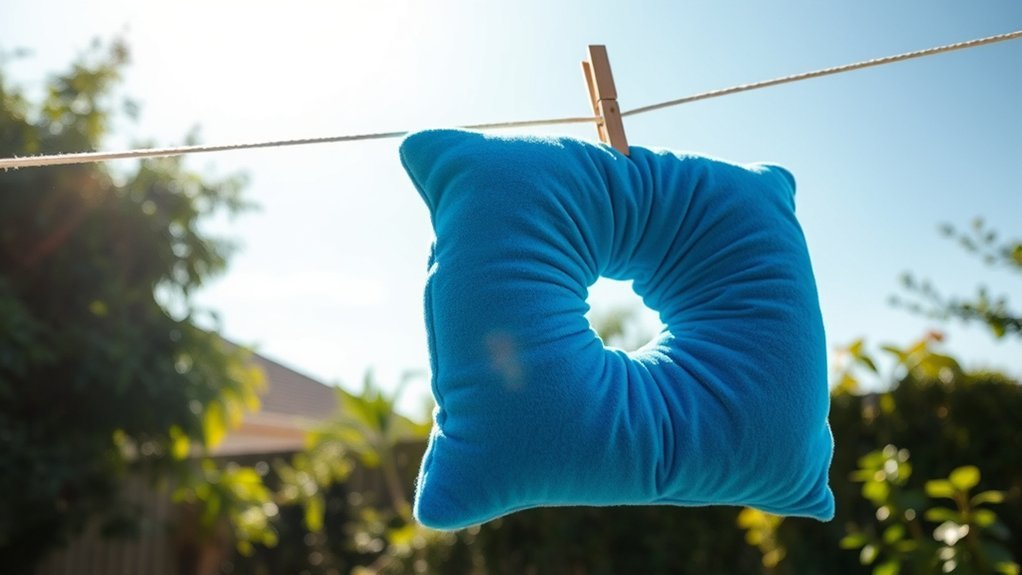
Last Updated on September 10, 2026 by Daniel Globe
A damp travel pillow can develop a musty smell, lose its shape, or stay wet deep inside if you dry it the wrong way. The safest method depends on the entire pillow construction—not just whether the fill is foam, down, or synthetic. Before doing anything else, check the sewn care label or manufacturer instructions and treat a removable cover separately from the inner core.
Quick Answer
Check the care label first, remove any washable cover, and blot excess moisture without twisting the pillow. Most memory-foam cores and inflatable pillows should air dry, while some down and synthetic-fill pillows can tumble dry on low if their label allows it. Use airflow rather than high heat, and never store the pillow while it is still damp.
Key Takeaways
- The manufacturer’s care label takes priority over any general rule about pillow materials.
- Dry removable covers separately from the pillow core because the two parts often have different care instructions.
- Memory-foam cores and inflatable bladders usually need gentle air drying rather than high heat.
- Some conventional down and synthetic-fill pillows can tumble dry on low, but only when the care label specifically permits it.
- Do not store a travel pillow until the surface, seams, valve area, and center all feel completely dry.
At a Glance
| Time Required | A few hours for some covers and thin shells; overnight or longer for thick foam or absorbent fill. Dryness matters more than the clock. |
| Difficulty | Easy |
| Tools Needed | Dry towels, drying rack or clean surface, and optional fan or dehumidifier; dryer balls only when tumble drying is permitted |
| Cost | Usually $0 with household supplies; a laundromat or replacement may add cost when required |
Disclosure: As an Amazon Associate I earn from qualifying purchases. Some links on this page are affiliate links, at no extra cost to you.
Step-by-Step Guide to Drying Different Types of Travel Pillows

1. Check the Care Label Before You Start
Do not choose a drying method from the fill name alone. Two pillows that both contain down, foam, or synthetic fibers can have completely different instructions because of their casing, adhesives, coatings, valves, or internal bladders.
Look for a sewn care label, product manual, or manufacturer’s care page. If the pillow has a removable cover, check the cover and core separately. For example, Cabeau’s travel-pillow guidance allows washing and low-heat or air drying for certain removable covers while directing users to wipe the memory-foam insert with a damp cloth and air dry it.
Note: A washable cover does not automatically mean the foam, bladder, or fill inside the pillow can also go into a washing machine or dryer.
2. Remove Excess Moisture Without Wringing
If the pillow core is genuinely wet and its care instructions allow that type of cleaning, place it between dry towels and press gently to transfer moisture into the towels. Replace saturated towels as needed.
Do not twist or aggressively wring foam, down-filled shells, microbead pillows, or inflatable products. Twisting can stretch seams, distort foam, shift fill, or stress an internal bladder.
If a memory-foam insert is intended only for spot cleaning, do not intentionally soak it before drying. Tempur-Pedic’s pillow care guidance, for example, says TEMPUR material should not be cleaned with liquid, while its removable cover has separate laundering instructions.
3. Dry the Pillow According to Its Construction
Memory Foam Travel Pillows
For a memory-foam core that has been spot cleaned or accidentally dampened, blot the surface with dry towels and place it in a shaded, well-ventilated area. A fan can improve airflow without exposing the foam to high heat.
Rotate or reposition the pillow occasionally so all sides receive airflow. Do not put the cover back on until the foam feels dry at the surface and through the thickest areas.
Pro Tip: If a foam pillow feels noticeably cool when you press into a thick area, moisture may still be evaporating from inside. Give it more drying time rather than sealing it inside its cover or travel bag.
If the foam was accidentally saturated even though the manufacturer says to spot clean only, press out moisture with towels without twisting it, maximize airflow, and allow substantially more drying time. If the foam tears, develops a persistent musty odor, or does not return to its normal feel after it is completely dry, contact the manufacturer or replace the insert rather than repeatedly soaking it.
Inflatable Travel Pillows
Inflatable pillows require special care because heat or mechanical agitation can damage internal welds or the air bladder. Follow the exact product instructions.
For example, Sea to Summit instructs Aeros owners to wash the pillow with its valve closed, rinse it, and then air dry it completely with the valve open before long-term storage. The company specifically warns against tumble drying or spin drying these pillows because those processes can stress or damage the bladder and welds.
Wipe the valve and surrounding fabric dry, then position the pillow where air can reach both sides. Do not store it tightly packed while moisture remains.
Microbead Travel Pillows
Microbead pillows vary widely in shell fabric and construction, so check the care label before machine washing or tumble drying one. If the label does not clearly permit a dryer, air drying is the conservative choice.
Lay the pillow on a clean, dry towel or ventilated rack and turn it periodically. Pay particular attention to seams and any area where moisture could remain trapped between the beads and outer fabric.
Down-Filled Travel Pillows
Some conventional down pillows are designed for low-heat tumble drying. When the care label permits it, use low heat and add clean dryer balls to help separate damp down clusters and restore loft. Keep drying until no damp clumps remain.
Parachute’s down-pillow care instructions, for example, specify tumble drying on low with wool dryer balls.
That does not mean every pillow containing down belongs in a dryer. A hybrid pillow can contain down on the outside and an inflatable bladder inside. Sea to Summit’s Aeros Down Pillow is one example for which the manufacturer says not to tumble dry because of the TPU bladder.
Synthetic-Fill Travel Pillows
Synthetic fill is also product-specific. Some polyester or microfiber pillows can be tumble dried on low, while others require air drying. Do not assume synthetic fill means either “dryer safe” or “air dry only.”
For comparison, Parachute’s down-alternative pillow instructions permit low-heat tumble drying with dryer balls. Your travel pillow may differ, so follow its own label.
Hybrid Foam-and-Inflatable or Down-and-Inflatable Pillows
Hybrid designs deserve extra caution because the visible outer material may not reveal the most heat-sensitive component inside. If a pillow combines foam, fill, and an air bladder, follow the instructions for the complete product rather than applying generic advice for one material.
Warning: Never assume that a down exterior makes a hybrid inflatable pillow dryer-safe. Heat that is acceptable for loose down may still damage an internal bladder, adhesive, coating, valve, or welded seam.
Safe Air Drying Practices for Travel Pillows
Good airflow is usually more useful than aggressive heat when a pillow needs to air dry. Place the pillow in a dry, ventilated area where air can reach as much surface area as possible. A fan or nearby dehumidifier can help when indoor humidity is high.
- Use a clean drying rack, mesh surface, or dry towel.
- Turn or rotate the pillow periodically.
- Replace the towel underneath if it becomes damp.
- Keep heat-sensitive foam and coated fabrics away from radiators, heaters, and other strong heat sources unless the manufacturer specifically permits them.
- Do not put a removable cover back over the core until both pieces are completely dry.
The U.S. EPA recommends drying damp or water-damaged items within 24–48 hours as part of mold prevention. For a travel pillow, that is a moisture-control goal—not a guarantee that every pillow will be dry within exactly 48 hours.
The U.S. Environmental Protection Agency emphasizes moisture control because mold can begin growing when spores land on persistently damp material. If your pillow is drying slowly, improve airflow and reduce indoor humidity rather than storing it while it is still damp.
How to Tell When a Travel Pillow Is Fully Dry
Do not rely only on the outside fabric. Before storing or reassembling the pillow:
- Press several thick areas and check for cool or damp spots.
- Check seams, folds, piping, and zipper areas.
- For inflatable pillows, check around the valve and any layered fabric.
- For down or synthetic fill, feel for dense damp clumps and confirm that the fill has regained its normal loft.
- Smell the pillow after it has cooled to room temperature; a persistent musty odor can mean moisture or contamination remains.
Common Drying Mistakes to Avoid With Travel Pillows
A few habits account for much of the avoidable damage that occurs while drying travel pillows:
- Skipping the care label. Material names alone do not reveal whether a cover, coating, bladder, adhesive, or fill can tolerate a dryer.
- Drying the cover and core the same way. A machine-dryable cover may surround a foam insert that needs air drying.
- Using high heat to save time. Excessive heat can damage some foams, coated fabrics, adhesives, and inflatable components.
- Wringing or twisting a wet pillow. Press it with towels instead so you do not distort the core or stress seams.
- Assuming all down pillows are dryer-safe. Hybrid down-and-inflatable models may specifically prohibit tumble drying.
- Putting the pillow away while the center is still damp. Exterior fabric can feel dry before thick foam or clustered fill is ready for storage.
- Adding unapproved fabric treatments. Use only detergents, softeners, dryer sheets, odor removers, or other products allowed by the manufacturer’s care instructions.
How to Maintain Pillow Shape and Fluffiness After Drying
A little care after drying helps the pillow return to its normal shape:
- For down or synthetic fill that is approved for tumble drying, dryer balls can help redistribute the fill and break apart damp clumps.
- For memory foam, let the core return to room temperature and gently reshape it by hand rather than aggressively pulling or twisting it.
- For microbead pillows, redistribute the beads gently after the shell is fully dry.
- For inflatable pillows, inspect the valve and seams before reinflating.
- Fluff and reshape the pillow after travel instead of leaving it crushed in luggage for long periods.
- Store only once fully dry, following the manufacturer’s instructions for compression, storage bags, and valve position.
Long-term storage instructions can differ. Sea to Summit recommends storing its Aeros pillow flat or loosely rolled with the valve open, while some memory-foam manufacturers caution against prolonged tight compression. A travel case that is appropriate for carrying a pillow during a trip is not necessarily the best place to keep it compressed for months.
Is It Time to Get Your Travel Pillow Professionally Cleaned?
Professional cleaning is not automatically the right next step for a travel pillow. Some foam, coated, or inflatable products should not be dry cleaned or exposed to solvents at all. Start with the care label and manufacturer instructions.
| Sign to Watch For | Best Next Step |
|---|---|
| Persistent odor after complete drying | Repeat only the cleaning method permitted by the care label. If odor remains, contact the manufacturer or consider replacement. |
| Visible mold or mildew-like growth | Stop using and storing the pillow with other items. Check manufacturer guidance; replacement may be safer for porous fill that cannot be cleaned thoroughly. |
| Delicate or specialty construction | Contact the manufacturer before using solvents, professional dry cleaning, or an unfamiliar cleaning process. |
| Heavy airline or transit use | Clean a removable washable cover more frequently and care for the core only as its label allows. |
| Manufacturer recommends professional cleaning | Use a cleaner experienced with that material and provide the product care instructions. |
Frequently Asked Questions
Can I put a travel pillow in the dryer?
Only if the care label specifically allows it. Some removable covers, conventional down pillows, and synthetic-fill pillows can tumble dry on low. Many memory-foam cores and inflatable pillows should air dry instead. Check the cover and inner core separately because their instructions may differ.
How long does a travel pillow take to air dry?
There is no universal drying time. A thin cover may dry in a few hours, while thick foam or absorbent fill may need overnight or longer. Humidity, airflow, thickness, and how wet the pillow became all matter. Store it only when seams, thick areas, and the center are fully dry.
What should I do if I accidentally soaked a memory-foam pillow?
Do not twist it. Press it gently between dry towels, then place it in a well-ventilated shaded area with good airflow. Rotate it periodically and allow extra time for the center to dry. If the manufacturer says the foam should never be saturated, avoid repeating the process and contact the manufacturer if the foam remains distorted or musty.
How often should I wash and dry my travel pillow?
There is no single schedule for every pillow. Wash a removable cover when it is visibly dirty, sweaty, or after trips when needed, following its label. Clean the inner core only as often and by the method the manufacturer recommends.
Can I air dry my pillow outside in the shade?
Usually, provided the care instructions allow air drying and the weather is dry. Shade and moving air are preferable to strong direct heat for many foam and coated products. Bring the pillow indoors if outdoor humidity, rain, dew, or dirt would make it wetter.
What’s the best way to store my travel pillow after drying?
Make sure the pillow is completely dry first, then follow its storage instructions. Avoid trapping a damp pillow in an airtight bag. Some inflatable pillows should be stored loosely with the valve open, while some foam pillows should not remain tightly compressed for extended periods.
Will drying my pillow affect its warranty?
Improper care can potentially affect warranty coverage if the damage results from a method the manufacturer prohibits. Read the care label and warranty terms before machine washing, tumble drying, dry cleaning, or applying heat to the pillow.
Sources
- U.S. Environmental Protection Agency — A Brief Guide to Mold, Moisture and Your Home — supports moisture control and the recommendation to dry damp materials within 24–48 hours to help prevent mold growth
- Cabeau — How to Clean Your Travel Neck Pillow — supports separate care for washable covers and memory-foam inserts
- Sea to Summit — How Do I Wash My Aeros Pillow? — supports air drying inflatable pillows with the valve open and avoiding machine spin drying
- Tempur-Pedic — TEMPUR-Neck Pillow Care — supports treating the removable cover and foam core differently and avoiding liquid cleaning of TEMPUR material
- Parachute — Down Pillow Care — supports low-heat tumble drying with dryer balls for a conventional down pillow when permitted by the product instructions
- Parachute — Down Alternative Pillow Care — demonstrates that some synthetic-fill pillows also permit low-heat tumble drying
Conclusion
Drying a travel pillow safely starts with the care label, not a one-size-fits-all rule about foam, down, or synthetic fill. Remove and dry washable covers separately, blot wet cores without twisting them, and use strong airflow when air drying is required. Use a tumble dryer only when the complete pillow’s instructions specifically permit it—especially with hybrid inflatable models.
Before packing the pillow away, check the thickest parts, seams, fill, and valve area for lingering moisture. If it remains musty, damaged, or visibly contaminated after the approved cleaning and drying process, contact the manufacturer or replace it rather than repeatedly exposing a delicate core to unapproved cleaning methods.

