
Last Updated on July 23, 2026 by Caleb Warren
You can store an electric scooter in a small apartment, but the safest location is not simply the smallest empty space. Choose a cool, dry, visible area that does not block a door, hallway, stairway, window used for escape, or fire exit. Turn the scooter off, inspect the battery, clean and dry the frame, and follow the owner’s manual for battery charge and tire pressure.
Quick Answer
Store an electric scooter upright or folded in a cool, dry, open area that does not block a door, hallway, or fire escape. Turn it off, clean and dry it, inspect the battery, set tire pressure to the model’s specification, and follow the owner’s manual for long-term charge level and check intervals.
Key Takeaways
- Keep the scooter away from exits, heaters, direct sunlight, water, and combustible clutter.
- Do not charge it while you are asleep, away from home, or unable to watch it.
- Use only the charger and replacement battery approved for your exact scooter.
- Follow the owner’s manual for storage charge, temperature, tire pressure, and inspection intervals.
- Stop using a battery that is swollen, cracked, leaking, unusually hot, hissing, smoking, or producing a strange odor.
At a Glance
| Time Required | About 15–30 minutes for cleaning, inspection, and setup |
| Difficulty | Easy; wall mounting may require basic installation skills |
| Tools Needed | Soft cloth, tire gauge, compatible pump, owner’s manual, and approved charger; mounting hardware if needed |
| Cost | No added cost for safe floor storage; a suitable stand or wall mount costs extra |
Disclosure: As an Amazon Associate I earn from qualifying purchases. Some links on this page are affiliate links, at no extra cost to you.
Why Electric Scooter Storage Matters
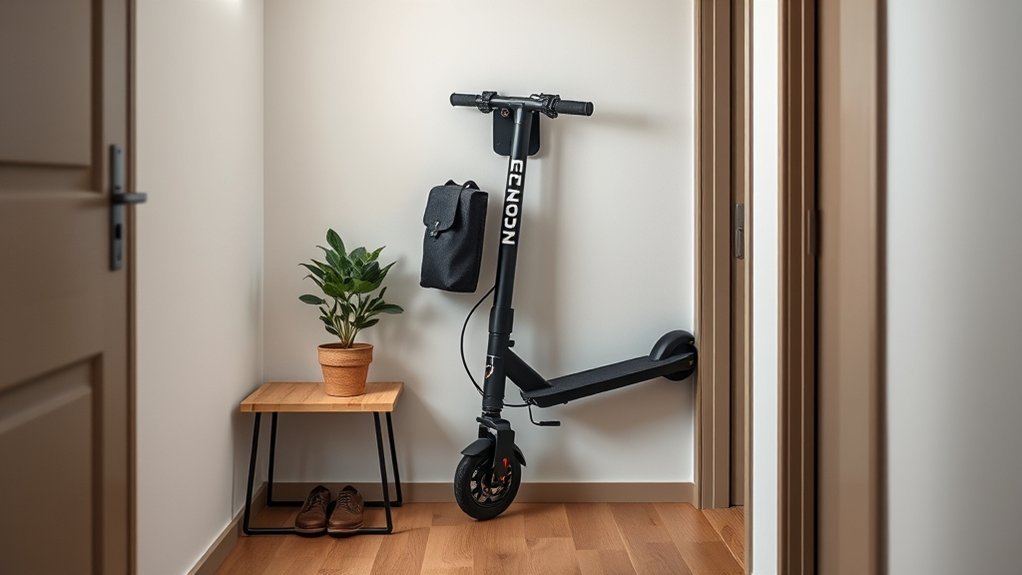
Proper electric scooter storage protects the frame, electrical system, battery, tires, and people living in your apartment. Moisture can encourage corrosion, while direct sunlight and extreme temperatures can speed up the aging of plastic, rubber, and battery components.
Storage safety matters most because an electric scooter contains a rechargeable lithium-ion battery. A damaged, defective, modified, or incorrectly charged battery can overheat and create a serious fire hazard. The U.S. Consumer Product Safety Commission advises owners to follow the manufacturer’s instructions, use the approved charger, remain present during charging, and never charge while sleeping or away from home.
The best apartment storage spot is dry, stable, visible, clear of escape routes, and far from heat or combustible clutter.
Check Apartment Rules and Scooter Safety
Before choosing a storage location, check your lease, building rules, condominium policy, dormitory policy, and local fire regulations. Some properties restrict where micromobility devices may be stored or charged. Building rules can also be stricter than the scooter manufacturer’s instructions.
Check whether your scooter or battery is affected by a safety recall. In the United States, you can search the CPSC recall database through its micromobility information center. You should also look for certification from a recognized testing laboratory. UL 2272 covers the electrical system of personal e-mobility devices, including e-scooters.
Warning: Do not keep or charge a scooter where it blocks your front door, hallway, stairway, fire escape, or another exit. Do not use a battery that has been modified, rebuilt with used cells, recalled, punctured, swollen, cracked, leaking, or damaged in a crash.
Choose the Best Spot in Your Apartment
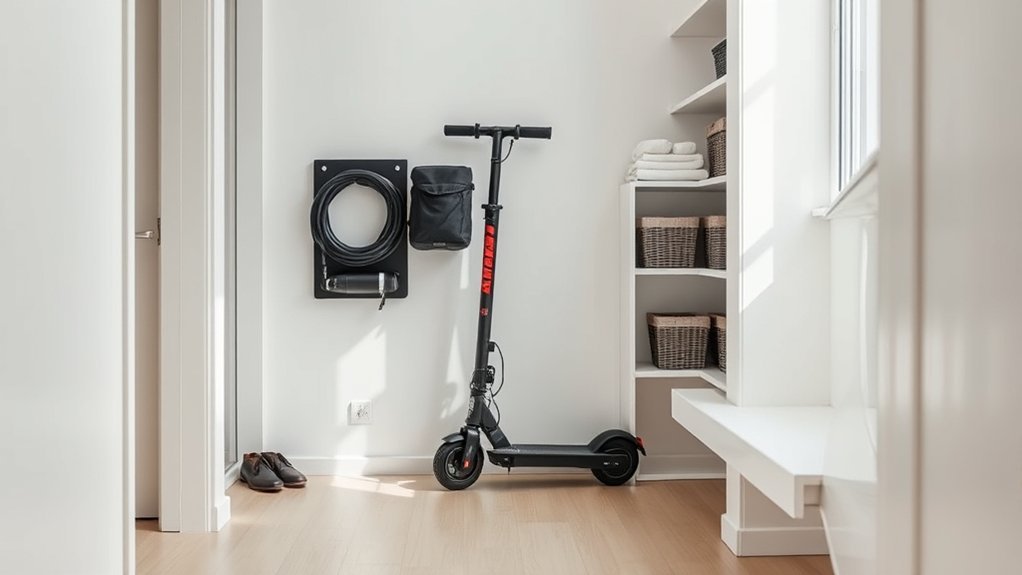
Start by looking for a low-traffic area where the scooter will remain upright and will not become a trip hazard. A dedicated corner, utility area, sturdy floor stand, or properly installed wall mount may work well. A folding scooter may fit beside a desk or behind stable furniture as long as it remains visible and does not block ventilation or an escape route.
Avoid placing the scooter under a bed, against a radiator, next to a stove, beside a space heater, in direct sunlight, near a wet entryway, or among paper, clothing, curtains, cleaning chemicals, and other combustible material. Do not charge it inside a closed closet or cabinet.
You may store a powered-off scooter in a closet only when the battery is healthy, the area is dry and uncluttered, the scooter cannot fall, and your building permits it. Keep it away from clothing, cardboard boxes, and heat sources. Leave the scooter easy to inspect instead of burying it behind stored items.
| Better Storage Location | Location to Avoid |
|---|---|
| Dry, visible corner away from traffic | Under a bed or buried behind combustible items |
| Stable floor stand away from exits | Hallway, stairway, doorway, or fire escape |
| Properly anchored wall mount | Loose hook, lightweight shelf, or unanchored rack |
| Cool area within the manual’s temperature range | Direct sun, heater, radiator, stove, or freezing balcony |
Pro Tip: Put a washable mat under the scooter after rainy or muddy rides. Dry the scooter before storage, and remove the wet mat once you have cleaned it.
Prep Your Scooter for Storage
Turn the scooter off and unplug the charger before cleaning or moving it into storage. Allow a recently used scooter and battery to cool to room temperature. Then clean the scooter, inspect its battery and controls, check the tires, and secure any loose folding parts.
Clean and Inspect
Wipe the frame, stem, deck, wheels, and accessible joints with a soft, slightly damp cloth. Do not spray water directly into the charge port, display, motor, battery compartment, or controls. Dry every surface before storing the scooter.
Inspect the following parts:
- Frame and stem for cracks, bends, or crash damage
- Folding latch for looseness or incomplete engagement
- Brake lever, cable, disc, drum, or electronic brake operation
- Throttle and power controls
- Lights, reflectors, and wiring
- Tires for cuts, bulges, embedded objects, and flat spots
- Charge port and charger cable for moisture, dirt, discoloration, or damage
If you find structural, brake, electrical, or battery damage, do not store the scooter as though it is ready for normal use. Contact the manufacturer or a qualified repair provider.
Check the Battery for Warning Signs
Look at and smell around the battery compartment without opening or dismantling it. The U.S. Fire Administration recommends routine checks for cracking, bulging, and leaking.
Stop using and charging the scooter if you notice:
- A swollen battery case or distorted deck
- Cracks, punctures, corrosion, or leaking material
- Unusual heat when the scooter is off
- A sharp, sweet, chemical, or burning odor
- Hissing, popping, or crackling sounds
- Smoke, sparks, or repeated charger faults
- Battery damage after a collision, drop, flood, or attempted modification
Warning: If the battery becomes hot, releases smoke or gas, hisses, or catches fire, move away immediately if you can do so safely. Alert everyone, leave the apartment, close the door behind you, and call emergency services. Do not remain inside trying to fight a lithium-ion battery fire.
Battery and Tire Prep
Check the owner’s manual before setting the battery level for storage. Many manufacturers recommend a partial charge for storage lasting more than a few weeks, but the correct percentage and recharge interval vary. For example, Xiaomi guidance for one model recommends about 80% before storage longer than 30 days. Do not assume that the same percentage applies to every scooter.
Inflate pneumatic tires to the exact pressure listed in the owner’s manual, manufacturer support page, or tire marking. Do not rely on a broad range copied from another scooter. Solid and honeycomb tires do not require inflation, but they should still be checked for cracks, separation, or flat spots.
| Check | What to Do | Why It Matters |
|---|---|---|
| Battery level | Use the storage level in the manual | Helps prevent over-discharge or unnecessary battery stress |
| Tire pressure | Inflate to the model’s specification | Reduces pressure loss, tire damage, and flat spots |
| Charge port | Clean, dry, and close its protective cover | Helps protect electrical contacts from moisture and debris |
| Folding mechanism | Fold and latch it according to the manual | Prevents falls and damage during storage |
Charge an Electric Scooter Safely in an Apartment
Charging and storage are not the same activity. A spot that is acceptable for a powered-off scooter may be unsuitable for charging. Charge in an open, dry area where you can see the scooter and quickly unplug the charger. Keep it away from beds, sofas, curtains, paper, clothing, fuels, cleaning chemicals, and other materials that burn easily.
- Use only the charger supplied or specifically approved by the manufacturer.
- Plug the charger directly into a suitable wall outlet unless the manufacturer says otherwise.
- Do not use a universal charger, damaged charger, loose outlet, extension cord, or overloaded power strip.
- Keep the scooter, charger, cable, and charge port dry.
- Stay home and awake while charging.
- Unplug the charger when charging is complete.
- Do not charge a battery that is damaged, swollen, unusually hot, wet, recalled, or recently involved in a crash.
- Do not charge immediately after a very hot or cold ride; allow the battery to reach the charging temperature stated in the manual.
Note: Fire departments may advise storing and charging micromobility devices outdoors or in an approved dedicated area where possible. Always follow your local fire department, landlord, and building requirements when they are stricter than general manufacturer guidance.
Use Wall Mounts, Racks, or Stands
A wall mount, rack, or floor stand can save space without hiding the scooter under furniture. The holder must support the scooter’s full weight and keep it from falling onto a person, pet, doorway, appliance, or valuable item.
- Check the scooter’s weight and the mount’s rated capacity.
- Anchor wall hardware into a suitable stud, masonry surface, or approved structural anchor.
- Do not rely on drywall alone unless the hardware is specifically rated and correctly installed for that load.
- Do not hang the scooter by a brake cable, electrical wire, plastic fender, light, or movable control.
- Keep the tires or frame from marking the wall by using a washable guard or mat.
- Confirm that the folding latch is secure before lifting the scooter.
- Place a floor stand on a level, slip-resistant surface.
If you rent your apartment, obtain permission before drilling into a wall. A stable floor stand may be the better option when mounting is not allowed.
Keep the Battery and Tires Healthy
Long storage can slowly reduce battery charge and tire pressure even when the scooter is not used. A short monthly inspection is a practical starting point, but the owner’s manual should control the actual battery and maintenance schedule.
Battery Charge Levels
Do not leave the battery fully discharged. Deep discharge can make some lithium-ion batteries difficult or impossible to recharge. At the same time, do not repeatedly top the battery to 100% during storage unless the manufacturer instructs you to do so.
- Record the battery percentage when storage begins.
- Check the display or app at the interval stated in the manual.
- Recharge only with the approved charger when the level approaches the manual’s minimum storage limit.
- Disconnect the charger when charging is complete.
- Do not turn on or ride the scooter merely to “balance the cells” unless the manufacturer specifically requires that procedure.
Storage temperature also varies by model. As one example, Segway lists a recommended storage temperature of 50–86°F for the F2 Pro, while its wider permitted storage range is different. Check your exact model instead of treating one range as universal.
Tire Pressure Checks
Pneumatic tires naturally lose pressure during use and storage. Check them with an accurate gauge and use the exact pressure stated for your scooter. Specifications can differ even between models from the same brand.
| Condition | Possible Effect | Action |
|---|---|---|
| Pressure below specification | Flat spots, extra rolling resistance, poor handling, or tire damage | Inflate to the manufacturer’s stated pressure |
| Pressure above specification | Reduced grip, harsh ride, or excess tire stress | Release air until the correct pressure is reached |
| Cuts, bulges, cracks, or exposed material | Possible tire failure | Do not ride until the tire is inspected or replaced |
| Solid tire separation or severe flat spot | Vibration and poor control | Arrange qualified service before riding |
Protect the Scooter From Children and Pets
Keep the scooter, charger, keys, and removable battery out of reach of young children. Prevent pets from chewing charger cables or knocking over the scooter. If the scooter has an app lock or physical lock, use it as an added control, but do not treat an electronic lock as a substitute for stable storage.
Long-Term Electric Scooter Storage Steps
- Read the manual. Find the correct storage charge, temperature range, tire pressure, and inspection interval for your model.
- Check rules and recalls. Confirm that apartment storage is permitted and that the scooter and battery are not under recall.
- Allow the scooter to cool. Do not begin charging immediately after a hot ride.
- Turn it off and unplug it. Remove the charger before cleaning or moving the scooter.
- Clean and dry it. Remove dirt, road salt, and moisture without spraying electrical parts.
- Inspect the battery and structure. Look for heat, swelling, odor, cracks, leaks, loose parts, and crash damage.
- Set the battery level. Charge only to the storage level required by the manufacturer.
- Set tire pressure. Inflate pneumatic tires to the exact model specification.
- Choose a safe position. Use a stable floor stand or correctly rated mount away from exits, heat, sunlight, water, and combustible clutter.
- Schedule checks. Inspect the scooter at the interval in the manual and record any battery recharge.
Prepare the Scooter After Storage
Do not unfold the scooter and immediately ride at full speed. Complete a short inspection first:
- Confirm that the battery case and deck have not swollen or changed shape.
- Check the charge port, charger, and cable.
- Inflate the tires to the correct pressure.
- Test the folding latch and stem for looseness.
- Test the brakes, throttle, lights, display, and bell.
- Look for error codes in the display or app.
- Charge the battery according to the manual while you remain present.
- Take a slow test ride in a safe area before returning to normal use.
Avoid Common Storage Mistakes
Avoid these mistakes when keeping an electric scooter in an apartment:
- Blocking a door, hallway, stairway, window, or fire escape
- Hiding the scooter under a bed or among clothing and cardboard
- Charging inside a closed closet or cabinet
- Charging overnight or while no one is home
- Using an incompatible, universal, damaged, or counterfeit charger
- Leaving the battery fully discharged for months
- Assuming every scooter should be stored at 80%
- Using a tire-pressure number from another model
- Storing the scooter while wet, muddy, or covered with road salt
- Mounting it on hardware that cannot support its weight
- Ignoring swelling, heat, odor, leaking, hissing, or charger faults
- Putting a lithium-ion battery in household trash or ordinary recycling
If the battery reaches the end of its life, follow the manufacturer’s instructions and take it to an approved battery recycler or hazardous-waste facility. Do not dismantle, puncture, burn, or place it in a household bin.
Frequently Asked Questions
How do you store an electric scooter in a small apartment?
Turn it off, clean and dry it, inspect the battery, set the tires and battery according to the manual, and place it on a stable floor stand or properly anchored mount. Keep it away from exits, beds, heat, direct sunlight, water, children, pets, and combustible clutter.
Are scooters good for autistic kids?
A nonmotorized scooter may offer enjoyable movement and coordination practice for some autistic children, but needs and responses differ. An electric scooter is not a therapy device. Consider the child’s balance, judgment, motor skills, sensory needs, and ability to follow safety rules. The American Academy of Pediatrics recommends that children under 16 not operate or ride motorized e-scooters. Use a helmet, close supervision, and advice from the child’s pediatrician or occupational therapist when needed.
What happens if an electric scooter is not used for a long time?
The battery can slowly discharge, pneumatic tires can lose pressure, metal parts can corrode in damp conditions, and controls or folding parts can become stiff or loose. Deep discharge may permanently damage some batteries. Follow the manual’s storage charge and inspection schedule, then inspect the scooter fully before riding again.
Can I store my e-bike in my apartment?
You may be able to store an e-bike in your apartment if your lease, building rules, and local fire regulations allow it. Keep it away from exits and combustible materials, use the approved charger, remain present during charging, and never charge a damaged battery. Because an e-bike is larger and heavier than an e-scooter, confirm that any rack or wall mount is rated for its full weight.
Can I store an electric scooter under my bed?
It is safer to avoid under-bed storage. A bed and its contents are combustible, and the hidden position makes battery heat, odor, swelling, or smoke harder to notice. Use an open, stable location away from exits and sleeping areas instead.
Can I charge an electric scooter overnight?
No. Do not charge an electric scooter while you are asleep or away from home. Stay present, use the manufacturer-approved charger, keep the scooter away from escape routes and combustible material, and unplug it when charging is complete.
Should I remove the battery before storing the scooter?
Remove the battery only if your scooter is designed for user removal and the manual explains how to do it. Do not open a sealed deck or battery enclosure. Store an approved removable battery in the position and temperature range specified by the manufacturer, away from metal objects and combustible materials.
Conclusion
Safe apartment storage requires more than folding your electric scooter into the smallest available gap. Choose a dry, stable, visible location away from exits, heat, water, sleeping areas, and combustible clutter. Inspect the battery, use only approved charging equipment, and follow your model’s manual for storage charge, temperature, tire pressure, and maintenance intervals.
A wall mount or stand can save space, but it must support the scooter securely. During long storage, check for battery damage, pressure loss, corrosion, or loose parts. Before riding again, test the tires, brakes, folding latch, lights, controls, and battery. These steps protect your scooter without creating an avoidable risk inside your apartment.
Sources
- U.S. Consumer Product Safety Commission: Micromobility Safety — approved chargers, supervised charging, battery replacements, recalls, and disposal.
- U.S. Fire Administration: Lithium-Ion Battery Safety — storage conditions, battery warning signs, exit clearance, charging, and emergency response.
- UL Solutions: Micromobility Testing and Certification — UL 2272 and electrical-system safety certification for e-scooters.
- Xiaomi Mi Scooter Pro FAQ — manufacturer-specific storage charge, temperature, maintenance, and tire-pressure examples.
- Segway Ninebot F2 Pro Support — manufacturer-specific storage temperature and tire-pressure specifications.
- American Academy of Pediatrics: E-Scooter Safety — child age and riding-safety guidance.
