Last Updated on July 23, 2026 by Caleb Warren
Winter storage protects an electric scooter from moisture, corrosion, flat tires, and battery damage, but the correct battery percentage and temperature depend on the exact model. Clean and dry the scooter, inspect it carefully, follow the owner’s manual for battery storage, and use only the manufacturer-approved charger when a top-up is needed.
Quick Answer
To store an electric scooter for winter, clean and dry it, inspect the battery, set the charge to the level in your model’s manual, inflate pneumatic tires, and keep the scooter in a cool, dry indoor location. Recheck it on the manufacturer’s schedule, and never charge a cold, damaged, or swollen battery.
Key Takeaways
- Use your scooter’s manual for the storage charge, temperature range, and recharge schedule because these rules vary by model.
- Store the scooter clean, fully dry, powered off, and protected from leaks, condensation, salt, direct sun, and freezing charging conditions.
- Use only the supplied or manufacturer-approved charger, stay present while charging, and unplug it when the charge cycle is complete.
- Never lubricate brake pads, rotors, drums, or tire tread. Apply only a manufacturer-approved lubricant to approved moving joints.
- Do not charge or keep using a battery that is swollen, cracked, leaking, unusually hot, hissing, or producing an unusual odor.
At a Glance
| Time Required | About 20–40 minutes, plus brief periodic checks |
| Difficulty | Easy |
| Tools Needed | Soft cloths, mild soap if approved, tire pump with gauge, original charger, and an approved joint lubricant only if the manual calls for it |
| Cost | Usually $0–$20 if you already own a pump and cleaning supplies |
Warning: Stop using and charging the scooter if the battery is swollen, cracked, leaking, unusually hot, hissing, or giving off an unusual odor. Keep people away and contact the manufacturer or local emergency services if it is smoking or heating rapidly.
Disclosure: As an Amazon Associate I earn from qualifying purchases. Some links on this page are affiliate links, at no extra cost to you.
Clean Your Scooter Before Storage
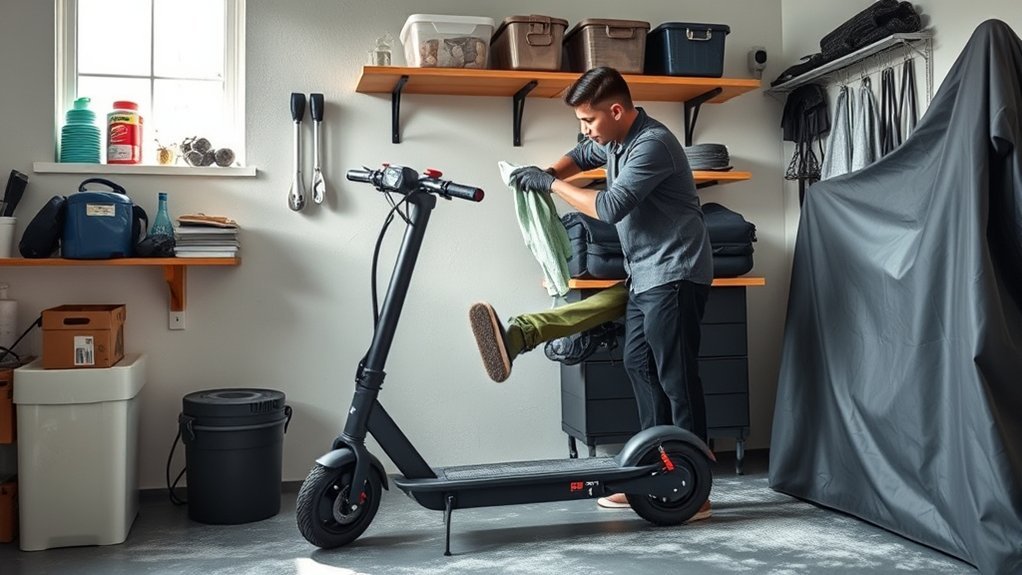
Turn the scooter off, unplug the charger, and close the charging-port cover before cleaning. Wipe the frame, deck, wheels, fenders, and underside with a soft damp cloth. Use mild soap only if your owner’s manual allows it. Do not immerse the scooter, spray it with a hose, or use a pressure washer because water can enter bearings, connectors, the display, or the battery enclosure.
Remove grit from tire tread, fasteners, and the area around the brakes with a dry brush or cloth. Do not put oil, wax, silicone spray, or rust treatment on brake pads, brake rotors, brake drums, tire tread, hand grips, or electrical connectors.
Dry every surface, seam, and charging-port area completely. Let the scooter air-dry in a ventilated room before covering or charging it. If the manual permits corrosion protection, apply a small amount to a cloth and wipe only exposed, non-braking metal. Spraying the product directly can spread it onto the brakes or electronics.
Pro Tip: Take clear photos of the scooter, battery label, serial number, and existing scratches before storage. The photos make it easier to notice swelling, corrosion, leaks, or new damage during later checks.
Inspect the Scooter and Battery
Check the frame, stem, folding latch, handlebars, brake levers, cables, lights, tires, charging port, and fasteners. Look for cracks, looseness, damaged insulation, bent parts, corrosion, water intrusion, or unusual wear. Test the brakes before storage, but do not ride the scooter if any safety-critical part is damaged.
Inspect the battery enclosure without opening it. A fixed battery is not a user-serviceable part. Remove a battery only when the manufacturer designed it to be removable and the manual gives clear instructions. Do not open, modify, rebuild, or disconnect an internal pack yourself.
Check the model and serial number against current safety notices on the U.S. Consumer Product Safety Commission micromobility page or the equivalent product-safety authority in your country.
Set the Battery to the Correct Storage Charge
The correct winter storage charge is model-specific. Some manufacturers recommend a middle charge range, some specify about 80%, and some manuals require a full charge followed by scheduled recharging. Check the battery label, owner’s manual, app, or official support page before choosing a target.
Optimal Charge Range
Follow the percentage in your manual. For example, some Xiaomi guidance uses a 30–70% range for long storage, while other Xiaomi models call for about 80%. Some Segway manuals instruct owners to fully charge before storage and recharge every 30 days. These differences are why a universal “never store at 100%” rule is not reliable for every scooter.
If the manufacturer gives no storage percentage, keeping a healthy lithium-ion pack near the middle of its charge range, such as roughly 40–60%, is a cautious fallback. However, the manufacturer’s instructions always take priority.
Avoid Deep Discharge
Do not store the scooter with an empty or nearly empty battery. Battery-management electronics can continue to draw a small amount of power while the scooter sits, and a pack that falls too low may become difficult or impossible to recharge. Turn the scooter fully off instead of leaving it in standby mode.
Use only the charger supplied with the scooter or a replacement specifically approved by the manufacturer. The CPSC warns against unapproved universal micromobility chargers because a plug can fit even when the electrical requirements are incompatible.
Recheck Battery Level
Record the storage date and starting charge. Recheck the battery on the schedule in the manual or app. When no schedule is provided, a check every four to eight weeks is a practical routine. Recharge only enough to return the battery to the manufacturer’s storage target.
Do not charge a battery that is below its permitted charging temperature. Bring the scooter or removable battery into a dry, temperature-controlled space and let it warm naturally before charging. Do not place it beside a heater or use a hair dryer.
Choose a Dry Indoor Storage Spot
Choose a stable, dry, ventilated indoor location within the storage-temperature range listed for your scooter. A room around 10°C to 25°C is a practical target for many models, but it is not a universal requirement. Some manuals permit a wider storage range. Avoid standing water, roof leaks, salt, direct sunlight, furnaces, radiators, and large temperature swings that cause condensation.
| Location | Main Risk | Better Approach |
|---|---|---|
| Dry temperature-controlled room | Low moisture risk | Good choice when it does not block an exit |
| Damp basement or shed | Humidity, leaks, rust, and battery damage | Use a drier location or control the moisture first |
| Unheated garage | Cold charging, condensation, and temperature swings | Use only if the manual permits the temperature and the area stays dry |
Keep the scooter away from combustible clutter and do not place it in a hallway, stairwell, or primary exit. Put it on a stable surface where it cannot fall, and protect it from children, pets, vehicles, and heavy objects.
Use a clean, breathable dust cover only after the scooter is completely dry. Do not wrap it tightly in plastic or use a non-breathable tarp that can trap condensation.
Protect Tires, Cables, and Hinges
Inflate pneumatic tires to the pressure printed in the owner’s manual, on the tire sidewall, or in the official app. Do not guess because recommended pressure varies by scooter and tire. Solid and honeycomb tires do not need inflation.
Check pneumatic-tire pressure during storage. If the scooter will sit for months, move it slightly during each inspection or support it only in a way approved by the manufacturer so the same part of each tire does not carry the load continuously.
The safest storage specification is the one written for your exact scooter model, especially for battery charge, charging temperature, and tire pressure.
Wipe visible brake and control cables clean and check for fraying, kinks, rust, or split housings. Do not coat cables with oil or silicone unless the service manual specifically directs you to do so. Many cable housings are lined or sealed, and excess product can migrate onto braking surfaces.
Clean the folding hinge and latch, then check that they lock securely. Apply only the exact lubricant and method approved by the manufacturer. Keep all lubricant away from brake rotors, pads, drums, tires, grips, charging ports, and electrical connectors.
Check the Battery on the Manufacturer’s Schedule
A six-week check is reasonable for many scooters, but it is not a universal rule. Official schedules can range from about 30 days to one or two months, depending on the model and starting charge. Follow your manual first.
Battery Check Schedule
- Look for swelling, cracks, leaks, corrosion, unusual heat, odor, or sounds before touching the charger.
- Check the displayed charge level and compare it with your storage log.
- Inspect the charger, cable, plug, and charging port for damage or contamination.
- Confirm that the battery is within its permitted charging-temperature range.
- Recharge only to the model’s stated storage target, then unplug the charger.
- Recheck tire pressure, moisture, pests, and the stability of the storage area.
Recharge Before Deep Discharge
If the charge has fallen below the model’s storage target, use the original or approved charger in a dry, open area away from combustible materials. Stay present while charging, never charge while sleeping, and unplug the charger when the required level is reached. Do not leave the charger connected throughout the winter.
Note: A temporary drop in displayed range during cold weather does not automatically mean the battery has permanent damage. Let the battery return to a permitted operating temperature, then assess it under normal conditions.
Avoid Winter Storage Mistakes
- Do not use one battery percentage for every scooter. Follow the model-specific manual.
- Do not store the battery empty. It can continue to self-discharge during a long idle period.
- Do not charge a cold battery. Warm it naturally to the manufacturer’s permitted charging range first.
- Do not use an unapproved universal charger. Use the supplied or manufacturer-approved unit.
- Do not charge unattended or while sleeping. Stay nearby and unplug the charger when finished.
- Do not spray lubricant near the brakes or electronics. Contaminated braking surfaces can reduce stopping performance.
- Do not store a wet scooter under sealed plastic. Trapped moisture encourages corrosion and electrical faults.
- Do not disassemble a fixed battery. Contact the manufacturer or an authorized service provider.
- Do not ignore battery damage. Swelling, heat, leaking, odor, smoke, or hissing requires immediate attention.
Prepare Your Scooter for Spring
Move the scooter into a dry, moderate-temperature area before inspection or charging. Remove the cover and look for corrosion, pests, moisture, cracked tires, loose fasteners, damaged wiring, or battery changes.
- Inflate pneumatic tires to the model’s recommended pressure and inspect them for cuts, cracks, bulges, and flat spots.
- Check the folding latch, stem, handlebars, deck, fenders, axles, and fasteners for looseness or damage.
- Inspect the brake pads, rotor or drum, cable, and lever action. Never lubricate a brake friction surface.
- Test the lights, display, horn or bell, throttle, brake cut-off, and app connection while the wheel is safely off the ground if the manual permits.
- Charge the battery to the level required before use. Many models call for a full charge before returning to service, but follow your manual.
- Take a short, low-speed test ride in a safe area and confirm steering, acceleration, and braking before normal use.
If the scooter will not power on, will not accept a charge, shows a battery error, smells unusual, becomes hot, or has weak brakes, stop troubleshooting and contact the manufacturer or an authorized repair provider.
Frequently Asked Questions
Can you store an electric scooter outside in winter?
Outdoor winter storage is a poor choice for most electric scooters because rain, snow, road salt, direct sun, condensation, and temperature swings can damage the frame, electronics, tires, and battery. Use a dry indoor location within the manufacturer’s storage-temperature range.
How cold is too cold for an electric scooter?
There is no single cutoff for every model. Check the operating, storage, and charging temperatures in your manual because they can be different. Cold usually reduces available range temporarily, while charging below the permitted temperature can damage the battery. Warm it naturally before charging.
What happens if an electric scooter is not used for a long time?
The battery can self-discharge, pneumatic tires can lose pressure, moisture can cause corrosion, and moving parts or brakes can develop problems. Store it correctly and inspect the charge, tires, battery condition, and storage area on the schedule in the manual.
How do you winterize an electric scooter?
Clean and dry it, inspect the battery and safety parts, set the battery to the manufacturer’s storage charge, inflate pneumatic tires, turn the scooter fully off, and store it in a dry indoor location. Recheck it at the interval in the manual and prepare it carefully before the first spring ride.
Should you remove the battery for winter storage?
Remove it only if the scooter has a user-removable battery and the manual recommends removal. Do not open the deck or disconnect a fixed internal pack. Store a removable battery according to its own temperature, charge, and placement instructions.
Can you charge an electric scooter in a cold garage?
Only when the battery temperature is within the charging range stated in the manual. If the garage is colder, move the scooter or removable battery to a dry, moderate-temperature location and let it warm naturally before connecting the approved charger.
Conclusion
Good winter storage starts with the manual for your exact scooter. Clean and dry the scooter, inspect the battery and safety parts, use the correct storage charge, protect pneumatic tires, and choose a dry indoor location. Check it on the manufacturer’s schedule, charge only within the allowed temperature range, and use only an approved charger. A careful spring inspection and low-speed test ride will help you return to the road safely.
Sources
- U.S. Consumer Product Safety Commission: Micromobility Information Center — charging, battery, inspection, recall, and fire-safety guidance.
- CPSC: Warning About Universal Micromobility Chargers — charger compatibility and supervised charging.
- Xiaomi Electric Scooter 3 Lite FAQ — cleaning, dry storage, tire checks, and a model-specific 30–70% long-storage range.
- Xiaomi Electric Scooter 5 Pro Battery Guidance — model-specific storage charge, temperature limits, and periodic recharging.
- Segway Ninebot eKickScooter ZING C9 User Manual — cleaning, indoor storage, charging temperature, and long-storage charging instructions.
- U.S. Environmental Protection Agency: Used Lithium-Ion Batteries — damaged battery handling and proper recycling or hazardous-waste disposal.