Last Updated on September 10, 2026 by Daniel Globe
Electric scooter repair costs vary widely because shops may quote labor only, parts only, or an all-in price. A simple brake adjustment can be inexpensive, while a battery, motor, controller, or damaged wiring can cost enough to make replacement worth considering. The scooter model, wheel design, part availability, local labor rates, warranty coverage, and the exact fault all affect the final bill.
Quick Answer
Electric scooter repairs can range from a modest brake adjustment or tire fix to several hundred dollars for electrical, battery, or motor work. Current U.S. shops publish prices such as $35 for a brake adjustment, roughly $50–$125 for some tire jobs, and $90 or more in labor for certain battery replacements before the battery itself is added.
Key Takeaways
- There is no single nationwide electric scooter repair price; model, wheel type, scooter weight, labor rate, and parts availability can change the bill substantially.
- Ask whether a quote includes both parts and labor before comparing shops.
- Tire, brake, charging-port, controller, display, wiring, battery, and motor faults are among the most common paid repairs.
- Battery packs and charging systems deserve extra caution because damaged or incompatible lithium-ion components can create a fire risk.
- For an expensive repair, compare the complete repair bill with the scooter’s current value, battery condition, parts support, remaining warranty, and replacement cost.
Disclosure: As an Amazon Associate I earn from qualifying purchases. Some links on this page are affiliate links, at no extra cost to you.
How Much Does Electric Scooter Repair Cost?
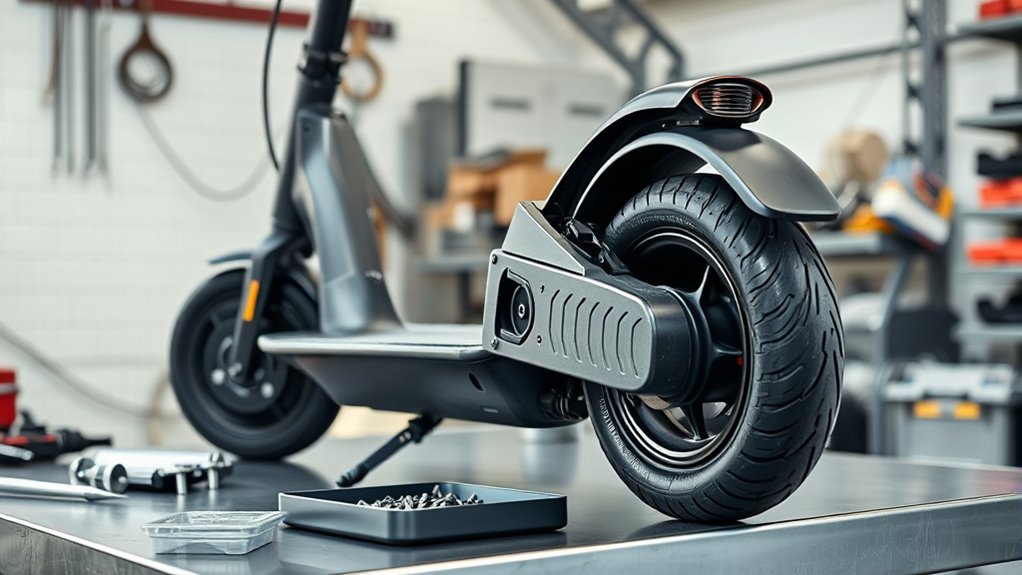
Electric scooter repair costs depend more on the specific scooter and repair than on a single national average. Some repair shops publish labor separately from replacement parts, while others advertise a starting price that may include some parts.
For example, Central Scoot currently lists $70 labor for a standard flat-tire repair, $35 for a single brake adjustment, $90 labor for battery replacement, $50–$195 for motor-replacement labor depending on the scooter, and $100–$250 for controller-replacement labor. Parts can be additional. Ready Workshop lists e-scooter labor such as $35 for a brake adjustment and roughly $50–$125 for different flat-tire jobs.
Those prices are useful benchmarks, not universal rates. Before approving a repair, ask the shop for an itemized estimate showing the diagnostic fee, labor, replacement parts, shipping, taxes, and any storage or rush-service charge.
| Repair | Published Current Examples | What Changes the Price |
|---|---|---|
| Diagnostic inspection | About $50–$90 at one current U.S. shop; other shops may start around $75 | Scooter speed/class, electrical troubleshooting time, and whether the fee is credited toward repair |
| Flat tire / tire service | Roughly $45 starting prices to $125 labor for some tire configurations | Motorized wheel, tubeless or solid tire, wheel size, scooter weight, and parts |
| Brake service | About $35 for a basic adjustment; hydraulic and component replacement can cost much more | Mechanical vs. hydraulic brakes, pads, rotor, cable, caliper, and bleeding |
| Battery replacement | One shop lists $90 installation labor before the battery; another lists battery replacement starting around $250 | Battery voltage, capacity, OEM availability, enclosure design, shipping, and installation labor |
| Motor replacement | Published labor can range from about $50 to $195 on some models; other repair businesses start motor work around $250 | Motor type, power, wheel design, connector access, parts cost, and diagnosis |
| Controller replacement | About $100–$250 labor at one current shop | Controller availability, wiring complexity, programming, and scooter performance class |
Note: Published repair menus are examples, not nationwide averages. A $70 tire job in one city may cost substantially more or less elsewhere, and some menus show labor without the replacement part.
What Drives Electric Scooter Repair Costs?
Repair bills rise or fall based on several variables. Brand and model matter because common scooters are more likely to have replacement parts, service documentation, and technicians who already know the platform. Proprietary or less-common models may require special parts or longer troubleshooting.
Labor rates are another major factor. A simple mechanical adjustment can take relatively little shop time, while intermittent electrical faults may require diagnosis before any part is replaced. Many shops therefore charge a diagnostic fee separately.
Tire design can change labor considerably. Removing a non-motorized wheel is usually simpler than working on a hub-motor wheel. Solid tires can also require more installation effort than some pneumatic tires. Heavy performance scooters may carry additional labor charges because they are more difficult to lift, disassemble, and test.
Parts availability can be just as important as labor. A technician may diagnose the scooter quickly but still need to order a controller, display, battery, motor, brake assembly, or proprietary connector. Shipping can then become part of both the cost and turnaround time.
Warranty status also matters. Check the manufacturer’s warranty and service process before paying a third-party shop. If the defect is covered, authorized warranty service may reduce or eliminate your out-of-pocket cost.
Pro Tip: Give the repair shop your exact brand, model, serial number, error code, photos or video of the problem, and a description of when the fault occurs. Better information can shorten diagnosis and help the shop confirm parts availability before you bring the scooter in.
Common Electric Scooter Repairs and Their Prices
Common repair categories include tires and tubes, brake adjustments, pads and rotors, charging ports, throttles, dashboards, controllers, wiring, batteries, motors, stems, folding mechanisms, and suspension components. The total depends on whether the repair requires only adjustment or labor, or whether a proprietary replacement component is needed.
Battery And Motor Costs
Battery and motor work is often more expensive than routine tire or brake service because the replacement component itself can be costly. Battery prices vary with voltage, energy capacity, enclosure design, battery-management electronics, and whether an original or manufacturer-approved pack is available. Installation can be charged separately.
Motor costs vary with motor power, hub design, wheel configuration, connectors, and whether the motor is replaced as a complete wheel assembly. A shop may also need to rule out controller, wiring, hall-sensor, brake-cutoff, or battery problems before concluding that the motor itself has failed.
Do not assume a weak scooter automatically needs a new motor. Reduced range, weak acceleration, shutdowns under load, or charging problems can also come from the battery, controller, connectors, brakes dragging, low tire pressure, or another electrical fault.
Warning: Do not open, rebuild, modify, or continue charging a lithium-ion scooter battery that is swollen, leaking, unusually hot, giving off an unusual odor, making abnormal noises, smoking, or visibly damaged. The U.S. Consumer Product Safety Commission advises using only a replacement battery confirmed by the manufacturer to be suitable for the device and only the supplied or manufacturer-recommended charger.
CPSC micromobility guidance also advises owners to remain present while charging and not to charge an e-scooter while sleeping or away from home.
Tire And Brake Repairs
Tires and brakes are common wear items, but there is no single reliable $20–$80 price band for every scooter. Current shop menus show that basic brake adjustment may cost around $35, while hydraulic bleeding, cable replacement, rotors, calipers, or full hydraulic component replacement cost more.
Tire service varies even more. A standard pneumatic flat can be cheaper than a tubeless or solid-tire job, and a motorized wheel may require additional labor. One current San Francisco service menu lists e-scooter flat-tire labor from about $50 for certain wheels to $125 for some higher-speed tubeless repairs.
You can reduce tire failures by maintaining the manufacturer’s recommended pressure, checking for embedded debris, and replacing worn tires before the casing or tread becomes unsafe. For brakes, inspect pad wear, cable condition, rotor alignment, lever feel, and stopping performance regularly.
Controller, Charging Port, Display, and Wiring Repairs
Not every no-power or acceleration problem is a bad battery or motor. The controller, charging port, display, throttle, brake cutoff, connectors, and wiring can all cause similar symptoms.
- Controller: A failed controller can cause no-start conditions, jerky power, error codes, or motor cutouts.
- Charging port: Bent pins, loose wiring, corrosion, or damaged connectors can prevent charging even when the battery itself is healthy.
- Display or throttle: A damaged dashboard or throttle can prevent the scooter from starting or responding correctly.
- Wiring and connectors: Loose, pinched, overheated, or water-damaged wiring may create intermittent faults that take longer to diagnose.
Because several components can produce the same symptom, paying for diagnosis before ordering expensive electrical parts can save money.
When Is Scooter Repair Worth It?
Repair usually makes sense when one serviceable component has failed but the rest of the scooter is in good condition. A tire, tube, brake, cable, charging port, throttle, or other isolated fault is often easier to justify than replacing an otherwise reliable scooter.
A repair costing less than roughly half of the scooter’s current replacement value can be a useful rule of thumb, but it is not an industry standard. Battery health, structural condition, parts support, warranty coverage, and likely future repairs matter too.
- Repair it when one component has failed and the frame, steering, battery, motor, and electronics are otherwise healthy.
- Repair it when the fault can be solved with an available part at a reasonable all-in cost.
- Think carefully before authorizing multiple expensive repairs at once, such as a battery plus motor or controller.
- Replace the scooter if the frame, stem, folding mechanism, or other safety-critical structure is badly damaged and the manufacturer does not provide an approved repair path.
- Compare the repair bill with the price and expected service life of a suitable replacement scooter rather than relying on the original purchase price alone.
Electric Scooter Repair vs DIY Fixes
DIY work can make sense for simple maintenance when the manufacturer provides instructions and you have the correct tools. Depending on the model, this may include inflation, cleaning, some tire work, mechanical brake adjustment, bolt checks, or replacement of straightforward external components.
Electrical repairs require more caution. Battery packs, battery-management electronics, controllers, motor wiring, and charging systems can be damaged by incorrect parts, short circuits, improper connectors, water intrusion, or poor assembly. If you do not have the manufacturer procedure or cannot positively identify the fault, professional diagnosis is usually the safer choice.
DIY Repair Savings
The most realistic DIY saving is usually the shop labor you avoid, not the entire retail repair price. For example, a shop that charges $70 labor for a flat tire may still require you to buy the tube or tire separately. Doing the job yourself can remove some or all of that labor charge if you already own the necessary tools and can perform the procedure correctly.
Use the scooter manufacturer’s manual, official repair instructions, and model-specific torque or assembly specifications whenever available. Segway, for example, currently publishes official self-repair resources and model-specific repair videos through its service portal.
- Compare the price of the correct replacement part with the shop’s complete quote.
- Add the cost of tools, sealants, tubes, fasteners, or other supplies you do not already own.
- Consider the value of your time and the possibility of damaging another component.
- Use DIY mainly for jobs you can complete according to manufacturer instructions.
When To Call Pros
Professional help is a good choice when the problem involves a lithium-ion battery pack, melted or damaged connectors, controller faults, internal motor wiring, repeated electrical shutdowns, hydraulic-brake work you are not trained to perform, structural damage, or a fault that cannot be diagnosed confidently.
A technician can test several components before you buy an expensive replacement part. This is especially valuable when a weak battery, controller fault, damaged connector, brake sensor, and motor problem could produce similar symptoms.
You should also use an authorized or qualified service route when the manufacturer requires a specific procedure for a warranty claim or provides an official repair program for that component.
Safety And Warranty Risks
DIY repair does not automatically void an entire U.S. consumer-product warranty simply because you used an independent repairer or third-party part. The Federal Trade Commission explains that companies generally cannot condition warranty coverage on using a specified repair service or branded part unless applicable legal exceptions apply.
However, a manufacturer may deny coverage for a defect or damage that was actually caused by improper repair, an incompatible component, modification, or unauthorized service. Manufacturer terms can also contain model-specific exclusions. Segway, for example, warns in its official repair guidance that failures or damage resulting from unauthorized repairs or improper parts may not be covered.
Before repairing a scooter that is still under warranty:
- Download or save the current warranty terms.
- Check whether the fault itself is covered.
- Ask the manufacturer whether it offers free parts or authorized service.
- Keep receipts, photos, and repair records.
- Avoid modifications that can make it difficult to determine the original cause of a failure.
How to Save On Electric Scooter Repairs
Preventive maintenance is one of the best ways to reduce avoidable repair costs. Keep tires at the specified pressure, check brake operation, inspect visible cables and connectors, tighten fasteners according to the manual, and address unusual noises or looseness before they become larger failures.
For the battery, follow the manufacturer’s charging instructions. CPSC advises using the supplied or recommended charger, unplugging the device when charging is complete, remaining present while charging, and using only a replacement battery pack approved for the scooter.
You can also reduce repair spending by getting more than one quote when the scooter is out of warranty. Ask each shop the same questions:
- Is there a diagnostic fee?
- Does the estimate include both labor and parts?
- Are taxes, shipping, or storage extra?
- Is the replacement part original, manufacturer-approved, or aftermarket?
- Is the part currently in stock?
- Does the repair have a workmanship or parts warranty?
- Will the shop contact you before exceeding the estimate?
Before paying for an expensive repair, also search the scooter model on the CPSC recalls database. A safety recall may provide a manufacturer remedy that changes your repair decision.
How Long Scooter Repairs Take
Actual turnaround time has two parts: hands-on labor time and waiting time. A shop may complete a simple brake adjustment or common tire repair quickly, but the scooter can remain at the shop much longer if diagnosis is difficult or the correct part must be ordered.
Published shop menus illustrate the difference. Some businesses advertise basic flat-tire or brake work measured in minutes, while specialist repair menus for larger scooters may assign one or more labor hours to tire, controller, motor, or stem work. Neither tells you how long the scooter will be unavailable if the part is backordered.
- Simple maintenance: often same-day when the shop has capacity and parts.
- Electrical diagnosis: may take longer because several related components need testing.
- Battery, controller, display, or motor replacement: installation can be relatively straightforward once the correct part arrives, but sourcing can extend the total turnaround.
- Uncommon or discontinued models: parts availability can be the main delay.
When requesting a quote, ask for both the expected bench time and the expected completion date.
Repair or Replace Your Electric Scooter?
Once you know the diagnosis and complete price, compare repair with replacement. Do not base the decision on one percentage alone.
| Repair Is Usually More Attractive When | Replacement Becomes More Attractive When |
|---|---|
| The fault is isolated to one serviceable part. | Several expensive components are failing together. |
| The battery still has good usable range and performance. | The battery is already heavily degraded and another major repair is required. |
| Parts are readily available. | Critical parts are discontinued, unavailable, or unusually expensive. |
| The frame, stem, folding mechanism, steering, and brakes are structurally sound. | There is significant safety-critical structural damage without an approved repair path. |
| Warranty coverage reduces the repair bill. | The out-of-pocket repair cost approaches the price of a suitable replacement with a new warranty. |
A “repair if it costs less than 50% of replacement” rule can be a useful starting point, but it should not override safety, battery condition, parts support, or the likelihood of another major failure soon after the first repair.
Frequently Asked Questions
Is It Worth Fixing an Electric Scooter?
Often, yes. Tire, brake, cable, charging-port, throttle, and other isolated repairs can be worthwhile when the scooter is otherwise in good condition. For expensive battery, motor, or controller work, compare the all-in repair price with the scooter’s current value, battery health, parts availability, warranty coverage, and replacement cost.
How Much Does It Cost to Fix an Electric Scooter?
There is no dependable nationwide flat rate. Current U.S. repair menus show examples such as about $35 for a basic brake adjustment, roughly $50–$125 for some tire repairs, $90 labor for certain battery installations before the battery cost, and $100–$250 labor for some controller replacements. Always check whether a quoted price includes parts.
What Is the Average Life of an Electric Scooter?
There is no universal lifespan that applies to every electric scooter. Battery degradation, mileage, rider load, road conditions, water exposure, storage temperature, maintenance, build quality, and parts availability all matter. Instead of relying on a fixed number of years, evaluate battery range, structural condition, recurring faults, and whether replacement parts are still supported.
What Are the Common Problems in Electric Scooters?
Common problems include punctures and tire wear, brake adjustment or pad wear, battery degradation, charging-port faults, damaged chargers, loose or overheated connectors, controller faults, throttle or display problems, motor issues, stem or folding-mechanism looseness, and water-related electrical damage.
How Much Does an Electric Scooter Diagnostic Cost?
Diagnostic policies vary by shop. Some current U.S. scooter repair businesses publish diagnostic charges around $50–$90, while others start around $75. Ask whether the diagnostic charge is credited toward the repair if you approve the estimate.
Does Fixing an Electric Scooter Yourself Void the Warranty?
Not automatically in the United States. FTC guidance says a company generally cannot void an entire consumer-product warranty solely because you used an independent repairer or third-party part. However, warranty coverage can be denied for damage or defects caused by improper repair, modification, or an incompatible part. Always read the specific warranty before starting work.
Can I Replace an Electric Scooter Battery Myself?
Only when the manufacturer provides an approved replacement battery and a clear procedure that you are qualified to follow. Do not rebuild, modify, or improvise a lithium-ion battery pack. CPSC recommends using only a replacement battery confirmed by the manufacturer to be suitable for the scooter.
How Long Does an Electric Scooter Repair Take?
Simple mechanical jobs can sometimes be completed the same day, but total turnaround depends on diagnosis, shop workload, and parts availability. An electrical repair that needs a special controller, display, battery, or motor may take much longer if the component must be ordered.
Conclusion
Electric scooter repair cost depends on the exact fault, the scooter model, local labor rates, and whether replacement parts are included in the quote. Basic brake or tire work may be relatively inexpensive, while battery, controller, motor, wiring, and structural repairs can cost much more.
Start with an accurate diagnosis, ask for an itemized parts-and-labor estimate, check warranty coverage and recalls, and compare the complete repair bill with the scooter’s current condition and replacement cost. For lithium-ion battery or charging-system problems, follow the manufacturer’s procedure and current CPSC safety guidance rather than choosing an unapproved battery, charger, or improvised repair simply because it is cheaper.
Sources
- U.S. Consumer Product Safety Commission — Micromobility Safety — battery replacement, charger, inspection, and charging-safety guidance.
- Federal Trade Commission — Warranty and Right-to-Repair Guidance — explains limits on conditioning warranty coverage on specified parts or repair services.
- Segway Service and Support — manufacturer repair resources, official spare-parts guidance, warranty information, and model-specific service procedures.
- UL Solutions — Personal E-Mobility Safety — information on ANSI/CAN/UL 2272 and electrical-system safety for e-scooters.
- Central Scoot Repair Pricing — current published U.S. labor-price examples for diagnostics, tires, brakes, batteries, motors, and controllers.
- Ready Workshop E-Scooter Repair Pricing — current published labor examples for tire, brake, and maintenance services.