
Last Updated on July 28, 2026 by Daniel Globe
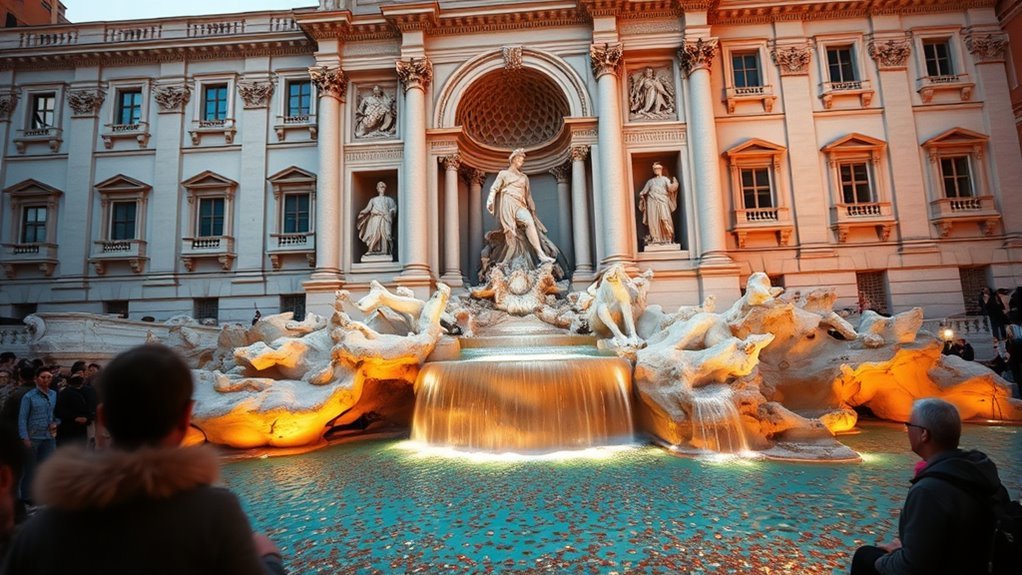
The Trevi Fountain is far more than a famous place to toss a coin. It is the monumental end point of Rome’s ancient Aqua Virgo water system, a showcase of Baroque architecture, and one of the city’s best-known pieces of public art. Its history stretches from 19 BCE to Nicola Salvi’s 18th-century design and today’s carefully managed visitor experience.
Quick Answer
The Trevi Fountain is Rome’s monumental Baroque terminal display for the Acqua Vergine, descended from Agrippa’s Aqua Virgo of 19 BCE. Nicola Salvi began the present fountain in 1732, Giuseppe Pannini completed it in 1762, and Pietro Bracci sculpted Oceanus. In 2026, close-up inner-perimeter access costs €2 for most non-resident visitors.
Key Takeaways
- The name “Trevi” is probably connected with a trivium, or three-way street junction, although Rome’s heritage authority also notes a possible link to the three outlets of an earlier fountain.
- The fountain marks the monumental end of the Acqua Vergine, descended from the Aqua Virgo inaugurated by Agrippa in 19 BCE.
- The central figure is Oceanus, not Neptune, with Abundance and Salubrity representing the beneficial effects of water.
- Bernini proposed an earlier scheme in 1640; Nicola Salvi’s present design was selected in 1732 and completed by Giuseppe Pannini in 1762.
- From February 2, 2026, most tourists and non-residents pay €2 to enter the fountain’s inner perimeter; viewing from outside remains free.
- Coins collected from the fountain support Caritas Roma programs; approximately €1.86 million was collected in 2025.
Disclosure: As an Amazon Associate I earn from qualifying purchases. Some links on this page are affiliate links, at no extra cost to you.
How Did the Trevi Fountain Get Its Name?
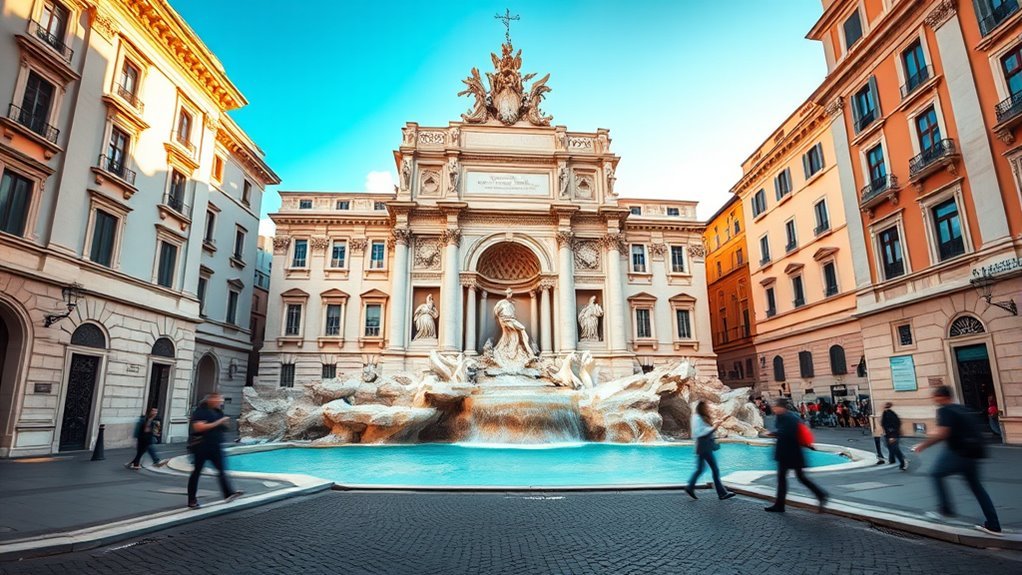
The familiar explanation is that “Trevi” comes from the Latin trivium, meaning a place where three streets meet. Turismo Roma describes this as the probable origin of the Trevi district’s name.
The story is not completely settled, however. Rome’s Sovrintendenza Capitolina notes that the name was already documented in the Middle Ages as Regio Trivii and may instead be connected with the three water outlets of an older fountain at the site. That makes the “three roads” explanation the leading tradition rather than an absolute certainty.
Why Is the Trevi Fountain So Large?
The Trevi Fountain is roughly 26 meters high and 49 meters wide, giving it the scale of a building façade rather than an ordinary street fountain. That is partly because it was designed as a monumental water display, or mostra, announcing the end of an aqueduct.
It also uses the façade of Palazzo Poli as its architectural backdrop. Salvi combined a triumphal-arch composition, a deep central niche, sculpted rock formations, statues, and moving water into one theatrical scene. The small surrounding piazza makes the fountain feel even larger because visitors encounter the monument at close range.
The spectacle no longer depends on wasting an enormous volume of fresh water. The ancient Acqua Vergine continues to supply the monument, while modern pumping and recirculation equipment helps keep the water display operating while limiting consumption.
The Aqua Virgo Aqueduct Behind the Trevi Fountain
The fountain is the monumental terminal display of the Aqua Virgo, known in modern Rome as the Acqua Vergine. Marcus Vipsanius Agrippa inaugurated the aqueduct in 19 BCE to supply the Campus Martius and his baths.
According to the Sovrintendenza Capitolina, its springs lay near the eighth mile of the Via Collatina in the area now known as Salone. The aqueduct followed a winding, mostly underground route of more than 20 kilometers before reaching central Rome.
A legend says that a young woman showed Roman soldiers where to find the spring. The story later became part of the fountain’s sculptural decoration. Official heritage sources also note another possible explanation for the aqueduct’s name: the purity and freshness of its water.
The Acqua Vergine is the only one of Rome’s eleven principal ancient aqueducts to have remained continuously in operation into the modern era.
The fountain’s water display also uses modern hydraulic equipment. ACEA, the company responsible for major Roman fountain systems, has documented recirculation equipment used to reduce water consumption and protect monumental fountains.
Who Is the Sea God in the Trevi Fountain?
Many visitors call the central figure Neptune, but Rome’s heritage authority identifies him as Oceanus. He represents the world-encircling ocean and stands at the center of the fountain’s larger story about the power and benefits of water.
Oceanus, Not Neptune
Pietro Bracci carved the great figure of Oceanus in marble during the final years of the fountain’s construction. Oceanus rides a shell-shaped chariot pulled by two sea horses, or hippocamps, restrained by Tritons.
One horse is restless while the other is calm. Their contrast represents water’s changing character: energetic and turbulent at one moment, peaceful at another.
Myths and Symbolism
Oceanus is only one part of the program. On either side are allegorical figures of Abundance and Salubrity, or Health, which represent the prosperity and well-being associated with a dependable water supply.
Reliefs above them recall the Aqua Virgo. One depicts the young woman traditionally said to have shown soldiers the spring, while another refers to Agrippa and the aqueduct’s construction. The fountain therefore combines mythology, engineering history, and civic symbolism in one façade.
The Meaning of the Trevi Fountain’s Statues
The fountain’s figures are easier to understand when you read them as one story about water rather than as separate statues.
- Oceanus dominates the center as the personification of the world-ocean.
- The restless sea horse represents water’s force and turbulence.
- The calm sea horse represents its quieter character.
- Abundance represents prosperity and plentiful water.
- Salubrity represents health and water’s beneficial qualities.
- The reliefs connect the sculpture to the Aqua Virgo’s legendary and historical origins.
Together, the sculptures link Rome’s control and distribution of water with public prosperity, health, and civic identity.
How Bernini and Salvi Shaped the Trevi Fountain
If the statues give the Trevi Fountain its symbolic meaning, several generations of architects and sculptors gave the monument its final form.
Gian Lorenzo Bernini proposed a new fountain for Pope Urban VIII in 1640. Rome’s heritage authority says only a limited part of his project—a base and basin arrangement—was realized. The present fountain should therefore not be described simply as Bernini’s design finished by Salvi.
In 1732, Pope Clement XII launched a new competition. Nicola Salvi’s proposal was selected for its monumental character and because it interfered less with Palazzo Poli behind it. Salvi worked on the fountain until his death in 1751.
Giuseppe Pannini later supervised completion of the monument and modified parts of the central rockwork and basins. Pietro Bracci carved the central Oceanus group between 1759 and 1762.
At a Glance
| 19 BCE | Agrippa inaugurates the Aqua Virgo aqueduct. |
| 1640 | Bernini proposes an earlier fountain scheme for Pope Urban VIII. |
| 1732 | Pope Clement XII selects Nicola Salvi’s design and construction begins. |
| 1751 | Salvi dies before the fountain is finished. |
| 1759–1762 | Pietro Bracci carves the Oceanus group while Giuseppe Pannini oversees final work. |
| 1762 | The present Trevi Fountain is completed. |
| 2026 | Rome introduces a €2 ticket for most tourists and non-residents entering the fountain’s inner perimeter. |
How Was the Trevi Fountain Funded?
The current Trevi Fountain was commissioned under Pope Clement XII, and public lottery revenue helped finance the long construction project. Treccani’s biography of Nicola Salvi records the use of lottery proceeds and notes that financial problems contributed to interruptions during the roughly 30-year project.
- Pope Clement XII launched the decisive design competition in 1732.
- Salvi’s monumental design was selected for its architectural qualities and its relatively limited impact on Palazzo Poli.
- Lottery proceeds helped pay for construction.
- Work continued after Salvi’s death and was completed under Giuseppe Pannini in 1762.
This was not a modern public subscription or crowdfunding campaign. It was an 18th-century papal project supported in part by revenue from the state lottery.
The Coin Toss Tradition at the Trevi Fountain
The coin toss is one of the fountain’s most recognizable traditions. The simplest version says that tossing one coin into the fountain means you will return to Rome. Turismo Roma also records the romantic tradition in which additional coins are associated with finding love and eventually marriage.
A popular version of the ritual says to turn your back to the fountain and toss the coin over your left shoulder with your right hand. The exact technique is part of modern folklore rather than a formal rule, but the return-to-Rome tradition is firmly tied to the fountain’s modern identity.
The money has a practical purpose as well. Caritas Roma reported in June 2026 that coin proceeds reached about €1.86 million in 2025. The funds are used for social programs serving people in difficult circumstances.
Do not try to retrieve coins from the basin. Roma Capitale states that coins collected from the Trevi Fountain are city property and are assigned to charitable social programs.
The Lesser-Known Fountain of the Lovers
Trevi has another romantic tradition that many visitors miss. On the fountain’s right side is a small rectangular basin with two spouts, traditionally known as the Fountain of the Lovers.
Turismo Roma records an old belief that couples who drank from it would remain faithful to each other. The custom was especially associated with couples preparing for a long separation.
Trevi Fountain’s Famous Film Appearances
The Trevi Fountain became an international screen icon long after its completion. Its most famous film moment is Federico Fellini’s La Dolce Vita, in which Anita Ekberg enters the water and calls to Marcello Mastroianni. That scene did more than almost any other piece of popular culture to connect the fountain with postwar images of Rome.
Classic Films Spotlight
- La Dolce Vita (1960): Anita Ekberg’s nighttime fountain scene became one of Italian cinema’s best-known images.
- Roman Holiday (1953): the fountain appears among the film’s celebrated Rome locations, although it is not the movie’s famous wading scene.
- Three Coins in the Fountain (1954): the Trevi coin tradition is central to the film’s story and title.
- The Lizzie McGuire Movie (2003): the fountain appears as part of Lizzie’s Rome adventure and wishing scene.
- At Walt Disney World’s Epcot, the Italy Pavilion includes a Neptune Fountain that Disney describes as being inspired by Rome’s Trevi Fountain.
Pop Culture Legacy
From La Dolce Vita to Three Coins in the Fountain, filmmakers have repeatedly used Trevi as shorthand for Rome, romance, travel, and reinvention. That screen history helped turn an 18th-century civic monument into a global cultural symbol.
The Trevi image has traveled well beyond Italy, appearing in theme parks, television, advertising, photography, and countless tributes. Epcot’s version is best described as Trevi-inspired rather than an exact working replica.
What Is the Trevi Fountain Made Of?
The fountain is not made from a single type of stone. Rome’s Sovrintendenza lists travertine, marble, stucco, plaster, and metals among its materials. Carrara marble appears in major sculptural elements, while travertine is especially important in the architectural and rockwork portions.
Those materials face constant exposure to flowing water, moisture, pollution, biological growth, and weather. Rome completed a major restoration supported by Fendi in 2015, following work that began in 2014. Further maintenance took place from October through December 2024, including stone cleaning, consolidation, protective treatments, waterproofing, and work on metal components.
That ongoing conservation explains why seemingly simple visitor rules—such as staying out of the basin and not climbing on the monument—matter.
How to Visit the Trevi Fountain in 2026
Rome introduced a new access system on February 2, 2026. Most tourists and non-residents must pay €2 to enter the controlled inner perimeter closest to the fountain.
According to the official Trevi Fountain website, residents of Rome and the Metropolitan City, children under 6, people with disabilities and one accompanying person, licensed tour guides, and eligible Roma MIC Card holders can enter free when they meet the stated requirements.
Note: As of July 2026, the official site lists inner-perimeter visiting hours of 11:30 a.m.–10:00 p.m. on Monday and Friday and 9:00 a.m.–10:00 p.m. on the other days, with last entry at 9:00 p.m. Hours can change for maintenance or public-order reasons, so check the official site before visiting.
Pro Tip: You do not need the €2 ticket simply to see or photograph the Trevi Fountain from outside the controlled inner perimeter. The fountain remains visible from the surrounding public area.
The official rules also prohibit smoking, eating or drinking within the controlled monumental area, sitting on the basin edge, climbing, pouring liquids, and throwing objects other than the traditional coin.
Why You Shouldn’t Swim in the Trevi Fountain
La Dolce Vita made entering the fountain look glamorous on screen, but visitors cannot recreate Anita Ekberg’s scene today. Wading, swimming, or drawing water from the fountain is prohibited.
Current official rules state that wading into or drawing water from the Trevi Fountain can bring an administrative fine starting at €450.
Warning: Do not enter the basin, draw water, climb the monument, or try to retrieve coins. Beyond fines, misuse can damage stone, waterproofing, metal supports, and the fountain’s hydraulic systems.
The restrictions are about preservation as much as crowd control. The fountain’s stone and metal components require regular inspection, cleaning, consolidation, and protection from moisture, pollution, corrosion, and physical damage.
- Wading into or drawing water from the fountain can trigger a fine starting at €450.
- Other prohibited behavior inside the controlled area can carry separate administrative fines.
- Climbing and physical contact can damage vulnerable stone and architectural details.
- Removing coins interferes with a collection system that supports charitable programs.
- Serious damage or defacement can carry substantially stronger penalties under Italian law.
Frequently Asked Questions
What is the secret of the Trevi Fountain?
Its best-known tradition says that tossing a coin into the fountain will bring you back to Rome. A popular version calls for throwing it over your left shoulder with your right hand. The coins also have a real-world purpose because the collected money supports Caritas Roma social programs.
What is hidden under the Trevi Fountain?
A few steps away and more than nine meters below modern street level is Vicus Caprarius, the City of Water. Excavations carried out from 1999 to 2001 exposed ancient buildings and a water-storage structure associated with the nearby Aqua Virgo. Water still flows through the archaeological site today.
What are some interesting facts about the Trevi Fountain?
The current fountain was built from 1732 to 1762, marks the monumental end of the Acqua Vergine, and features Oceanus rather than Neptune at its center. Bernini proposed an earlier scheme in 1640, lottery proceeds helped fund Salvi’s project, and a €2 inner-perimeter ticket for most non-residents began on February 2, 2026.
What are Rome’s hidden gems near the Trevi Fountain?
Vicus Caprarius is one of the closest overlooked sites. Elsewhere in central Rome, visitors can explore San Clemente’s archaeological layers, the Aventine keyhole at the Knights of Malta, quieter corners of the Villa Borghese gardens, and the historic churches, lanes, and food scene of Trastevere.
Do you need a ticket to see the Trevi Fountain in 2026?
You need a €2 ticket if you are a tourist or non-resident entering the controlled inner perimeter during ticketed visiting hours, unless you qualify for free admission. You can still see and photograph the fountain from outside that inner area without buying a ticket.
What happens to the coins thrown into the Trevi Fountain?
The coins are collected under an agreement involving Roma Capitale and the Diocese of Rome and are used by Caritas Roma for social-assistance programs. Caritas reported that approximately €1.86 million was collected from the fountain in 2025.
Conclusion
When you stand before the Trevi Fountain, you are looking at far more than marble, sculpture, and moving water. The monument connects Agrippa’s 19 BCE Aqua Virgo with Baroque Rome, Nicola Salvi’s architecture, Pietro Bracci’s Oceanus, modern cinema, and a coin tradition that now supports charitable work.
Its story is still changing. New visitor controls introduced in 2026 show how Rome is trying to balance access with preservation. Respect the barriers, keep out of the water, follow the official access rules, and the fountain can continue doing what it has done for centuries: turning Rome’s history of water into public spectacle.
Sources
- Sovrintendenza Capitolina — Fontana di Trevi — official history, construction dates, Oceanus, materials, restoration, and monument details.
- Sovrintendenza Capitolina — Acquedotto Vergine — Aqua Virgo’s 19 BCE origin, route, source, and continuous operation.
- Official Trevi Fountain Visitor Website — 2026 ticket rules, hours, exemptions, access information, prohibitions, and penalties.
- Treccani — Nicola Salvi — design competition, lottery financing, Salvi’s work, Pietro Bracci, and completion history.
- Caritas Roma — Trevi Fountain Coin Report — 2022–2025 coin proceeds and their use in social programs.
- ACEA — Rome’s Monumental Fountain Systems — management of major fountain water systems and recirculation infrastructure.
