
Last Updated on July 24, 2026 by Daniel Globe
Florence is one of those cities where some of the best experiences cost nothing. You can step inside the Cathedral of Santa Maria del Fiore, study Renaissance sculpture in Piazza della Signoria, browse lively markets, walk beside the Arno, relax in public gardens, and climb to Piazzale Michelangelo and San Miniato al Monte for memorable skyline views. The key is knowing which sights are truly free and which charge for separate attractions.
Quick Answer
Some of the best free things to do in Florence include entering the main Cathedral, exploring Piazza della Signoria and the Loggia dei Lanzi, walking along the Arno, browsing outdoor markets, visiting the Rose Garden, enjoying Piazzale Michelangelo, and continuing uphill to San Miniato al Monte.
Key Takeaways
- The Cathedral of Santa Maria del Fiore is free to enter, but the Dome, Bell Tower, Baptistery, museum, and Santa Reparata area use paid passes or tickets.
- Piazza della Signoria, the Loggia dei Lanzi, the Arno riverbanks, Piazzale Michelangelo, and many public squares cost nothing to explore.
- Browsing Florence’s markets is free, but Mercato Centrale itself is a covered food market rather than an outdoor market.
- Italy’s Domenica al Museo program offers free admission to participating state museums on the first Sunday of the month, but access rules can vary.
- Several churches and gardens provide additional free stops, making it possible to build a full sightseeing day around no-cost attractions.
Disclosure: As an Amazon Associate I earn from qualifying purchases. Some links on this page are affiliate links, at no extra cost to you.
Explore the Duomo and Its Surroundings
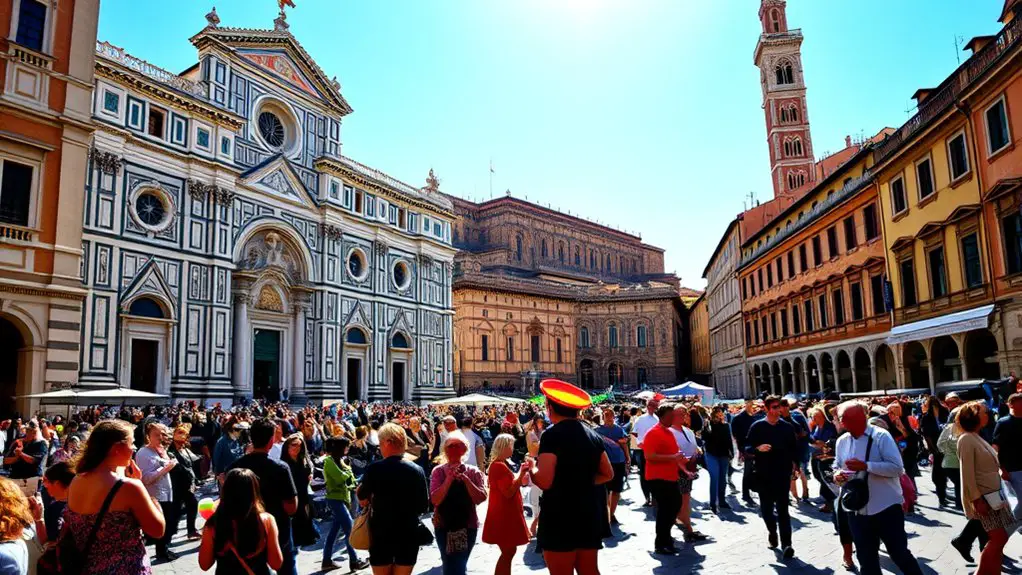
When you wander through central Florence, you can’t miss the Cattedrale di Santa Maria del Fiore, better known as the Duomo.
The current façade is a 19th-century neo-Gothic design associated with architect Emilio De Fabris. Its white, green, and red marble makes the exterior worth studying even before you step inside.
According to the Opera di Santa Maria del Fiore, entry to the main Cathedral is free and does not require a ticket. Visitor access is normally available Monday through Saturday and closes on Sundays and during religious celebrations, although hours can change.
Inside, you can experience the scale of the nave, see major works of Florentine art, and look up toward Brunelleschi’s famous dome without paying for general Cathedral admission.
Note: Free Cathedral entry does not mean the entire Duomo complex is free. The Dome climb, Giotto’s Bell Tower, Baptistery, Opera del Duomo Museum, and Santa Reparata archaeological area are covered by separate ticket or pass options. Appropriate clothing is also required for entry to the Cathedral.
Outside, Piazza del Duomo is completely open to explore. Walk around the Cathedral, Giotto’s Bell Tower, and Baptistery to appreciate how the buildings fit together before continuing into the historic center.
Stroll Through Historic Squares
Florence’s historic squares let you experience much of the city’s architecture and public life without buying a ticket.
Start at Piazza del Duomo, where the Cathedral, Baptistery, and Bell Tower dominate the surrounding streets.
Next, walk to Piazza della Signoria, Florence’s historic civic center. You can see Palazzo Vecchio from outside, the Fountain of Neptune, a copy of Michelangelo’s David, and the sculptures beneath the Loggia dei Lanzi without paying admission.
For a more neighborhood-focused atmosphere, cross the Arno and spend time in Piazza Santo Spirito. The square hosts cafés and recurring markets. Florence’s official tourism calendar distinguishes between an antiques market associated with the second Sunday of the month and the Fierucola rural and artisan market, normally held on the third Sunday except in August.
Piazza Santa Croce is another impressive free public space, with a wide open square facing the marble façade of the Basilica of Santa Croce. The square costs nothing to visit, although ordinary sightseeing admission to the monumental complex itself is normally ticketed.
Finish at Piazzale Michelangelo for a broad view over Florence’s rooftops, the Arno, Palazzo Vecchio, and the Duomo.
Visit Florence’s Outdoor and Food Markets
Florence’s markets are enjoyable even when you do not plan to buy anything. You can browse leather goods, clothing, household items, produce, antiques, and local crafts while getting a feel for everyday commercial life.
It helps to distinguish the city’s outdoor markets from its covered food halls. The official Florence market guide lists both types.
Products Worth Considering

Magnet for refrigerator or locker

Italian Travel Souvenir design.

Local Artisan Goods
The San Lorenzo outdoor market spreads through streets near the Basilica of San Lorenzo and Mercato Centrale. Its stalls mainly sell clothing, accessories, leather goods, and souvenirs.
Mercato Centrale itself is different: it is a historic covered market building. The ground floor focuses on food sellers, while the upper level contains food businesses and restaurants. Walking through the building is free, but anything you eat or buy is, of course, an added cost.
At Sant’Ambrogio Market, the covered market contains food shops while additional stalls outside sell items such as flowers, clothing, and household goods.
The Mercato del Porcellino, also known as the Mercato Nuovo or Straw Market, is a tourist-oriented market beneath a Renaissance loggia. Today its stalls sell mainly leather goods and souvenirs. Beside it stands the famous bronze wild-boar fountain commonly called the Porcellino.
At Piazza Santo Spirito, check the date before planning around a particular market. The second-Sunday market is associated with antiques, while the Fierucola on the third Sunday focuses more on small-scale agriculture and traditional natural handicrafts.
Unique Souvenir Finds
You do not have to shop to enjoy Florence’s markets. Browsing is one of the easiest free ways to compare local styles, watch vendors at work, and see how tourist-oriented markets differ from neighborhood food markets.
San Lorenzo is convenient for leather goods and souvenirs, while Mercato del Porcellino provides a smaller market experience close to Piazza della Signoria.
For food-market atmosphere, explore Mercato Centrale or Sant’Ambrogio. For antiques, collectibles, and more unusual finds, check Florence’s recurring neighborhood markets and the Mercato delle Pulci in Piazza Annigoni.
The Le Cascine market is traditionally held on Tuesday mornings, with long rows of stalls along the Arno selling clothing, produce, household goods, and other everyday items.
Pro Tip: Market schedules can shift around holidays or special events. Check the current Florence tourism calendar before crossing the city for a specific weekly or monthly market.
Enjoy Scenic Views From Piazzale Michelangelo
Piazzale Michelangelo is one of Florence’s best-known free viewpoints. The hilltop square was designed by Giuseppe Poggi during Florence’s 19th-century urban transformation, and work on the square was completed in 1875.
At its center is a monument composed of bronze copies of Michelangelo works, including David and the four allegorical figures from the Medici Chapels.
The real attraction, however, is the view. From the terrace you can pick out the Duomo, Palazzo Vecchio, Santa Croce, Ponte Vecchio, the Arno, and the hills beyond Florence.
You can reach the square on foot from the San Niccolò area using the Poggi ramps and uphill paths. The climb costs nothing and becomes part of the experience.
Sunset is especially popular, but it is also the busiest time.
Pro Tip: Arrive before sunset rather than at sunset if you want time to find a comfortable viewpoint. For a quieter experience, visit earlier in the morning.
Walk Along the Arno River
Walking beside the Arno River gives you a free, flexible way to see Florence away from museum queues.
The river is especially atmospheric around sunrise and evening, when the light reflects from the buildings and bridges.
- Historic Bridges: Walk toward Ponte Vecchio, then continue along the river for different views back toward Florence’s historic center.
- Riverside Streets: Follow the lungarni to watch local traffic, cyclists, rowers, and daily life along the water.
- Photo Stops: Pause on bridges and riverside viewpoints for changing perspectives of Ponte Vecchio, the hills, and the skyline.
You can also use the Arno as a simple navigation line between the historic center, Santo Spirito, San Niccolò, and the climb toward Piazzale Michelangelo.
Discover the Loggia Dei Lanzi
As you enter Piazza della Signoria, stop at the Loggia dei Lanzi, a covered open-air sculpture gallery beside Palazzo Vecchio and the Uffizi.
There is no museum ticket required simply to walk beneath the loggia and view its sculptures from the public square.
Outdoor Sculpture Gallery
The Loggia displays major works including Benvenuto Cellini’s Perseus with the Head of Medusa and Giambologna’s Rape of the Sabine Women.
- Major Renaissance Sculpture: See monumental works in their public setting rather than behind museum doors.
- Easy Access: The Loggia sits directly on Piazza della Signoria, so it fits naturally into a central Florence walking route.
- Architectural Setting: The wide arches frame both the sculptures and views across the civic square.
Historical Significance
The Loggia dei Lanzi was built in the second half of the 14th century and was originally conceived as a covered place for public ceremonies and gatherings.
Its role changed over time. During the Medici period it became associated with the Lanzi soldiers who gave the structure its familiar name, and by the 16th century it had begun its transformation into an open-air sculptural display.
That mix of civic history, architecture, and art makes the Loggia much more than a convenient place to stand in the shade.
Relaxing Atmosphere
The Loggia also provides a useful pause during a long walking day. From beneath its arches you can take in Piazza della Signoria while studying sculptures at your own pace.
Because it sits between Palazzo Vecchio and the Uffizi, it is an easy no-cost cultural stop even when you are not visiting either museum.
Experience the Rose Garden
Below Piazzale Michelangelo sits the Rose Garden (Giardino delle Rose), a public hillside garden overlooking Florence.
The garden contains more than 350 types of roses along with lawns, landscaped paths, sculptures by Belgian artist Jean-Michel Folon, and a small Japanese garden donated by Florence’s sister city of Kyoto.
A free Florence day does not have to feel like a compromise: the Rose Garden combines greenery, public art, and one of the city’s classic skyline views.
From the slopes you can see the historic center, including the Duomo and Palazzo Vecchio. It also provides a pleasant stop on the climb between San Niccolò and Piazzale Michelangelo.
The garden is open throughout the year, but closing times change by season. The official Rose Garden listing publishes the current schedule.
Spring and early summer bring the most obvious rose displays, but the views and Folon sculptures make the garden worthwhile outside peak flowering season as well.
Attend Free Exhibitions and Events
Florence has recurring museum initiatives, civic celebrations, exhibitions, library programs, and neighborhood events that can add free culture to your trip.
The important part is checking the specific event rather than assuming that an entire festival or venue is always free.
Local Art Exhibitions
Small galleries, cultural organizations, libraries, and temporary exhibition spaces regularly publish programs around Florence.
Contemporary spaces such as Street Levels Gallery may have exhibitions that can be visited without a major museum ticket, while the Oblate Library hosts cultural programming and offers an appealing central location near the Duomo. Admission policies depend on the individual event, so check the current listing before visiting.
You can also watch for outdoor installations and temporary displays in public squares, where viewing the work itself may cost nothing.
Cultural Festivals Experience
Florence’s civic calendar includes processions, concerts, neighborhood celebrations, and seasonal events that spill into public streets and squares.
One of the most important is the Feast of San Giovanni on June 24. Public processions and the city’s traditional fireworks can be watched from public areas, although particular reserved events or viewing arrangements may carry a charge.
Other festivals, including food and wine events such as the Florence Wine Event, should not automatically be treated as completely free. Public areas may be open to everyone while tastings, classes, or special activities require payment.
Note: Festival schedules and prices change from year to year. Use the official Florence events calendar to confirm what is free during your actual travel dates.
Museum Free Sundays
On the first Sunday of each month, Italy’s Domenica al Museo initiative provides free admission to participating state museums, monuments, archaeological sites, parks, and monumental gardens.
In Florence, major state institutions such as the Uffizi Galleries participate. The Uffizi’s official guidance includes the Uffizi, Pitti Palace, and Boboli Gardens under the initiative, while the Galleria dell’Accademia has also participated in current 2026 dates.
That can make the first Sunday of the month an excellent opportunity to see collections that normally require a ticket.
However, free days can draw large crowds, and reservation or priority-access rules may differ from ordinary days. Check the Italian Ministry of Culture’s Domenica al Museo page and the individual museum’s website before you go.
Hike to San Miniato Al Monte
Once you reach Piazzale Michelangelo, continue uphill to San Miniato al Monte for another impressive free stop.
The basilica is one of Florence’s best-known examples of Tuscan Romanesque architecture, with a geometric marble façade, mosaics, and a peaceful hilltop setting.
Florence’s official low-cost tourism guidance lists San Miniato al Monte among the city’s free churches. Current visitor hours are published on the official Florence tourism listing for San Miniato al Monte.
Outside, the churchyard gives you another broad view over Florence. Nearby, you can also walk through the Porte Sante cemetery and take in the quieter atmosphere above Piazzale Michelangelo.
Because this is an active religious site, visit respectfully and remember that worship services can affect tourist access.
Relax at Le Cascine Park
For a larger green space away from the historic center, head to Le Cascine Park along the Arno.
The park itself is a good place for walking, jogging, cycling, resting beneath the trees, or having a picnic without paying an entrance fee.
- Tuesday Market: The traditional Mercato delle Cascine is held on Tuesday mornings, with stalls selling clothing, produce, household items, and more.
- Recreation: Long paths and open spaces provide room for an easy walk or a break from crowded central streets.
- Events: The park hosts markets, concerts, fairs, and cultural events during the year. Some are free while others may require tickets, so check the individual event listing.
Le Cascine is particularly useful when you want a less monument-focused day and more space to slow down.
More Free Churches and Gardens to Add
The Duomo and San Miniato al Monte are not Florence’s only no-cost religious stops. The city’s official low-cost guide also identifies churches such as Santo Spirito, Santa Trinita, Santissima Annunziata, Ognissanti, Santa Felicita, and Santi Apostoli as free options.
These churches can provide a quieter look at Florence’s religious architecture and art, but remember that they are active places of worship rather than conventional museums. Opening hours may be limited around services.
Near Piazzale Michelangelo, the Iris Garden is another worthwhile seasonal stop. It normally opens only during the spring flowering period, from late April into May, and admission is free.
Together with the year-round Rose Garden, it gives budget travelers another reason to spend time on the hills south of the Arno.
Build a Free Florence Walking Route
You can connect many of these attractions in a single walk without paying for transportation.
- Begin at Piazza del Duomo: Walk around the Cathedral complex and enter the main Cathedral during free visitor hours.
- Continue to Piazza della Signoria: See Palazzo Vecchio from outside and explore the Loggia dei Lanzi.
- Walk toward the Arno: Follow the river and cross near Ponte Vecchio.
- Explore Santo Spirito: Wander through the Oltrarno streets and check whether a market is taking place.
- Climb through San Niccolò: Head toward the Rose Garden and the Poggi ramps.
- Stop at Piazzale Michelangelo: Take in the skyline before continuing uphill.
- Finish at San Miniato al Monte: Visit the basilica and enjoy one final view over Florence.
This route involves a substantial amount of walking and an uphill climb at the end, but it links architecture, public art, neighborhoods, river views, gardens, and churches with no attraction ticket required for the basic route.
Products Worth Considering


Frequently Asked Questions
Where can you visit in Florence for free?
Good free choices include the main Florence Cathedral, Piazza del Duomo, Piazza della Signoria, the Loggia dei Lanzi, Piazzale Michelangelo, the Rose Garden, San Miniato al Monte, stretches of the Arno riverfront, Le Cascine Park, and several other churches. Public squares are free even when the museums or churches facing them charge admission.
How much should you budget per day in Florence?
There is no single reliable daily figure because accommodation and dining choices vary widely. A €30–€70 daytime budget can be workable for some travelers when lodging is already paid, most sightseeing is free, and meals are kept simple. It should not be treated as an all-in Florence budget once accommodation and paid attractions are included.
Are there free museums in Florence?
Yes, especially through Italy’s Domenica al Museo program on the first Sunday of each month. Participating state sites in Florence include the Uffizi Galleries, and the Galleria dell’Accademia participates on designated free Sundays. Always check the current official list and access rules. Santa Croce is different: ordinary tourist admission to its monumental complex is normally ticketed, although it has its own special free dates and free-admission categories.
Can you go to Piazzale Michelangelo for free?
Yes. Piazzale Michelangelo is a public panoramic square, so you can walk up, enjoy the skyline, see the bronze Michelangelo monument, and stay for sunset without buying an admission ticket.
Is the Duomo in Florence free to enter?
The main Cathedral of Santa Maria del Fiore is free to enter during visitor hours and does not require a Cathedral ticket. Separate attractions in the Duomo complex, including Brunelleschi’s Dome, Giotto’s Bell Tower, the Baptistery, museum, and Santa Reparata area, use paid ticket or pass options.
Are Florence’s markets free to visit?
Yes. You can browse markets such as San Lorenzo, Mercato del Porcellino, Sant’Ambrogio, and the Tuesday Cascine market without an entrance ticket. You only spend money when you choose to buy food, clothing, souvenirs, or other goods.
Sources
- Opera di Santa Maria del Fiore — Plan Your Visit — Cathedral admission, current visitor hours, ticketed monuments, and dress requirements.
- FeelFlorence — The Markets of Florence — San Lorenzo, Sant’Ambrogio, Porcellino, Cascine, and recurring neighborhood markets.
- FeelFlorence — Rose Garden — location, features, seasonal opening hours, and accessibility.
- Italian Ministry of Culture — Domenica al Museo — current first-Sunday free-admission program for state cultural sites.
- Uffizi Galleries — Free Entry Sunday — participation of the Uffizi Galleries and free-day access information.
- Opera di Santa Croce — Organise Your Visit — normal ticket prices, opening hours, and designated free-entry dates.
Conclusion
You do not have to spend heavily to experience Florence. The free Cathedral, historic squares, Loggia dei Lanzi, Arno riverfront, markets, public gardens, Piazzale Michelangelo, and San Miniato al Monte can easily fill a day or more. Plan around current opening hours, know which parts of major complexes require tickets, and Florence becomes remarkably rewarding even on a tight sightseeing budget.
