
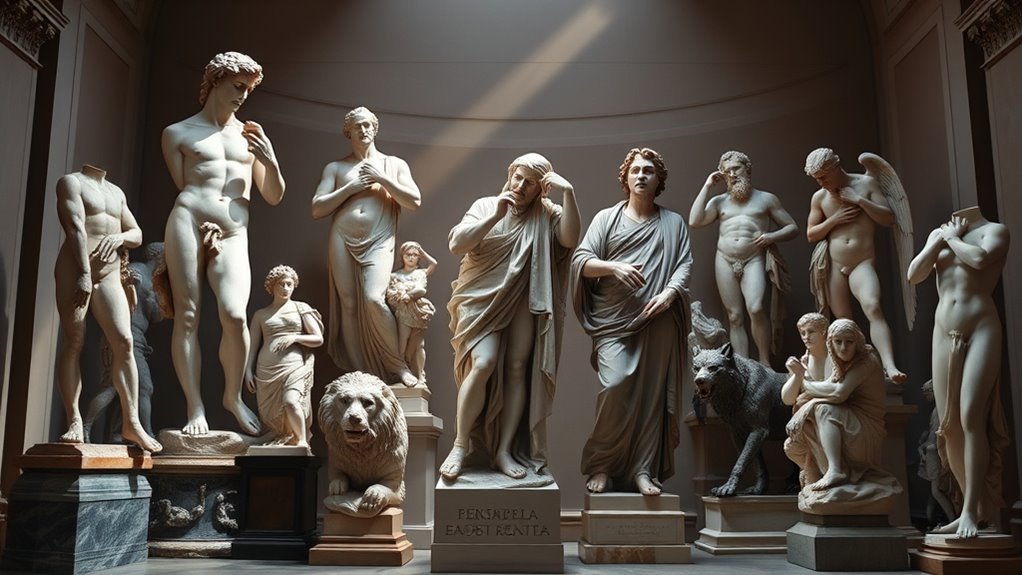
Last Updated on July 24, 2026 by Daniel Globe
Italy’s most famous statues show how artists transformed marble and bronze into convincing bodies, powerful stories, and public symbols. This guide covers works made by Italian sculptors, including examples displayed outside Italy, as well as one French sculpture that clearly reflects the influence of Michelangelo. You will learn what makes each work important and where you can see it today.
Quick Answer
The most famous Italian statues include Michelangelo’s David and Pietà, Bernini’s Apollo and Daphne and Rape of Proserpina, Donatello’s bronze David, Cellini’s Perseus, and Giambologna’s Rape of the Sabine Women. Most are in Florence, Rome, or Vatican City.
Key Takeaways
- Michelangelo’s David and Pietà are defining works of Renaissance sculpture.
- Bernini made marble appear to twist, soften, and move in his major Baroque groups.
- Many Florentine statues carried political messages linked to republican or Medici power.
- Some important Italian sculptures, including Canova’s Psyche Revived by Cupid’s Kiss, are now outside Italy.
- Outdoor works in Florence and Rome are often free to view, while major museums may require timed tickets.
Disclosure: As an Amazon Associate I earn from qualifying purchases. Some links on this page are affiliate links, at no extra cost to you.
Famous Italian Statues at a Glance
| Sculpture | Artist and date | Period | Current location |
|---|---|---|---|
| Pietà | Michelangelo, 1498–1499 | Renaissance | St. Peter’s Basilica, Vatican City |
| David | Michelangelo, 1501–1504 | Renaissance | Galleria dell’Accademia, Florence |
| Rape of Proserpina | Gian Lorenzo Bernini, 1621–1622 | Baroque | Galleria Borghese, Rome |
| Apollo and Daphne | Gian Lorenzo Bernini, 1622–1625 | Baroque | Galleria Borghese, Rome |
| Perseus with the Head of Medusa | Benvenuto Cellini, completed 1554 | Mannerism | Loggia dei Lanzi, Florence |
| Psyche Revived by Cupid’s Kiss | Antonio Canova, 1787–1793 | Neoclassical | Louvre Museum, Paris |
Note: “Italian statue” can mean a sculpture made by an Italian artist or a sculpture displayed in Italy. This guide includes both types and clearly identifies works now located outside Italy.
Why Italian Statues Still Matter
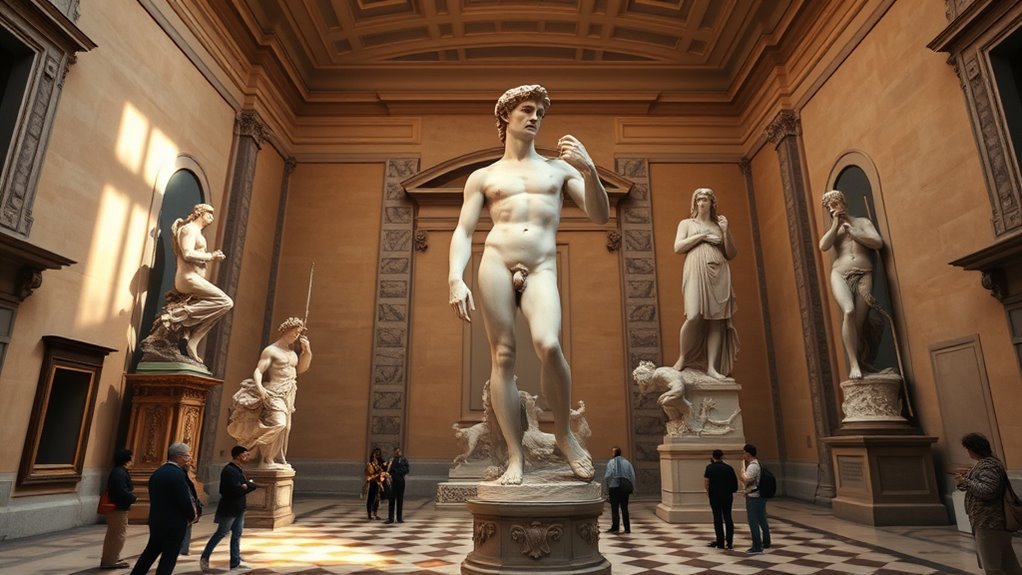
Italian sculpture shaped how later artists represented the human body, emotion, movement, religion, and political authority. Renaissance sculptors studied ancient Greek and Roman art while developing more natural anatomy, balanced poses, and individual expression. Baroque artists then made figures appear to move through the viewer’s space.
These statues were not created only for beauty. Churches used sculpture to support devotion. Governments and ruling families placed statues in public squares to communicate strength, legitimacy, or civic identity. Museums now preserve many of these works, but several still stand in the plazas and churches for which they were made.
Italian sculpture matters because it joins technical skill with public storytelling. Stone and bronze become ways to express grief, courage, faith, fear, ambition, and political power.
Michelangelo’s Pietà in St. Peter’s Basilica
Michelangelo created the Pietà in 1498–1499 for a French cardinal’s funerary monument. It is now displayed in the first chapel on the right inside St. Peter’s Basilica in Vatican City. The composition shows the Virgin Mary holding the body of Jesus after the Crucifixion.
The work combines grief with unusual calm. Mary’s lowered face and broad robes create a stable triangular composition, while Christ’s body rests across her lap. Michelangelo polished the marble so carefully that skin, cloth, and hair appear to have different textures.
The sculpture is also notable because it is the only work Michelangelo signed. His name appears across the sash on Mary’s chest. The Vatican Museums’ study of the Pietà confirms the commission, the Carrara marble, and its unique signature.
The Pietà is protected behind glass. This changes how closely you can study the surface, but the chapel setting still connects the sculpture with its religious purpose.
Bernini’s Rape of Proserpina in Rome
Gian Lorenzo Bernini completed the Rape of Proserpina in 1621–1622. It is displayed in the Galleria Borghese in Rome. The historical English title uses “rape” in the older sense of seizure or abduction, although the sculpture clearly presents an act of violence.
The subject comes from classical mythology. Pluto seizes Proserpina and carries her toward the underworld. Bernini makes the scene feel immediate by arranging the bodies along strong diagonal lines. Proserpina twists away, pushes against Pluto’s face, and cries out as he restrains her.
The most famous detail is Pluto’s hand pressing into Proserpina’s thigh. Bernini carved the marble so that the surface appears to yield under his fingers. This technical effect supports the story rather than serving as a separate display of skill. The viewer sees physical force, resistance, fear, and imbalance in a single moment.
The Galleria Borghese identifies the work as an autograph sculpture completed by Bernini in one year.
Content note: This sculpture depicts abduction and sexual violence from classical mythology. Its beauty and technical skill should not hide the fear and lack of consent shown in the scene.
Michelangelo’s David in Florence
Michelangelo carved David between 1501 and 1504. The original stands in Florence’s Galleria dell’Accademia and measures 517 centimeters high. Unlike many earlier images of David, Michelangelo shows the biblical hero before his fight with Goliath rather than after the victory.
David’s enlarged hands, focused gaze, visible veins, and tense posture suggest that he is preparing to act. His weight rests mainly on one leg in a classical pose called contrapposto, but the figure does not feel relaxed. The turned head and tightened muscles create psychological tension.
David’s Creation
Michelangelo worked from a large marble block that had already been partly shaped and abandoned by earlier sculptors. Turning this difficult material into a complete standing figure strengthened his reputation as one of Florence’s leading artists.
| Feature | Effect |
|---|---|
| Monumental scale | Gives the young hero a commanding public presence |
| Contrapposto pose | Balances stability with the possibility of movement |
| Detailed anatomy | Makes the idealized body appear physically convincing |
| Turned head and focused eyes | Suggest awareness of the approaching danger |
| Sling held quietly at the shoulder | Keeps attention on judgment and preparation instead of action |
Symbol of Florence
The statue was originally planned for Florence Cathedral, but a committee decided to place it outside Palazzo Vecchio. There it became a public symbol of Florentine strength and independence. The original moved to the Galleria dell’Accademia in the 19th century, and a replica now marks its former outdoor position.
The Galleria dell’Accademia’s official record gives the date, dimensions, commission history, and civic meaning of the work.
Bernini’s Apollo and Daphne in the Galleria Borghese
Bernini created Apollo and Daphne between 1622 and 1625. The sculpture captures the climax of a story from Ovid’s Metamorphoses. Apollo reaches Daphne just as she begins to transform into a laurel tree to escape him.
The Moment of Pursuit
The sculpture is designed around movement. Apollo steps forward with one leg raised, while Daphne twists away. Their bodies form open curves that encourage you to move around the sculpture instead of viewing it from only one position.
Daphne’s expression and raised arms show fear and urgency. Apollo appears surprised as the person he has been pursuing becomes physically unreachable. Bernini therefore presents the transformation as an event unfolding in real time.
Daphne’s Transforming Form
Daphne’s transformation begins at the edges of her body. Her toes extend into roots, bark spreads over her legs, her fingers become branches, and leaves grow around her head. The fine carving makes the thin leaves appear fragile even though they are made from marble.
The scene can be read as a story about desire, escape, and bodily autonomy. Daphne avoids capture, but the cost is permanent transformation. This tension prevents the work from being only a graceful display of mythological beauty.
Bernini’s Marble Realism
Bernini changes the finish and thickness of the stone to distinguish skin, hair, bark, cloth, and leaves. The polished bodies seem soft, while the rougher tree surfaces appear dry and fibrous. These contrasts make the transformation easy to follow.
The official Galleria Borghese room guide explains how the sculpture became the central work of the Apollo and Daphne Room.
Canova’s Psyche Revived by Cupid’s Kiss in the Louvre
Antonio Canova’s Psyche Revived by Cupid’s Kiss, often shortened to Cupid and Psyche, was created between 1787 and 1793. It is now displayed in the Louvre Museum in Paris.
The sculpture shows Cupid bending over Psyche as she wakes and reaches toward him. Their arms create a circular frame around their faces, while Cupid’s wings and Psyche’s reclining body spread the composition outward.
Canova’s polished marble, controlled anatomy, and balanced arrangement reflect Neoclassical interest in ancient art. However, the figures do not feel cold or distant. The space between their faces creates anticipation, affection, and tenderness.
The Louvre describes the work as a marble tour de force and displays it in the Michelangelo Gallery.
Hercules and Cacus at Palazzo Vecchio
Baccio Bandinelli’s marble group Hercules and Cacus was installed beside the entrance to Palazzo Vecchio in 1534. Hercules stands over the defeated fire-breathing giant Cacus, presenting physical victory on a monumental scale.
The sculpture’s political history is more complicated than a simple symbol of the Florentine Republic. Plans for a companion to Michelangelo’s David began earlier, but the completed work was commissioned under Medici authority by Pope Clement VII and Alessandro de’ Medici. Its position beside Palazzo Vecchio therefore linked heroic force with the return and consolidation of Medici power.
Bandinelli emphasized large muscles, tightly grouped bodies, and a strong frontal view. The work has long attracted debate, partly because viewers compared it directly with Michelangelo’s celebrated David on the opposite side of the entrance.
Cellini’s Perseus With the Head of Medusa in Florence
Benvenuto Cellini completed the bronze Perseus with the Head of Medusa in 1554. It stands under the Loggia dei Lanzi in Florence’s Piazza della Signoria.
Perseus raises Medusa’s severed head while standing over her body. The polished bronze, controlled pose, elaborate base, and carefully cast details display Cellini’s skill with a difficult material. Unlike a marble statue carved by removing stone, a large bronze required a successful mold and metal pour.
The sculpture was commissioned by Cosimo I de’ Medici and carried a political message. The defeated Medusa could be read as an image of disorder overcome by firm rule. The Uffizi Galleries describe the bronze as both a masterpiece and a political manifesto connected with Medici government.
You can view the statue from the square without buying a museum ticket. Looking from the sides and rear reveals details that are easy to miss from the front.
The Veiled Virgin and Marble Illusion
Giovanni Strazza created The Veiled Virgin in the 19th century, probably around 1850. The Carrara marble bust shows the Virgin Mary with a veil that appears almost transparent over her face, hair, and closed eyes.
The illusion depends on carefully controlled depth. Strazza carved the veil as part of the same block rather than placing a separate layer over the face. Subtle ridges suggest folds, while the visible facial features make the stone seem thin and weightless.
The work is in the Presentation Convent at Cathedral Square in St. John’s, Newfoundland and Labrador. It arrived in Newfoundland in 1856. The location is important because the sculpture is sometimes incorrectly associated with The Rooms museum.
The veil can suggest modesty, mourning, faith, or the boundary between the physical and spiritual worlds. These interpretations are strengthened by Strazza’s decision to make solid marble appear soft and translucent.
Bernini’s Four Rivers Fountain in Piazza Navona
Bernini designed the Fountain of the Four Rivers for Pope Innocent X. It was built between 1648 and 1651 in the center of Piazza Navona. The fountain joins sculpture, architecture, moving water, plants, animals, papal symbols, and an obelisk into one public monument.
The four river figures represent the continents known to 17th-century Europeans:
- The Danube represents Europe.
- The Ganges represents Asia and holds a long oar.
- The Nile represents Africa and has a covered head because the river’s source was then unknown to Europeans.
- The Río de la Plata represents the Americas and raises one arm beside an armadillo.
Bernini directed the project, but specialist sculptors executed the individual river gods. The figures sit on a dramatic travertine formation that appears to support the granite obelisk above them.
The obelisk was not taken from Heliopolis. Rome’s heritage authority identifies it as a Roman copy from the period of Emperor Domitian. It was recovered in pieces from the Circus of Maxentius on the ancient Appian Way before being raised over the fountain.
The Sovrintendenza Capitolina documents the fountain’s history, materials, artists, restoration work, and construction dates.
Bernini’s Ecstasy of Saint Teresa
Bernini’s Ecstasy of Saint Teresa stands in the Cornaro Chapel of Santa Maria della Vittoria in Rome. Created in the mid-17th century, the group represents a mystical experience described by Teresa of Ávila, in which an angel pierces her heart with a golden spear and fills her with divine love.
Bernini did not treat the central sculpture as an isolated object. He designed the chapel as a complete theatrical setting. Hidden light enters from above, gilded rays descend behind the figures, and carved members of the Cornaro family watch from architectural boxes on the side walls.
| Feature | Effect |
|---|---|
| Deep marble folds | Make Teresa’s robe appear restless and weightless |
| Facial expression | Combines physical weakness with spiritual intensity |
| Hidden natural light | Illuminates the figures from above |
| Cornaro family spectators | Turns the chapel into a staged event with multiple viewers |
The church setting remains essential to the work. Architecture, sculpture, colored marble, gilding, and light combine to guide the viewer’s emotional response.
How Rodin’s Thinker Reflects Italian Sculpture
Auguste Rodin was French, so The Thinker is not an Italian statue. It belongs in this discussion because its powerful body and compressed pose reflect Rodin’s close study of Michelangelo and the Italian Renaissance.
Rodin first conceived the figure around 1880 as part of The Gates of Hell. It was originally associated with Dante, the Italian author of the Divine Comedy. The figure later became an independent sculpture and a broad symbol of thought, creativity, and inner struggle.
- The bent body makes thought appear physically demanding.
- The strong muscles combine potential action with stillness.
- The downward gaze and closed pose create concentration.
- Multiple authorized casts mean there is no single object known as the only original Thinker.
The Musée Rodin explains the sculpture’s connection with Dante, Michelangelo, The Gates of Hell, and its later enlargement.
Italian Renaissance Sculpture in Context
Italian Renaissance sculpture developed mainly during the 15th and 16th centuries. Artists studied surviving ancient sculpture, experimented with perspective and anatomy, and gave religious or mythological figures a stronger sense of physical presence.
Materials shaped what artists could achieve. Marble allowed smooth skin, sharp edges, and controlled changes in texture. Bronze supported open poses, narrow limbs, and forms that would be difficult to carve safely from stone.
Patronage also mattered. Churches commissioned devotional works, merchant guilds paid for public saints, republican governments used civic symbols, and powerful families such as the Medici placed art in public spaces to support their authority.
More Famous Italian Statues to Know
Donatello’s Bronze David
Donatello’s bronze David, made in the mid-15th century, is one of the key sculptures of the early Renaissance. The youthful hero stands over Goliath’s severed head in a relaxed contrapposto pose. Its nudity, freestanding design, and life-sized bronze form marked a major revival of classical sculptural traditions.
The work is displayed in the Donatello Hall of Florence’s Museo Nazionale del Bargello. The Musei del Bargello identify it as an icon of the museum and one of the great masterpieces of Renaissance bronze.
Michelangelo’s Moses
Michelangelo carved Moses for the tomb of Pope Julius II. The monumental seated figure holds the Tablets of the Law and appears to turn in anger after seeing the Israelites worship the golden calf.
The sculpture was carved in the early 16th century and has been displayed in the Basilica of San Pietro in Vincoli in Rome since the completed tomb was installed in 1545. Tense muscles, prominent veins, a flowing beard, and the twisting torso make the seated figure appear ready to rise.
Bernini’s David
Bernini’s David, created in 1623–1624, shows the hero in the middle of action. Unlike Michelangelo’s still and watchful figure, Bernini’s David twists his body while preparing to release the sling.
The work is in the Galleria Borghese. Its open pose extends into the viewer’s space and demonstrates the Baroque preference for action, changing viewpoints, and dramatic timing.
Giambologna’s Rape of the Sabine Women
Giambologna’s marble group, unveiled in 1583, stands in the Loggia dei Lanzi in Florence. Three figures rise in a twisting spiral: a young man lifts a woman while an older man crouches below them.
The sculpture was designed to be viewed from several sides. Its upward movement and complex arrangement helped connect late Renaissance Mannerism with the more active compositions of Baroque sculpture.
How Baroque Sculpture Changed Italian Art
Baroque sculpture moved away from the calm balance associated with much Renaissance art. Artists favored action, diagonals, emotional expression, dramatic lighting, and compositions that reached into the viewer’s space.
- Movement became central. Figures twist, run, struggle, or transform.
- Light became part of the design. Deep folds and undercut surfaces create changing shadows.
- The viewer became a participant. Many works require movement around them or place the viewer inside a staged setting.
- Architecture and sculpture merged. Chapels and fountains became complete environments rather than simple supports for statues.
Bernini’s Apollo and Daphne, Rape of Proserpina, David, and Ecstasy of Saint Teresa show these changes especially clearly.
Where to See Famous Italian Statues
Florence, Rome, and Vatican City contain the largest concentration of works discussed in this guide.
- Galleria dell’Accademia, Florence: Michelangelo’s original David.
- Piazza della Signoria, Florence: Bandinelli’s Hercules and Cacus, a replica of Michelangelo’s David, and nearby outdoor sculpture.
- Loggia dei Lanzi, Florence: Cellini’s Perseus and Giambologna’s Rape of the Sabine Women.
- Museo Nazionale del Bargello, Florence: Donatello’s bronze David and other Renaissance sculpture.
- St. Peter’s Basilica, Vatican City: Michelangelo’s Pietà.
- Galleria Borghese, Rome: Bernini’s David, Rape of Proserpina, and Apollo and Daphne.
- Santa Maria della Vittoria, Rome: Bernini’s Ecstasy of Saint Teresa.
- San Pietro in Vincoli, Rome: Michelangelo’s Moses.
- Piazza Navona, Rome: Bernini’s Fountain of the Four Rivers.
- Louvre Museum, Paris: Canova’s Psyche Revived by Cupid’s Kiss.
- Presentation Convent, St. John’s: Strazza’s Veiled Virgin.
- Musée Rodin, Paris: a monumental cast of Rodin’s Thinker.
Pro Tip: Reserve timed museum tickets before visiting Florence or Rome during busy travel periods. Churches may change access during services, and individual sculptures can temporarily move for conservation or exhibitions. Check the official institution’s website before your visit.
Frequently Asked Questions
What is the most famous statue in Italy?
Michelangelo’s David is usually considered the most famous statue in Italy. Its monumental scale, detailed anatomy, civic history, and worldwide reproduction have made it an international symbol of Renaissance art and Florence.
Where is the original Michelangelo David?
The original David is inside the Galleria dell’Accademia in Florence. The figure outside Palazzo Vecchio is a replica marking the original public location.
What are the top 10 biggest statues?
Rankings depend on whether they measure only the figure or include the pedestal and building. By figure height, commonly listed leaders include the Statue of Unity, Spring Temple Buddha, Laykyun Sekkya, Vishwas Swaroopam, Ushiku Daibutsu, Guishan Guanyin, Mother of All Asia, Great Buddha of Thailand, Sendai Daikannon, and Dai Kannon of Kita no Miyako Park. Guinness recognizes the 182-meter Statue of Unity as the world’s tallest statue.
What is the prettiest town in Italy?
There is no objective winner. Manarola is a popular choice because of its colorful buildings and coastal setting. Positano, Ravello, Orvieto, Bellagio, and San Gimignano are also frequently praised. This question is based on personal taste rather than sculpture history.
What are the top 10 statues in art history?
No official top-ten list exists. Frequently discussed works include Michelangelo’s David and Pietà, the Venus de Milo, the Winged Victory of Samothrace, the Laocoön Group, Rodin’s Thinker, Donatello’s bronze David, Bernini’s Apollo and Daphne, the Terracotta Army, and the Statue of Liberty.
What is the difference between Renaissance and Baroque sculpture?
Renaissance sculpture often emphasizes balanced poses, clear anatomy, stable composition, and classical ideals. Baroque sculpture usually emphasizes movement, emotional intensity, dramatic light, changing viewpoints, and figures that appear to enter the viewer’s space.
Which famous Italian statues can you see for free?
You can normally view Cellini’s Perseus, Giambologna’s Rape of the Sabine Women, Bandinelli’s Hercules and Cacus, and Bernini’s Fountain of the Four Rivers in public spaces without a museum ticket. Church entry and access conditions can change.
Conclusion
Italian statues remain important because they combine technical mastery with stories about faith, courage, desire, grief, violence, and public power. Michelangelo gave marble calm strength in the Pietà and controlled tension in David. Bernini made stone appear to run, twist, resist, and transform. Donatello, Cellini, Bandinelli, Giambologna, Canova, and Strazza each expanded what sculpture could communicate.
Seeing these works in person also reveals something photographs often miss: their true scale, changing surfaces, relationship with architecture, and dependence on the viewer’s position. Whether you encounter them in a church, museum, or public square, they show why Italian sculpture has remained central to art history for centuries.
Sources
- Vatican Museums: The Casts of the Three Pietàs — Pietà commission, material, location, and signature.
- Galleria dell’Accademia: Michelangelo’s David — date, dimensions, commission, and civic history.
- Galleria Borghese — official context for Bernini’s major Borghese sculptures.
- Uffizi Galleries: The Loggia dei Lanzi — Cellini’s Perseus, its location, and political meaning.
- Musei del Bargello — Donatello’s bronze David and the Bargello sculpture collection.
- Sovrintendenza Capitolina: Fountain of the Four Rivers — construction, artists, river figures, obelisk origin, and restoration history.
