
Last Updated on September 11, 2026 by Daniel Globe
Three point two ounces of slime is a small amount, but the measurement can mean two different things. A package marked 3.2 oz usually gives the slime’s weight, while 3.2 fl oz describes its volume. The term “slime” can also refer to either a children’s craft material or Slime-brand tire sealant, so you should identify the product before measuring, mixing, or using it.
Quick Answer
Three point two ounces by weight equals about 90.7 grams. Three point two U.S. fluid ounces equals about 94.6 milliliters, 0.4 cup, or 6.4 tablespoons. It is not 1/2 cup, which equals 4 fluid ounces. Use a scale for an exact craft-slime portion and the manufacturer’s calculator for tire sealant.
Key Takeaways
- Three point two ounces by weight is about 90.7 grams, while 3.2 fluid ounces is about 94.6 milliliters.
- Three point two fluid ounces equals 0.4 cup, not 1/2 cup.
- For an exact 3.2-ounce craft-slime portion, make a small batch and weigh out 90.7 grams.
- Craft slime must never be placed in a tire, and tire sealant must never be used as a toy.
- The correct amount of Slime tire sealant depends on tire dimensions, tube type, product formula, and operating speed.
Disclosure: As an Amazon Associate I earn from qualifying purchases. Some links on this page are affiliate links, at no extra cost to you.
What Is 3.2 Ounces of Slime?
The answer depends on whether “oz” refers to weight or volume. These measurements are related, but they are not interchangeable.
| Measurement | Equivalent |
| 3.2 ounces by weight | About 90.7 grams |
| 3.2 U.S. fluid ounces | About 94.6 milliliters |
| 3.2 U.S. fluid ounces in cups | 0.4 cup, slightly less than 1/2 cup |
| 3.2 U.S. fluid ounces in spoons | 6.4 tablespoons or about 19.2 teaspoons |
The National Institute of Standards and Technology lists one U.S. fluid ounce as approximately 29.57 milliliters and one regular ounce as approximately 28.35 grams. Because slime’s density and air content can vary, you cannot reliably convert a finished slime’s weight into cups without measuring it.
For an exact 3.2-ounce portion, measure 90.7 grams of finished slime on a digital kitchen scale.
Why 3.2 Ounces Is a Good Size
A 3.2-ounce portion is easy to hold, store, color, and customize. It is large enough for stretching and sensory play but small enough to limit waste if you are testing a new recipe or add-in.
A Manageable Craft-Slime Portion
For craft projects, 3.2 ounces gives you enough slime to knead with both hands without filling a large container. You can divide it into two or three smaller pieces to compare colors, glitter, foam beads, or textures. A small portion is also easier to supervise and clean up than a full-size batch.
A Possible Tire-Sealant Quantity
Three point two fluid ounces may fall within the recommended range for some small tires, but it is not a universal dose. The correct amount depends on the tire’s width and height, whether it has an inner tube, the sealant formula, and whether the vehicle travels at highway speeds.
Slime Products directs users to its official Slime Calculator or the chart on the product label. The calculator includes general ranges for common applications and accepts custom tire dimensions.
Check the Tire Type and Speed
Before adding tire sealant, confirm whether the tire is tubed or tubeless. Use a tube-specific formula for an inner tube and a compatible tubeless formula for a tubeless tire. Do not assume that one Slime product works in every setup.
Warning: Craft slime and tire sealant are completely different products. Never put homemade craft slime in a tire. Slime’s preventive tire and tube formulas may also be restricted from use above 45 mph. Follow the exact product label, and do not use sealant as a permanent repair for sidewall cuts, large gashes, damaged rims, or other structural tire damage.
How to Make About 3.2 Ounces of Craft Slime
Recipe yield varies because glue, activator, add-ins, kneading, and retained water change the final weight. The most reliable method is to make a slightly larger small batch and weigh out exactly 90.7 grams of finished slime.
At a Glance
| Time Required | 10 to 15 minutes |
| Difficulty | Easy with adult supervision |
| Tools Needed | Bowl, spoon, measuring spoons, digital kitchen scale, and airtight container |
| Cost | Varies; the recipe uses part of a glue bottle and small amounts of household supplies |
Ingredients
- 3 fluid ounces of washable school glue
- 1 level teaspoon of baking soda
- About 2 teaspoons of contact-lens solution suitable for the glue maker’s slime recipe
- 1 or 2 drops of food coloring, optional
- A small pinch of craft glitter, optional
This is a reduced version of the proportions used in Elmer’s current color-slime recipe. Contact-lens formulas differ, so use the brand and amount recommended by the glue manufacturer whenever possible.
Warning: An adult should supervise mixing and play. This activity is not suitable for children younger than 3. Do not eat slime or place it near the mouth, eyes, pets, food, or food-preparation surfaces. Wash hands before and after use, and stop playing if skin irritation develops.
Instructions
- Place the bowl on a stable, washable surface.
- Pour 3 fluid ounces of school glue into the bowl.
- Add the baking soda and mix until no dry clumps remain.
- Add food coloring or a small pinch of glitter, if desired.
- Add about 1 1/2 teaspoons of contact-lens solution and stir thoroughly.
- When the mixture begins pulling away from the bowl, knead it for 2 to 3 minutes.
- If it remains sticky after kneading, add the remaining contact-lens solution a few drops at a time. Knead after every addition.
- Place a clean container on a digital scale and press the tare button.
- Add finished slime until the scale reads 3.2 ounces or approximately 90.7 grams.
- Store the measured portion in an airtight container. Keep any extra slime in a separate sealed container.
Pro Tip: Slime often feels sticky immediately after mixing. Knead it thoroughly before adding more activator. Too much activator can make the batch stiff, rubbery, and easy to tear.
How Glue and Borate Activators Create Slime
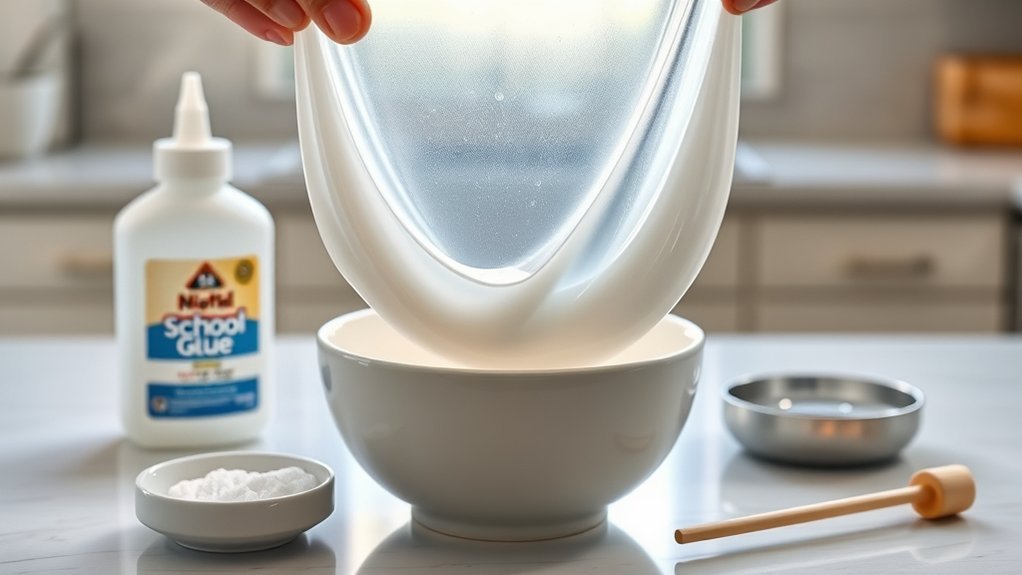
Washable glue contains long polymer chains suspended in water. A compatible activator supplies borate compounds that form weak links between those chains. The linked network moves more slowly than plain glue, creating a stretchy, gel-like material.
Educational chemistry resources from Carnegie Mellon University explain that these weak cross-links can break and reform as the material moves. That is why slime can stretch when pulled slowly but may snap when pulled quickly.
Activator strength matters. Too little cross-linking leaves the mixture wet and sticky. Too much makes it firm, brittle, or rubbery. There is no universal one-to-one ratio because glue and activator formulas differ.
Note: Contact-lens solution is not automatically suitable for slime. Follow a tested recipe from the glue or activator manufacturer rather than assuming every lens solution has the same ingredients or strength.
Best Add-Ins for Small Slime Batches
Small batches can change quickly when you add glitter, color, beads, clay, or other materials. Begin with less than you think you need. You can always add more, but removing an add-in is difficult.
Glitter Boosters
For a 3.2-ounce portion, start with a small pinch or about 1/4 teaspoon of fine craft glitter. Fold it into finished slime during the final kneading stage. Fine glitter usually spreads more evenly, while large glitter pieces or confetti create a chunkier feel.
- Add a small pinch first.
- Knead until the glitter is evenly distributed.
- Add another pinch only if the effect is too subtle.
Avoid sharp, metallic, glass, or unidentified decorative particles. Large amounts of glitter can reduce stretch and make the slime messy.
Scent and Color Mix-Ins
One or two drops of food coloring is normally enough for a small batch. Add the color to the glue before activation so it spreads evenly. Gel coloring is concentrated, so touch a toothpick to the gel and transfer only a tiny amount.
Do not make medical or calming claims about scented slime. Essential oils and concentrated fragrances may irritate sensitive skin, especially in children. A fragrance-free batch is the safer default. If you use a scent product, choose one specifically labeled for the intended craft and follow its directions.
How to Fix Sticky Slime Fast
Sticky slime usually needs more kneading or a very small amount of the same activator used in the recipe. Making several large adjustments at once can overactivate the batch.
- Knead first: Work the slime for 2 to 3 minutes with clean, dry hands.
- Add activator gradually: Add only a few drops, then knead again.
- Repeat carefully: Stop as soon as the slime releases from your fingers.
- Check your hands and surface: Water, lotion, food residue, and oils can make slime feel stickier.
If the slime is watery because the recipe contains too much added water, adding more glue and then carefully rebalancing the activator may help. Baking soda alone is not a dependable fix for every recipe.
If the slime becomes too firm, knead it for several minutes before changing it. A few drops of warm water or a tiny amount of matching glue may soften some batches, but recovery is not guaranteed. A drop of plain, unscented lotion can make certain slime recipes softer, although it also changes the formula and should not be used when skin sensitivity is a concern.
Clear, Glitter, and Glow Slime Ideas
You can adapt the same small-batch method by changing the glue or adding a carefully measured mix-in.
- Clear slime: Use clear washable school glue. Air bubbles may make the fresh slime look cloudy, but many bubbles rise out after the slime rests in a sealed container.
- Glitter slime: Use clear or colored glue and knead in a small amount of craft glitter, or follow the proportions provided for a glitter-glue recipe.
- Glow slime: Use glue manufactured for glow-in-the-dark slime. Elmer’s publishes a tested glow-slime recipe using glow glue, baking soda, and contact-lens solution.
Avoid adding unidentified glow powders, paints, pigments, or chemicals. A product that glows is not automatically suitable for prolonged skin contact or children’s crafts.
Safe Slime Tips for Kids
Keep slime-making safe by preparing the materials before children begin and supervising the full activity. Use washable, non-toxic craft supplies from labeled containers, but remember that “non-toxic” does not mean edible or irritation-free.
Supervise every step, prevent ingestion, wash hands after play, and store slime where children and pets cannot reach it without permission.
- Do not allow children younger than 3 to make or play with homemade slime.
- Keep slime away from the mouth, eyes, broken skin, food, and pets.
- Wash hands before and after mixing or playing.
- Stop immediately if redness, burning, itching, coughing, or eye irritation develops.
- Store activators, borax products, glue, and finished slime out of reach.
- Discard slime that develops mold, an unusual odor, heavy contamination, or a major texture change.
Poison Control advises following product directions carefully and seeking medical guidance after borate ingestion. In the United States, you can contact Poison Control at 1-800-222-1222 or use its online help service.
Cleaning Slime From Fabric and Surfaces
Lift away as much slime as possible without rubbing it deeper into the material. Rinse washable fabric with cool or lukewarm water, then follow the fabric’s care instructions. White vinegar may help loosen some glue-based residue, but test it first on an inconspicuous area. Do not apply vinegar to electronics, natural stone, delicate finishes, or materials that the manufacturer says should not contact acids.
How Slime Became a Trend
Toy slime has existed for decades, but online videos gave homemade slime a new audience during the 2010s. Short demonstrations made it easy to share recipes, colors, stretching techniques, bubble sounds, and unusual textures.
For many children and hobbyists, mixing and customizing the slime is as important as playing with the finished material. The activity combines simple chemistry, color design, tactile play, and experimentation. Online interest also helped creators build businesses around premade slime, kits, add-ins, demonstrations, and sponsored content.
Frequently Asked Questions
Is 3.2 ounces of slime 1/2 cup?
No. Three point two U.S. fluid ounces equals 0.4 cup, which is slightly less than 1/2 cup. One-half cup equals 4 fluid ounces. If the label says 3.2 oz by weight, you cannot accurately convert it to cups without knowing the slime’s density.
How much slime activator should I use for 3 ounces of glue?
For the scaled recipe in this article, begin with about 1 1/2 teaspoons of compatible contact-lens solution after mixing in 1 teaspoon of baking soda. Knead thoroughly, then add the remaining activator a few drops at a time. Follow the glue manufacturer’s recipe because activator formulas vary.
What is the safest slime for kids?
Premade slime or a tested manufacturer recipe made with labeled, washable supplies is easier to control than an improvised formula. Adult supervision, handwashing, age limits, safe storage, and preventing ingestion remain necessary even when the ingredients are labeled non-toxic.
How do you make slime with three ingredients?
A common three-ingredient method uses washable glue, baking soda, and a compatible contact-lens solution. Mix the glue and baking soda first, add the contact solution gradually, and knead until the slime releases from the bowl and hands.
How much Slime tire sealant goes in a tire?
The amount varies by tire size, tire construction, application, product formula, and speed. Some small applications use approximately 3 to 4 fluid ounces, while others require more. Check the product label or enter the tire dimensions in the official Slime Calculator.
Can homemade craft slime seal a tire?
No. Homemade craft slime is not a tire-repair product and may damage the valve, tube, tire, or wheel. Use only a sealant specifically approved for the tire type and application.
Conclusion
Three point two ounces of slime is a convenient small portion, but you must identify the measurement and product first. By weight, it equals about 90.7 grams. By U.S. fluid volume, it equals about 94.6 milliliters or 0.4 cup.
For craft slime, make a tested small batch and weigh out the finished 3.2-ounce portion. Add activator and mix-ins gradually, supervise children, and discard contaminated slime. For Slime-brand tire sealant, use the correct tube or tubeless formula, follow the product label, and calculate the amount from the tire’s actual dimensions and operating conditions.
Sources
- National Institute of Standards and Technology: U.S. customary-to-metric conversions — supports the ounce, fluid-ounce, gram, and milliliter conversions.
- Elmer’s Color Slime Recipe — supports the glue, baking-soda, contact-solution, kneading, and supervision guidance.
- Elmer’s Glow in the Dark Slime Recipe — supports the glow-slime method and safety guidance.
- Carnegie Mellon University: Polyvinyl Alcohol Slime — explains polymer cross-linking and texture changes.
- Poison Control: Borates, Borax, and Boric Acid — supports the ingestion, irritation, handling, and storage warnings.
- Slime Products Calculator — supports tire-sealant quantity selection based on tire dimensions and application.
