
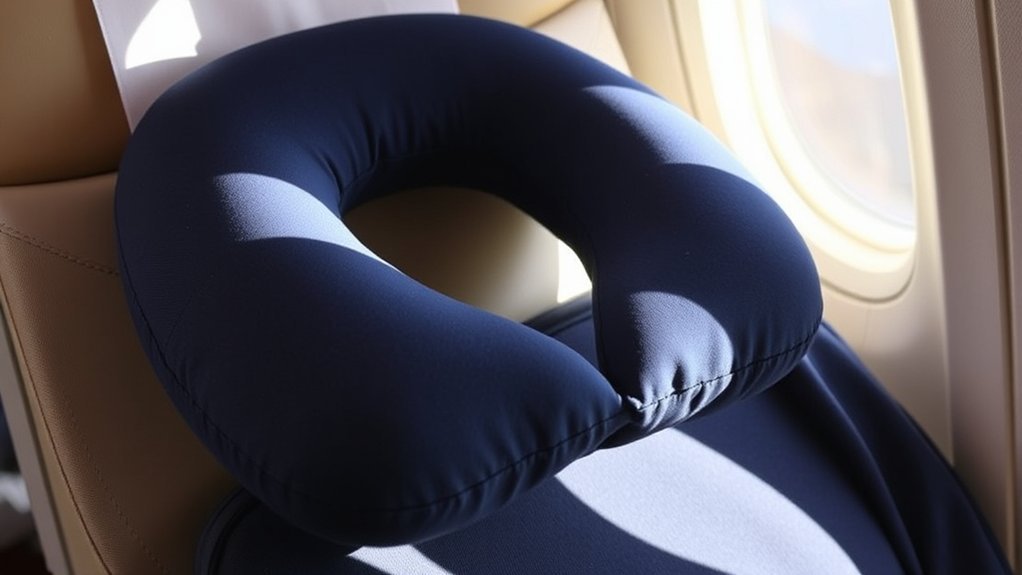
Last Updated on July 27, 2026 by Caleb Warren
A travel pillow with chin support is built to solve one specific problem: your head dropping forward once you fall asleep sitting up. Instead of letting your chin sink toward your chest, a raised, wrapped, or adjustable front section helps support your jaw and head. The right design depends on how you sleep, your neck length, the seat, and how much space you have to pack it.
Quick Answer
A travel pillow with chin support helps limit forward head-drop while you nap sitting upright. Look for enough front height to meet your chin or jaw without forcing your head backward, plus an adjustable closure. Foam models hold a fixed cushioned shape, while inflatable models usually pack smaller and let you change firmness.
Key Takeaways
- Chin support is most useful if your head tends to fall forward when you sleep upright; side leaners may prefer stronger lateral support or a 360-degree design.
- Fit matters more than fill alone. The front should reach your chin or jaw without making breathing, swallowing, or normal head position uncomfortable.
- Memory foam provides a fixed, cushioned structure; inflatable pillows trade some bulk for adjustable firmness and a much smaller packed size.
- Check rear thickness, closure adjustment, fabric temperature, wash instructions, and whether any headrest attachment works with the seat you will use.
- Test the pillow at home before a long trip so you can find the best position without learning by trial and error at 35,000 feet.
Disclosure: As an Amazon Associate I earn from qualifying purchases. Some links on this page are affiliate links, at no extra cost to you.
What Is a Travel Pillow With Chin Support?
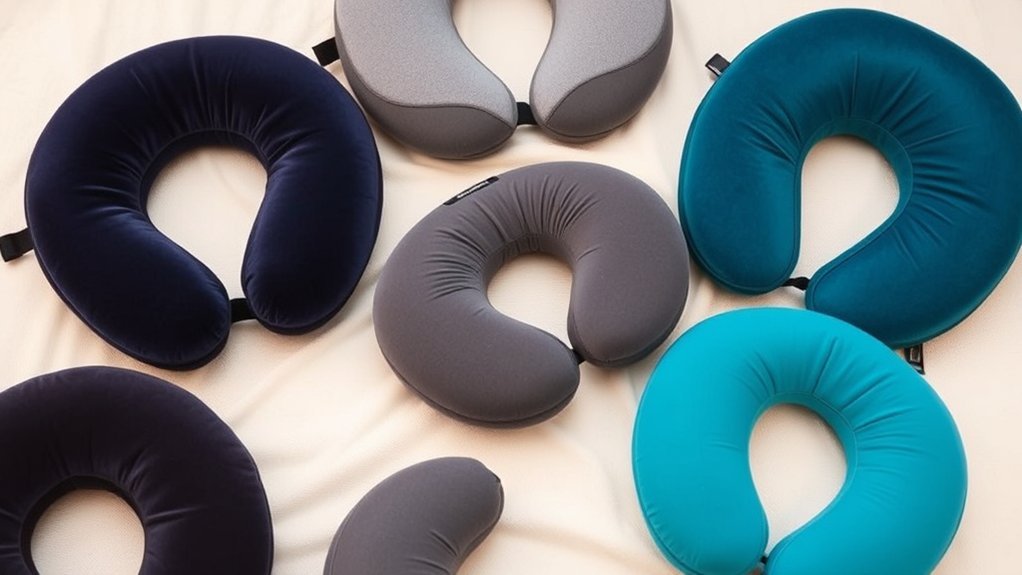
A travel pillow with chin support is built for comfort during long journeys, especially when you need to nap while sitting upright. Its front section supports part of the chin or jaw so your head is less likely to tip forward once your neck muscles relax.
The goal is mechanical support rather than medical treatment. Keeping the head closer to a comfortable, centered position can reduce the amount of unsupported forward flexion you experience while resting. Research on forward-head posture shows that changing head position also changes the mechanics of the cervical spine and surrounding muscles, although posture alone does not determine whether someone will develop neck pain. Biomechanical research indexed by PubMed documents these changes, while newer longitudinal research shows that neck pain is influenced by more than flexion angle alone.
These pillows come in several forms. Some use memory foam or other compressible fill, some inflate with air, and others use an internal support wrapped in fabric. Current products may also use overlapping ends, front clasps, chin straps, or attachments that connect to a seat or headrest.
Benefits of Using a Travel Pillow With Chin Support
The clearest benefit is simple: the pillow gives your head somewhere to rest when you begin to nod forward. That can make an upright nap feel more stable and may reduce the uncomfortable muscle effort that comes from repeatedly catching your head as it drops.
Mayo Clinic notes that poor posture and holding the head in one position for a long time can strain neck tissues. A travel pillow cannot guarantee that you will avoid neck pain, but a properly fitted model can help you maintain a more comfortable resting position.
| Benefit | What It Does | Best Match |
|---|---|---|
| Head Stabilization | Gives the chin or jaw support before the head drops far forward | Travelers who nod forward while napping |
| More Comfortable Positioning | Helps limit prolonged unsupported forward flexion | Long flights, trains, buses, and passenger road trips |
| Adjustable Fit | Straps, clasps, wraps, or inflation can change support position and firmness | Travelers who struggle with fixed U-shaped pillows |
| Portability | Compressible or inflatable designs reduce packed bulk | Carry-on and personal-item travelers |
| Fewer Head-Bob Interruptions | May make it easier to stay settled instead of repeatedly catching a falling head | Travelers who frequently wake when their head moves |
Note: A travel pillow is a comfort accessory, not a treatment for a neck condition. If neck pain is severe, keeps returning, persists for several days, or comes with weakness, numbness or tingling, seek medical advice instead of relying on a different pillow.
Chin Support vs. Side Support: What’s the Difference?
These two styles often get lumped together, but they solve different positioning problems. Chin-support designs use a raised front, overlapping ends, a clasp, a strap, or another support surface to limit forward head-drop. Side-support designs focus more on keeping your head from leaning toward one shoulder.
If you tend to wake up with your chin near your chest, prioritize front support. If you usually wake leaning toward the window or your seatmate, stronger side support may matter more. Many modern pillows combine both functions, so a 360-degree or adjustable design can be useful if your head moves in several directions.
Neither label guarantees a good fit. A high side wall may still be too short for a long neck, while a large front section can be uncomfortable if it presses too high on your jaw. Your own sleeping pattern is a better guide than the shape alone.
Types of Travel Pillows With Chin Support
U-Shaped Pillows With a Front Closure
These look similar to traditional neck pillows but add an adjustable clasp, overlapping front, raised chin area, or front strap. The closure helps keep the two sides from spreading apart as your head relaxes. Some current memory-foam designs, including models documented by Cabeau, pair side support with an adjustable front closure.
Wraparound and Overlapping Designs
Wraparound pillows continue around the front of the neck instead of leaving a wide gap. Some let you overlap the ends to vary the amount of chin support. For example, BCOZZY describes a double-support design intended to support the head, neck, and chin in several positions.
Scarf-Style or Internal-Support Pillows
These use a firmer internal support wrapped in fabric rather than a thick doughnut of fill. The support can often be placed at the side, nearer the front, or under part of the jaw. Trtl’s current fitting instructions, for example, tell users they can experiment with positioning the support farther toward the chin to keep the head more upright.
Headrest-Attached Designs
Some pillows use straps that connect to the seat or headrest. That extra anchor can reduce sliding and forward movement, but compatibility depends on the seat. Check the manufacturer’s instructions before assuming the attachment will work on every aircraft, train, bus, or car seat.
Inflatable Chin-Support Pillows
Inflatable models are useful when packed size matters most. You can usually change firmness by adding or releasing air. Their comfort depends heavily on shape and inflation level, so do not assume maximum inflation equals maximum support. An overinflated pillow can push the head into an awkward position.
All of these styles can work well for long-haul flights, overnight trains, buses, and other situations where you need to remain upright while resting.
Warning: A closure should feel secure, not constricting. Do not cinch a pillow so tightly that it interferes with normal breathing or swallowing or causes numbness, dizziness, pain, or significant pressure around the front of your neck. Loosen or remove it if it feels wrong.
Choosing the Right Travel Pillow With Chin Support
Start With Your Neck and Jaw Fit
The front support needs to be high enough to meet your chin or jaw before your head drops far forward. If it sits several inches below your chin, it may do little once you fall asleep. If it is too tall, it can push your jaw upward or make the pillow feel crowded.
Neck length matters too. Taller travelers and people with longer necks may need greater side height or a height-adjustable support, while petite travelers may find tall, rigid designs uncomfortable.
Check the Back of the Pillow
A thick pad behind your neck can push your whole head forward when it is trapped between you and an upright airline seat. Look at the rear profile as carefully as the chin section. Some pillows use a thin or flat rear panel specifically to reduce this problem.
Compare Adjustment, Not Just Shape
An adjustable clasp, wrap, drawstring, support angle, or inflation level lets you fine-tune the pillow after you sit down. That is often more useful than simply choosing a pillow because it is labeled U-shaped or 360-degree.
Choose the Fill for Your Packing Style
Memory foam keeps a consistent molded shape and provides a cushioned feel, but even compressible foam takes up some luggage space. Inflatable pillows usually pack much smaller and let you vary firmness. Other designs use polyester fill, microbeads, or an internal structural support.
Support quality depends on the whole design, so there is no universal rule that one fill type supports every traveler better than another.
Check Fabric and Cleaning Instructions
Warm, thick fabric can become uncomfortable during a long flight, especially if the pillow wraps closely around your neck. Breathable fabric is worth prioritizing if you sleep hot.
Cleaning systems also vary. Many foam pillows use a removable machine-washable cover while the foam itself must be spot-cleaned. Other models are designed so most or all of the textile pillow can be washed after an insert is removed, and some filled pillows are advertised as fully machine washable. Always follow the care label for the specific model.
Consider Price Last
Price varies widely and does not guarantee a good fit. Compare adjustability, chin height, packed size, cover care, return policy, and how the pillow sits against your usual seat before paying extra for features you may not use.
Pro Tip: Test a new pillow at home in a dining chair, office chair, or another upright seat before your trip. Close your eyes, relax your neck, and see which direction your head naturally moves. Adjust the front support until it catches that movement without forcing your head into an uncomfortable position.
How to Fit a Travel Pillow With Chin Support
- Sit all the way back first. Settle into the seat with your back supported before putting the pillow on.
- Center the rear section. Make sure the pillow is not bunching behind your neck or pushing your head forward.
- Position the chin support. Bring the raised or wrapped section toward the part of your chin or jaw that normally drops when you doze.
- Adjust the closure gradually. Tighten only until the pillow stays in position. You should still be able to breathe, swallow, and move comfortably.
- Relax your head. Let your neck muscles soften for a few seconds. Your head should settle into the pillow rather than slide over or through it.
- Fine-tune the angle. Rotate the pillow, reposition an internal support, or reduce inflation if the pillow tips your head forward, backward, or too far sideways.
Common Fit Problems
- Your chin slips over the front: the support may be too low, too soft, too loose, or positioned too far down the neck.
- Your head is pushed forward: the rear section may be too thick for the seatback.
- Your head still falls sideways: you may need taller side walls or a hybrid design with lateral support.
- The pillow feels tight but still does not support you: tightening further is not necessarily the answer; the shape or height may simply be wrong for your neck.
- You get hot quickly: look for a cooler cover, less wraparound fabric, or a design that leaves more of the neck exposed.
When to Use Your Travel Pillow With Chin Support?
Reach for a travel pillow with chin support when you need to rest while remaining upright: long-haul flights, overnight buses, extended train journeys, airport layovers, or road trips when you are a passenger.
It is most useful when forward head-drop is the movement that wakes you. If your head almost always falls toward one shoulder instead, a strong side-support design may be a better match. If you move in several directions, consider an adjustable or 360-degree design rather than buying only for chin support.
Travelers who already have recurring neck problems should treat the pillow as a comfort aid, not a substitute for professional advice. A model that feels supportive to one person may aggravate another person’s symptoms because neck length, shoulder width, seat position and pain triggers differ.
Warning: On road trips, this type of pillow is for resting passengers only. A driver should remain alert and should not use a sleep-oriented pillow or any setup intended to encourage dozing.
Frequently Asked Questions
Can a travel pillow with chin support help prevent neck pain?
It may make an upright nap more comfortable by limiting unsupported head-drop, but it has not been proven to prevent neck pain. Neck pain has many possible causes, so think of the pillow as a positioning and comfort aid rather than treatment.
How tight should a chin-support travel pillow be?
Only tight enough to stay in position and support your head. You should be able to breathe, swallow, and relax normally. If you feel strong pressure, numbness, dizziness, pain, or throat discomfort, loosen or remove it.
How do I clean a travel pillow with chin support?
Check the care label first. Many foam pillows have removable machine-washable covers while the foam insert is spot-cleaned. Some wraparound designs require removing an internal support before washing, and some filled pillows are fully washable.
Are travel pillows with chin support machine washable?
Some are, but not all. A removable cover may be machine washable even when the foam or structural insert is not. Follow the manufacturer’s instructions for the exact pillow instead of washing the whole product automatically.
What materials are commonly used in these travel pillows?
Common designs use memory foam, polyester or other soft fill, inflatable air chambers, or a firmer internal support wrapped in fabric. Foam gives a fixed cushioned shape, while inflatable pillows usually offer the smallest packed size and adjustable firmness.
Can I use a travel pillow with chin support while sitting up?
Yes. Upright sitting is the main use case. The pillow is meant to provide a resting surface for your neck, head, and chin or jaw while you nap in a plane, train, bus, or similar seat.
Why does my travel pillow push my head forward?
The back of the pillow may be too thick for your seat, especially when the seat has a headrest that already projects forward. Try rotating the pillow if its design allows it, reducing inflation, or choosing a model with a thinner rear section.
Can I use one during a road trip?
Yes, if you are a passenger and the pillow does not interfere with the vehicle’s seat belt or your comfortable seating position. It should not be used by a driver as a sleep aid.
Conclusion
A travel pillow with chin support can be a useful fix for a specific travel annoyance: your head dropping forward after you fall asleep sitting up. The best choice is not automatically the thickest pillow, the firmest one, or the most expensive one. It is the design that reaches your chin or jaw at the right height, stays comfortable against the seat, and supports the direction your head actually moves.
Choose chin support for forward nodding, stronger side support for sideways leaning, or a hybrid if you do both. Then test the fit before your trip. A few minutes of adjustment at home can tell you more than a product label ever will.
Sources
- Mayo Clinic — Neck Pain: Symptoms and Causes — posture, prolonged positioning, neck-pain causes, and symptoms that warrant medical care.
- PubMed — Cervical Spine Muscle-Tendon Unit Length Differences Between Neutral and Forward Head Postures — biomechanical effects of forward-head posture.
- PubMed — Cervical Flexion Posture and Neck Pain Longitudinal Study — evidence that neck pain is multifactorial and cervical flexion alone did not predict later neck pain in the study population.
- Cabeau — Evolution S3 Neck Pillow — official documentation for memory-foam construction, front adjustment, seat straps, washable cover, and packing design.
- BCOZZY — Travel Neck Pillow — official documentation for wraparound chin support, multiple positions, and washability.
- Trtl — Pillow Plus — official guidance on height adjustment, chin/front positioning, fit, and cleaning.

