
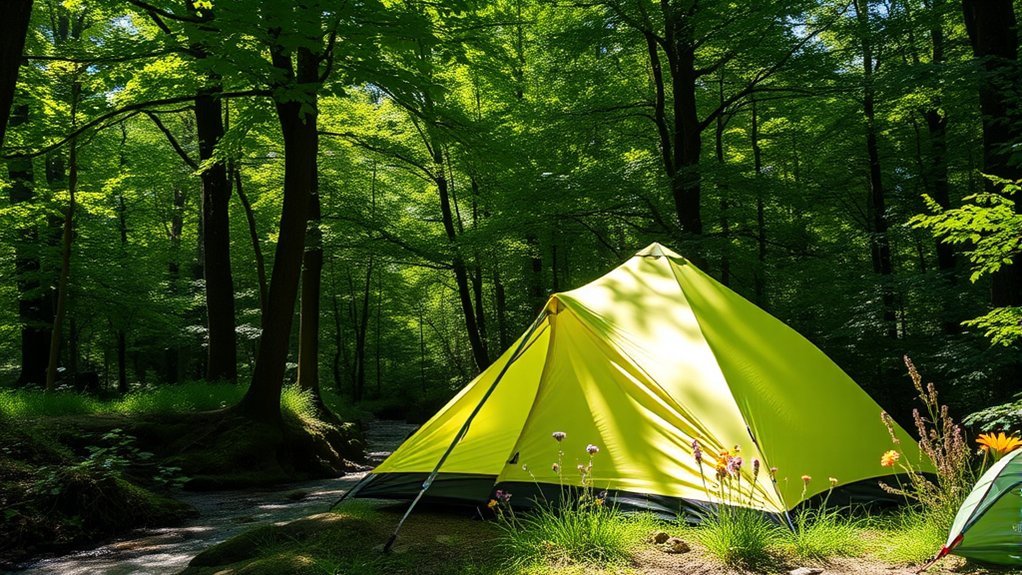
A 3-season tent is your go-to shelter for spring, summer, and autumn camping. Weighing between 2 to 4 pounds, it’s perfect for backpacking. These tents feature double-wall construction for durability and ventilation, protecting you from moderate rain and light snow. They’re best suited for moderate weather conditions, like those found in forests or mountains. However, they struggle in extreme winds or heavy snowfall. Discover essential tips for choosing the perfect 3-season tent to enhance your outdoor experience.
Understanding 3-Season Tents

When you’re planning a camping trip in spring, summer, or autumn, understanding the features of a 3-season tent can greatly enhance your experience. These tents are crafted from lightweight materials, typically weighing between 2 to 4 pounds, making them ideal for backpacking. Their double-wall construction offers a perfect balance of durability and ventilation options, allowing for adequate airflow while minimizing condensation. The mesh inner layer aids in moisture management, essential for maintaining comfort in varying temperatures.
Most 3-season tents are designed to withstand moderate rain and wind but aren’t suited for heavy snowfall or extreme weather conditions. As about 80% of campers prefer this versatile option, you can use a 3-season tent in diverse settings, from forests to mountains. Knowing these features guarantees you choose a tent that meets your needs, allowing you to enjoy the great outdoors with confidence and freedom.
Key Features of 3-Season Tents
A 3-season tent is the perfect companion for your outdoor adventures in spring, summer, and autumn. These tents typically weigh between 2–4 pounds, making them easy to pack for backpacking trips. Their design materials often include lightweight fabrics that balance durability and breathability, allowing you to stay comfortable in varying weather conditions.
Most 3-season tents feature a mesh inner layer and effective ventilation systems, helping manage airflow and reduce condensation. While they excel in moderate rain and light snow due to their double-wall construction, keep in mind they won’t hold up in harsh winter conditions. This versatility makes them a favorite among 80% of campers, suitable for diverse settings—whether you’re nestled in a forest, sprawled in a field, or perched on a mountain. Embrace the freedom of the outdoors with a tent that adapts to your explorations!
Products Worth Considering
TENT: 20D Nylon Fabric, BOTTOM: 40D Nylon Fabric, Silicone Coated, Waterproof, Ripstop, 90.6inch (230cm) * 59inch (150cm) * 47.2inch (120cm). 【Note】: The Tent Itself is...
Ideal Conditions for Using a 3-Season Tent
When choosing a 3-season tent, it’s crucial to take into account the weather resistance factors like moderate rain and wind. These tents excel in a variety of terrains, including forests and mountains, making them perfect for spring, summer, and autumn camping. Keep in mind that while they can handle mild winter conditions, they’re not meant for extreme environments.
Products Worth Considering
Light and comfortable: The internal dimensions of the Forceatt backpacking tent are 225 x 185 x 120 cm (88.4 x 72.7 x 47.2 inches), which can accommodate three people at the same time. At the same time, its packaging measures 43 x 18 cm and weighs 3.3 kg, which saves space and is easy to transport.
Weather Resistance Factors
While 3-season tents excel in moderate weather conditions, understanding their limitations is essential for an enjoyable camping experience. These tents are perfect for spring, summer, and autumn, providing adequate rain protection and ventilation. However, they’re not built for heavy snowfall or high winds that could threaten their structural integrity.
| Weather Factor | Suitability |
|---|---|
| Moderate Rain | Excellent |
| Light Snow | Acceptable |
| High Winds | Not Recommended |
When camping in forests, fields, or mountains, keep an eye on local weather patterns. Most campers rely on 3-season tents for their balance of weight, packability, and durability, making them a popular choice for diverse outdoor adventures.
Terrain and Environment
Choosing the right terrain and environment considerably enhances your camping experience with a 3-season tent. These tents thrive in mild weather, making them perfect for camping in forests, fields, and mountains during spring, summer, and autumn. When selecting your spot, consider terrain types that offer moderate shelter from the elements; you want to avoid areas prone to heavy snowfall or extreme winds, as 3-season tents aren’t built for that. Their lightweight design, typically between 2 to 4 pounds, makes them excellent for backpacking trips on varied terrains. Additionally, the mesh inner layers provide enhanced ventilation, managing condensation effectively. With about 80% of campers opting for 3-season tents, you’ll find them ideal for most outdoor adventures without needing extreme weather protection.
Seasonal Usage Guidelines
Using a 3-season tent is most effective during spring, summer, and autumn, as these seasons provide ideal conditions for camping. They handle moderate rain, wind, and cooler temperatures well. While you can use a 3-season tent in mild winter conditions, make certain it has sturdy pole structures and limited mesh to prevent wind and snow ingress. Here are some camping tips for seasonal usage:
| Season | Ideal Conditions |
|---|---|
| Spring | Mild temperatures, occasional rain |
| Summer | Warm, dry weather with ventilation |
| Autumn | Cool nights, stable weather |
| Mild Winter | Calm days, light snowfall |
| Harsh Winter | Not recommended, use 4-season tent |
Don’t forget your tent maintenance to keep it in top shape for your adventures!
Limitations of 3-Season Tents in Winter
Although 3-season tents might seem like a versatile option for all your camping adventures, their limitations become glaringly apparent in winter conditions. These tents, designed primarily for moderate weather, struggle against heavy snowfall and high winds. Their lighter fabrics and increased mesh ventilation fail to retain warmth, making them inadequate for cold nights. When you’re considering winter preparedness, remember that using a 3-season tent in harsh conditions can lead to snow ingress and wind exposure, increasing your risk of hypothermia.
While some campers attempt tent modifications to improve performance, it’s wise to reserve these tents for calmer days without anticipated snowfall or severe weather. The limited durability and inadequate wind resistance can compromise your comfort and safety. If you’re aiming for liberation in your winter adventures, investing in a 4-season tent may be the more sensible option.
Products Worth Considering
FOUR SEASON TENT: While other 3 season tents are only available for spring, summer and fall, this extreme weather tent is suitable for all seasons of the year. In winter, the snow skirt of this 2 person tent makes sure that it can keep snow away. The roll-able design makes it convenient when there is no snow around. In other seasons, the mesh design of the 4 season backpacking tent keeps bugs away while the double-layer door ensures ventilation
Lightweight and Durable: The OneTigris STELLA Camping Tent features a lightweight and durable 20D Nylon outer fabric with a single-layer silicone coating, making it both sturdy and easy to carry at only 4.4lb/2kg. Suitable for backpackers, bushcrafters, everyday campers, and families Waterproof: With a 3000mm waterproof rating, the STELLA camping tent is perfect for use in all weather conditions. The removable blackout outer tent allows for greater flexibility in use.
4 SEASON TENT: We offer a limited ONE-YEAR GUARANTEE. Polyester rain fly, groundsheet, and bathtub with PU 5000 coating are firmer than you expected. Weatherproof material with factory-sealed seams keeps you dry and comfortable in four seasons or cold weather! Better material but more affordable! You really need an appropriate lightweight 2-person tent for backpacking for ALL SEASON!
Comparisons With 4-Season Tents
When comparing 3-season tents to their 4-season counterparts, it’s essential to take into account the specific demands of your camping environment. 4-season tents excel in extreme conditions, featuring robust materials and structures that provide superior stability against heavy winds and snowfall. While they offer enhanced durability, the 4-season drawbacks include increased weight and bulk, often making them less convenient for casual backpackers.
On the other hand, 3-season tents shine with their lightweight designs and excellent ventilation, perfect for spring, summer, and fall adventures. They typically weigh between 2–4 pounds and pack down small, making them a top choice for those who prioritize mobility. However, their limitations become evident in harsh weather; they can handle only moderate rain and light snowfall. So, if you’re facing unpredictable weather or high-altitude conditions, you’ll want to choose a 4-season tent for safety and comfort.
Products Worth Considering
Spacious Ultralight Design - Award-winning backpacking tents with extended dimensions for taller adventurers. Revolutionary HyperBead fabric creates a waterproof tent that's significantly lighter and stronger than traditional materials, with breathable nylon ripstop and mesh body for optimal comfort during tent camping
Extremely Lightweight: Weighing only 2 pounds for the single-person tent, this is a camping essential for backpackers, allowing for a significant reduction in load and freeing up more energy to carry other equipment
WATERPROOF & LONG-LASTING: Polyester rain fly & groundsheet & bathtub with PU 5000 coating is firmer than you expected. Weatherproof material with factory-sealed seams keeps you dry and comfortable in all season&all weather condition! Better material but more affordable! You really need an appropriate lightweight 2 person tent for backpacking!
Recommendations for Choosing a 3-Season Tent
When you’re choosing a 3-season tent, focus on weight and packability to guarantee comfort during your backpacking trips. Look for models that weigh between 2–4 pounds and fit well into a 60-65 liter pack, so you can carry all your gear without hassle. Additionally, make certain the tent features strong weather resistance elements like an X-frame design to handle various conditions effectively.
Products Worth Considering
EASY SETUP FREE STANDING TENT: With one set of aluminum alloy tent poles, the tent is super easy to assemble, it takes less than two minutes for anyone with no experience.The double-Y structure can make it self standing without peg nails. It is the easiest tent you have ever put up. Perfect 3 person tent for Backpacking, cycling, Hiking, Bikepacking, Mountaineering, Fishing or Car Camping. And The Tent comes with a instruction manual.
Extremely Lightweight: Weighing only 2 pounds for the single-person tent, this is a camping essential for backpackers, allowing for a significant reduction in load and freeing up more energy to carry other equipment
WATERPROOF & LONG-LASTING: Polyester rain fly & groundsheet with PU 5000 coating is firmer than Oxford fabric. Weatherproof material with factory-sealed seams keeps you dry and comfortable in all season&all weather conditions! Definitely a decent lightweight 3 person tent for camping or backpacking!
Weight and Packability
Choosing the right 3-season tent involves paying close attention to weight and packability, especially if you plan on backpacking. Aim for a tent that weighs between 2–4 pounds to guarantee you can easily transport it over long distances. Look for models that fit into a 60-65 liter pack, allowing you to carry everything you need for a week-long trip. Prioritize tent materials that enhance compressibility and a compact footprint when packed. Balance weight distribution with durability and weather resistance to guarantee performance in moderate winds and light snow. Lightweight options like the REI Co-op Quarter Dome SL 1 (2 lbs 6 oz) and Big Agnes Fly Creek HV UL1 (2 lbs 1 oz) deliver excellent packability without compromising quality.
Weather Resistance Features
To guarantee you stay comfortable and safe during your 3-season adventures, focusing on weather resistance features is vital. Look for tents with an X-frame design and steep pitches that enhance stability and provide excellent snow shedding capabilities. Prioritize weather durability by choosing a model weighing 2-4 pounds, easily fitting in your 60-65 liter backpack. Larger flys are important for effective rain protection and preventing snow drift inside your tent. Confirm adequate space with limited ventilation mesh to retain warmth while managing condensation on cooler nights. Finally, opt for double-wall construction to improve breathability and waterproofing, vital for handling rain and light snow. Your choice in these features can greatly impact your outdoor experience.
Frequently Asked Questions
Can I Use a 3-Season Tent in Winter With Proper Gear?
You can use a 3-season tent in winter with proper gear, but consider insulation, snow load, and ventilation. Make certain your sleeping system’s adequate, and prepare for cold-weather challenges to enhance your winter camping experience.
How Do I Maintain My 3-Season Tent for Longevity?
“An ounce of prevention is worth a pound of cure.” Regularly clean your tent, avoid harsh chemicals, and store it dry to preserve fabric care. Proper maintenance guarantees your tent lasts through many adventures.
Are 3-Season Tents Heavier Than 2-Season Tents?
Yes, 3-season tents typically weigh more than 2-season ones due to sturdier materials for added durability and weather resistance. The weight comparison often reflects the trade-off between lightweight design and enhanced protection in harsher conditions.
What Are the Best Brands for 3-Season Tents?
When choosing the best brands for 3-season tents, consider REI, Big Agnes, and MSR. They shine in tent comparisons, offering durability and comfort, helping you embrace the wild without compromise. Adventure awaits with these trusted names!
Can I Set up a 3-Season Tent on Snow?
You can set up a 3-season tent on snow, but it’s not ideal for winter conditions. Consider using a four-season tent for better stability and insulation. Proper site selection and snow preparation are essential for success.
Conclusion
In conclusion, a 3-season tent is your trusty companion for spring, summer, and fall adventures, designed to keep you cozy and protected from the elements. While it’s not built for harsh winter conditions, it shines in moderate weather. Choose wisely, and you’ll find a tent that suits your needs like a glove. With the right features and understanding of its limitations, you can set out on memorable camping trips, creating stories that will last a lifetime.