
Last Updated on July 27, 2026 by Caleb Warren
When packing for a flight, a travel pillow can make upright rest more comfortable without taking over your luggage. The best choice is one that supports the way your head naturally falls, fits your seat comfortably, and packs down without damaging the pillow. Before heading to the airport, also check your airline’s cabin-baggage rules so you know whether the pillow needs to fit inside your bag.
Quick Answer
Pack a travel pillow by checking your airline’s cabin-baggage rules first, then cleaning and fully drying the pillow, compressing or deflating it according to its design, and storing it in a clean pouch or inside your bag. TSA permits pillows through U.S. checkpoints, but airlines—not TSA—decide whether a pillow counts toward your carry-on or personal-item allowance.
Key Takeaways
- Choose a pillow based on how your head moves while you sleep: side support, chin support, or maximum packability.
- Memory-foam pillows are usually more structured but bulkier; inflatable models pack smaller and let you adjust firmness.
- TSA lists pillows as permitted in carry-on and checked baggage, but your airline controls cabin-baggage limits and exemptions.
- Compress or roll foam only when the manufacturer allows it; completely deflate inflatable pillows before packing.
- Keep the pillow clean with its travel pouch, a washable protector, or another clean storage bag, and follow its care label when washing it.
At a Glance
| Time Required | About 5–10 minutes before packing |
| Difficulty | Easy |
| Tools Needed | Travel pouch or clean storage bag; straps or the pillow’s built-in case if supplied |
| Cost | Usually $0 if you already have the pillow and a clean storage bag; a separate protector or case is optional |
Disclosure: As an Amazon Associate I earn from qualifying purchases. Some links on this page are affiliate links, at no extra cost to you.
The Importance of a Travel Pillow for Comfortable Flights

Comfort matters even more on long-haul flights, where you may spend hours sitting upright. A travel pillow can help support your head and neck so you do not have to work as hard to keep your head from dropping sideways or forward while resting.
A Cleveland Clinic physician also notes that a neck pillow can be useful during travel. The goal is comfort and support rather than forcing your neck into a rigid position.
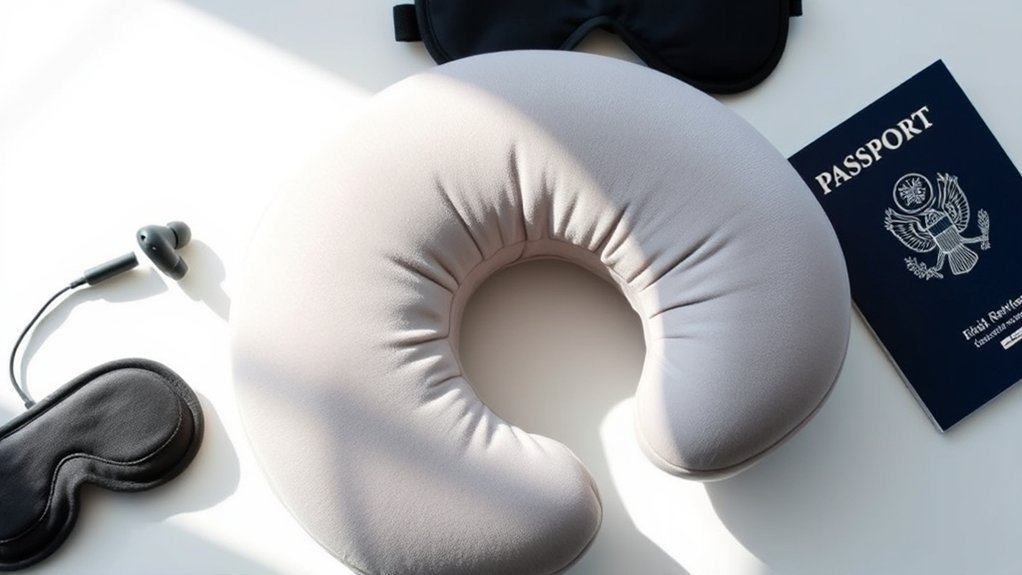
Travel pillows come in U-shaped, wrap-around, scarf-style, inflatable, foam, and compact rectangular designs. Pairing the pillow with an eye mask, earplugs, or noise-canceling headphones can also reduce light and noise when you are trying to rest.
Warning: Keep straps, clips, and loose pillow parts out of the aisle, and follow flight-crew instructions about stowing personal items during taxi, takeoff, landing, or an emergency.
Criteria for Selecting the Perfect Travel Pillow
Choosing the right travel pillow starts with how you normally rest in an airplane seat. A traditional U-shaped pillow can provide side support. A wrap-around design with front or chin support may suit people whose head tends to fall forward. A compact rectangular or crescent-style pillow can be useful if you usually lean against the window.
Match the Material to Your Priorities
Next, consider the filling. Memory foam generally feels more structured and molds to the head and neck, but it takes up more luggage space. Inflatable pillows are much smaller when deflated and allow you to change firmness by adding or releasing air. Fiber-filled designs fall between the two and may be easier to wash depending on the care label.
| Feature | Memory Foam | Inflatable |
|---|---|---|
| Feel | Structured and cushioned | Firmer or softer depending on inflation |
| Packability | Moderate; some models compress into a case | Excellent when fully deflated |
| Firmness Adjustment | Usually fixed | Adjustable with air volume |
| Cleaning | Often has a removable cover; follow insert-care instructions | Varies by fabric, bladder, and cover design |
| Best For | Travelers who prioritize cushioning and structure | Travelers who prioritize luggage space |
Test the Fit Before Your Trip
Sit in a straight-backed chair and try the pillow for several minutes. Your head should feel supported without the pillow forcing your chin sharply toward your chest or pushing your head far forward. Check the front closure, height, side support, and any straps while wearing the same type of clothing you expect to wear on the flight.
A removable, washable cover is also worth prioritizing. It lets you clean the part that touches your face and neck without automatically washing the foam or inflatable bladder.
TSA Rules vs. Airline Baggage Rules
There are two separate questions when you bring a travel pillow on a plane: whether security permits it and whether your airline treats it as an extra cabin item.
The Transportation Security Administration lists pillows as permitted in both carry-on and checked baggage at U.S. airport security checkpoints. TSA permission, however, does not create an exemption from your airline’s baggage rules.
The Federal Aviation Administration advises travelers to check directly with their airline for the number and size of items allowed in the cabin. Those rules can differ by carrier, fare, aircraft, and route.
For example, American Airlines currently allows one carry-on and one personal item and separately lists items such as certain child-care and mobility equipment that do not count against that allowance. Frontier likewise publishes specific size limits and exemptions for its cabin baggage. An ordinary travel pillow is not a universal federally protected extra item.
Note: If you already have the maximum number of cabin items, the safest approach is to make sure the pillow can fit inside your carry-on or personal item before boarding. Do not rely on clipping it to the outside of your bag as a guaranteed exemption.
Smart Packing Tips for Your Travel Pillow
Packing method depends on the pillow’s construction. Before compressing anything, check the manufacturer’s care and storage instructions.
How to Pack a Memory-Foam Travel Pillow
- Make sure it is clean and dry. Moisture trapped inside a travel case can lead to unpleasant odors.
- Remove or fold accessories. Secure clips, straps, and cords so they do not snag.
- Compress only as directed. If the manufacturer supplies a compression case, roll or fold the pillow using that method. Cabeau, for example, instructs users of certain memory-foam models to roll the pillow before placing it in the supplied case.
- Place it with soft items. Pack the compressed pillow between clothing rather than against hard or sharp objects.
- Let it expand before use. Take it out before you plan to sleep so the foam has time to regain its intended shape.
How to Pack an Inflatable Travel Pillow
- Open the valve and completely deflate the pillow.
- Press out remaining air gently rather than forcing or sharply creasing the bladder.
- Inspect the valve and seams for dirt, lint, or visible damage.
- Fold or roll it according to the manufacturer’s instructions.
- Store it in its pouch or another clean compartment away from sharp objects.
Pro Tip: With an inflatable pillow, leave it deflated until you are settled at your seat. It takes up very little room in your bag and you can adjust the firmness when you are ready to use it.
How to Pack a Wrap-Around or Fiber-Filled Pillow
Fold it only along natural seams or according to its storage instructions. If it does not compress well, place it near the top of your luggage where it will not be crushed by shoes, toiletry bags, or other hard items.
A pillow-specific travel case is useful because it separates the surface that touches your face from luggage contents. A clean towel or washable protector can also provide a barrier when no case is available.
Compression bags can save space for some soft items, but do not vacuum-compress a travel pillow unless its manufacturer specifically says that method is suitable.
Maintaining Pillow Freshness While Traveling
Your pillow touches airplane seats, luggage, your hands, and your face, so keeping its sleeping surface separated from dirty items is worthwhile.
| Method | Benefit | Best Practice |
|---|---|---|
| Washable Pillow Protector | Keeps the main pillow cleaner | Wash and dry it fully between trips |
| Clean Towel or Storage Pouch | Separates the pillow from luggage contents | Use a clean, completely dry barrier |
| Disposable Pillow Cover | Convenient temporary barrier | Useful when laundering is not practical |
| Dry Storage | Reduces trapped moisture and odors | Do not repack the pillow while damp |
| Fabric Freshener, If Permitted | May reduce unwanted odors | Use only if the care label permits it and avoid heavy fragrance near the face |
Note: Always follow the pillow’s own care label. A removable cover may be machine washable even when the foam insert or inflatable bladder is not. For example, Cabeau directs owners of certain memory-foam pillows to machine-wash the removable cover but wipe the foam insert with a damp cloth and let it air dry.
Cleaning a Travel Pillow on the Go
If the cover is removable and washable, clean it according to the label. For a non-removable surface, use only the cleaning method approved by the manufacturer. Avoid soaking memory foam or getting water inside an inflatable bladder unless the instructions specifically allow it.
Whatever method you use, let every part dry completely before sealing the pillow inside a case or suitcase.
Enhancing Comfort With Travel Accessories
A travel pillow works best as one part of a simple in-flight comfort setup. An eye mask can block cabin light, while earplugs or noise-canceling headphones can reduce distracting sound. Dress in layers so you can adjust as the cabin temperature changes.
On long flights, keep the items you plan to use within easy reach so you are not repeatedly opening the overhead bin.
When you put the pillow on, adjust it until your head feels supported without excessive pressure under your jaw or behind your neck. Some designs can be rotated so the thicker support is in front or to one side; follow the instructions for your particular pillow instead of assuming every U-shaped model must be worn the same way.
The best travel pillow is not simply the softest one—it is the one that supports the way your head actually moves while you rest and still fits your packing limits.
Travel Pillow Preflight Checklist
- Check the operating airline’s current carry-on and personal-item rules.
- Test the pillow in an upright chair before the trip.
- Wash the removable cover if needed and let every part dry fully.
- Deflate or compress the pillow only by an approved method.
- Place it in a clean pouch, protector, or luggage compartment.
- Make sure it can fit inside your permitted baggage if a gate agent asks you to consolidate items.
- Secure clips and straps so they cannot drag or catch on other belongings.
- Keep the pillow accessible if you plan to use it soon after boarding.
Frequently Asked Questions
Can I bring a travel pillow in my carry-on bag?
Yes. TSA lists pillows as permitted in both carry-on and checked baggage at U.S. security checkpoints. Your airline still controls how many cabin items you may bring and how large they can be, so check the operating carrier’s baggage policy before departure.
Does a travel pillow count as a personal item?
There is no universal airline rule exempting ordinary travel pillows. TSA security rules do not determine baggage allowances. Some carriers or gate agents may allow a small wearable pillow without treating it as a separate bag, but you should be prepared to place it inside your permitted carry-on or personal item if required.
How do I clean my travel pillow while on the go?
Follow the manufacturer’s care label. Wash a removable cover when permitted, and clean the insert only by the recommended method. Many memory-foam inserts should not be soaked. Whatever the material, let the pillow dry completely before placing it back in a closed travel case.
Are inflatable travel pillows worth the investment?
They can be a good choice when luggage space matters most. An inflatable pillow packs very small and lets you adjust firmness by changing the amount of air. The tradeoff is that it may feel less cushioned or structured than a foam pillow, depending on the design.
What size travel pillow is best for long flights?
There is no single best size. The pillow should support your head without crowding your seat or forcing your head forward. It should also fit your packing plan. If you are bringing a large conventional pillow rather than a compact neck pillow, check your airline’s current cabin-baggage dimensions before flying.
Can I clip my neck pillow to the outside of my backpack?
You can physically attach many travel pillows to a backpack, but doing so does not guarantee that the airline will exempt the pillow from its cabin-item limit. If you are already carrying the maximum number of allowed items, make sure the pillow can be placed inside your bag if you are asked to consolidate.
Can I use a regular pillow instead of a travel pillow?
Yes, but a full-size bed pillow is bulkier and may be harder to fit within your airline’s cabin-baggage allowance. A compact neck, wrap-around, or inflatable pillow is usually easier to pack and use in an upright airplane seat.
Sources
- Transportation Security Administration — Pillows — confirms that pillows are listed as permitted in both carry-on and checked baggage at U.S. security checkpoints.
- Federal Aviation Administration — Carry-On Baggage Tips — explains that travelers should check their airline’s rules for the number and size of cabin items.
- American Airlines — Carry-On Bags — provides current personal-item, carry-on, and exemption guidance.
- Frontier Airlines — Bag Options — provides current personal-item dimensions, carry-on limits, and listed exemptions.
- Cleveland Clinic — Tips for Traveling With Back Pain — supports the use of neck pillows as a travel-comfort aid.
- Cabeau — Evolution Classic Care and Packing Instructions — provides a manufacturer example of cleaning a removable cover, caring for memory foam, and rolling a compressible travel pillow.
Conclusion
A travel pillow is easiest to fly with when you choose one that fits both your body and your luggage. Test it before the trip, clean and dry it, then compress or deflate it only as the design allows. Keep it protected from dirty luggage contents and make sure you can place it inside your permitted baggage if your airline requires cabin items to be consolidated.
Once you are on board, pair the pillow with simple comfort accessories such as an eye mask, earplugs, or noise-canceling headphones. A little preparation gives you a cleaner, easier-to-pack setup and a better chance of resting comfortably during the flight.

