
Last Updated on July 27, 2026 by Caleb Warren
Yes, you can bring a travel pillow on a plane. The TSA permits pillows in both carry-on and checked baggage, but the airline—not TSA—decides how the pillow counts toward your cabin baggage allowance. A compact neck pillow is usually the easiest option because a bulky pillow may need to fit inside one of your allowed bags.
Quick Answer
Yes. TSA allows pillows in carry-on and checked baggage. Whether a travel pillow counts as a personal item or another cabin item depends on the airline. Southwest explicitly says neck pillows do not count toward its carry-on limit, while airlines such as Spirit require neck and head pillows to fit inside the personal-item bag.
Key Takeaways
- The TSA allows pillows in both carry-on and checked baggage.
- Airlines decide whether a separate pillow counts toward your carry-on or personal-item allowance.
- Southwest explicitly says neck pillows do not count toward its carry-on limit, while Spirit says neck and head pillows must fit completely inside the personal-item bag.
- There is no universal maximum travel-pillow size. What matters is the pillow’s packed size and your airline’s baggage rules.
- Compact, compressible, or inflatable neck pillows are usually easier to pack than full-size bed pillows.
Disclosure: As an Amazon Associate I earn from qualifying purchases. Some links on this page are affiliate links, at no extra cost to you.
How to Pack Your Pillow for Air Travel
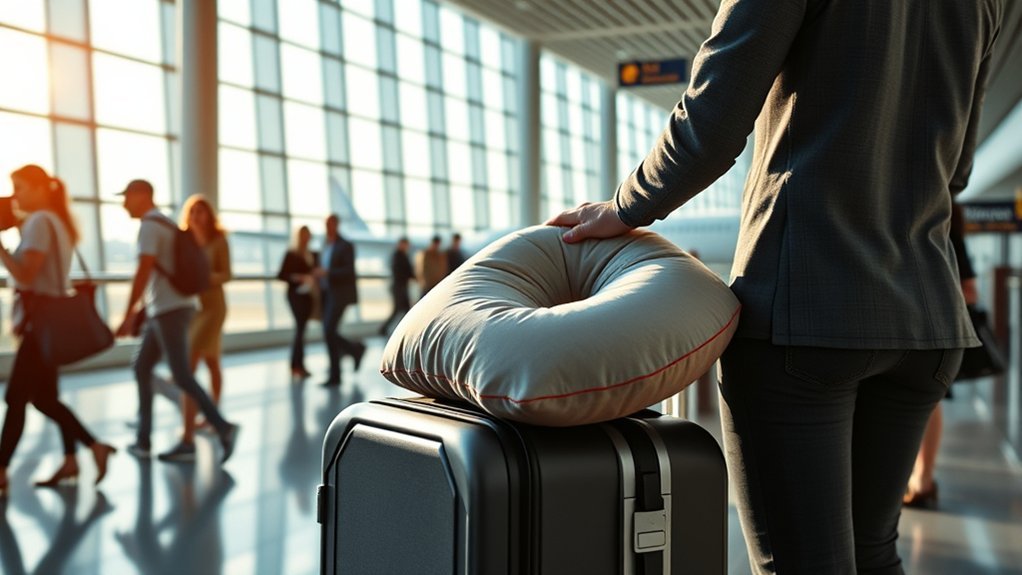
Packing your travel pillow for air travel is easiest when the pillow compresses into your existing luggage. Inflatable neck pillows pack nearly flat, while many memory-foam and fiber-filled neck pillows can be squeezed into a pouch or compression sack.
Do not assume a pillow clipped to the outside of your backpack is automatically exempt from the airline’s item limit. Unless your carrier specifically gives neck pillows an exception, the safest approach is to place the pillow completely inside your personal item or carry-on before boarding.
A full-size bed pillow is different. TSA may allow it through security, but the airline can still treat it as one of your permitted cabin items if you carry it separately. On a fare that charges for a full-size carry-on, that distinction can matter.
Pro Tip: Measure your bag after the pillow is packed, not before. A soft backpack that meets the limit when empty can become too deep once a thick foam pillow is stuffed inside.
TSA Rules vs. Airline Baggage Rules
Two different sets of rules apply when you bring a pillow to the airport. The Transportation Security Administration controls security screening and lists pillows as permitted in both carry-on and checked bags.
Your airline controls how many pieces you may take into the cabin, how large those pieces may be, and whether a pillow receives any special exemption. Passing through TSA security therefore does not guarantee that a separate bulky pillow will be accepted at the gate without counting toward your baggage allowance.
This distinction is especially important on basic or low-cost fares where one personal item may be included but a larger carry-on costs extra.
What Size Pillows Can You Bring on a Plane?
There is no universal airline rule that says a travel pillow must be a particular size. Instead, the important measurement is usually the size of the personal item or carry-on containing it—or the pillow itself if the airline treats the pillow as one of your permitted pieces.
| Airline | Current Personal-Item Rule | Travel-Pillow Takeaway |
|---|---|---|
| American Airlines | Maximum 18 × 14 × 8 in (45 × 35 × 20 cm); must fit under the seat. | No pillow-specific exemption is listed, so packing it inside an allowed item is safest. |
| Delta Air Lines | Delta does not publish a fixed numeric personal-item limit on its current page; a purse, laptop bag, small backpack, or similar-size item must fit beneath the seat. | Use a compact, collapsible pillow that can be stored quickly and securely. |
| United Airlines | Maximum 9 × 10 × 17 in (22 × 25 × 43 cm); must fit under the seat. | United’s relatively narrow personal-item dimensions make a compressible pillow particularly useful. |
| Southwest Airlines | The current policy requires the personal item to fit under the seat and does not publish a numeric personal-item dimension on the page. | Southwest specifically says neck pillows do not count toward the carry-on limit. |
| Frontier Airlines | Maximum 18 × 14 × 8 in; current policy also lists a 35 lb maximum and says personal-item size is checked during boarding. | Keep a separate pillow within your permitted baggage unless Frontier confirms otherwise for your trip. |
| Spirit Airlines | Maximum 18 × 14 × 8 in (45 × 35 × 20 cm). | Spirit specifically says neck and head pillows may be carried aboard as long as they fit completely inside the personal-item bag. |
| JetBlue | Maximum 17 × 13 × 8 in (43.2 × 33 × 20.32 cm); must fit under the seat. | No pillow-specific exemption is listed among JetBlue’s standard carry-on exceptions. |
A soft neck pillow may compress into dimensions far smaller than its normal shape, while a rigid or full-size pillow may not. For that reason, a claimed “standard” travel-pillow measurement is less useful than measuring the pillow in the condition in which you will actually board.
Note: Airline policies can change, and partner or codeshare flights may follow the operating carrier’s rules. Check the operating airline’s current baggage page shortly before you travel.
Are There Charges for Bringing a Travel Pillow?
The airlines reviewed here do not impose a fee simply because an item is a travel pillow. The possible charge comes from how the pillow is counted. A separate bulky pillow can become an additional personal item, carry-on, or checked item if it does not qualify for an airline-specific exception.
This matters most on fares where a personal item is free but a larger carry-on costs extra. An oversized personal item can also trigger a fee on carriers that charge for baggage that exceeds their free allowance.
Airline-Specific Pillow Charges
Southwest provides one of the clearest pillow-specific rules: its current policy lists pillows among personal items and states that neck pillows do not count toward the carry-on limit. Spirit takes a different approach and says neck and head pillows must fit completely inside the personal-item bag.
American, United, Frontier, Delta, and JetBlue publish general cabin-baggage rules rather than a broad neck-pillow exemption comparable to Southwest’s. On those airlines, the lowest-risk strategy is to make sure the pillow can be packed into one of the pieces your fare already permits.
Personal Item Regulations
A personal item is normally the smaller cabin item that fits underneath the seat in front of you. The exact rule is carrier-specific. Some airlines publish fixed dimensions, while others describe the permitted item by examples and require it to fit safely beneath the seat.
Do not assume that a rule from your outbound airline applies to a connecting carrier. A pillow that causes no problem on one flight may need to be packed differently on the next.
Types of Travel Pillows Allowed on Planes
Neck pillows made from memory foam, polyester fill, or similar soft materials are among the easiest options to travel with because they can often be compressed or worn without taking up much luggage space.
Inflatable neck pillows are even more compact when deflated. TSA does not prohibit ordinary pillows merely because they are inflatable, but airline-specific restrictions still apply.
Do not confuse a small inflatable neck pillow with larger inflatable beds, cubes, wedges, or seat-extension products. For example, Delta’s current carry-on policy specifically lists inflatable devices such as wedges, cubes, and beds among prohibited cabin comfort products.
Memory foam travel pillows are also permitted through TSA screening. Their main drawback is bulk: dense foam may not compress enough for a tightly limited personal-item bag.
Full-size bed pillows can pass TSA screening too, but they are much more likely to create an airline baggage-count or storage problem. There is no special federal right to bring a full-size pillow as an extra cabin piece.
Neck Pillow Policies by Airlines
There is no single neck-pillow rule shared by every airline. Southwest explicitly says neck pillows do not count toward its carry-on limit. Spirit expressly says neck and head pillows must fit completely inside the personal-item bag. Other airlines may simply apply their normal carry-on and personal-item limits.
That means you should avoid relying on statements such as “neck pillows never count as luggage.” The safest universal strategy is to choose a compressible pillow that can go inside your permitted bag when necessary.
Are Travel Pillows Provided on Flights?
Do not assume a pillow will be waiting at your seat. Bedding amenities vary by airline, aircraft, cabin, and route. A long-haul international flight or premium cabin is more likely to offer bedding than a short domestic economy flight, but the only reliable answer for a specific trip is the airline’s current onboard-amenities information.
Things to keep in mind:
- Bring your own pillow when you need a particular level of neck support.
- Airline-provided bedding and packaging practices vary, so ask a crew member if you have a hygiene concern.
- Premium long-haul cabins are more likely to include pillows or other bedding than short economy flights.
- A compact personal pillow gives you consistent comfort when you change airlines or aircraft.
Tips for Using a Travel Pillow Effectively
A travel pillow is most useful when it supports your head without forcing your neck into an awkward angle. Adjust the pillow before trying to sleep, and make sure it does not interfere with your seat belt, aisle access, or the passenger next to you.
| Tip | What to Do |
|---|---|
| Inflate After Boarding | Keep an inflatable pillow flat while moving through the airport, then inflate it after you reach your seat. |
| Pack Before the Gate | If your airline does not exempt the pillow, place it inside your allowed bag before boarding begins. |
| Adjust Firmness | For an inflatable model, use only enough air to support your head comfortably. |
| Keep a Neutral Position | Position the pillow so your head is supported instead of being pushed sharply forward or sideways. |
| Use It Beyond the Plane | A compact travel pillow can also be useful on trains, buses, and airport layovers. |
Warning: Loose carry-on items must be properly stowed for takeoff and landing, and passengers must follow crew instructions. A flight attendant may require you to place a pillow under the seat or in an approved storage area if it is loose, bulky, or could obstruct the cabin.
Frequently Asked Questions
Can I use my travel pillow during takeoff and landing?
It depends on how the pillow is being used and the crew’s instructions. Federal rules require carry-on baggage to be properly stowed for takeoff and landing. A crew member may therefore ask you to stow a loose or bulky pillow. Always follow the flight crew’s directions.
Are inflatable travel pillows allowed on planes?
Ordinary inflatable neck pillows are permitted through TSA screening, but the airline can restrict particular comfort devices. Large inflatable beds, wedges, cubes, and seat-extension products may be prohibited even when a small inflatable neck pillow is acceptable.
Can I carry more than one travel pillow on a flight?
TSA does not impose a special one-pillow limit, but your airline’s cabin-baggage allowance still applies. Multiple separate pillows could be treated as additional items, so pack them inside your permitted luggage unless the carrier confirms an exemption.
Do airlines provide storage for large travel pillows?
Do not count on special pillow storage. Cabin items generally need to fit in an approved overhead compartment, beneath a seat, or in another location approved by the airline. A compact pillow is much easier to accommodate.
Can I bring a memory foam travel pillow on a plane?
Yes. TSA allows pillows, including ordinary memory-foam travel pillows. The practical issue is their packed size: dense foam can be harder to compress, so make sure the pillow complies with your airline’s cabin-baggage allowance.
Does a neck pillow count as a personal item?
It depends on the airline. Southwest explicitly says neck pillows do not count toward its carry-on limit. Spirit says neck and head pillows must fit completely inside the personal-item bag. Airlines without a published pillow exemption may apply their ordinary carry-on and personal-item rules.
Can a pillow go through airport security?
Yes. TSA lists pillows as allowed in both carry-on and checked baggage. As with any item, the final security-screening decision rests with the TSA officer, and airline baggage rules still apply after you pass security.
Conclusion
Yes, you can bring a travel pillow on a plane, and TSA allows pillows in both carry-on and checked baggage. The part that varies is how your airline counts the pillow. Southwest explicitly exempts neck pillows from its carry-on limit, Spirit requires neck and head pillows to fit inside the personal-item bag, and other carriers apply their own baggage rules. A compact, compressible pillow gives you the most flexibility and the lowest chance of a problem at the gate.
Sources
- Transportation Security Administration — Pillows — confirms pillows are permitted in carry-on and checked baggage.
- Federal Aviation Administration — Carry-On Baggage Tips — official cabin-baggage and safe-stowage guidance.
- American Airlines — Carry-on Bags — personal-item and carry-on dimensions.
- Delta Air Lines — Carry-On Baggage — personal-item guidance and restrictions on certain inflatable comfort devices.
- United Airlines — Carry-on Bags — current personal-item dimensions and under-seat requirement.
- Southwest Airlines — Carryon and Personal Item Policy — current pillow guidance and neck-pillow carry-on exception.
