
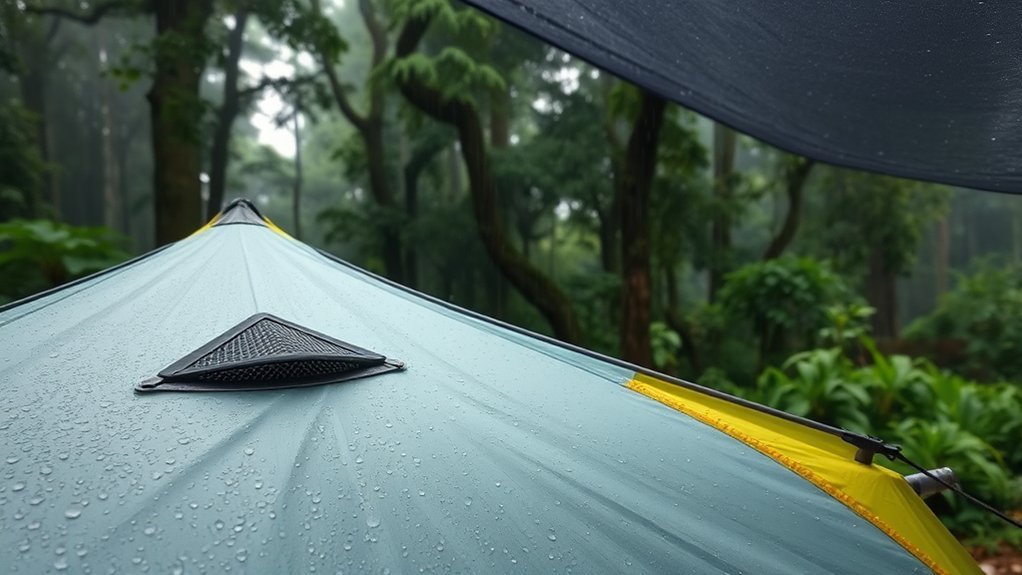
To combat tent condensation in humid weather, pitch your tent in the shade to create a warmer microclimate, and avoid setting up near water to decrease humidity levels. Opt for higher ground to prevent cold air pooling, and never dry wet gear inside the tent. Guarantee good airflow by fully opening vents and doors. Finally, regularly wipe down and dry your tent. These strategies can help minimize moisture, and further techniques are just ahead.
HOW TENT CONDENSATION IS CREATED

When you set up a tent in humid weather, condensation can quickly become a problem due to the interaction of cold tent fabric and the warm, moist air inside. This occurs primarily because of significant temperature differences between the cooler tent exterior and the warmer air generated by your breath and body heat. Higher humidity levels inside the tent amplify the likelihood of condensation, as warm air can hold more moisture but releases it when it cools against the tent walls.
Moisture sources, such as cooking or bringing damp gear inside, contribute additional humidity, further exacerbating the issue. Proper ventilation is essential to combat condensation, allowing moist air to escape and helping maintain a balanced temperature inside the tent. By understanding how condensation forms, you can take proactive steps to mitigate its effects, ensuring a more comfortable camping experience.
PITCH YOUR TENT IN THE SHADE OF A TREE
Choosing to pitch your tent in the shade of a tree can greatly enhance your camping experience, especially in humid weather. The tree canopy above your tent provides essential microclimate benefits, creating a warmer air pocket that helps mitigate drastic temperature changes. This shade minimizes direct sunlight, reducing heat loss and condensation on your tent walls. Additionally, trees play an important role in moisture management; they collect dew and condensation on their leaves, preventing it from settling directly on your tent.
Moreover, camping under trees improves airflow around your tent, enhancing ventilation and further decreasing the risk of condensation buildup. Just be sure to select sturdy trees free of widow-makers, as safety should always be a priority during your outdoor adventures. By leveraging the natural advantages of tree shade, you can enjoy a more comfortable and condensation-free camping experience.
DON’T CAMP RIGHT NEXT TO WATER
Camping too close to water can lead to increased humidity levels, which considerably raises the risk of condensation inside your tent. The effects of water proximity create a microclimate that’s cooler and wetter, making your camping experience less enjoyable. To mitigate these humidity effects, follow these guidelines:
- Set up at least 200 feet away from any lakes or rivers to maintain a drier environment.
- Choose higher ground to avoid cold air currents that can exacerbate moisture build-up.
- Use tarps or ground covers to create an additional barrier against moisture from the ground.
- Ventilate your tent effectively by keeping windows slightly open, allowing humid air to escape.
CAMP ON HIGHER GROUND
Opting for higher ground can considerably reduce the risk of tent condensation during humid weather. When you choose elevated camping spots, you’re avoiding the cold air that pools in low dips, which often leads to moisture buildup. Warm air rises, maintaining a more consistent temperature that helps keep your tent walls warmer and drier.
| Benefit | Description | Impact on Condensation |
|---|---|---|
| Temperature Consistency | Higher ground guarantees warm air stays nearby | Reduces moisture |
| Better Airflow | Elevated areas promote natural ventilation | Prevents moisture buildup |
| Avoid Cold Pockets | Cold air collects in valleys | Decreases condensation risk |
| Elevated Terrain | Ridges often have drier conditions | Less humidity |
DON’T DRY WET GEAR INSIDE THE TENT
While it might be tempting to dry wet gear inside your tent after a day of hiking, doing so can greatly raise humidity levels, leading to condensation on the walls. To maintain an effective humidity control strategy, follow these practical tips:
Drying wet gear inside your tent can increase humidity, causing condensation. Consider these tips for effective humidity control.
- Hang clothes outside: Use a tarp to shield items from rain, allowing them to dry while keeping your tent comfortable.
- Opt for a change of clothes: Bring dry alternatives to avoid the need for drying wet items inside, reducing moisture risks.
- Store gear properly: Keep wet gear outside or in a designated area away from the tent to optimize gear storage without compromising your comfort.
- Ventilation is key: Guarantee your tent has adequate airflow to reduce humidity buildup from any unavoidable dampness.
Products Worth Considering
[HEAVY-DUTY WATERPROOF PROTECTION] Made with durable rip-stop fabric featuring polyethylene lamination on both sides for maximum water resistance. Keeps your gear, tent, firewood, and equipment completely dry in rain, snow, or harsh outdoor conditions
[HEAVY-DUTY WATERPROOF PROTECTION] Made with durable rip-stop fabric featuring polyethylene lamination on both sides for maximum water resistance. Keeps your gear, tent, firewood, and equipment completely dry in rain, snow, or harsh outdoor conditions
【WRINKLE-RESISTANT,WATERPROOF&DURABL】The rain poncho is made of high-density, rhombic lattice 230T polyester material, which is not only beautiful but also more tear-resistant than other materials. This Heavy-duty material ensures that the poncho can with stand harsh weather conditions and last for extended periods without showing any signs of wear and tear. The rain poncho is coated with double-layer PU,making it smoother and more water-resistant while also preventing wrinkles.
DRY YOUR TENT OFF
After your camping trip, it’s essential to wipe down your tent with a towel to minimize moisture and prevent mold growth. Make sure to separate the rainfly from the inner tent for better airflow while drying both components. This simple step can greatly enhance your tent’s longevity and your overall camping experience.
Products Worth Considering
Streak-Free, Spot-Free Drying: With SMINDER’s car drying towels advanced 1200 GSM microfiber and twisted-loop technology, you’ll enjoy a flawless finish every time. Just one pass and your car is 100% dry, streak-free, and water spot-free. The microfiber towels for cars absorb up to an entire gallon of water, making them perfect for efficient, high-performance drying.
【Non-magnetic stainless steel】The Laundry Drying Rack is made of non-magnetic stainless steel with high quality and can not be adsorbed by magnet. It is non-rusting and has high quality welding design and long service life.
Premium Material: Professional microfiber drying towels are crafted from an advanced blend of 87% polyester and 13% polyamide. They are ultra soft and comfortable, ensuring a gentle touch on your vehicle's surface. With an extra-large size of 31 " x 24 ", they perfectly fit SUVs, RVs, trucks, and boats, significantly reducing drying time and making car drying jobs a breeze
Wipe Tent Down
Wiping down your tent before packing it away can dramatically reduce moisture accumulation, which is essential in humid conditions. This practice is vital for effective tent maintenance and moisture prevention. Here are some steps to follow:
- Use a clean, dry towel to wipe the inner surfaces of your tent.
- Focus on corners and seams, where moisture tends to gather.
- If available, let your tent dry in the sun during breaks for enhanced drying.
- Pack your tent in a breathable stuff sack to minimize moisture transfer.
Regularly wiping down your tent not only helps prevent mold but also prolongs its lifespan. By taking these steps, you can maintain a fresh environment for your next adventure.
Separate Components for Drying
To make certain your tent dries thoroughly and effectively, always separate the rainfly from the inner tent after use. This significant step in tent drying allows both components to air out completely, preventing moisture retention that can lead to mold growth. After separating, use a towel to wipe down both pieces, eliminating excess moisture. To further enhance moisture prevention, pack wet components in separate stuff sacks during transport. When you reach your next location, dry your tent in direct sunlight whenever possible; this guarantees it’s completely moisture-free before storage. Regularly drying your tent not only maintains its structural integrity but also safeguards it against long-term damage caused by trapped moisture. Embrace these practices for a liberating camping experience!
GIVE YOUR TENT PLENTY OF ROOM TO BREATHE
How can you guarantee your tent remains condensation-free in humid weather? Proper tent positioning is essential for maximizing air circulation and minimizing moisture buildup. Follow these practical tips to give your tent plenty of room to breathe:
Ensure your tent stays condensation-free in humid weather by optimizing its positioning for better airflow.
- Pitch your double-walled tent correctly: Keep the rainfly elevated above the inner wall to enhance airflow.
- Avoid contact: Make sure that tent walls and gear don’t touch to prevent trapping moisture inside.
- Set guidelines tautly: This maintains the tent’s shape and height, promoting better airflow while you sleep.
- Use supports: Employ sticks or other supports under guidelines to raise wall angles, creating more effective ventilation space between the inner tent and rainfly.
Products Worth Considering
Extendable Pole: Extendable pole with a range of 24"-48" to meet any need; The set includes 4 green support rods with a material thickness of 0.4mm; 4 lengths of 24.8” of 19mm diameter metal pipe, 4 lengths of 15.7” of 16mm diameter metal pipe
Extendable Poles for Flexible Setup: Includes four mounting bars that adjust from 39" to 60", allowing flexible installation to fit different tent widths and fine-tune ventilation layouts
Extendable Poles for Flexible Setup: Includes four mounting bars that adjust from 24" to 36", allowing flexible installation to fit different tent widths and fine-tune ventilation layouts
VENTILATION IS YOUR BEST FRIEND
Even with proper positioning and ample space for your tent to breathe, effective ventilation remains your best ally in combating condensation. Implementing ventilation techniques is essential for reducing moisture build-up inside your tent. Start by opening vents, windows, and doors to enhance airflow management, allowing moist air to escape while drier air circulates.
Position your tent to face the wind direction, maximizing natural ventilation and facilitating the removal of humid air. Rolling back the rainfly and vestibule door further increases airflow, reducing the likelihood of condensation.
To guarantee peak performance, keep ventilation panels unobstructed by gear, which can hinder effective air circulation. By prioritizing these ventilation techniques, you’ll create a more comfortable, dry environment, liberating yourself from the worries of condensation. Embrace the benefits of proper airflow management, and enjoy your camping experience without the burdens of dampness.
Products Worth Considering
Efficient Cooling & Ventilation Kit: Includes AeroZesh T4 4” Inline Duct Fan, E12 Speed Controller, 4” Black Carbon Filter, and φ4” 8' Black Ducting; Ideal for moving and transporting air in various air circulation and ventilation projects; Allows for precise and easy control over the fan speed and airflow, stabilizing and optimizing your growth environment
Powerful Airflow: Delivers strong airflow up to 130 CFM, efficiently enhancing ventilation and removing exhaust; Ideal for grow tents, greenhouses, basements, bathrooms, kitchens, attics, and workshops
20000mAh Battery with Power Bank Function - ADUST 3 in 1 Rechargeable battery powered fan, equipping with a light, power bank and fan, has 20000mAh large capacity battery with high conversion rate. 100% power can be used continuously for 12-138 hours depending on different options. The portable camping fan have 5V/3A Type-C input/output and 5V/3A USB output charging port. Therefore you can use the battery operated fan as a large portable charger to reverse charging 2 phones for emergency using.
NEED SOME EXTRA AIRFLOW? HERE’s HOW:
When you find yourself battling condensation in your tent, there are several effective strategies to boost airflow. Implementing these airflow techniques can make a significant difference in moisture management:
- Open all vents, windows, and doors: This promotes air circulation and allows moist air to escape.
- Position your tent facing the wind: Enhancing airflow through ventilation panels helps keep the interior drier.
- Roll back the rainfly and vestibule doors: This maximizes airflow, creating pathways for fresh air to enter while humid air exits.
- Keep gear away from ventilation openings: Make certain your belongings don’t block airflow, as this can contribute to moisture buildup.
Products Worth Considering
Get better airflow by cracking your windows, even in the rain
Material: Made of 210T argent coated cloth, waterproof, Sunproof and .
DARK TENT: The blackout design camping tent is perfect for sleeping in and allows you to have privacy on outdoor adventures; It also keeps out most temp changes with the blackout fabric
Frequently Asked Questions
What Materials Are Best for Minimizing Tent Condensation?
To minimize tent condensation, choose breathable fabrics that allow moisture vapor to escape. Pair them with moisture barriers to prevent external humidity from seeping in, ensuring a drier and more comfortable camping experience.
How Does Humidity Affect Different Types of Tents?
Humidity greatly affects tent types, causing varying condensation effects. Breathable materials reduce moisture buildup, while less ventilated designs trap humidity, leading to discomfort. Choosing the right tent type is essential for a better camping experience.
Can I Use a Dehumidifier in My Tent?
Yes, you can use a dehumidifier in your tent, but consider your tent size and available power sources. Portable dehumidifier options can help manage moisture effectively, ensuring a more comfortable camping experience even in humid conditions.
What Time of Day Is Best for Ventilation?
The best time for ventilation is during the morning, when airflow is typically stronger. As temperatures rise, utilize the evening breeze to further enhance airflow and reduce humidity, promoting a more comfortable tent environment.
How Do I Clean My Tent to Prevent Mold?
To clean your tent and prevent mold, use mild soap and water, scrub gently, and rinse thoroughly. Dry it completely before storing. Regular tent cleaning tips can help maintain its longevity and keep mold at bay.
Conclusion
In humid weather, managing tent condensation is essential for a comfortable camping experience. Remember, about 80% of campers report experiencing condensation at some point. By pitching your tent wisely, ensuring proper ventilation, and keeping wet gear outside, you can greatly reduce moisture buildup. Emphasizing airflow and selecting the right campsite can make all the difference. With these practical strategies, you can enjoy your outdoor adventure without the hassle of a damp tent. Happy camping!