
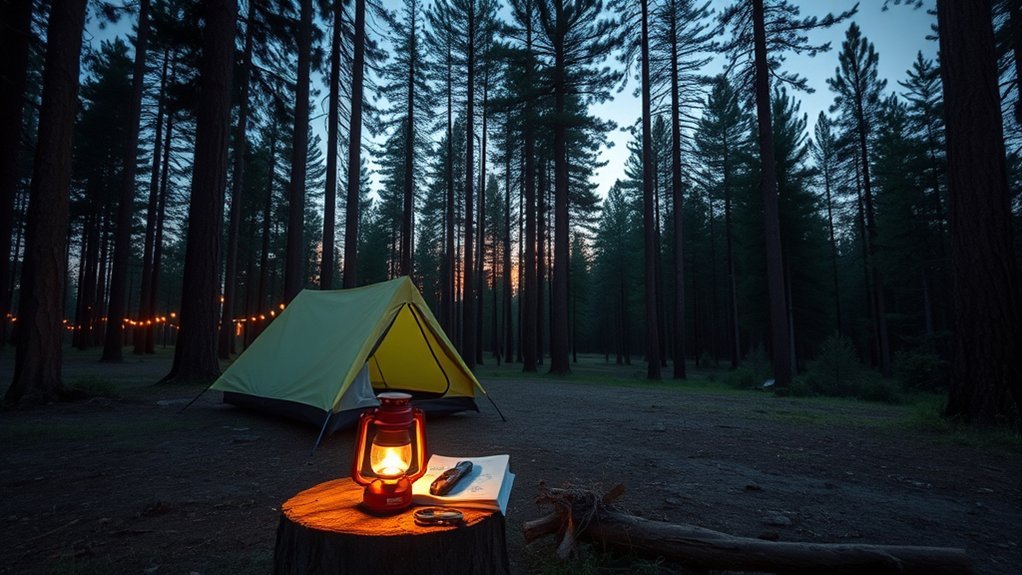
When solo female tent camping, choose a well-populated campground for safety and amenities. Arrive early to set up your tent and familiarize yourself with the area. Always trust your instincts—if something feels off, don’t hesitate to move to a more populated spot. Share your plans and location with loved ones, and maintain awareness of your surroundings. Finally, prepare for emergencies with a first aid kit and other essentials. There’s more to explore for a secure camping experience.
Choose the Right Campsite

When it comes to solo female tent camping, choosing the right campsite is vital for your safety and comfort. Opt for well-populated campgrounds where fellow campers are nearby; this not only boosts your safety but also fosters a sense of community. Research the area beforehand to guarantee you have access to essential camping amenities like restrooms and water sources, enhancing your overall experience. Look for campsites with good visibility and accessibility, allowing you to stay aware of your surroundings and quickly get help if needed. It’s wise to avoid isolated locations, especially if you’re new to solo camping, as they present higher risks. Familiarize yourself with campground rules and regulations to guarantee compliance; this knowledge empowers you and contributes to a secure environment. By prioritizing campsite selection, you set the stage for a liberating and enjoyable adventure in nature.
Products Worth Considering
Roomy 8 People Family Tent: Spacious tunnel design family outdoor tent for 8 people, with a size 20' (14'+6') x 9' x 80"(H), it is enough for 2 full air mattresses or 8 sleeping bags. An 80-inch height is enough for you to stand up while walking in the tent.
Roomy 6 People Family Tent: Spacious design offers enough room for 6 people family, with a size 10' x 9' x 78"(H) (90 sq ft),2 air mattresses or 6 sleeping bags are well fit in the tent,78 inch center height is enough for you to stand up changing
Plan a Simple Trip
To guarantee your solo camping experience is enjoyable and stress-free, it’s vital to plan a simple trip that focuses on ease and safety. Start by choosing a well-established campground with easy access and essential amenities. Arriving early gives you ample daylight for setting up your tent and familiarizing yourself with your surroundings, enhancing your safety.
Keep your itinerary straightforward, allowing time for relaxation and spontaneous exploration instead of jamming too many activities into your schedule. For meal planning, opt for easy-to-cook dishes that require minimal camping gear and ingredients, making mealtime a breeze.
Finally, use a checklist to pack only the essentials, lightening your load and simplifying navigation around your campsite. This thoughtful planning not only enhances your sense of freedom but also guarantees you embrace the beauty of your solo adventure with confidence and peace of mind.
Products Worth Considering
Reusable Design: Featuring an A4-sized 8.27" X 11.69" , wipe-clean material, this RV Packing List is designed for repeated use, offering cost-effective solution for all RV travel enthusiasts.
Trust Your Instincts
Trusting your instincts is essential for staying safe while camping solo, as your intuition often serves as an early-warning system in unfamiliar surroundings. When something feels off, act on those gut feelings. You have the power to prioritize your safety and comfort.
| Scenario | Response |
|---|---|
| Strange noises at night | Check your surroundings |
| Uncomfortable interaction | Politely disengage |
| Feeling watched | Move to a more populated area |
| Unexpected visitors | Trust your gut and be cautious |
| Signs of danger | Leave the area immediately |
Studies reveal that women often have heightened intuitive responses, making it vital to recognize and respect your boundaries. Engaging with others can be enriching, but always listen to your intuitive responses. Each camping experience helps build confidence, empowering you to make informed decisions. Remember, your instincts are your best ally.
Share Your Location With Loved Ones
Before you set off on your solo camping adventure, make certain to share your exact location and plans with trusted friends or family. Providing GPS coordinates not only keeps them informed but also enhances your safety by allowing them to track your journey. Establishing a timeline for check-ins guarantees someone’s always aware of your whereabouts, making it easier to act if anything goes awry.
Products Worth Considering
📱 Global Cloud Positioning – Works with both Google's Find Hub and Apple Find My (Not for Huawei)
Real-Time Location Tracking with No Monthly Fees: Keep track of what matters most without any hidden costs. This GPS locator uses the SeekTag app to show your item's real-time location on your phone. There are no subscriptions and no SIM card required, making it a cost-effective tracking solution for your auto, motorcycle, truck, or trailer. You can track over a long distance with peace of mind.
Real-Time GPS Tracking: Experience the convenience of our GPS tracker for vehicles, providing precise positioning and real-time location updates directly to your smartphone. Stay informed about your vehicle's whereabouts anytime, ensuring peace of mind wherever you go.
Inform Contacts of Plans
As you prepare for your solo camping adventure, sharing your plans with trusted friends or family members can greatly enhance your safety. Inform them of your itinerary details, including your campsite location and expected return time. Here’s how to keep your loved ones in the loop:
- Share GPS coordinates of your campsite for precise location tracking.
- Establish a timeline for regular check-ins or updates.
- Use contact methods like texting or location-sharing apps for real-time updates.
- Communicate any changes in your plans to guarantee they know where you are.
This proactive communication not only helps your contacts stay informed but also enables emergency services to act swiftly if needed, allowing you to embrace your adventure with peace of mind.
Use GPS Coordinates
When you share your GPS coordinates with loved ones, you not only enhance your safety but also create an essential connection that reassures them of your well-being. Accurate GPS tracking allows them to follow your journey in real-time, providing peace of mind. In remote areas where cell service may falter, your coordinates can help emergency services locate you quickly if needed. Informing friends or family of your planned campsite guarantees they can check in on you and confirm your safety at agreed intervals. Regularly updating them with your GPS location throughout your trip reinforces your commitment to safety and keeps them informed of any changes. Embrace the freedom of solo camping while guaranteeing you’re never truly alone.
Stay Aware of Your Surroundings
Staying aware of your surroundings is essential for your safety while tent camping alone. By honing your observational skills, you empower yourself to enjoy nature without unnecessary risks. Here’s what to keep in mind:
- Watch for changes in wildlife behavior; unusual movements can signal potential dangers.
- Regularly scan the area for other campers or hikers; their presence can enhance your safety.
- Stay alert to environmental changes; sudden weather shifts can impact your comfort and safety.
- Trust your instincts; if something feels off, re-evaluate your situation and consider relocating.
Products Worth Considering
Comprehensive Package: our 7 in 1 emergency whistle is made of high strength, drop resistant, and high temperature ABS engineering material, demonstrating quality and reliability; We offer a set of 12 whistles in a compact size; Each whistle comes with a long enough lanyard, ideal for attaching to backpacks, belts, or necks; This hiking whistle is suitable for both summer and winter, making it a reliable companion for your outdoor activities
NON BRITTLE PLASTIC, can't crack or break, bright color-highly visible, never fade and non corrodible, pretty good whistles to carry in case of emergency.
Whistle with high accuracy compass and thermometer, can grasp the current temperature and direction in the first time;When there is no fire in the wild, you can use the fire magnifying glass attached to the survival whistle to refract sunlight onto dead grass and leaves to generate fire.
Prepare for Emergencies
When you’re out camping alone, being prepared for emergencies can make all the difference. Stock a first aid kit with essential supplies and have a reliable communication device on hand to reach help if needed. Plus, it’s smart to inform someone about your plans and familiarize yourself with local emergency services before you set off.
Products Worth Considering
SIGNAL MIRROR MATERIAL and SIZE: (Material)-Acrylic, strong toughness and not easy to break, better reflective effect, signal mirror military grade survival signal mirror for rescue. SIZE - 3 in X 2 in X 0.22 in, Product weight:1.16 oz.
【 Super Bright 3 LED Flashlight 】 The flashlight on this emergency hand crank radio has been upgraded from a 1W single bead to a 3W 3 LED bead that provides 140LM of brightness, enough to provide you with emergency lighting in the event of a power outage.
Essential Safety Supplies
Packing the right safety supplies is crucial for solo female tent campers to guarantee a secure and enjoyable experience in the great outdoors. To prepare for emergencies, make certain to include these essential items:
- A thorough first aid kit with bandages, antiseptic wipes, pain relievers, and personal medications.
- A reliable multi-tool or knife for various tasks, from meal prep to emergency repairs.
- Bear spray if you’re in bear country; practice using it beforehand for wildlife precautions.
- A portable water filtration system or purification tablets to guarantee safe drinking water.
Emergency Communication Plan
As you prepare your safety supplies for your solo camping adventure, don’t overlook the importance of an effective emergency communication plan. Always carry reliable communication devices, like a satellite phone or GPS messenger, to reach help if needed. Inform a trusted friend or family member about your itinerary and establish check-in times to keep them updated on your safety.
| Emergency Contacts | Communication Devices |
|---|---|
| Trusted family member | Satellite phone |
| Nearest hospital | GPS messenger |
| Ranger station | Portable solar charger |
Familiarize yourself with the nearest emergency services before heading out. With a solid plan in place, you’ll feel empowered to embrace your solo adventure fully!
Frequently Asked Questions
What Should I Pack for Solo Female Tent Camping?
You’ll want to pack camping essentials like a sturdy tent, sleeping bag, and cooking gear. Don’t forget safety gear, including a first aid kit, whistle, and personal alarm. Stay prepared, and enjoy your adventure!
How Can I Stay Connected While Camping in Remote Areas?
To stay connected while camping in remote areas, pack a satellite phone for reliable communication and a portable charger to keep your devices powered. You’ll feel empowered, knowing you can reach out whenever you need to.
Are There Specific Gear Recommendations for Solo Female Campers?
For solo female campers, prioritize quality camping essentials like a reliable tent, sleeping bag, and portable stove. Don’t forget essential safety gear, including a first aid kit, whistle, and personal alarm to enhance your peace of mind.
What Self-Defense Options Should I Consider While Camping Alone?
As shadows stretch, carry pepper spray like a fierce guardian; its fiery spray can deter threats. Attach a personal alarm to your gear—its piercing call slices through silence, ensuring you’re never without a voice in the wilderness.
How Do I Choose the Right Tent for Solo Camping?
To choose the right tent for solo camping, consider lightweight, durable materials like nylon, and make certain it’s spacious enough for your gear. Balance size with portability, so you can easily set up and enjoy your adventures.
Conclusion
In the end, solo camping as a woman can be a thrilling adventure, but your safety should always come first. By choosing the right campsite and trusting your instincts, you empower yourself to embrace the wilderness confidently. Remember, it’s not just about enjoying nature; it’s about making memories without compromise. So, pack your gear, share your plans, and step into the great outdoors—where every star in the sky whispers tales of freedom waiting to be discovered!