

Last Updated on September 10, 2026 by Daniel Globe
Microbead travel pillows are lightweight, flexible pillows usually filled with thousands of tiny expanded-polystyrene (EPS) beads. The beads shift around your head and neck, giving the pillow its familiar squishy, moldable feel. Their portability makes them convenient for travel, but there are trade-offs involving plastic waste, cleaning, bead leakage, and possible odors from new EPS-filled products.
Quick Answer
Microbead travel pillows are usually filled with expanded-polystyrene beads. They are light and moldable, but escaped beads can become persistent plastic litter, and EPS products can release small amounts of styrene and other VOCs. Cleaning varies by model, so follow the care label. Buckwheat, foam, fiberfill, and inflatable pillows are common alternatives.
Key Takeaways
- Most microbead pillows use tiny expanded-polystyrene beads that shift easily and create a moldable feel.
- The federal Microbead-Free Waters Act applies to certain rinse-off cosmetics, not pillow filling.
- Some microbead pillows are machine washable and others are spot-clean only, so the sewn-in care label should control how you clean yours.
- Expanded-polystyrene products can emit styrene and other volatile compounds, but odor alone does not prove that normal pillow use is causing harmful exposure.
- Stop using a pillow if its seams tear or beads escape, especially around children and pets.
Disclosure: As an Amazon Associate I earn from qualifying purchases. Some links on this page are affiliate links, at no extra cost to you.
What Are the Environmental Risks of Microbead Pillows?
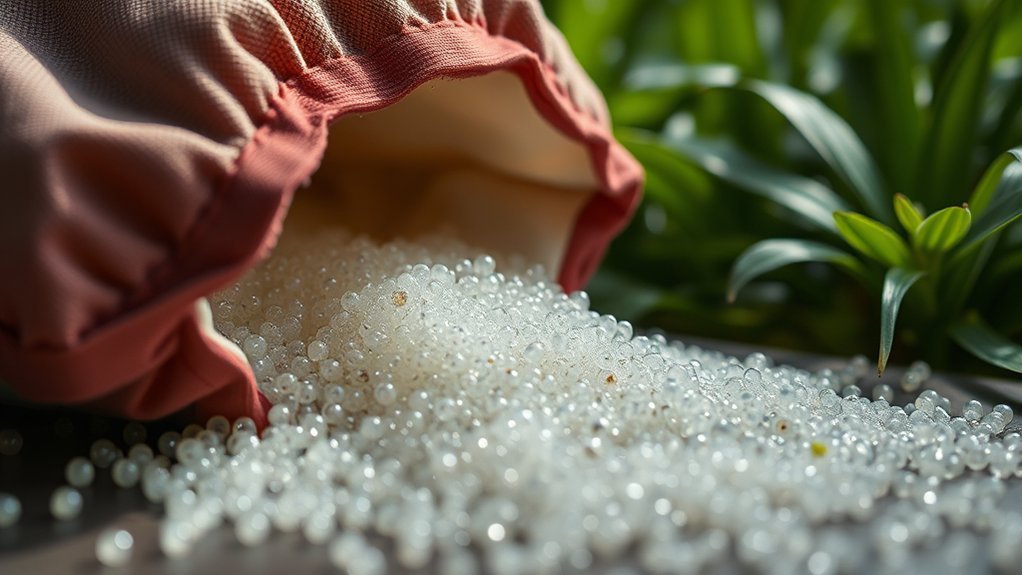
The main environmental concern is the filling itself. Polystyrene is a plastic, and tiny beads that escape from a damaged pillow or are improperly discarded can become persistent plastic debris. Beads smaller than 5 millimeters also fall within NOAA’s general size definition for microplastics.
Once small plastic pieces reach waterways, wildlife can mistake them for food. NOAA notes that microplastics occur throughout marine and freshwater environments and can be eaten by organisms ranging from zooplankton and shellfish to fish and larger animals.
EPA’s national municipal-solid-waste data show that the United States generated 35.7 million tons of plastic materials in 2018, equal to 12.2% of total municipal solid waste generated that year.
That EPA figure describes the overall U.S. plastic waste stream rather than microbead pillows specifically, but it shows why preventing small plastic products from becoming litter matters. EPA also reports that about 27 million tons of plastic entered landfills in 2018.
Note: Pillow microbeads should not be confused with the legal definition used in the Microbead-Free Waters Act of 2015. That federal law targets solid plastic particles intentionally used to exfoliate or cleanse in rinse-off cosmetics and certain nonprescription drug-cosmetic products. It does not prohibit polystyrene beads simply because they are used as pillow filling.
What’s Inside Your Microbead Pillow?
Microbead pillows are commonly filled with very small expanded-polystyrene foam beads enclosed in a stretchy synthetic fabric. Because each bead can move independently, the filling shifts when you press on it. This lets the pillow conform to different positions without using a solid block of foam.
The feel depends on bead size, fill quantity, fabric stretch, pillow shape, and how tightly the shell is packed. A loosely filled pillow may feel soft and highly moldable, while a densely filled design can feel noticeably firmer.
Some products are marketed as hypoallergenic, particularly as an alternative to feather or down filling. Treat that as a product-specific claim rather than a guarantee that every microbead pillow will work for every person with allergies. The cover fabric, accumulated dust, dyes, finishes, and other materials can also affect comfort and sensitivity.
With repeated compression, a pillow may gradually feel flatter or less supportive. There is no reliable universal lifespan for all microbead pillows, so condition is more useful than age when deciding whether to replace one.
Microbead vs. Other Travel Pillows: A Comparison
Microbeads are only one way to build a travel pillow. Memory foam, polyester fiber, inflatable chambers, and natural hull fillings each solve the portability-versus-support problem differently.
| Fill Type | Travel Strengths | Main Trade-Offs | Cleaning |
|---|---|---|---|
| Microbeads | Light, squishy, highly moldable | Plastic fill can escape if the shell tears; support varies with fill level | Varies by manufacturer |
| Memory foam | More structured support; many compress for packing | Can be bulkier and may also have a new-foam odor | Usually removable cover; foam-care instructions vary |
| Inflatable | Smallest packed size and adjustable firmness | Less cushioned feel; vulnerable to leaks or punctures | Usually wipe-clean; follow valve and cover instructions |
| Buckwheat hulls | Firm, moldable support with airflow between hulls | Heavier and may rustle when moved | Hull filling generally stays dry; remove it before washing the cover |
| Polyester fiberfill | Soft, inexpensive, widely available | May compress or clump with use | Many designs are washable, but check the label |
If reducing plastic fill is your priority, a buckwheat-hull pillow is one option. The hull filling is plant-based and can be biodegradable, although the environmental profile of the complete pillow still depends on its cover, zipper, packaging, shipping, and eventual disposal. Buckwheat hulls also should not simply be thrown into a washer; makers commonly instruct users to remove the hulls and wash only the fabric case.
How Can You Maintain Your Microbead Travel Pillow?
The safest cleaning rule is simple: read the care label first. There is no universal washing method for microbead pillows. Some products are designed for machine washing, while others are labeled for spot cleaning only.
When the manufacturer permits machine washing, follow its stated water-temperature, cycle, detergent, and drying instructions exactly. When the label says spot clean, do not assume that another brand’s washing instructions apply to yours.
Pro Tip: A removable, washable cover is one of the most useful features to look for when buying a travel pillow. It lets you clean the surface that contacts your face and neck without repeatedly washing the bead-filled inner pillow.
| Maintenance Task | Frequency | Tips |
|---|---|---|
| Spot Cleaning | As needed | Use the cleaner and method allowed by the care label |
| Airing Out | When odor or dampness is noticeable | Use a dry, well-ventilated area away from excessive heat |
| Pillowcase Washing | Regularly during frequent use | Follow the removable cover’s own care label |
| Check for Damage | Before and after trips | Inspect seams, fabric, closures, and any bead leakage |
| Store Properly | When not in use | Store clean and completely dry without crushing sharp objects against it |
Warning: Stop using a microbead pillow if the fabric or seams tear and beads can escape. Small polystyrene beads should be kept away from young children and pets. The U.S. Consumer Product Safety Commission has documented inhalation and suffocation hazards when similar loose polystyrene beads became accessible in bean-filled products.
User Experiences With Microbead Pillows: Comfort and Concerns
Whether a microbead pillow feels comfortable depends heavily on how full it is and how much support you expect. The moving beads allow the pillow to change shape quickly, which can be useful when you want to position it behind your neck, head, lower back, or shoulder.
The same movement can be a drawback for someone who prefers a pillow that holds one fixed contour. As the pillow is compressed, you may need to redistribute the beads to restore the shape you want. Some people also notice the texture or sound of the beads moving inside the cover.
Odor is another possible concern with new EPS-filled products. A noticeable smell should be treated separately from the question of whether the pillow is comfortable. If a new pillow has an unpleasant odor, follow the manufacturer’s instructions and allow it to air in a well-ventilated space before deciding whether to keep using it.
Are Microbead Pillows Safe for Long-Term Use?
There is not enough evidence to label all microbead pillows either completely harmless or inherently dangerous during ordinary use. The more useful approach is to separate the known issues: EPS products can release volatile compounds, escaped beads are a physical hazard and pollution concern, and product construction and care vary significantly.
Off-Gassing and Styrene Concerns
Polystyrene is made from styrene, and finished polystyrene products can contain small amounts of unreacted styrene. A 2020 peer-reviewed study of products containing expanded-polystyrene beads, including pillows, cushions, and soft toys, measured emissions of styrene and several other volatile compounds. The researchers also found that emissions increased as test temperature increased.
That evidence supports saying that EPS-filled products can be a source of indoor VOC emissions. It does not mean every microbead travel pillow creates a dangerous exposure during normal use. Actual exposure depends on the product, concentration, ventilation, temperature, time, and other sources of VOCs in the surrounding air.
The CDC/NIOSH chemical-hazard guidance for styrene lists effects such as eye and respiratory irritation, headache, dizziness, and drowsiness at sufficient exposure levels. Those occupational hazard descriptions should not be interpreted as proof that a consumer pillow will cause the same symptoms.
If a new pillow produces a strong odor that bothers you, stop using it temporarily and air it in a well-ventilated location. Return or replace it if the odor remains unacceptable rather than trying to mask the smell with fragrances.
Environmental Impact Considerations
The most straightforward way to reduce the environmental risk while owning a microbead pillow is to keep its filling contained. Inspect weak seams and worn fabric before traveling, and retire the pillow when the casing can no longer securely hold the beads.
- Do not intentionally empty polystyrene beads outdoors or into a drain.
- Keep a damaged pillow contained so loose beads do not spread through a home, vehicle, airport, or outdoor area.
- Check local waste or recycling rules before disposal because acceptance of expanded polystyrene varies by location.
- If avoiding plastic fill is a priority, consider a plant-based hull pillow or another reusable travel-pillow design with replaceable components.
What Should You Look for When Buying a Microbead Travel Pillow?
A good travel pillow is not just about the filling. Construction often matters more than broad marketing claims.
- Secure seams: Look for tight stitching and no visible weak points where beads could escape.
- Removable cover: This makes routine cleaning much easier.
- Clear care label: Avoid guessing whether the inner pillow can be washed or dried.
- Appropriate fill level: Softer, less-filled designs are easier to reshape; fuller designs tend to feel firmer.
- Useful shape: A U-shaped pillow may suit upright airline seating, while a small bolster can work behind the neck or lower back.
- Packability: Compare the actual packed volume, not just the advertised weight.
- Return policy: This is useful when you are sensitive to odor, texture, noise, or firmness.
When Should You Replace a Microbead Pillow?
There is no evidence-based rule that every microbead pillow lasts a fixed two or three years. Replace yours based on its condition instead.
It is time to retire the pillow when seams are opening, beads are escaping, the outer fabric is badly worn, the filling remains permanently flattened, the pillow no longer gives adequate support, or an odor remains objectionable after following the manufacturer’s airing and care directions.
Frequently Asked Questions
Can microbead pillows be machine washed or dried?
Some can and some cannot. Check the sewn-in care label for your exact pillow. If the manufacturer specifies spot cleaning only, do not machine wash it. If machine washing or drying is permitted, follow the stated cycle, water-temperature, detergent, and heat instructions.
How do microbead pillows compare in weight to traditional pillows?
Microbead travel pillows can be lightweight, but there is no universal weight advantage over every foam, fiberfill, or inflatable design. Compare the listed weight and packed size of the specific pillows you are considering.
Do microbead pillows have an odor when new?
Some EPS-filled products can have a noticeable odor. Research has measured styrene and other volatile compounds emitted from products containing expanded-polystyrene beads. If the smell bothers you, air the pillow in a well-ventilated area according to its care instructions and return it if the odor remains unacceptable.
How long can I expect a microbead pillow to last?
There is no dependable lifespan that applies to every microbead pillow. Construction, fill quantity, frequency of use, storage, and cleaning all matter. Replace the pillow when seams weaken, beads leak, the fabric deteriorates, or the filling no longer provides adequate support.
Are microbead travel pillows banned in the United States?
The federal Microbead-Free Waters Act does not ban pillow filling. Its definition covers certain solid plastic particles intentionally used to exfoliate or cleanse in rinse-off cosmetics and related nonprescription drug-cosmetic products.
What should I do if a microbead pillow starts leaking?
Stop using it and keep the loose filling away from children and pets. Contain the damaged pillow and escaped beads so they cannot spread outdoors or enter drains. Replace or securely repair the pillow only if the manufacturer provides an appropriate repair method.
Conclusion
Microbead travel pillows can be practical when you want a lightweight, moldable cushion, but the trade-offs are worth understanding. Their polystyrene filling creates a plastic-waste concern if beads escape, cleaning instructions vary by product, and EPS-filled products can emit small amounts of volatile compounds.
Before buying or keeping one, check the care label, seam quality, removable-cover design, fill firmness, and how you react to any initial odor. Replace a damaged pillow before beads begin leaking. Travelers who would rather avoid polystyrene can compare memory foam, inflatable, fiberfill, and buckwheat-hull designs to find the combination of support, packability, cleaning, and environmental impact that best fits their travel comfort needs.
Sources
- U.S. Food and Drug Administration — The Microbead-Free Waters Act FAQs — defines which plastic microbeads are covered by the federal rinse-off cosmetics law.
- U.S. Environmental Protection Agency — Plastics: Material-Specific Data — source for the 2018 U.S. plastic generation, landfill, and recycling figures.
- NOAA Marine Debris Program — Microplastics — explains the under-5-mm definition, environmental persistence, and wildlife ingestion concerns.
- Environmental Science and Pollution Research — Emission Fluxes of Styrene Monomers and Other Chemicals for Products Containing Expanded Polystyrene Beads — peer-reviewed measurements of VOC emissions from EPS-bead pillows, cushions, and soft toys.
- CDC/NIOSH — Pocket Guide to Chemical Hazards: Styrene — toxicology and exposure-effect context for styrene.
- U.S. Consumer Product Safety Commission — Polystyrene Bead Product Recall — documents inhalation and suffocation hazards when loose polystyrene beads become accessible to children.
