

Last Updated on July 24, 2026 by Mason Reed
Pulling a tarp from your pack should not start with ten minutes of untangling cord. The easiest fix is to bundle each line the same way every time, keep the release end easy to find, and store each bundle so it cannot mix with the others. A figure-8 hank works well because it reduces built-up twist and opens quickly at camp.
Quick Answer
Wrap each guyline in a figure-8 around your thumb and pinky, leave a short tail, then use that tail to secure the middle with an easy-release tuck. Store each finished hank separately or against its tarp tie-out. Match the cord diameter to your tensioners, and dry dirty or wet lines before long-term storage.
Key Takeaways
- Use a figure-8 hank instead of winding the cord repeatedly in one direction.
- Secure the bundle with a quick-release tail, not a tight permanent knot.
- Keep attached guylines beside their own tie-out so separate lines cannot knot together.
- Choose cord by grip, stretch, visibility, and hardware compatibility, not fiber name alone.
- Inspect for cuts, glazing, fuzzy areas, hard spots, and damaged tensioners before each trip.
At a Glance
| Time Required | About 30 to 60 seconds per short guyline after practice |
| Difficulty | Easy |
| Tools Needed | None; a small stuff sack, tie-out pocket, or reusable keeper is optional |
| Cost | $0 with your existing guylines; replacement cord varies |
What’s in This Article
- Why Organized Guylines Matter
- Choosing the Right Guyline Material
- What to Do Before You Wrap
- How to Do the Figure-8 Wrap
- How to Release the Bundle
- How to Store Your Wrapped Guylines
- Troubleshooting Guyline Tangles
- Common Mistakes to Avoid
- Tarp Packing Tips for Faster Setup
- Frequently Asked Questions
- Sources
Disclosure: As an Amazon Associate I earn from qualifying purchases. Some links on this page are affiliate links, at no extra cost to you.
Why Organized Guylines Matter

Tangled guylines turn a quick shelter pitch into a frustrating job, especially when wind or rain is moving in. A consistent storage method lets you find the working end, release the cord, and reach a stake or anchor without pulling several lines into one knot.
Organization also makes inspection easier. When each line is separate, you can quickly see fraying, cuts, melted or glazed spots, and damaged tensioners. REI’s tent setup guidance also recommends carrying extra cord, stakes, and tensioners when conditions may require a longer or additional guyline.
The best storage method is the one you can release in seconds while wearing cold or wet gloves.
Choosing the Right Guyline Material
Fiber type matters, but it is only one part of cord handling. Construction, coating, diameter, stiffness, visibility, knot choice, and tensioner design can all change how a line behaves. Always check the diameter range listed for your linelock or tensioner before replacing the original cord.
Dyneema and Spectra are brand names used for high-modulus polyethylene fibers. These fibers are known for high strength, low stretch, and abrasion resistance. However, a very thin, slick line can be harder to grip and may not hold in hardware designed for thicker cord. For example, Samson lists Zing-It in 1.75 mm and 2.2 mm sizes and describes its coated HMPE construction as low-stretch, abrasion-resistant, and low-friction.
Pro Tip: Bright or reflective cord is easier to see with a headlamp. It can reduce accidental trips, but you should still route lines away from paths and camp work areas.
| Cord Type | Handling Traits | Main Trade-Off | Best Fit |
|---|---|---|---|
| Coated HMPE cord | Light, low-stretch, smooth, and often firm | Thin sizes can be slippery and may not fit every tensioner | Ultralight tarps and compatible hardware |
| Polyester accessory cord | Good grip, moderate stretch, and easy handling | Usually heavier than very thin HMPE cord | General tent and tarp use |
| Nylon accessory cord | Flexible, grippy, and widely available | More stretch can require retensioning | Budget and general-purpose setups |
| Braided mason line | Inexpensive, light, and easy to see in bright colors | Outdoor durability, grip, and strength vary by product | Low-cost experiments after testing |
Warning: Tent and tarp guylines are shelter components, not life-safety ropes. Do not use them for climbing, rappelling, suspending people, or any load that could cause injury if the line fails.
What to Do Before You Wrap
A neat figure-8 starts with a line that is ready to store. Use this short check before making the bundle:
- Brush or shake off grit that could wear the cord or jam a tensioner.
- Loosen the linelock so the cord is not stored under tension.
- Decide whether the line will stay attached to the tarp or be stored separately.
- Untwist the cord by running it loosely through your fingers.
- Leave enough tail to finish and release the bundle.
If your line stays attached, start close to the tarp tie-out and work toward the stake end. This keeps the secured bundle beside the correct attachment point. If you remove your lines, label different lengths with small colored thread, heat-shrink markers, or separate pockets rather than tying identification knots into the cord.
How to Do the Figure-8 Wrap
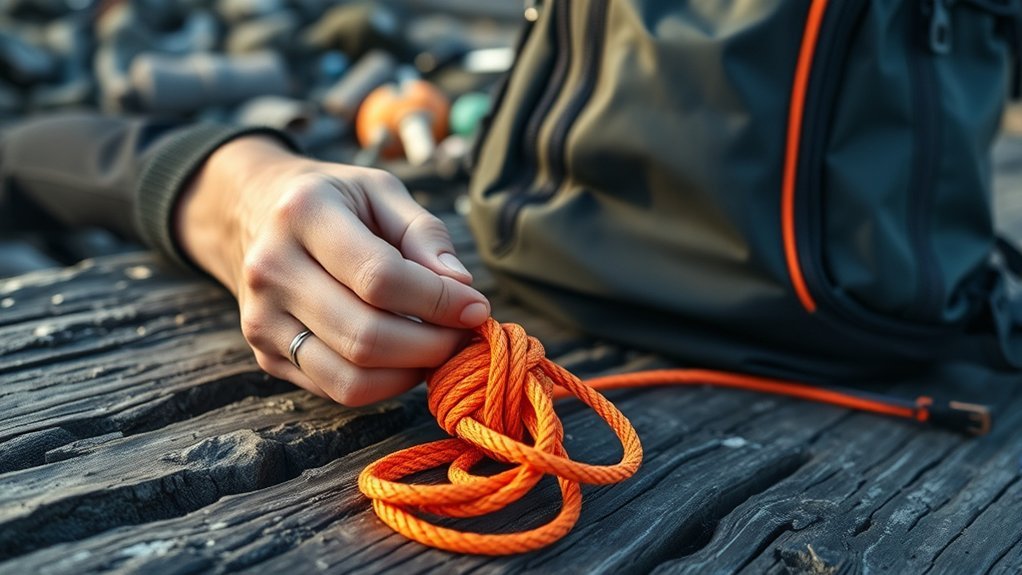
This method makes a figure-8 hank, not a figure-eight knot. The cord passes around two fingers in alternating directions, which helps it pay out with less twist than a same-direction coil.
- Hold the starting end. Pin the tarp end under your thumb, or pinch the first few inches between your thumb and palm.
- Spread your thumb and pinky. Make an open hand shape with enough space for an even bundle.
- Wrap the first diagonal. Carry the line across your palm, around your pinky, and back across the palm.
- Complete the figure-8. Pass the line around your thumb, then return toward your pinky.
- Repeat with light tension. Keep each wrap flat and even. Do not pull hard enough to crease the cord or trap a tensioner inside the bundle.
- Stop with a short tail. Leave about 8 to 12 inches of cord, or enough to wrap several times around the center.
- Remove and pinch the hank. Slide the figure-8 off your fingers while holding its narrow center.
- Wrap the middle. Wind the remaining tail around the center three to five times.
- Make an easy-release tuck. Form a small bight in the tail and push it under the final center wrap. Pull only enough to keep the hank closed.
Note: Do not cinch the finishing tuck into a hard knot. Thin or dirty cord can become difficult to release after it has been wet and loaded.
How to Release the Bundle
Find the small release bight or tail at the center of the hank. Pull it out from under the last wrap, unwind the center turns, and hold the tarp end while the rest of the line drops or feeds toward the anchor. Do not throw the bundle through brush, since branches can pull loops through one another.
If the hank does not open cleanly, set it down and separate the outer loops before pulling harder. A hard tug on the wrong strand can turn a loose crossing into a real knot.
How to Store Your Wrapped Guylines
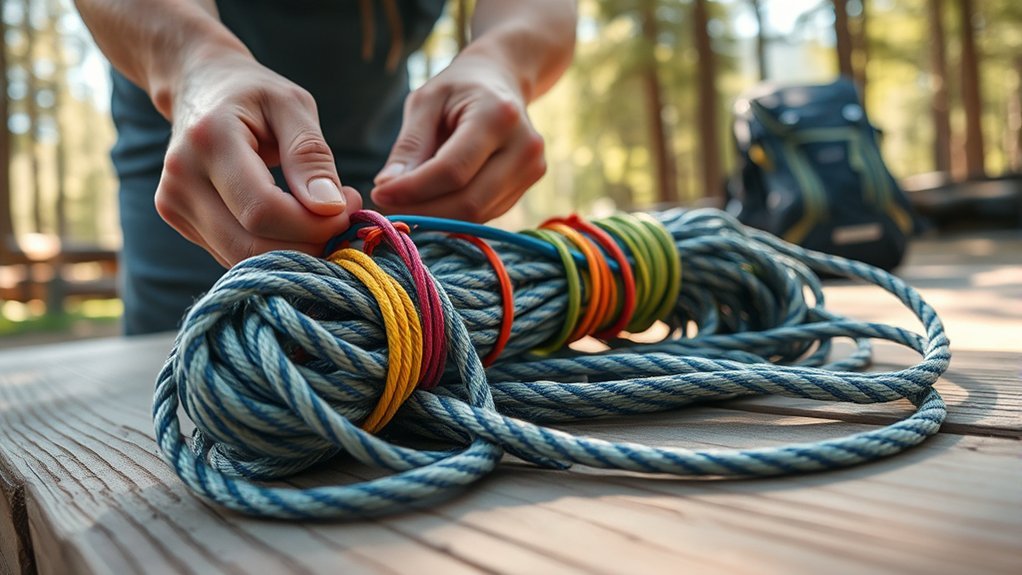
Wrapped lines still need separation. Choose the storage method that matches your shelter and packing routine:
- Attached to the tarp: Place each hank beside its own tie-out before folding or rolling the tarp.
- Small tie-out pockets: Use built-in pockets when your tarp provides them, but do not force wet cord into a sealed pocket.
- Separate stuff sack: Put individual hanks into a small breathable sack, with stakes in a different sleeve so sharp edges do not damage the cord or tarp.
- Sleeve-style tarp storage: Products such as Hennessy Hammock SnakeSkins can contain a rainfly and its guylines when the lines are laid into the fly folds before the sleeves are pulled over it.
- With individual stakes: This can speed setup, but cover sharp stake points and avoid wrapping cord tightly around edges that may cause wear.
Warning: If you must pack wet guylines in the field, unpack and air-dry them as soon as practical. Dirt and moisture trapped with the tarp can cause odor, mildew smells, and coating damage during storage.
| Habit | When to Do It | Why It Helps |
|---|---|---|
| Make a fresh figure-8 hank | Every pack-up | Keeps loops controlled for the next pitch |
| Inspect the full cord and hardware | Before each trip and after severe weather | Finds damage before the shelter depends on it |
| Dry lines and tarp fully | After wet use and before long-term storage | Reduces odor, mildew, and coating damage |
Troubleshooting Guyline Tangles
The Bundle Opens Inside the Stuff Sack
Use a longer finishing tail, add one more center wrap, and tuck a bight under the final wrap. The finish should hold the hank closed without becoming a tight knot. A small reusable silicone band can also help, but avoid disposable rubber bands that may break or stick to fabric after long storage.
The Cord Twists as It Pays Out
Make sure you are alternating around the thumb and pinky rather than making repeated circles. Also release the hank from the same end you used as the finishing tail. If a removable line already contains twist, stretch it out loosely and let it rotate before wrapping again.
Several Attached Lines Knot Together
Move each finished hank against its own tie-out before folding the tarp. Fold one side at a time and keep the bundles inside separate folds. Do not place all loose tails in the middle of the tarp.
A Thin Line Slips Through the Tensioner
Stop using that combination until you confirm the hardware’s recommended cord diameter. A wrapping method cannot fix a line that is too thin, too slick, or worn for its linelock.
The Line Is Dirty or Hard to Inspect
Wash it gently in lukewarm water with mild soap, rinse it well, and air-dry it away from direct heat. Petzl’s synthetic-rope cleaning guidance warns against strong solvents, stain removers, and degreasers. Follow the shelter or cord manufacturer’s instructions when they differ.
Common Mistakes to Avoid
- Stuffing several loose guylines into one pocket.
- Confusing a figure-8 hank with a figure-eight knot.
- Pulling the finishing tuck so tight that it jams.
- Wrapping around a stake edge that can cut or flatten the line.
- Choosing replacement cord without checking linelock compatibility.
- Assuming all Dyneema, Spectra, nylon, or polyester cords handle the same way.
- Storing wet lines and tarp fabric for days without drying them.
- Ignoring fuzzy areas, cuts, glazing, hard spots, or slipping hardware.
Tarp Packing Tips for Faster Setup
- Practice the complete pitch and pack-up at home before the trip.
- Keep guylines attached when your shelter design allows it and when that method makes setup faster for you.
- Shorten adjustable lines before wrapping, but release heavy tension from the hardware.
- Use the same pocket, sleeve, or sack on every trip.
- Store spare cord separately so it does not mix with the working guylines.
- Pack stakes where their points cannot rub against cord or shelter fabric.
- Carry a little extra cord for unusual anchors or a damaged section, as recommended in REI’s tarp shelter guide.
Frequently Asked Questions
How often should I check my guylines for wear?
Inspect them before each trip, during pack-up after severe weather, and whenever a line rubbed against rock, bark, metal, or a sharp stake. Replace a line when you find cuts, melted or glazed areas, major fuzzing, hard spots, or damage that makes its strength uncertain.
Can I use guylines of different lengths on the same tarp?
Yes. Corners, side pull-outs, doors, and ridgelines often need different lengths. Mark or separate them so you can identify each line quickly, and make sure every line is long enough to reach a suitable anchor without forcing a poor angle.
What is the best way to clean dirty guylines?
Use lukewarm water and a small amount of mild soap, then rinse thoroughly. A soft brush can remove grit from non-damaged cord. Air-dry the line in a ventilated place away from direct heat before wrapping and storing it.
Does the material change how much a guyline tangles?
It can affect handling, but construction and storage method matter too. Firm, coated cord may hold a neat hank well, while very soft cord can collapse into loose loops. Very thin, slick cord may still tangle or slip through incompatible hardware, so test the complete system.
How do I choose the right length for my guylines?
Start with the shelter manufacturer’s recommendation. Add enough reach for the terrain and anchor options you expect, but avoid carrying large amounts of unused line at every tie-out. Extra cord can be stored separately for trees, rocks, snow anchors, or repairs.
Should I keep guylines attached to the tarp?
Either method can work. Attached lines usually speed setup and reduce the chance of leaving cord behind. Detached lines can make drying, replacement, and custom rigging easier. The important part is to bundle each line separately and keep it with the correct tie-out or label.
Is a figure-8 wrap the same as a figure-eight knot?
No. A figure-8 wrap, also called a figure-8 hank, is a storage pattern made around two fingers or two points. A figure-eight knot is a load-bearing knot form. For storage, you want an easy-release hank, not a tightly dressed knot.
A figure-8 hank is a simple habit, not a guarantee against every tangle. Pair it with an easy-release finish, compatible cord and hardware, separate storage, and a quick inspection before each trip. Once the method becomes automatic, your guylines should come out of the pack ready to deploy instead of tied together.
Sources
- REI Co-op: How to Set Up a Tent: guyline placement, extra cord, stakes, and tensioners.
- Samson Rope: Lash-It and Zing-It: HMPE construction, available diameters, coating, stretch, friction, and abrasion traits.
- Honeywell Advanced Materials: Spectra Fiber Cordage Brochure: Spectra fiber strength, elongation, abrasion, water, and friction properties.
- Petzl: How Do I Wash a Rope?: mild-soap cleaning, rinsing, and air-drying guidance for synthetic rope.
- Hennessy Hammock: SnakeSkins: sleeve-style rainfly packing with guylines laid into the fly.
- REI Co-op: How to Clean, Waterproof, and Care for a Tent: drying and storage guidance that reduces mildew and coating damage.
