

Last Updated on August 26, 2026 by Mason Reed
Choosing a family camping tent is less about finding the biggest capacity number and more about making sure your family, sleeping setup, gear, and campsite actually fit. Start with the number of sleepers, then compare floor dimensions, peak height, doors, vestibules, weather protection, setup requirements, packed size, and the conditions in which you expect to camp.
Quick Answer
Treat a tent’s listed capacity as a close-fit sleeping estimate, not a comfort rating. For family car camping, sizing up one capacity class often provides useful room for children, pets, cots, and gear. Also compare the actual floor dimensions, peak height, weather protection, doors, vestibules, setup system, and campsite footprint before buying.
Key Takeaways
- Tent capacity tells you roughly how many people can sleep inside; it does not guarantee comfortable living or gear space.
- A family of four may prefer a six-person car-camping tent, but actual floor dimensions matter more than a universal sizing formula.
- Check whether your sleeping pads, cots, mattresses, pets, and indoor gear will physically fit.
- For most fair-weather family trips, a three-season tent is the practical starting point; severe winter conditions require a shelter designed for those conditions.
- Ventilation, rainfly coverage, doors, vestibules, guylines, storage, and easy setup can matter as much as raw floor area.
- Before buying a very large tent, verify that it fits the tent pad or designated camping area at places you expect to visit.
At a Glance
| Time Required | About 20–30 minutes to compare your family, sleeping layout, campsite, and shortlisted tents |
| Difficulty | Easy to moderate |
| Tools Needed | Tape measure plus the dimensions of your sleeping pads, cots, or mattresses |
| Cost | Varies widely by capacity, construction, weather protection, materials, and brand; compare current prices after identifying your must-have features |
Disclosure: As an Amazon Associate I earn from qualifying purchases. Some links on this page are affiliate links, at no extra cost to you.
Assessing Your Family Size and Comfort Needs
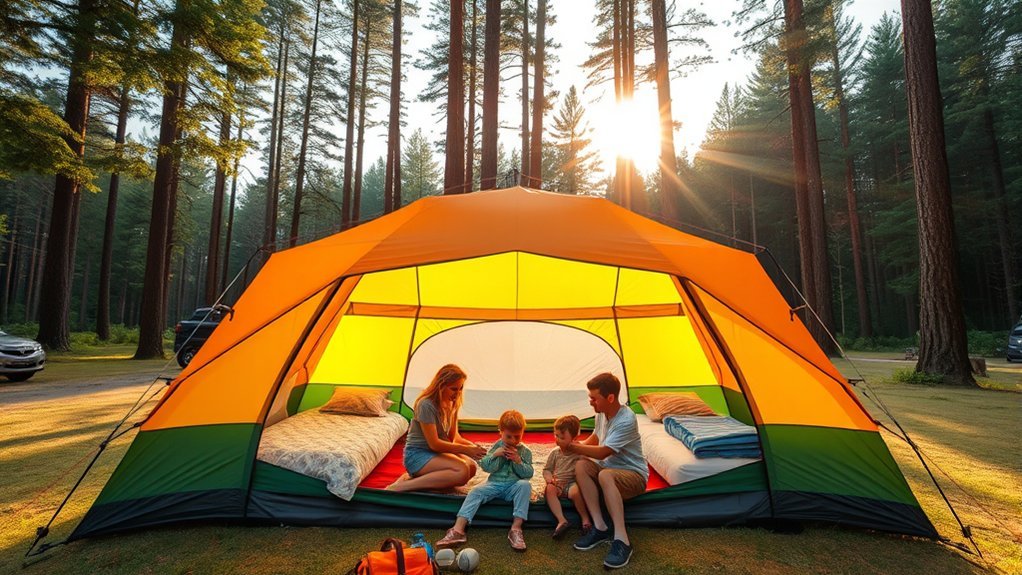
When choosing a family camping tent, start with the people who will actually sleep inside. Count adults and children, then include pets and occasional guests. Next, decide how much personal space your family needs. A tight sleeping arrangement may work for one night, while a weeklong campground stay usually benefits from more room to change clothes, organize equipment, and move around.
Do not assume that a four-person tent automatically provides comfortable living space for four people and all their belongings. According to REI’s camping-tent guidance, listed capacity is essentially a close-fit estimate. Extra room for gear, pets, playing, or cots is not built into that number.
For example, a family of four may find a six-person car-camping tent much more comfortable than a four-person model. That is a useful rule of thumb, but it is not a universal formula. A roomy four-person design can have different usable dimensions from another manufacturer’s four-person model, so always check the specifications.
Height and wall shape matter too. A high peak does not guarantee standing room throughout the tent. Cabin-style tents with straighter walls tend to preserve more usable headroom near the edges, while many dome designs narrow toward the top. If standing while dressing is important, compare both peak height and wall geometry.
If you have young children, a tent with a divider or separate sleeping zone can offer privacy and help organize bedtime. Families with pets should also decide whether the animal will sleep in the main sleeping area or under a protected vestibule when the tent design and conditions make that appropriate.
Understanding Tent Sizes and Capacities
Capacity is a starting point, not the final answer. There is no universal industry rule that gives every camper the same amount of floor space, so two tents carrying the same capacity label can feel very different inside. Compare the number of sleepers with the tent’s exact length, width, floor area, peak height, and wall shape.
Determine Family Size
Use this simple process instead of automatically doubling your family size:
- Count regular sleepers: Include every adult and child who normally sleeps in the tent.
- Add comfort needs: Consider pets, overnight guests, people who move a lot while sleeping, and anyone who needs more personal space.
- Decide where gear will go: Gear stored inside consumes floor space; gear stored in a vestibule or vehicle may let you use a smaller tent.
- Compare the next size up: For family car camping, moving from a four-person to a six-person model, for example, can provide useful breathing room without requiring a tent twice the nominal capacity.
Pro Tip: Mark a shortlisted tent’s floor dimensions on your floor at home with removable tape. Place your sleeping pads, cots, or mattresses inside the outline. This quickly shows whether the advertised capacity works for your family’s real sleeping setup.
Consider Gear Space
Gear can consume a surprising amount of room. Cots normally need more floor area than compact sleeping pads, and large air mattresses may leave little usable space around the doors. Before buying, check the dimensions of everything you intend to put inside.
Vestibules can reduce indoor clutter by providing covered space outside the sleeping area for footwear and selected equipment. Interior pockets, gear lofts, and hanging loops also keep small items off the floor.
For car camping, tent weight is usually less important than it is for backpacking, but packed size still matters. Large family tents can occupy substantial space in a vehicle and at home between trips. Check the packed dimensions, not only the erected dimensions.
Future Growth Potential
If you expect your family to grow or regularly invite friends or relatives, extra capacity can extend the useful life of your tent. Just avoid buying far more shelter than you need solely for a hypothetical future trip.
Very large tents can require more storage space, take longer to pitch, catch more wind, and be difficult for one person to handle. They can also exceed the dimensions of campground tent pads. Balance future flexibility against how you camp today.
Measure the Floor, Not Just the Capacity Number
When two tents have the same stated capacity, compare their actual usable dimensions. Important measurements include:
- Floor length: Especially important for tall sleepers and long cots.
- Floor width: Determines how many sleeping pads or mattresses can sit side by side.
- Floor area: Useful for broad comparisons, although shape still matters.
- Peak height: Shows the maximum interior height, not necessarily standing height everywhere.
- Wall angle: Straighter walls generally make more of the advertised floor area feel usable.
- Vestibule area: Covered external storage can free sleeping space inside.
If you use an air mattress or cot, measure it before shopping. A tent can technically sleep the advertised number of people on compact pads while being unsuitable for the same number of bulky mattresses.
Check Your Campsite Footprint Before Buying
A bigger tent is only useful when your campsite can accommodate it. The National Park Service notes that campground layouts and tent areas vary, and some locations require tents to remain on designated pads. Some National Park Service campgrounds also specifically warn that larger tents may not fit available pads.
Before buying an oversized cabin or multi-room tent, check the campgrounds you visit most often. Look for:
- tent-pad length and width;
- limits on tents or people per campsite;
- space required for guylines and stakes;
- parking and vehicle limits;
- whether all equipment must remain inside a defined campsite boundary.
Remember that the tent’s listed floor dimensions may not include vestibules, awnings, or extended guylines, so the complete pitched footprint can be larger.
Exploring Different Tent Styles
Choose a tent style according to your camping environment and how your family uses the interior rather than assuming one shape corresponds to a fixed capacity.
Dome tents use curved or crossed poles and often offer a useful balance of packed size, straightforward pitching, and wind-shedding shape. Lower-profile models may perform well in exposed conditions, although actual weather performance depends on the complete structure.
Cabin tents prioritize vertical walls and headroom. They can feel spacious for family car camping, especially when you want room to stand, change clothes, use cots, or create sleeping zones. Their greater height and broad wall surfaces can make careful staking and guying particularly important in wind.
Tunnel tents use a series of arches to create a long interior with generous usable space. Depending on the model, they can provide good sleeping and living zones, but their structural performance depends on correct orientation, staking, and guyline tension.
Canvas and bell-style tents can provide durable, roomy shelters for extended campground stays or glamping-style use. Their trade-offs commonly include substantial weight, packed bulk, longer drying requirements, and more demanding transport.
Tent aesthetics can matter too. Light-colored interiors often feel brighter, while highly visible exterior colors can make a shelter easier to locate. Treat color as a secondary preference after fit, weather protection, ventilation, and construction.
Evaluating Seasonal Suitability
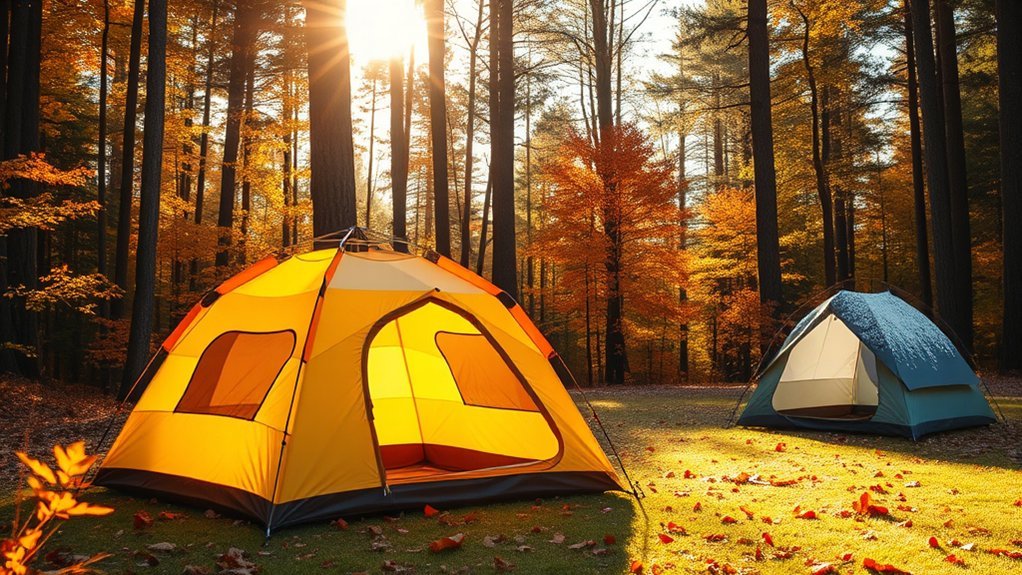
Choosing the right tent also means matching its design to the seasonal conditions you expect. Always check the local forecast and the shelter manufacturer’s intended-use guidance rather than assuming that a large family tent can handle every type of weather.
For most family campground trips in moderate spring, summer, and fall conditions, a properly pitched three-season tent is the practical starting point. Severe winter weather requires a shelter specifically designed for stronger winds, snow loading, and colder conditions.
- Three-season tents: Designed primarily for spring, summer, and fall conditions. Mesh panels and vents generally favor airflow while a properly installed rainfly provides rain protection. They are not intended for sustained severe winter storms or heavy snow loading.
- Extended-season or 3+ season tents: Some models add structural strength and reduce mesh to handle colder shoulder-season conditions while remaining less specialized than a full winter shelter.
- Four-season tents: Built for harsher weather such as strong winds and snow. Stronger structures and reduced mesh can make them warmer and less airy during hot summer trips.
- Local conditions: Wind exposure, thunderstorms, rain, snow, heat, humidity, elevation, and campsite protection all affect the level of shelter you need.
Warning: A camping tent is not safe shelter from lightning. The National Weather Service advises seeking a substantial building or a hard-topped vehicle when thunder or lightning threatens. Know where your safe shelter is before a storm reaches your campsite.
Weatherproofing Details That Matter
Season labels alone do not tell you how dry or stable a tent will feel. Compare the complete weather-protection system:
- Rainfly coverage: A full-coverage fly generally protects more of the tent body than a small roof fly, while partial designs may favor views and ventilation in mild conditions.
- Seams: Check whether critical seams are factory taped, sealed, or require user treatment according to the manufacturer’s instructions.
- Floor design: A durable floor with raised perimeter construction can help reduce exposure to splash and shallow surface water.
- Stakes and guylines: A freestanding frame should still be anchored. Properly tensioned guylines can improve stability in wind.
- Site selection: Avoid low spots where rainwater can collect, dead branches overhead, and other obvious hazards.
The National Park Service recommends setting tents on large, flat areas away from low or sunken ground and following the manufacturer’s pitching instructions. It also advises campers to watch for hazards such as wind, lightning, flash flooding, and dead branches.
Importance of Setup Ease and Time
When you’re camping with children, an uncomplicated setup can make arrival much easier. Instead of relying on a universal setup-time claim, compare each model’s pole design, instructions, number of components, staking requirements, and whether the manufacturer realistically describes one-person pitching.
Quick Assembly Features
Useful setup features include:
- Color-coded poles or sleeves: These make it easier to identify which frame section goes where.
- Clip systems: Clips can simplify attaching the tent body to the frame compared with feeding every pole through a long sleeve.
- Pre-attached or hubbed frames: Common on some instant-style tents, these reduce the number of loose pieces you must identify during assembly.
- Clearly marked rainfly orientation: Helpful when weather arrives before you have finished pitching.
Fast-pitch and instant tents can be convenient, but setup time varies by model and conditions. A very large “instant” tent may still require staking, guying, rainfly attachment, and more than one person in windy weather.
Simplified Instructions
Look for clear visual instructions sewn into the storage bag or supplied with the tent. Before your first trip, complete a full practice pitch at home. Both REI and the National Park Service recommend becoming familiar with setup before relying on the tent in the field.
A home practice also lets you confirm that the poles, stakes, guylines, rainfly, footprint, and other components are present before you reach your campsite.
One-Person Setup Capability
A tent advertised for one-person setup can be useful when one adult needs to pitch while another watches children. Still, assess the tent’s height and width as well as its marketing claim. Large family tents may be difficult for a shorter camper to reach across or lift into position alone.
When possible, watch the manufacturer’s complete setup demonstration rather than a shortened promotional clip. Pay attention to whether staking, rainfly installation, and guylines are included in the demonstration.
Durability and Material Considerations
For family camping tents, durability depends on more than whether the fabric label says nylon or polyester. Fabric weight, weave, coatings, seams, pole construction, UV exposure, abrasion, care, and overall design all influence longevity and weather performance.
Here is a more useful comparison:
| Material or Component | Useful Characteristics | What to Check |
|---|---|---|
| Nylon / ripstop nylon | Can provide strong, relatively lightweight tent fabric | Fabric weight, coating, seam construction, UV exposure, and intended use |
| Polyester | Common in car-camping tents and generally handles UV exposure better than comparable nylon fabrics | Coating, fabric weight, seam treatment, and overall construction |
| Aluminum poles | Commonly provide a favorable strength-to-weight balance and bent sections may be replaceable | Pole diameter, alloy/design, replacement availability, and number of intersections |
| Fiberglass poles | Often used to keep the purchase price down | Weight, replacement sections, joint quality, and suitability for expected wind |
| Canvas / cotton-blend fabric | Can offer durable, comfortable shelter for vehicle-supported camping | Packed weight, drying time, storage requirements, weather treatment, and maintenance |
A footprint can reduce abrasion against the tent floor. If you use a generic tarp instead of a model-specific footprint, tuck it completely beneath the tent so exposed edges do not collect rainwater underneath.
Repairability also deserves attention. Check whether the manufacturer sells replacement pole sections, rainflies, stakes, and other components, and review the warranty before buying.
Features That Enhance Comfort and Functionality
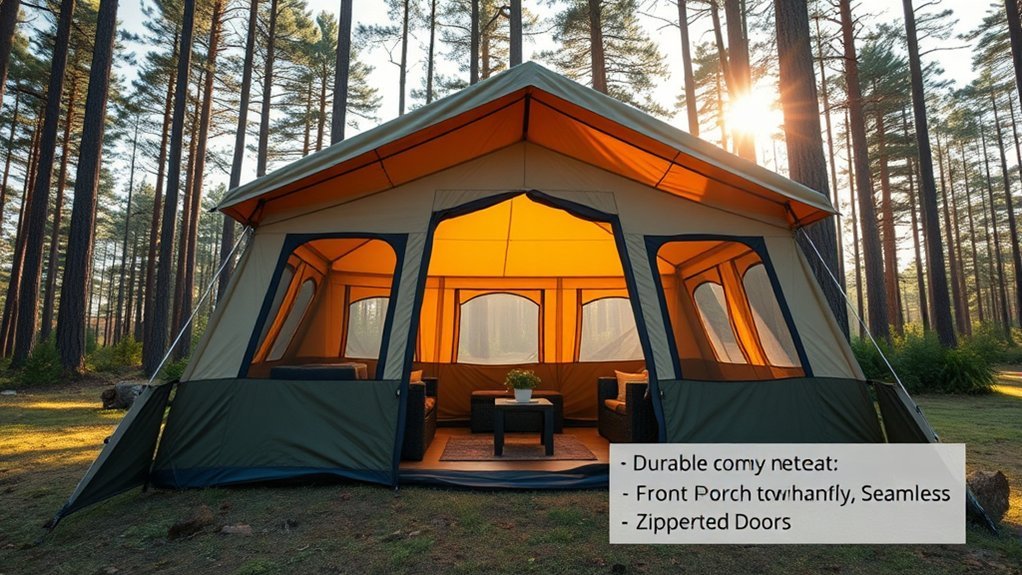
After size and weather protection, compare the features that make a tent easier for a family to live in.
- Ventilation: Mesh panels, adjustable vents, and doors that can create cross-flow help warm, humid air escape and can reduce condensation.
- Family privacy: Dividers or multiple sleeping zones can make bedtime and changing clothes easier.
- Storage: Gear lofts, pockets, vestibules, and hanging loops keep frequently used items organized and preserve floor space.
- Multiple doors: Two doors can reduce the need to climb over sleeping family members during nighttime exits.
- Vestibules or awnings: Covered exterior areas are useful for muddy footwear and selected gear.
- Interior height: Standing room is especially convenient on multi-day family trips.
Ventilation and Condensation
Every sleeping person adds moisture to the air inside a tent. Cool tent fabric can cause that moisture to condense, particularly in humid or cool conditions. A wet inner wall does not automatically mean the rainfly leaked.
For a family tent, look for substantial mesh plus rainfly vents that can remain open while still providing reasonable weather coverage. When conditions allow, increase airflow rather than sealing every opening.
Note: More doors, taller ceilings, larger vestibules, and extra storage usually improve livability, but they may also increase weight, packed size, complexity, and price. Prioritize features your family will actually use.
Car Camping vs. Backpacking Family Tents
Most large family tents are designed for car camping, where the vehicle handles the weight. They prioritize floor area, standing height, storage, and comfort rather than minimum trail weight.
Backpacking shelters make different compromises. They are usually lighter and more compact but offer less interior space and fewer comfort features. If you need to carry a shelter several miles, compare packaged weight, minimum trail weight, packed dimensions, and how the load can be divided among adults.
A large cabin or instant tent that feels easy to carry from the parking spot to a campsite can become impractical on a hiking trail. For true backpacking, choose a shelter specifically intended for that use rather than relying on a conventional family car-camping tent.
Budgeting for Your Family Camping Tent
Set your budget after deciding which features are essential. Tent prices change with brand, capacity, materials, pole construction, weather protection, season rating, and convenience features, so fixed price ranges can become outdated quickly.
For occasional mild-weather camping, you may not need the most expensive shelter. Families who camp frequently or in demanding conditions may benefit from spending more on stronger poles, a better rainfly, quality zippers, repairability, and durable construction.
Remember to budget for accessories that may not come with the tent, including:
- a properly sized footprint or groundsheet;
- stakes suitable for your normal soil conditions;
- additional guylines if recommended by the manufacturer;
- a basic pole and fabric repair kit;
- a mallet if appropriate for your stakes and campground;
- a gear loft or vestibule if sold separately.
Sales can reduce the cost of a quality shelter, but do not buy a poor fit simply because it is discounted. A tent that is too small, too difficult to pitch, or inappropriate for your weather is not good value.
Family Tent Buying Checklist
Before purchasing, run through this checklist:
- Sleepers: How many adults, children, guests, and pets need space?
- Sleeping system: Will you use pads, cots, or air mattresses, and do their dimensions fit?
- Gear: Will equipment stay inside, in vestibules, or in the vehicle?
- Floor dimensions: Does the actual length and width work for your layout?
- Height: Is standing or easy kneeling important?
- Doors: Can family members enter and exit without climbing over one another?
- Ventilation: Are there enough mesh panels and adjustable vents for your normal climate?
- Rain protection: Does the fly, floor, seam construction, and staking system match your expected conditions?
- Setup: Can the adults in your group realistically pitch it?
- Campsite fit: Will the complete footprint fit the tent pads at your usual campgrounds?
- Transport: Will the packed tent fit comfortably in your vehicle and storage area?
- Repairability: Are replacement poles, parts, and support available?
Frequently Asked Questions
What are the best brands for family camping tents?
There is no single best brand for every family. Coleman, REI Co-op, The North Face, Big Agnes, Kelty, and other established manufacturers make family or car-camping shelters in different sizes and price ranges. Compare individual models by floor dimensions, weather protection, setup, ventilation, warranty, replacement parts, and your expected conditions rather than choosing by brand name alone.
How do I clean and maintain my camping tent?
Follow the manufacturer’s care instructions. For routine care, gently remove dirt, use suitable mild cleaning products when necessary, and let the tent dry completely before long-term storage. Avoid machine washing or drying unless the manufacturer specifically permits it. Inspect seams, poles, zippers, coatings, and the rainfly periodically, and store the dry tent loosely in a cool, dry location.
Can I use a family tent for backpacking trips?
You can carry any tent that fits your load limits, but most large family car-camping tents are too heavy and bulky for practical backpacking. A purpose-built backpacking shelter normally provides a better balance of packed weight, size, weather protection, and trail comfort. Some smaller crossover models can work if the load is divided among several hikers.
Are there eco-friendly tent options available?
Yes, but sustainability claims vary. Look for manufacturers that clearly disclose recycled materials, fabric treatments, chemical coatings, repair programs, replacement parts, and manufacturing certifications. Durability matters too: a repairable tent that remains useful for many seasons can reduce the need for frequent replacement.
What accessories should I consider for my tent?
Useful accessories can include a correctly sized footprint, appropriate stakes, extra guylines when recommended, a repair kit, gear loft, lantern or headlamp, and a vestibule if the model supports one. Choose accessories for your tent and campsite rather than assuming every trip requires the same equipment.
Should a family of four buy a four-person or six-person tent?
A four-person tent may physically sleep four people, but a six-person car-camping model often gives a family of four more room for movement and gear. Do not rely on the number alone: compare the actual floor dimensions with your sleeping pads or mattresses and make sure the larger tent also fits your intended campsites.
Is a cabin tent or dome tent better for families?
Cabin tents usually prioritize vertical walls, headroom, and spacious car-camping interiors. Dome tents often provide a lower profile and simpler structure. Neither style is automatically better. Choose according to your desired living space, setup preferences, packed size, campsite dimensions, and expected wind and weather.
Conclusion
The right family camping tent is the one that fits your family’s real sleeping arrangement, your normal campsites, and the weather you expect—not simply the model with the largest person rating. Start with capacity, then verify floor dimensions, headroom, doors, vestibules, ventilation, rain protection, setup, packed size, and repairability.
For family car camping, sizing up one capacity class often creates useful comfort, but measure your pads, cots, or mattresses before deciding. Practice pitching the tent at home, confirm that it fits your campground’s tent area, and choose a shelter designed for the conditions in which you will actually use it. Those checks will do more for comfortable family camping than any single capacity number.
Sources
- REI Co-op — What to Look for in a Camping Tent — tent capacity, floor space, doors, vestibules, ventilation, and family-camping fit.
- REI Co-op — Camping for Beginners — sizing up for comfort and practicing tent setup before a trip.
- REI Co-op — Tent Care Basics — cleaning, drying, storage, footprints, UV exposure, seams, and waterproof coatings.
- U.S. National Park Service — Finding and Setting Up a Campsite — campsite hazards, tent placement, footprints, drainage, and manufacturer setup guidance.
- U.S. National Park Service — What to Bring Camping — tent capacity and the distinction between sleeping space and room for gear or pets.
- National Weather Service — Outdoor Lightning Safety — tents are not safe lightning shelters and campers should seek a substantial building or hard-topped vehicle.
