
Last Updated on September 11, 2026 by Daniel Globe
12-gauge No. 8 shot is a practical choice for clay targets and small upland birds at close to moderate distances. Many combinations work well from about 20 to 35 yards, while 40 yards should be treated as a pattern-testing checkpoint rather than a guaranteed effective limit. Your shotgun, choke, shell, pellet material, target, and shooting conditions all affect the final result.
Quick Answer
Most 12-gauge No. 8 loads perform best on clays, doves, quail, and similar targets from about 20 to 35 yards. Some combinations produce usable patterns near 40 yards, but you should confirm that distance on paper. Improved-cylinder, light-modified, and modified chokes are common starting points.
Key Takeaways
- No. 8 lead shot measures approximately 0.090 inch in diameter and provides about 410 pellets per ounce.
- Its dense pellet count makes it well suited to close and moderate clay targets and small upland birds.
- Choke changes pattern spread and density. It does not add pellet energy or make the shot travel farther.
- A paper pattern from your own shotgun is more useful than a universal yardage claim.
- Check current hunting regulations because lead shot is prohibited for U.S. waterfowl hunting and may be restricted on other lands.
Disclosure: As an Amazon Associate I earn from qualifying purchases. Some links on this page are affiliate links, at no extra cost to you.
What Range Does 12-Gauge #8 Shot Work Best At?
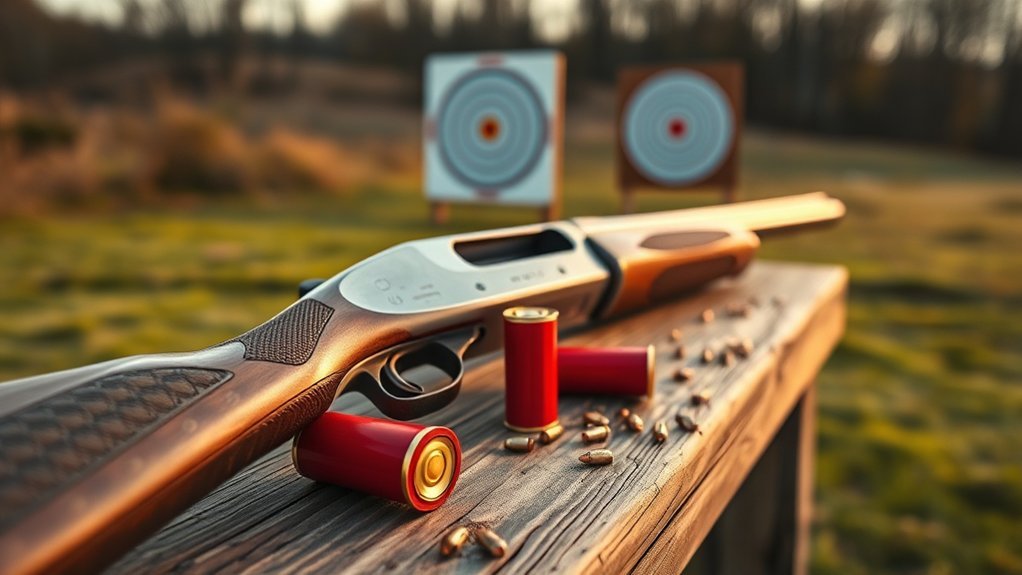
For many clay-target and upland loads, the most useful working range for 12-gauge No. 8 shot is approximately 20 to 35 yards. At those distances, its high pellet count can produce an even pattern while each pellet still has enough energy for appropriate small targets.
Some shotgun, choke, and shell combinations remain effective near 40 yards. Others develop thin areas or large gaps before that point. Texas Parks and Wildlife recommends testing the shotgun at the distance where you expect to shoot and notes that pattern gaps commonly become a concern beyond about 40 yards. A choke cannot correct insufficient pellet energy, and a fast shell cannot correct a poor pattern.
| Approximate Distance | Common Starting Choke | Typical Use |
| 15–25 yards | Skeet, cylinder, or improved cylinder | Close skeet presentations, close sporting targets, or birds in dense cover |
| 20–35 yards | Improved cylinder or light modified | General clays, dove, quail, and other suitable small game |
| 30–40 yards | Light modified or modified | Longer clay presentations or open-field upland shots after pattern testing |
| Beyond 40 yards | Do not choose by choke alone | No. 7½ or another suitable load may offer better pellet energy, but legality and paper-pattern results must guide the choice |
Note: Effective hunting range and safe projectile-travel distance are not the same thing. Shot pellets can travel much farther than the distance at which they produce a useful pattern. Always know your target, background, firing zone, and applicable range rules.
Why Does #8 Shot Pattern So Well?
No. 8 shot can create dense patterns because each pellet is relatively small. More pellets fit into a given payload than with No. 7½ shot, giving you more potential impact points across the target area. Pattern quality still depends on pellet hardness, wad design, velocity, choke, barrel, and the individual shell.
Pellet Count Advantage
Under the SAAMI shot-size formula, No. 8 shot has an average diameter of approximately 0.090 inch. Conventional lead loads contain roughly the following pellet counts:
- ¾ ounce of No. 8: approximately 307 to 308 pellets
- 1 ounce of No. 8: approximately 410 pellets
- 1⅛ ounces of No. 8: approximately 460 to 461 pellets
These are approximate figures. Antimony content, plating, pellet uniformity, and alternative shot materials can change pellet weight and the final count.
No. 8 shot offers more pattern coverage than No. 7½, but each pellet is lighter. Its advantage is density, not extra individual pellet power.
Uniform Pattern Density
A large pellet total gives the load the potential to fill a target area evenly. However, a high pellet count does not guarantee a good pattern. Pellets may cluster in the center, leave thin outer areas, or produce random gaps.
Harder, rounder pellets usually resist deformation better than very soft pellets. A well-designed wad may also protect the shot as it moves through the barrel. These factors can improve consistency, but the only dependable way to evaluate the combination is to shoot it on paper.
How to Pattern No. 8 Shot
- Use a safe, authorized shooting area with a suitable backstop.
- Place a clean paper target at the distance you expect to shoot, such as 20, 30, 35, or 40 yards.
- Use paper large enough to show the complete pattern. A 30-inch reference circle is commonly used.
- Mark the target with the shell brand, gauge, payload, shot size, velocity, choke, and distance.
- Fire from a steady position while following all range rules.
- Use a fresh target for each shot and test more than one shell because individual patterns vary.
- Check whether the pattern is centered on your aiming point.
- Look for large gaps, weak edges, and uneven pellet clusters.
- Repeat the test with another choke or load and compare the results.
Pro Tip: Pattern at the actual distance and with the exact shell you intend to use. Changing the manufacturer, payload, velocity, wad, shot material, or choke can change the result even when the box still says No. 8.
How Does #8 Shot Compare to #7½ and #9?
No. 8 sits between No. 7½ and No. 9 in both pellet diameter and pellet count. No. 7½ has fewer, heavier pellets and is often favored for longer clay presentations. No. 9 places more, lighter pellets in the pattern and is commonly useful for close targets. No. 8 provides a balanced middle option.
| Lead Shot Size | Nominal Diameter | Approximate Pellets per Ounce | General Strength |
| No. 7½ | 0.095 inch | About 350 | More individual pellet energy for longer clay targets |
| No. 8 | 0.090 inch | About 410 | Balanced pattern density and pellet energy |
| No. 9 | 0.080 inch | About 585 | Very dense coverage for close clay targets |
Pellet diameter is only part of the comparison. A 1-ounce moderate-velocity No. 8 target shell may feel and perform differently from a 1⅛-ounce high-velocity shell. Choose the complete load rather than judging it only by shot number.
What Choke Works Best With 12-Gauge #8 Shot?
There is no single best choke for every No. 8 load. An improved-cylinder choke is a useful starting point for close targets, while light modified or modified often provides better density as distance increases.
A choke controls how quickly the pattern opens. It does not increase individual pellet energy, and it does not make the shot travel farther. The Texas Parks and Wildlife hunter-education guide recommends patterning the actual shotgun, choke, and shell at the intended distance.
Improved Pattern With Choke
- Skeet or cylinder: Useful for very close, fast clay presentations when a wide pattern is preferred.
- Improved cylinder: A forgiving choice for many targets from approximately 20 to 30 or 35 yards.
- Light modified: A balanced option for general sporting clays and moderate-range upland shooting.
- Modified: Often useful when the target is farther away and the improved-cylinder pattern becomes too thin.
- Full: May produce a very tight pattern, but it should not be selected automatically for No. 8 shot or longer hunting shots.
Best Choke Choices
Start with the choke that fits the expected target distance, then confirm it on paper. If the pattern has large gaps, try a tighter choke or another shell. If the center is excessively dense and the outer pattern is weak at close range, try a more open choke.
Do not assume two shotguns with the same choke marking will print identical patterns. Bore dimensions, choke geometry, barrel condition, wad design, and pellet quality can all affect the result. Winchester likewise advises shooters to test the actual gun-and-load combination because there is no substitute for firing it at a known distance.
When Should You Use #8 Shot in Trap and Skeet?
No. 8 shot is a versatile clay-target choice because it combines a high pellet count with more individual pellet mass than No. 9. It is commonly suitable for skeet, standard trap, sporting clays, and practice sessions where most presentations are close to moderate in distance.
For reduced recoil, look at the complete shell specification. A 7/8-ounce or 1-ounce moderate-velocity load usually produces less recoil than a heavier or faster shell when fired from the same gun. Gun weight, action type, fit, and shooting form also affect felt recoil.
Current association rules still matter:
- The 2026 NSSA Rule Book permits lead shot from No. 7½ through No. 9 and limits the 12-gauge payload to 1⅛ ounces.
- The 2026 NSCA Rule Book also permits lead shot from No. 7½ through No. 9 and limits 12-gauge registered-event loads to 1⅛ ounces.
- Individual clubs may impose stricter shot-size, velocity, material, or ammunition rules.
For longer handicap trap targets or distant sporting presentations, some shooters prefer No. 7½ because its larger pellets retain more individual energy. No. 8 may still pattern well, but the choice should be based on the target presentation, competition rules, and your tested results.
How Do Weather Conditions Affect #8 Shot?
Weather affects the shooter and target presentation more noticeably than it changes the basic identity of No. 8 shot. Strong wind can move lightweight clay targets, change their speed or angle, and make a smooth lead harder to judge. Wind can also affect a shot cloud, especially as distance increases, but you should not rely on a fixed wind correction for every load.
Cold weather can make clothing bulkier, reduce mobility, and change gun mount or cheek position. Keep ammunition clean and dry, and do not fire shells that are swollen, corroded, cracked, water-damaged, or otherwise questionable. Store and use ammunition according to the manufacturer’s instructions.
Warning: Stop shooting during lightning, severe wind, hail, or any condition that makes firearm control, target identification, or range operation unsafe. Follow the range officer’s instructions immediately.
Is 12-Gauge #8 Shot Good for Small Game?
Yes. Lead No. 8 is commonly used for doves, quail, and other suitable small game at close to moderate distances. Its dense pattern helps with small, fast targets, while its light pellets can reduce unnecessary damage compared with much larger shot when the distance and target are appropriate.
However, the correct load depends on the species, presentation, local law, shot material, and the pattern from your shotgun. No. 8 may be too light for larger birds, longer shots, or situations where more penetration is required. It should not be treated as an all-purpose hunting load.
Warning: Lead No. 8 shot is not legal for U.S. waterfowl hunting. Approved nontoxic shot is required, and some public lands also require nontoxic ammunition for dove, quail, rabbit, squirrel, or other upland hunting. Check current federal, state, provincial, tribal, refuge, and property-specific regulations before carrying ammunition into the field.
Steel No. 8 and lead No. 8 are not ballistic equivalents. Steel is less dense than lead, while bismuth and tungsten-based materials have different densities and pattern characteristics. Follow the ammunition manufacturer’s choke guidance and pattern the exact nontoxic load you plan to use.
Firearm and Ammunition Safety
- Keep the muzzle pointed in a safe direction.
- Keep the firearm unloaded until you are at the firing position and authorized to load.
- Keep your finger outside the trigger guard until you are ready to fire.
- Use only ammunition matching the gauge and chamber markings on the firearm.
- Know your target, the surrounding firing zone, and what lies beyond it.
- Wear suitable eye and hearing protection.
- Never mix 12-gauge shells with ammunition of another gauge.
- Follow the firearm manufacturer’s manual and all range-officer instructions.
These principles are consistent with the SAAMI firearm-safety rules. New shooters should receive in-person instruction from a qualified coach, hunter-education instructor, or range professional.
Frequently Asked Questions
What is No. 8 shot good for?
No. 8 shot is commonly used for skeet, trap, sporting clays, dove, quail, and other suitable small game at close to moderate distances. It offers a useful balance between pellet count and individual pellet energy.
What is better, No. 7½ or No. 8 shot?
No. 8 provides more pellets and a denser potential pattern, while No. 7½ provides fewer but heavier pellets. No. 8 is often useful for close and moderate clay targets. No. 7½ may be preferable for longer presentations where individual pellet energy matters more.
What shotgun do Navy SEALs carry?
The Benelli M4 and M1014 are publicly documented military-associated shotgun models, but it is inaccurate to say that every Navy SEAL carries one. Equipment varies by unit, mission, and period. This question is also separate from No. 8 birdshot, which is primarily used for clay targets and appropriate small game.
Is No. 7½ or No. 8 better for sporting clays?
No. 8 is a strong general choice for close and moderate sporting targets because it provides dense coverage. No. 7½ may be better for long or edge-on targets. Many shooters carry both when course rules allow it.
Can you use No. 8 shot at 40 yards?
Some No. 8 loads produce useful patterns at 40 yards, but the distance should be verified with your shotgun, choke, and shell. If the pattern has large gaps or insufficient target coverage, shorten the distance or test another load.
Is No. 8 steel the same as No. 8 lead?
No. Both may share the same nominal pellet diameter, but steel is less dense than lead. Pellet count, retained energy, pattern behavior, choke recommendations, and suitable uses can differ. Pattern the exact shell and follow the manufacturer’s instructions.
Conclusion
12-gauge No. 8 shot is most useful when you need dense coverage for clays or suitable small game at close to moderate distances. A range of about 20 to 35 yards is a practical starting point, while 40 yards should be confirmed through pattern testing.
Choose improved cylinder, light modified, or modified according to the target distance, but remember that choke controls the pattern rather than pellet energy. Match the complete shell to your intended use, follow current competition or hunting rules, and verify the combination on paper before relying on it.
Sources
- SAAMI Shot Size Glossary — supports nominal pellet-diameter calculations.
- Texas Parks and Wildlife: Chokes and Patterns — supports choke function, pattern testing, and practical hunting-distance guidance.
- Winchester Ammunition: Pattern Your Shotgun — supports testing the actual shotgun, shell, and choke combination.
- 2026 NSSA Rule Book — supports registered American skeet shot-size, payload, and safety rules.
- 2026 NSCA Rule Book — supports registered sporting-clays shot-size and payload limits.
- U.S. Fish and Wildlife Service: Approved Nontoxic Shot Clarification — supports current federal nontoxic-shot requirements.
