
Last Updated on July 29, 2026 by Mason Reed
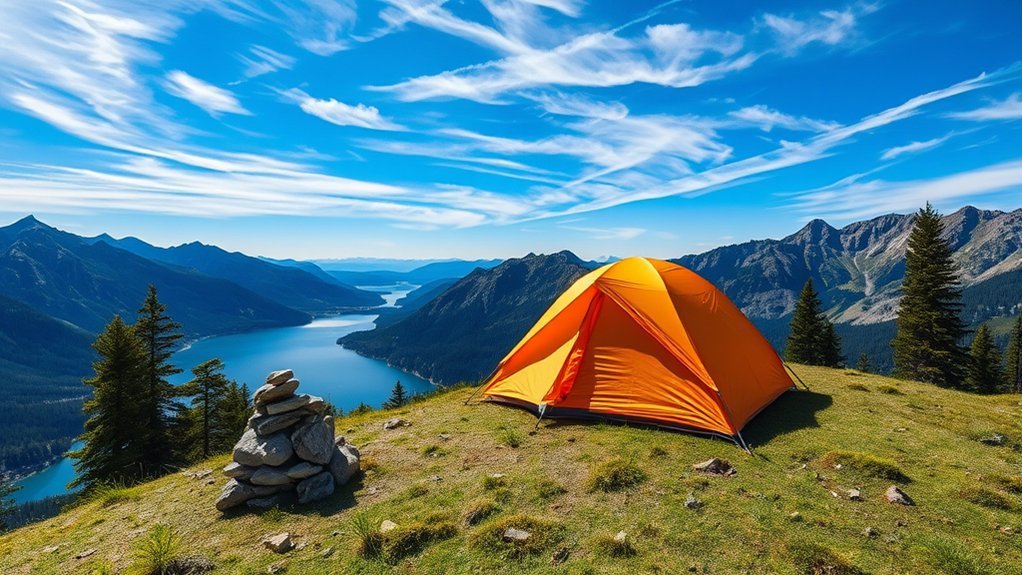
Safe mountain tent placement starts with terrain, not a fixed distance or elevation rule. Before unpacking, check local camping regulations, the weather forecast, drainage, overhead hazards, wildlife signs, wind exposure, and your escape route. A sheltered site can improve comfort, but it must also be dry, durable, legal, and clear of hazards.
Quick Answer
Pitch a mountain tent on a legal, durable, well-drained surface below exposed ridges but outside gullies, washes, floodplains, avalanche paths, and rockfall zones. Inspect nearby trees and overhead limbs, orient the tent according to its manufacturer’s wind instructions, use every required stake and guyline, and keep a safer lightning shelter or evacuation plan available.
Key Takeaways
- Use designated or previously established campsites whenever local rules require or provide them.
- Choose durable, slightly raised ground that drains without placing the tent on a ridge, drainage channel, dry wash, or floodplain.
- Never rely on a tent for lightning protection; identify a sturdy building or hard-topped vehicle before storms arrive.
- Inspect trees, limbs, cliffs, loose rocks, snow slopes, wildlife signs, and wind exposure before pitching.
- Follow your tent manual for wind orientation, stake placement, pole configuration, and guyline use.
- Keep vents open when conditions allow and store wet equipment outside the sleeping area to reduce condensation.
At a Glance
| Time Required | About 10–20 minutes to inspect the area and pitch securely |
| Difficulty | Easy to moderate in normal conditions; advanced in snow, severe wind, or avalanche terrain |
| Tools Needed | Tent manual, complete stake and guyline set, groundsheet if recommended, weather forecast, map, and headlamp |
| Cost | Usually $0 with existing gear; permits and specialized snow or sand anchors may cost extra |
Disclosure: As an Amazon Associate I earn from qualifying purchases. Some links on this page are affiliate links, at no extra cost to you.
How to Choose a Safe Mountain Tent Site
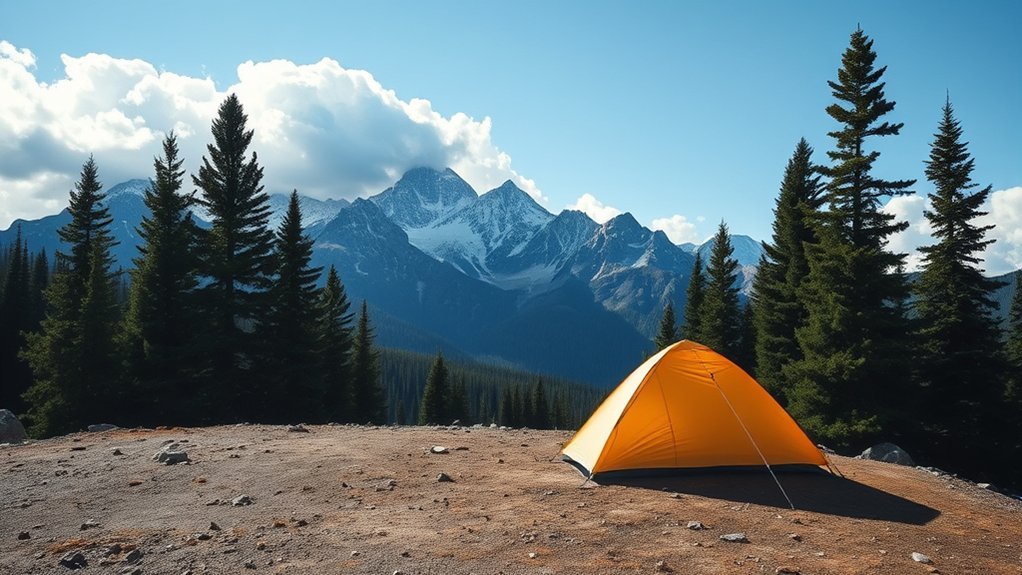
Mountain weather and terrain can change quickly, so choosing the right site is as important as pitching the tent correctly. Do not rely on a universal rule such as camping a fixed number of feet above a valley. Instead, evaluate the complete site and follow all posted restrictions, permit terms, designated-campsite rules, and land-manager instructions.
- Confirm that camping is permitted. Use a designated or established site when required. Check closures, permits, fire restrictions, food-storage rules, and minimum distances from water and trails.
- Choose a durable surface. Previously used tent pads, bare soil, rock, gravel, sand, dry grass, and snow are usually more durable than fragile vegetation. Follow Leave No Trace guidance and local rules.
- Check drainage. Select flat or gently sloping ground that will shed water without channeling it beneath the tent. Avoid depressions, gullies, creek beds, dry washes, floodplains, and the bottom of narrow valleys.
- Look overhead and uphill. Check for dead limbs, leaning or damaged trees, loose rocks, unstable slopes, cliff bands, cornices, and anything that could fall or roll into camp.
- Assess wind exposure. Avoid ridge crests, saddles, cliff edges, broad treeless benches, and obvious wind funnels when a safer sheltered option is available.
- Check for wildlife activity. Avoid active game trails, feeding areas, carcasses, berry patches, fresh tracks, droppings, or heavily used access routes to water.
- Plan for lightning and evacuation. Know how you will reach a sturdy building, hard-topped vehicle, or safer terrain before a storm arrives.
- Test the sleeping surface. Lie down before fully pitching to check slope, hidden rocks, roots, and whether your head will be higher than your feet.
Warning: A tent provides no protection from lightning. If thunder is audible, move to a substantial building or hard-topped vehicle when one is accessible. Do not shelter beneath an isolated tree, on an exposed ridge, or beside conductive fences, poles, or wet ropes.
In areas without a site-specific rule, minimum-impact guidance commonly recommends camping about 200 feet from lakes, streams, and trails. That is not universal: some parks require a different distance, and designated sites may have their own boundaries. Local regulations always take priority.
Understanding Mountain Wind Patterns
Wind in mountain terrain rarely behaves like a steady breeze across level ground. Ridges, saddles, cliffs, gullies, boulders, and tree lines can accelerate, redirect, or disturb airflow. A place that feels calm in the afternoon may become exposed after a front arrives or nighttime downslope winds develop.
Observe several clues before pitching:
- The direction in which grass, shrubs, and tree branches lean
- Fast-moving clouds, blowing dust, spindrift, or ripples on nearby water
- Flagging on trees, where branches grow mainly on the sheltered side
- Wind moving through saddles, gaps, canyon mouths, or between large obstacles
- Forecast changes expected overnight rather than only the conditions present at setup
Do not assume that the calmest pocket is automatically the safest. The area immediately behind a sharp-edged boulder, wall, or cliff may experience swirling turbulence. Large rocks can also indicate rockfall terrain. Move far enough from an obstacle to avoid falling material and disturbed airflow while still benefiting from broader shelter.
Pro Tip: Set an empty water bottle or a small strip of fabric at the proposed site for a minute. Shifting or rapidly changing movement can reveal gusts and eddies that are easy to miss while you are walking.
Identifying Safe Natural Windbreaks
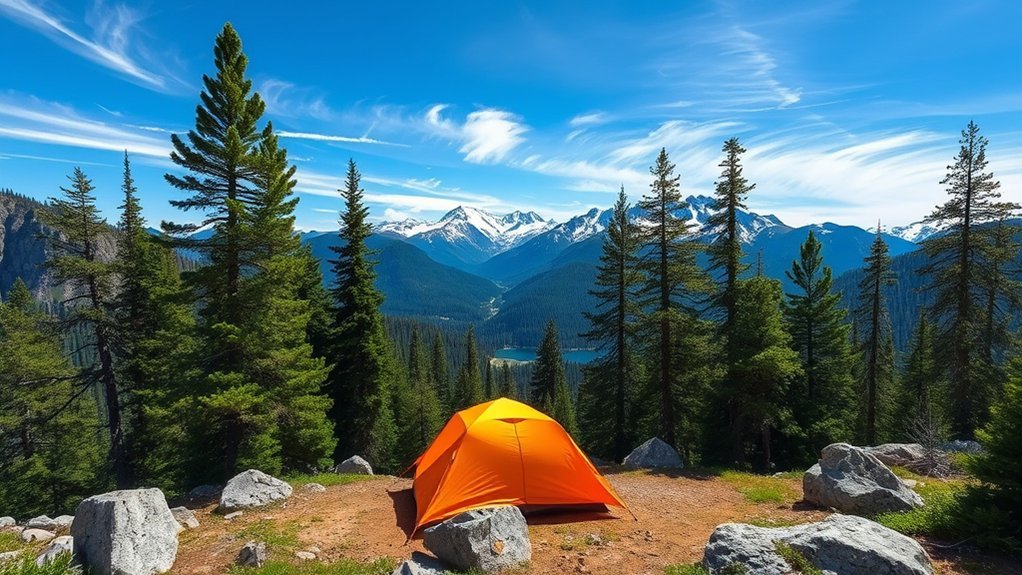
Healthy forest cover, rounded hills, low ridges, and broad terrain shoulders can reduce wind exposure. The safest windbreak is one that provides shelter without adding a falling-tree, lightning, rockfall, or drainage hazard.
Using Trees Safely
Inspect the full height of nearby trees in daylight. The USDA Forest Service advises campers to avoid leaning, dead, partially dead, damaged, or split trees. Also look for broken tops, hanging limbs, exposed roots, fresh cracks, fungal decay, fire damage, and trees that could reach the tent if they fell.
Do not pitch directly beneath the tallest isolated tree during stormy weather. A dense stand of similar-height, healthy trees may be less exposed than an isolated tree, but it does not make a tent safe from lightning.
Using Hills and Rock Features
A broad, rounded landform may block some wind without producing the severe turbulence associated with a sharp edge. Stay away from the base of loose scree, cliff faces, unstable boulders, and gullies that collect falling rocks or runoff.
When practical, select a protected bench below the most exposed crest but above obvious drainage channels. Confirm that the bench is not beneath an avalanche path or cornice when snow is present.
Weather, Drainage, and Climate Control
Mountain temperatures can vary sharply with elevation, cloud cover, wind, slope aspect, and cold-air drainage. A valley bottom may become colder and damper overnight, while a high ridge may remain much windier. There is no reliable universal temperature difference or fixed elevation above the valley that guarantees comfort.
| Weather or Terrain Factor | What to Check |
|---|---|
| Temperature changes | Review the hourly forecast and bring layers and a sleep system suitable for temperatures below the expected low. |
| Drainage | Look for channels, deposited debris, flattened vegetation, water stains, mud, and routes that runoff would follow. |
| Humidity and condensation | Choose dry ground, tension the rainfly correctly, open protected vents, and keep wet gear out of the sleeping area. |
| Storm movement | Watch the sky and forecast, identify safer shelter, and do not wait until severe wind, hail, or lightning reaches camp. |
| Elevation and exposure | Expect colder conditions and stronger exposure at higher elevations, but do not move into a flood channel merely to get lower. |
Lightning, Flash-Flood, and Snow Hazards
Lightning
“A tent offers no protection from lightning.” — National Weather Service
Check the forecast before leaving and again when service is available. In thunderstorm-prone areas, plan activities so you are not on exposed peaks, ridges, or open slopes when storms commonly develop. If thunder begins, leave exposed terrain and move toward the safest available substantial building or hard-topped vehicle. Follow current National Weather Service lightning guidance.
Flash Floods
Do not camp in a creek bed, wash, narrow canyon bottom, drainage ditch, or low floodplain. A distant storm can send water through a campsite even when rain is not falling directly overhead. The National Weather Service warns that flash flooding may travel far from the producing thunderstorm.
Before pitching, identify the quickest route to higher ground. If water begins rising, runoff becomes muddy, or an official warning is issued, move immediately rather than trying to save or repack equipment.
Snow and Avalanche Terrain
When snow covers the mountains, avoid avalanche starting zones, paths, gullies, terrain traps, and runout areas below loaded slopes. Do not assume a flat campsite is safe if a steep snow-covered slope rises above it. Review the regional forecast through Avalanche.org and its network of U.S. avalanche centers. Travel or camping in avalanche terrain requires appropriate education, judgment, rescue equipment, and current local information.
Note: Avalanche conditions can persist into spring or summer at high elevations. The calendar alone does not determine whether a snow-covered slope is safe.
How to Secure a Tent Against Strong Mountain Winds
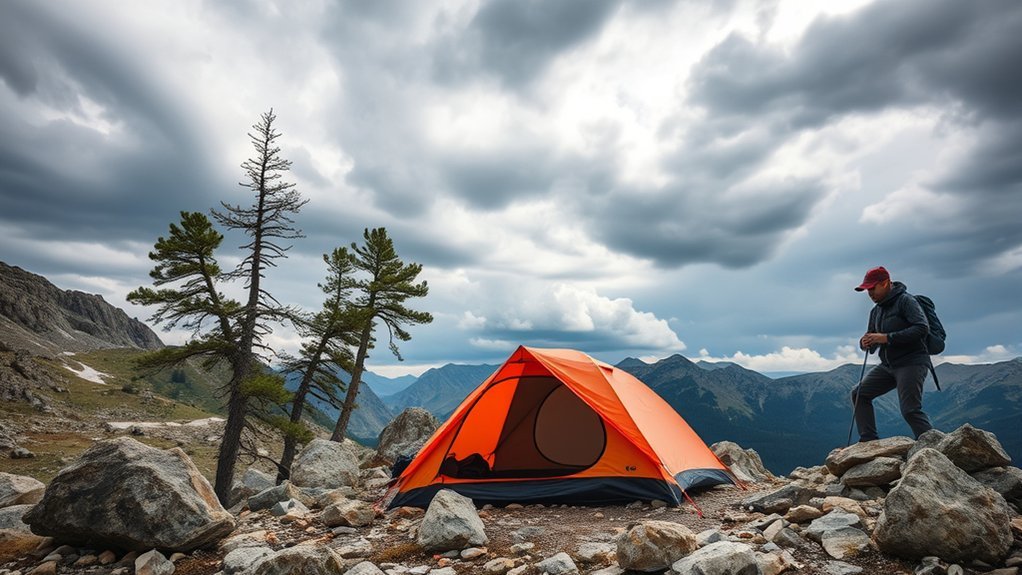
Site selection reduces the load on a tent, but a sheltered location does not replace correct pitching. Practice at home and carry the complete pole, stake, and guyline set supplied or recommended for your shelter.
- Follow the tent manual. Some models have a designated windward end or require a particular pole-supported side to face the wind. That guidance is more reliable than a universal “narrowest side” rule.
- Protect doors from severe wind-driven rain. Position a vulnerable entrance or vestibule away from the strongest gusts unless the manufacturer specifies another orientation.
- Assemble every structural component. Fully seat poles, clips, sleeves, hubs, buckles, and rainfly connections. Do not omit a pole or crossing point to save time.
- Stake the body or corners first. Pull the floor smooth without stretching it out of shape. Use stake points in the sequence recommended by the manufacturer.
- Match anchors to the ground. Standard stakes may work in firm soil. Loose sand, deep snow, gravel, rock slabs, or saturated ground may require longer stakes, snow stakes, buried deadman anchors, or secure rock anchors where permitted.
- Align anchors with the expected pull. There is no single correct 45-degree angle for every stake and surface. Seat each anchor firmly and position it so the guyline load does not easily lever it out.
- Use all storm guylines. Extend them far enough to provide useful support, avoid crossing them over sharp rocks, and anchor them to secure points. Hilleberg’s wind guidance likewise emphasizes fully extending and securing the tent’s guylines.
- Tension evenly. Guylines and the rainfly should be taut enough to limit flapping and keep the fly separated from the inner tent, but not so tight that poles or seams are distorted.
- Recheck the pitch. Inspect anchors after rain softens the soil, snow settles, fabric stretches, or wind direction changes.
Do not tie a tent to dead trees, loose rocks, unstable branches, or objects that could roll or fall. If the forecast exceeds your tent’s intended conditions or anchors repeatedly fail, relocate or retreat rather than depending on improvised reinforcement.
Ventilation and Wet-Weather Management
Condensation forms when moist interior air contacts a colder tent surface. Breathing, damp soil, cooking, wet clothes, and wet equipment all add moisture. No tent can eliminate condensation in every condition, but site selection and airflow can reduce it.
- Open protected rainfly vents and opposing inner-tent vents whenever weather permits.
- Stake and tension the rainfly so air can move between the fly and inner tent.
- Keep wet boots, rainwear, and packs in the vestibule or another protected area instead of hanging them over the sleeping space.
- Do not cook inside the tent. Besides adding moisture, an open flame or stove can cause fire, burns, and deadly carbon-monoxide exposure.
- Avoid touching sleeping bags and clothing against a wet fly or single-wall surface.
- Dry the tent and gear during breaks or after the trip before long-term storage.
A gentle breeze may improve cross-ventilation, while strong wind-driven rain may require closing or adjusting exposed openings. Use the vent configuration designed for your specific shelter rather than sealing every opening automatically.
Wildlife and Low-Impact Campsite Checks
Keeping distance from obvious wildlife activity protects both campers and animals. The National Park Service advises avoiding game trails, feeding areas, and locations with fresh tracks or droppings. In bear country, also avoid carcasses, berry patches, salmon streams, and other concentrated food sources.
Food, trash, toiletries, cookware, and other scented items must be stored according to local regulations. Requirements may include provided lockers or approved bear-resistant containers. Never store food or scented products in the sleeping tent.
Do not clear vegetation, dig drainage trenches, build wind walls, move large rocks, or create a new tent pad merely to improve the site. A good campsite is found rather than constructed.
The 60-Second Final Site Test
Before inserting the first stake, stop and answer these questions:
- Is camping legal here, and am I following the designated-site or setback rules?
- Is the surface durable, reasonably level, and free of sharp objects?
- Would rain flow around the tent rather than beneath it?
- Could a tree, branch, rock, cornice, or slope reach this spot?
- Am I outside dry washes, creek beds, flood channels, avalanche paths, and rockfall zones?
- Is there fresh wildlife activity or a natural travel route through the site?
- Can I orient and anchor the tent as its manufacturer recommends?
- Where will I go if lightning, flooding, fire, severe wind, or another emergency develops?
If any answer is uncertain, keep looking while there is still daylight. A few extra minutes spent selecting the site can prevent a wet, unstable, or dangerous night.
Frequently Asked Questions
What type of tent is best for mountain camping?
For typical snow-free trips in moderate weather, a sturdy three-season backpacking tent is often appropriate. Choose an all-season or four-season tent when substantial snow loading, winter temperatures, or severe exposure is expected. Pole structure, wind orientation, fly coverage, anchoring, ventilation, packed weight, and the manufacturer’s intended use matter more than the season label alone.
How do I choose a campsite away from wildlife?
Avoid active game trails, carcasses, feeding areas, berry patches, salmon streams, fresh tracks, droppings, and obvious access routes to water. Follow all local food-storage requirements and never keep food or scented items in the sleeping tent. Do not confuse wildlife screening with water-and-trail setback rules; those distances are set by the local land manager.
What should I do if it rains while camping?
Keep the rainfly correctly tensioned, open protected vents, and check that runoff is not flowing toward the tent. Store wet boots and rainwear in the vestibule rather than hanging them throughout the sleeping area. If water begins collecting beneath the tent or a creek, wash, or drainage channel rises, move to safer ground immediately.
How can I prepare for sudden weather changes?
Check the hourly and backcountry forecast, pack waterproof layers and insulation, carry navigation and emergency equipment, and establish clear turnaround and evacuation plans. Know where you can seek safer lightning shelter and what terrain leads to higher ground during a flood. Do not rely on mobile service being available.
Are specific tent materials better for mountains?
Quality nylon and polyester tent fabrics can both perform well when correctly designed, coated, maintained, and pitched. Material alone does not establish storm worthiness. Examine the pole structure, seams, rainfly coverage, floor construction, guy points, ventilation, season rating, repair options, and the manufacturer’s wind and snow guidance.
Should the tent door face toward or away from the wind?
In strong wind or driving rain, a vulnerable door or vestibule usually needs protection from the strongest gusts. In mild weather, a door or vent facing a gentle breeze may improve airflow. Follow the manufacturer’s orientation instructions because some tents have a designated windward end or stronger pole-supported side.
Is a low valley safer during a lightning storm?
Lower terrain may be less exposed than a peak or ridge, but not every valley is safe. Avoid creek beds, dry washes, narrow canyon bottoms, flood channels, and areas beneath unstable slopes. A substantial building or hard-topped vehicle is safer than any tent. Choose evacuation terrain that reduces lightning exposure without creating a flood, rockfall, or avalanche hazard.
How close can I safely pitch to trees?
There is no single safe distance for every tree. Inspect the tree’s height, lean, roots, trunk, crown, surrounding soil, and overhead limbs. Place the tent outside the reach of dead, leaning, split, fire-damaged, uprooted, or visibly unstable trees and branches. Avoid using an isolated tall tree as storm shelter.
Conclusion
Good mountain tent placement is a balance of shelter, drainage, durable ground, legal access, and escape options. A rounded hill or healthy tree stand may reduce wind, but only after you rule out falling limbs, lightning exposure, rockfall, flooding, wildlife activity, and snow hazards. Secure every required stake and guyline, maintain ventilation, and keep checking conditions after the tent is pitched. When the weather or terrain exceeds your shelter, skills, or safety plan, the right choice is to relocate or turn back.
Sources
- National Park Service — Leave No Trace Seven Principles — durable surfaces, campsite selection, and minimum-impact practices
- National Weather Service — Outdoor Lightning Safety — lightning shelter and tent limitations
- National Weather Service — Monsoon and Flash-Flood Safety — washes, distant storms, flooding, and evacuation
- USDA Forest Service — Safety and Outdoor Ethics — hazard-tree and falling-limb precautions
- Kenai Fjords National Park — Backcountry Camping — wildlife signs, game trails, and food storage
- Avalanche.org and the National Avalanche Center — regional avalanche forecasts, education, and terrain exposure
